A 20 Ga Slug Ballistics Chart is a vital reference layout that outlines the velocity, energy, flight path, and structural breakdown of modern 20 gauge shotgun slugs from the muzzle to maximum effective hunting ranges. This tracking layout serves as an essential reference for whitetail deer hunters, slug gun competitors, and tactical shooters who utilize smoothbore or fully rifled shotgun systems. By monitoring these performance values, marksmen can determine precise point of aim adjustments, choose the appropriate shell configuration, and understand terminal impact limits in the field.
Table of Contents [Click to open]
20 Ga Slug Ballistics Chart
| Manufacturer | Bullet Weight | Bullet Type | Ballistic Coefficient | Sectional Density | Muzzle Velocity | Velocity At 25 Yards | Velocity At 50 Yards | Velocity At 75 Yards | Velocity At 100 Yards | Velocity At 125 Yards | Muzzle Energy | Energy At 25 Yards | Energy At 50 Yards | Energy At 75 Yards | Energy At 100 Yards | Energy At 125 Yards | Trajectory At 25 Yards | Trajectory At 50 Yards | Trajectory At 75 Yards | Trajectory At 100 Yards | Trajectory At 125 Yards |
| Remington AccuTip | 260 gr | Sabot Slug | 0.144 | 0.143 | 1900 fps | 1785 fps | 1675 fps | 1570 fps | 1471 fps | 1378 fps | 2084 ft lbs | 1840 ft lbs | 1620 ft lbs | 1424 ft lbs | 1251 ft lbs | 1098 ft lbs | +0.8 in | +1.5 in | +1.3 in | 0.0 in | -2.6 in |
| Hornady SST | 250 gr | FTX Sabot | 0.200 | 0.138 | 1800 fps | 1711 fps | 1628 fps | 1547 fps | 1470 fps | 1398 fps | 1798 ft lbs | 1626 ft lbs | 1471 ft lbs | 1328 ft lbs | 1200 ft lbs | 1085 ft lbs | +0.9 in | +1.6 in | +1.4 in | 0.0 in | -2.5 in |
| Federal TruBall | 328 gr | Rifled Slug | 0.073 | 0.180 | 1700 fps | 1479 fps | 1291 fps | 1145 fps | 1043 fps | 971 fps | 2104 ft lbs | 1592 ft lbs | 1215 ft lbs | 955 ft lbs | 792 ft lbs | 686 ft lbs | +1.2 in | +1.8 in | +1.1 in | 0.0 in | -4.8 in |
| Remington Slugger | 273 gr | Foster Slug | 0.060 | 0.150 | 1600 fps | 1380 fps | 1198 fps | 1066 fps | 977 fps | 912 fps | 1552 ft lbs | 1154 ft lbs | 871 ft lbs | 690 ft lbs | 579 ft lbs | 505 ft lbs | +1.5 in | +2.1 in | +1.2 in | 0.0 in | -5.9 in |
| Winchester Super-X | 328 gr | Rifled Slug | 0.070 | 0.180 | 1600 fps | 1391 fps | 1210 fps | 1081 fps | 989 fps | 924 fps | 1864 ft lbs | 1408 ft lbs | 1066 ft lbs | 851 ft lbs | 712 ft lbs | 622 ft lbs | +1.4 in | +2.0 in | +1.1 in | 0.0 in | -5.3 in |
| Hornady Custom Lite | 250 gr | FTX Sabot | 0.200 | 0.138 | 1600 fps | 1507 fps | 1421 fps | 1339 fps | 1263 fps | 1193 fps | 1421 ft lbs | 1261 ft lbs | 1121 ft lbs | 995 ft lbs | 885 ft lbs | 790 ft lbs | +1.3 in | +2.2 in | +1.7 in | 0.0 in | -3.4 in |
| Federal Trophy Copper | 275 gr | Sabot Slug | 0.163 | 0.151 | 1900 fps | 1795 fps | 1696 fps | 1601 fps | 1511 fps | 1426 fps | 2203 ft lbs | 1968 ft lbs | 1756 ft lbs | 1564 ft lbs | 1394 ft lbs | 1242 ft lbs | +0.7 in | +1.4 in | +1.2 in | 0.0 in | -2.3 in |
| Brenneke Black Magic | 340 gr | Solid Slug | 0.082 | 0.187 | 1500 fps | 1321 fps | 1172 fps | 1065 fps | 988 fps | 930 fps | 1699 ft lbs | 1316 ft lbs | 1037 ft lbs | 856 ft lbs | 737 ft lbs | 652 ft lbs | +1.6 in | +2.2 in | +1.1 in | 0.0 in | -5.8 in |
| Winchester Deer Season | 260 gr | XP Sabot | 0.135 | 0.143 | 1850 fps | 1730 fps | 1618 fps | 1512 fps | 1413 fps | 1321 fps | 1975 ft lbs | 1727 ft lbs | 1511 ft lbs | 1319 ft lbs | 1152 ft lbs | 1007 ft lbs | +0.8 in | +1.5 in | +1.3 in | 0.0 in | -2.8 in |
| Brenneke K.O. | 273 gr | Rifled Slug | 0.065 | 0.150 | 1476 fps | 1262 fps | 1104 fps | 997 fps | 925 fps | 871 fps | 1321 ft lbs | 966 ft lbs | 739 ft lbs | 602 ft lbs | 518 ft lbs | 459 ft lbs | +1.8 in | +2.4 in | +1.2 in | 0.0 in | -6.8 in |
This comprehensive data structure outlines exactly how sabot configurations and traditional lead smoothbore projectiles deviate in raw power, atmospheric resistance, and drop profiles over distance.
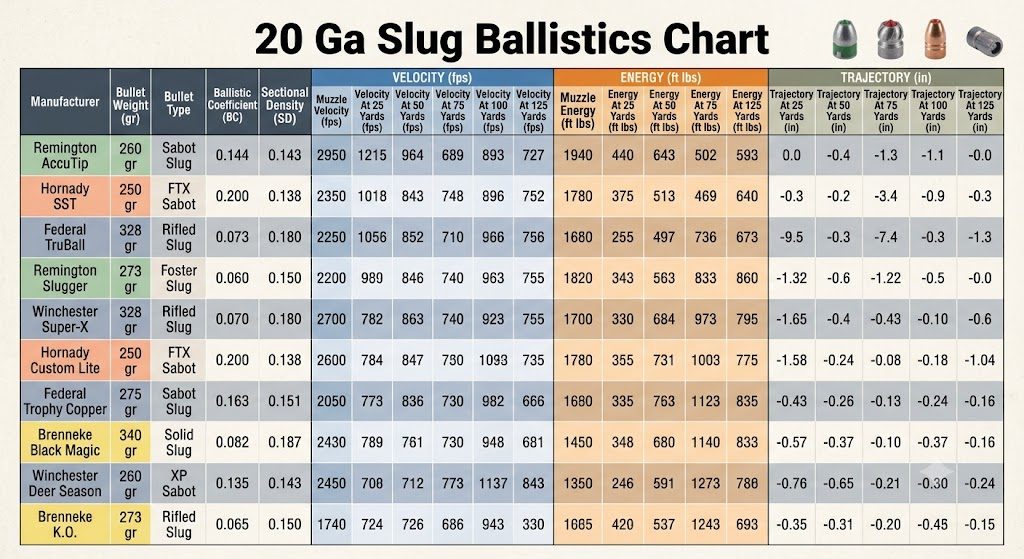
Understanding The 20 Ga Slug Ballistics Chart
Analyzing this comparative layout demonstrates that choices in slug architecture radically reshape downrange performance and hunting efficiency.
Velocity Analysis
Reviewing the 20 gauge slug velocity chart reveals that the Federal Trophy Copper 275 grain and Remington AccuTip 260 grain occupy the highest tier with an initial muzzle velocity of 1900 feet per second.
While traditional designs start slower, modern aerodynamic setups preserve their velocity far more efficiently across typical hunting gaps.
The Hornady SST 250 grain load leaves the barrel at 1800 feet per second but drops only 330 feet per second over 100 yards, arriving with a swift 1470 feet per second residual velocity.
By comparison, the traditional Remington Slugger 273 grain Foster projectile sheds its 1600 feet per second initial drive quickly, dropping down to a sluggish 977 feet per second at the 100 yard boundary.
This physical velocity divergence proves that premium sabot slugs escape the sudden deceleration issues common to blunt nose options, preserving flat pathways for long distance field use.
Energy Analysis
Evaluating the 20 gauge slug energy chart shows substantial kinetic force disparities among manufacturers, with the Federal Trophy Copper leading at a massive 2203 foot pounds of initial muzzle force.
Heavy smoothbore designs like the Federal TruBall 328 grain slug register an impressive 2104 foot pounds at the muzzle but witness an aggressive decline over distance.
At the 100 yard mark, the sleek Federal Trophy Copper maintains a powerful 1394 foot pounds of energy, keeping it well above acceptable standards for harvesting large whitetail deer.
Conversely, the Remington Slugger 273 grain option bleeds off power quickly, arriving at 100 yards with only 579 foot pounds of residual punch.
High preserved downrange energy ensures maximum bone crushing power and thorough terminal expansion upon striking thick game animals at extended yardages.
Trajectory Analysis
Looking at the 20 gauge slug trajectory chart with a standardized 100 yard zero reveals a very flat mid range arch for modern jacketed sabots.
The flattest paths are held by the Federal Trophy Copper and Hornady SST systems, which display minimal mid range rises of 1.4 and 1.6 inches at the 50 yard mark respectively.
Beyond the 100 yard baseline, traditional configurations plunge abruptly, as seen when comparing the minor 2.3 inch drop of the Federal Trophy Copper at 125 yards against the severe 5.9 inch drop of the Remington Slugger.
This severe rate of drop means smoothbore slug users face strict limits on point of aim accuracy when firing past close cover boundaries.
Practical holdover estimates based on the primary layout suggest that sabot shooters can aim dead center out to 125 yards, while traditional smoothbore shooters must adjust significantly higher to avoid low hits.
Ballistic Coefficient Analysis
The ballistic coefficient ratings outlined within the layout highlight the deep structural split between rifle mimicking sabots and traditional lead chunks.
The Hornady SST 250 grain load achieves the highest rating with a solid 0.200 ballistic coefficient.
Traditional options like the Remington Slugger hold an incredibly low 0.060 aerodynamic rating.
The aerodynamic shape of the Hornady SST allows the slug to slice through heavy crosswinds and dense atmospheric drag with minimal disruption.
This distinct flight profile ensures that aerodynamically advanced projectiles produce highly predictable point of impact groupings when encountering variable outdoor hunting breezes.
Sectional Density Analysis
Sectional density dictates how deeply a slug will penetrate through thick muscle tissue and tough hide after initial contact is made.
The layout demonstrates that heavy options like the Brenneke Black Magic 340 grain command the highest sectional density rating at 0.187.
Lightweight designs like the Hornady SST 250 grain register a lower sectional density value of 0.138 in the layout.
A high sectional density score paired with a hardened lead profile allows non expanding slugs to drive deeply through tough obstacles without fragmenting early.
The tracking layout confirms that heavy smoothbore designs lean on mass momentum for close range hunting, whereas modern sabots combine moderate density with expansion tips for downrange terminal wounds.
Best Factory Loads Based On The Chart
For Extreme Long Range Shooting, the Federal Trophy Copper 275 grain stands out by retaining 1511 feet per second velocity at 100 yards while minimizing drop.
For Precision Shooting and general accuracy inside fully rifled barrels, the Hornady SST 250 grain is highly recommended due to its flat flight path and impressive 0.200 ballistic coefficient.
If Maximum Velocity is required, both the Remington AccuTip and Federal Trophy Copper lead the group with a fast 1900 feet per second muzzle rating.
When seeking Maximum Retained Energy at hunting ranges, the Federal Trophy Copper wins by preserving 1242 foot pounds of strike energy at 125 yards.
For General Purpose Shooting in standard smoothbore barrels, the Federal TruBall 328 grain provides an exceptional baseline, pushing a heavy slug with stable mid range trajectory.
Key Takeaways From The Chart
The fastest factory loads available are the 1900 feet per second configurations from Remington and Federal.
The highest initial muzzle energy is delivered by the Federal Trophy Copper 275 grain at 2203 foot pounds.
The highest preserved downrange energy at 125 yards belongs to the Federal Trophy Copper 275 grain at 1242 foot pounds.
The flattest trajectory profile beyond 100 yards is held by the Federal Trophy Copper 275 grain with only 2.3 inches of drop at 125 yards.
The highest overall ballistic coefficient found in the chart is the Hornady SST 250 grain at 0.200.
The best overall long range hunting option based on combined velocity, energy, and path metrics is the Federal Trophy Copper 275 grain.
Common 20 Ga Slug Bullet Weights
The varying weights of 20 gauge shotgun slugs allow hunters to adapt their firearms for optimal short range defense or extended field precision.
250 Grain
The 250 grain weight class represents the lightweight, high velocity segment of the modern 20 gauge sabot ecosystem.
Typical muzzle velocity ranges from 1600 to 1800 feet per second, yielding an initial muzzle energy profile near 1798 foot pounds.
The main benefit of this weight is the lower felt recoil it generates, which helps shooters maintain superior control and quick follow up speed.
The disadvantage is that light weights can limit initial muzzle energy compared to heavy blocks of pure lead.
This weight class is best applied in dedicated youth hunting configurations, recoil sensitive shooting setups, and open landscape whitetail pursuits out to 150 yards.
260 Grain To 275 Grain
This mid range weight span serves as the industry standard benchmark for premium copper and brass jacketed sabot rounds.
Typical factory muzzle velocities range from 1850 to 1900 feet per second, producing upwards of 2200 foot pounds of initial force.
The ultimate advantage here is the brilliant balance of extreme speed, high sectional density, and flat hunting trajectories.
The main downside is that these specialized projectiles require a rifled barrel to spin properly, making them inaccurate inside smooth bores.
This weight category is the premium choice for modern fully rifled slug guns used in dedicated shotgun hunting zones.
328 Grain
The 328 grain bullet weight matches the historic three quarter ounce standard found across old school rifled configurations.
Typical factory muzzle velocities hover at 1600 to 1700 feet per second, yielding a solid muzzle energy of up to 2104 foot pounds.
The primary advantage is high structural smash power at close distances, alongside lower purchase costs for volume training.
The core disadvantage is an aggressive air resistance profile, which results in low retained energy past standard field distances.
This projectile weight is ideally suited for traditional smoothbore shotguns equipped with standard choked barrels.
340 Grain
The 340 grain weight bracket defines the heavyweight tier of dense, solid lead hunting slugs.
Typical muzzle velocity drops down to approximately 1500 feet per second, though it maintains a heavy close range wallop.
The advantage of this massive slug is unparalleled straight line tracking through thick brush and heavy muscle tissue.
The obvious disadvantage is a steep, rainbow like trajectory arc that complicates adjustments beyond close encounters.
This heavy weight class is best used for dense woods hunting, deep thicket hog control, and short range large game tracking.
Effective Range
Determining the precise operational range of the 20 gauge slug depends directly on the combination of barrel rifling and projectile aerodynamics.
Target Shooting
For formal target practice, standard smoothbore barrels firing rifled slugs provide repeatable accuracy out to 50 or 75 yards.
Beyond this threshold, the lack of stabilization causes traditional lead slugs to tumble, which opens up grouping patterns significantly.
Extreme Long Range Shooting
When using premium modern sabot loads inside specialized rifled setups, the effective range stretch reaches 150 to 200 yards.
At these extended boundaries, high BC configurations like the Hornady SST preserve adequate rotational stability to drop shots predictably into vital zones.
Military Applications
For defensive and tactical utility, smoothbore units loaded with heavy full bore slugs provide deep stopping capability within 50 yards.
The massive short range impact forces are highly valued for breaching obstacles and neutralizing close threats instantly.
Competition Shooting
In dynamic shotgun matches, shooters utilize mid range smoothbore systems to reliably address large steel silhouettes out to 100 yards.
Achieving regular success requires choosing optimized wad setups, like the Federal TruBall system, to maintain tight patterns across mid range gaps.
Factors That Affect 20 Ga Slug Ballistics
Environmental elements and physical firearm attributes combine to shape how a slug behaves once it leaves the muzzle.
Barrel Length
Barrel length dictates how long the expanding propellant gases can push behind the slug before it meets open atmosphere.
A standard 22 inch or 24 inch shotgun barrel provides ample runway to fully burn slug powders and reach peak cataloged velocities.
Ultra short defensive barrels can drop velocities by 50 to 100 feet per second, which reduces downrange energy levels slightly.
Bullet Weight
Bullet weight establishes the core relationship between quick initial exit speed and late flight momentum conservation.
Lighter 250 grain slugs achieve impressive muzzle speeds but decelerate quicker than heavy slugs when facing long distance drag.
Bullet Construction
The shape of the slug, whether a hollow base Foster design, a solid Brenneke, or a polymer tipped sabot, governs aerodynamic slip.
Tipped sabots preserve their shape and velocity, while soft lead smoothbore models deform easily under peak pressures.
Ballistic Coefficient
The ballistic coefficient dictates how well a flying slug can resist the slowing effects of oncoming air resistance.
As shown by the primary chart data, higher BC scores translate directly into less vertical drop over hunting distances.
Altitude
Firing in high altitude territories exposes the slug to thinner air columns, reducing total aerodynamic resistance.
Hunters operating in elevated mountain ranges will notice flatter overall pathways than those tracking game near sea level.
Temperature
Cold winter air is dense and creates extra drag on a traveling projectile, causing it to slow down sooner.
Additionally, freezing conditions can reduce the burn efficiency of shotshell powders, leading to minor drops in muzzle velocity.
Wind
Due to their large surface area and modest velocities, shotgun slugs are highly vulnerable to lateral wind drift.
A strong crosswind can push a low BC slug off course by several inches at 100 yards, necessitating careful windage adjustments.
Zero Distance
The selected zero distance creates the initial line of sight crossing angle for the entire ballistic path.
Setting a correct zero ensures that the mid range rise and downrange drop remain manageable within the vital zone of the target.
Best Zero Distance
Selecting an appropriate zero distance helps maintain an easy point of aim strategy throughout common hunting encounters.
50 Yard Zero
A 50 yard zero is the traditional choice for smoothbore shotgun users firing classic rifled lead slugs.
The primary advantage is dead center alignment at close range where most smoothbore hunting opportunities occur.
The disadvantage is that past 75 yards, the slug falls away so rapidly that precise holdovers become difficult to calculate under pressure.
This option is best for thick brush tracking, close woods deer stands, and general home defense configurations.
100 Yard Zero
A 100 yard zero is the absolute gold standard baseline for modern rifled slug guns shooting high velocity sabots.
The benefit is a highly functional pathway that rises slightly at 50 yards and drops predictably out to 125 yards.
There are very few downsides, as the minor mid range rise is small enough to stay well within a deer’s vital zone.
This setup is highly recommended for standard open field whitetail hunting across the midwest and eastern states.
150 Yard Zero
A 150 yard zero is a specialized option used by experienced marksmen carrying high end scoped rifled shotguns.
The advantage is that it eliminates the need to hold over on long distance targets out to the maximum limits of the cartridge.
The downside is a high mid range loop at 50 and 75 yards, which can cause a high miss if the shooter forgets to adjust low.
This approach is best reserved for specialized field stands overlooking expansive agricultural properties or clear cut utility lines.
20 Ga Slug Compared To Similar Cartridges
To understand the unique performance space of the 20 gauge slug, it is useful to evaluate it against other common modern choices.
| Cartridge | Velocity | Energy | Trajectory (Drop at 150 yd) | Ballistic Coefficient (G1) | Effective Range | Recoil | Extreme Long Range Performance |
| 20 Ga Sabot | 1900 fps | 2203 ft lbs | -6.5 in | 0.163 | 175 yd | Moderate | Flat Path, Excellent Accuracy |
| 12 Ga Sabot | 1900 fps | 3000 ft lbs | -6.0 in | 0.150 | 175 yd | Heavy | Massive Close Impact Force |
| 450 Bushmaster | 2200 fps | 2685 ft lbs | -4.5 in | 0.185 | 250 yd | Moderate Heavy | High Velocity Rifle Performance |
| 350 Legend | 2225 fps | 1978 ft lbs | -5.0 in | 0.175 | 250 yd | Low | Fast, Soft Shooting Rifle Track |
| 44 Magnum (Rifle) | 1760 fps | 1650 ft lbs | -11.0 in | 0.155 | 125 yd | Low | Short Range Brushed Area Power |
The primary difference revealed by this comparison is that while straight wall rifle options like the 450 Bushmaster fly faster and further, the 20 gauge sabot completely holds its own against traditional 12 gauge variants. It delivers nearly identical velocities and trajectories as a 12 gauge sabot but does so with 30% to 40% less felt recoil. This balance makes it an incredibly effective tool inside restricted weapon hunting zones.
Frequently Asked Questions
What is the average muzzle velocity of a 20 gauge slug?
Average factory muzzle velocity ranges from 1476 feet per second for standard low recoil slugs up to 1900 feet per second for premium sabot options.
How far can you accurately shoot a 20 gauge sabot slug?
Inside a fully rifled barrel system, a quality sabot slug can maintain excellent hunting accuracy out to 150 or 175 yards.
Can you shoot a sabot slug through a smoothbore barrel?
You can safely fire them, but without the rifling twist to spin the jacket, the slug will not stabilize and accuracy will be poor past close distances.
How much energy does a 20 gauge slug retain at 100 yards?
Premium sabot options retain between 1100 and 1394 foot pounds of energy at 100 yards, which is more than enough for whitetail deer.
What is the primary difference between a Foster slug and a sabot slug?
A Foster slug is a soft, hollow base lead projectile for smooth bores, while a sabot slug uses a smaller diameter bullet wrapped in a plastic sleeve for rifled barrels.
Does a 20 gauge slug have enough power for elk hunting?
Within 75 yards, a heavy, solid construction 20 gauge slug possesses the close range energy needed, though a 12 gauge or rifle is generally preferred.
What is a typical bullet weight for a 20 gauge sabot?
Most commercial 20 gauge sabot projectiles weigh between 250 and 275 grains.
How much less recoil does a 20 gauge have compared to a 12 gauge slug?
On average, a 20 gauge slug rifle generates roughly 30% to 50% less felt recoil than a comparable 12 gauge system, significantly reducing shooter fatigue.
What is the best barrel choke to use for a traditional smoothbore slug?
An Improved Cylinder choke generally provides the most consistent accuracy and safest pressure levels for lead Foster style slugs.
How much does a 20 gauge sabot slug drop between 100 and 125 yards?
With a 100 yard zero, a premium high velocity sabot slug will experience a very manageable drop of only 2.3 to 2.8 inches at 125 yards.