A 7mm Backcountry Ballistics Chart is a specialized numerical data table that tracks the velocity energy and bullet drop of the innovative new short barreled magnum cartridge. This comprehensive visual reference helps modern hunters and precision rifle shooters understand exactly how this high pressure steel cased ammunition performs over extended distances. By studying these specific flight metrics marksmen can calculate precise optical holdovers while ensuring massive terminal knockdown power on heavy big game animals. Utilizing this extensive ballistic data guarantees supreme accuracy and absolute ethical harvesting when utilizing compact suppressed hunting rifles in the field.
7mm Backcountry Ballistics Chart
| Manufacturer | Bullet Weight | Bullet Type | Ballistic Coefficient | Sectional Density | Muzzle Velocity | Velocity At 100 Yards | Velocity At 200 Yards | Velocity At 300 Yards | Velocity At 400 Yards | Velocity At 500 Yards | Muzzle Energy | Energy At 100 Yards | Energy At 200 Yards | Energy At 300 Yards | Energy At 400 Yards | Energy At 500 Yards | Trajectory At 100 Yards | Trajectory At 200 Yards | Trajectory At 300 Yards | Trajectory At 400 Yards | Trajectory At 500 Yards |
| Federal Premium | 155 gr | Terminal Ascent Twenty Inch | 0.586 | 0.274 | 3150 fps | 2981 fps | 2819 fps | 2663 fps | 2512 fps | 2365 fps | 3415 ft lbs | 3059 ft lbs | 2735 ft lbs | 2440 ft lbs | 2171 ft lbs | 1926 ft lbs | 1.2 in High | 0.0 in | 5.6 in Low | 16.1 in Low | 32.0 in Low |
| Federal Premium | 155 gr | Terminal Ascent Twenty Four | 0.586 | 0.274 | 3300 fps | 3125 fps | 2958 fps | 2796 fps | 2641 fps | 2491 fps | 3748 ft lbs | 3362 ft lbs | 3011 ft lbs | 2691 ft lbs | 2400 ft lbs | 2135 ft lbs | 1.0 in High | 0.0 in | 5.0 in Low | 14.5 in Low | 28.9 in Low |
| Federal Premium | 168 gr | Barnes LRX Twenty Inch | 0.550 | 0.298 | 3000 fps | 2814 fps | 2636 fps | 2465 fps | 2300 fps | 2142 fps | 3357 ft lbs | 2955 ft lbs | 2593 ft lbs | 2267 ft lbs | 1974 ft lbs | 1712 ft lbs | 1.5 in High | 0.0 in | 6.4 in Low | 18.6 in Low | 37.4 in Low |
| Federal Premium | 168 gr | Barnes LRX Twenty Four | 0.550 | 0.298 | 3150 fps | 2958 fps | 2774 fps | 2598 fps | 2428 fps | 2265 fps | 3701 ft lbs | 3264 ft lbs | 2870 ft lbs | 2517 ft lbs | 2199 ft lbs | 1913 ft lbs | 1.2 in High | 0.0 in | 5.8 in Low | 16.6 in Low | 33.5 in Low |
| Federal Premium | 170 gr | Terminal Ascent Twenty Inch | 0.646 | 0.301 | 3000 fps | 2852 fps | 2708 fps | 2570 fps | 2435 fps | 2304 fps | 3397 ft lbs | 3070 ft lbs | 2769 ft lbs | 2492 ft lbs | 2238 ft lbs | 2004 ft lbs | 1.4 in High | 0.0 in | 6.1 in Low | 17.5 in Low | 34.7 in Low |
| Federal Premium | 170 gr | Terminal Ascent Twenty Four | 0.646 | 0.301 | 3150 fps | 2997 fps | 2848 fps | 2705 fps | 2566 fps | 2432 fps | 3745 ft lbs | 3389 ft lbs | 3062 ft lbs | 2762 ft lbs | 2486 ft lbs | 2232 ft lbs | 1.2 in High | 0.0 in | 5.5 in Low | 15.8 in Low | 31.2 in Low |
| Federal Premium | 175 gr | Fusion Tipped Twenty Inch | 0.520 | 0.310 | 2975 fps | 2810 fps | 2651 fps | 2498 fps | 2349 fps | 2206 fps | 3439 ft lbs | 3068 ft lbs | 2731 ft lbs | 2424 ft lbs | 2144 ft lbs | 1890 ft lbs | 1.5 in High | 0.0 in | 6.4 in Low | 18.3 in Low | 36.7 in Low |
| Federal Premium | 175 gr | Fusion Tipped Twenty Four | 0.520 | 0.310 | 3125 fps | 2954 fps | 2790 fps | 2632 fps | 2479 fps | 2331 fps | 3794 ft lbs | 3391 ft lbs | 3024 ft lbs | 2691 ft lbs | 2387 ft lbs | 2111 ft lbs | 1.2 in High | 0.0 in | 5.7 in Low | 16.5 in Low | 32.8 in Low |
| Federal Premium | 195 gr | Elite Hunter Twenty Inch | 0.755 | 0.345 | 2850 fps | 2727 fps | 2608 fps | 2492 fps | 2378 fps | 2268 fps | 3517 ft lbs | 3220 ft lbs | 2945 ft lbs | 2688 ft lbs | 2449 ft lbs | 2227 ft lbs | 1.6 in High | 0.0 in | 6.7 in Low | 18.9 in Low | 37.4 in Low |
This specialized layout illustrates exactly how advanced steel alloy cases affect the overall aerodynamics and downrange flight performance of heavy seven millimeter bullets.
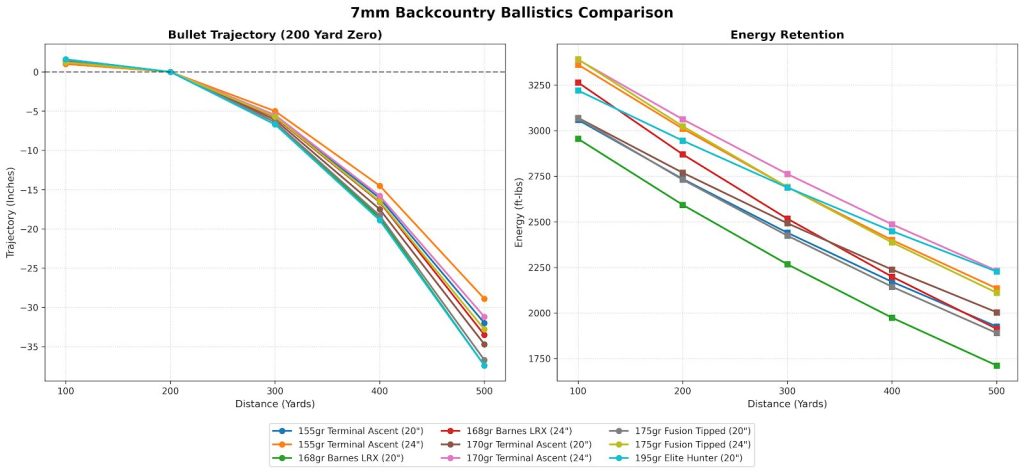
Understanding The 7mm Backcountry Ballistics Chart
Evaluating the data reveals that this modern cartridge utilizes immense chamber pressure to deliver full magnum performance from incredibly short barrels.
Understanding these exact ballistic metrics is absolutely critical for ethical hunting and proper shot placement during long distance engagements in the field.
Velocity Analysis
Reviewing the velocity metrics shows that the Federal Premium 155 grain Terminal Ascent fired from a twenty four inch barrel is the absolute fastest factory load in the entire table.
It leaves the muzzle at an incredible 3300 feet per second which gives it a massive advantage when tracking fast moving game across wide open plains.
Even when fired from a compact twenty inch barrel the same 155 grain projectile achieves a remarkable 3150 feet per second.
As we look further downrange the superior aerodynamic design of these match grade hunting bullets allows them to retain velocity exceptionally well.
The heavy Federal Premium 195 grain Elite Hunter starts at 2850 feet per second and impressively maintains 2268 feet per second by the five hundred yard mark.
This phenomenal velocity retention proves that the cartridge was engineered exclusively for delivering supersonic precision over incredibly long open valleys.
Energy Analysis
Muzzle energy dictates the absolute physical shock that a heavy game animal absorbs upon initial bullet impact.
The table data highlights that the Federal Premium 175 grain Fusion Tipped from a twenty four inch barrel generates the highest initial strike force with 3794 foot pounds of muzzle energy.
Classic options like the Federal Premium 170 grain Terminal Ascent also deliver incredibly powerful blows generating 3745 foot pounds of energy at the barrel exit.
Downrange energy retention clearly shows the immense superiority of utilizing high ballistic coefficient projectiles for extended shots across canyons.
By the time the Federal Premium 195 grain Elite Hunter reaches five hundred yards it still retains an astounding 2227 foot pounds of lethal kinetic force.
This massive retained energy completely confirms that hunters can ethically harvest massive elk and moose at extended distances where traditional standard cartridges simply run out of power.
Trajectory Analysis
Analyzing the trajectory profile with a standard two hundred yard zero clearly demonstrates the incredibly flat gravitational curve this high pressure cartridge experiences.
The flattest shooting factory load in the chart is the Federal Premium 155 grain Terminal Ascent from a twenty four inch barrel which exhibits a drop of only 28.9 inches at five hundred yards.
Even when firing the incredibly heavy Federal Premium 195 grain Elite Hunter from a short twenty inch barrel the bullet only drops 37.4 inches at the exact same distance.
Once the projectile passes three hundred yards the trajectory remains phenomenally straight requiring very minimal optical holdovers compared to traditional hunting rounds.
Shooters must completely understand that this exceptionally flat flight path allows incredibly forgiving margins of error when estimating unknown ranges in the field.
Ballistic Coefficient Analysis
The ballistic coefficient values listed in the table reveal the inherent aerodynamic supremacy of modern seven millimeter hunting bullets.
The Federal Premium 195 grain Elite Hunter holds the absolute highest rating in this specific category with an astonishing score of 0.755.
Highly advanced bonded configurations like the Federal Premium 170 grain Terminal Ascent feature a noticeably excellent aerodynamic rating of 0.646.
These incredibly high numbers explain exactly why the long sleek projectiles lose velocity and energy so slowly when flying through open air.
The sharp polymer tips easily slice through atmospheric resistance causing them to completely ignore heavy crosswinds during flight.
Sectional Density Analysis
Sectional density directly influences how stable a hunting bullet remains during flight and how deeply it penetrates thick targets upon arrival.
The chart confirms that the Federal Premium 195 grain Elite Hunter possesses the absolute highest sectional density rating of 0.345.
Lighter 155 grain hunting options exhibit noticeably lower sectional density values right around 0.274.
A higher sectional density means the bullet concentrates its heavy physical mass over a smaller cross sectional area forcing it deeper into the vital cavity of heavy game animals.
This specific data guarantees that hunters pursuing incredibly tough animals like grizzly bears should completely rely on the heavier projectiles to maximize deep tissue penetration.
Best Factory Loads Based On The Chart
For Extreme Flat Trajectory across open plains the Federal Premium 155 grain Terminal Ascent is the absolute best choice available today.
For Precision Elk Hunting the Federal Premium 170 grain Terminal Ascent provides a perfectly balanced trajectory with an exceptionally reliable terminal expansion profile.
If Maximum Initial Velocity is your primary goal the Federal Premium 155 grain Terminal Ascent takes the top spot by reaching 3300 feet per second.
When seeking Maximum Retained Energy at extreme distances the Federal Premium 195 grain Elite Hunter wins easily by preserving 2227 foot pounds of strike force at five hundred yards.
For Heavy Timber Hunting the Federal Premium 168 grain Barnes LRX offers unmatched solid copper monolithic penetration for smashing through thick shoulders.
Key Takeaways From The Chart
The fastest factory load in the entire chart at the muzzle is the Federal Premium 155 grain Terminal Ascent at 3300 feet per second.
The highest initial muzzle energy is produced by the Federal Premium 175 grain Fusion Tipped at 3794 foot pounds.
The highest retained kinetic energy at five hundred yards belongs to the Federal Premium 195 grain Elite Hunter at 2227 foot pounds.
The flattest trajectory at five hundred yards is achieved by the Federal Premium 155 grain Terminal Ascent with 28.9 inches of total bullet drop.
The highest overall ballistic coefficient listed is the Federal Premium 195 grain Elite Hunter at 0.755.
The best overall extreme range hunting performer based on combined energy retention and trajectory metrics is the Federal Premium 170 grain Terminal Ascent.
Common 7mm Backcountry Bullet Weights
The unique high pressure steel case capacity allows ammunition manufacturers to utilize a highly versatile spectrum of projectile weights optimized for distinct shooting applications.
155 Grain
The 155 grain projectile weight is a highly specialized lightweight offering designed specifically for maximum muzzle velocity and extremely flat mid range flight.
Typical muzzle velocity for this specific weight easily breaks the 3150 feet per second barrier creating a laser accurate flight path inside three hundred yards.
The primary advantage of this weight is the significantly reduced mid range bullet drop making it exceptionally easy to use on fast moving antelope.
The main disadvantage is that the lighter overall mass limits extreme deep penetration on heavy quartering shots involving thick bone on massive animals.
This specific weight is best applied in general target practice and open field white tailed deer hunting where extreme penetration is not entirely mandatory.
168 Grain
The 168 grain projectile represents the absolute gold standard sweet spot for perfectly balanced medium game hunting utilizing monolithic copper bullets.
Typical muzzle velocity sits comfortably around 3000 feet per second from a short twenty inch barrel generating an immense hydrostatic shock upon initial target impact.
The primary advantages of 168 grain options are brilliant terminal expansion manageable recoil and incredibly reliable deep penetration.
The primary disadvantage is that monolithic copper bullets require high velocity to expand making them slightly less effective past seven hundred yards.
This weight is the absolute ideal choice for dedicated mule deer hunters operating in steep mountain ranges who require absolute reliability.
170 Grain
The 170 grain projectile weight represents a slightly heavier middle ground for shooters wanting exceptional ballistic coefficients and reliable mass retention.
Typical muzzle velocity is roughly 3150 feet per second from a twenty four inch barrel which translates into incredibly consistent accuracy and heavy terminal bone crushing force.
The single biggest advantage of this weight is its traditional bonded lead core design which holds together beautifully when encountering heavy shoulder muscles.
The primary disadvantage is that factory ammunition utilizing this specific weight generates slightly more felt recoil than the lighter target options.
This weight is the ultimate choice for marksmen carrying a precision bolt action rifle into the deep high country for versatile elk harvesting.
175 Grain
The 175 grain bullet is a premium hunting option designed to guarantee absolutely perfect weight retention and massive energy transfer.
Typical muzzle velocity hovers around 3125 feet per second maintaining immense structural momentum without fragmenting into small pieces upon striking heavy targets.
The advantage of the 175 grain bonded bullet is its unmatched ability to cleanly pass completely through large game animals leaving a massive exit wound.
The main disadvantage is the increased cost of premium bonded projectiles compared to standard exposed lead core hunting options found in cheaper calibers.
This extreme weight is universally recommended for pursuing large tough game animals like moose or black bear where deep reliable penetration is absolutely essential.
195 Grain
The 195 grain bullet represents the absolute heaviest mainstream option for commercial factory loaded ammunition in this high pressure caliber.
Typical muzzle velocity drops down to around 2850 feet per second yielding incredible long range momentum and massive resistance to lateral wind drift.
The major benefit is that it provides the highest ballistic coefficient available guaranteeing the bullet will absolutely ignore crosswinds across wide open valleys.
The disadvantage is the massive overall length of the projectile which requires specialized fast twist barrels to properly stabilize the bullet during flight.
This heavyweight class is universally recommended for dedicated extreme long range target shooters pursuing incredibly tight groups at distances exceeding one thousand yards.
Effective Range
Understanding the realistic physical limits of this legendary modern cartridge helps shooters select the correct equipment for their specific extreme distance hunting goals.
Target Shooting
For standard paper targets the effective range easily spans from one hundred yards all the way out to fourteen hundred yards using quality factory ammunition.
At these extreme distances the massive heavy projectile remains comfortably supersonic keeping its flight path highly predictable through varying atmospheric conditions.
Extreme Long Range Shooting
When participating in extreme long range activities expert marksmen absolutely love this cartridge because it effortlessly mimics massive magnum performance.
Shooting past one thousand yards is highly encouraged for practice because the bullet retains incredible velocity and aerodynamic efficiency.
Military Applications
This specific cartridge concept was originally inspired by military professionals looking for a compact high pressure round for specialized short barreled sniper applications.
The goal was to deliver a heavy high ballistic coefficient projectile that could instantly neutralize targets at extreme distances without requiring a massive heavy weapon platform.
Today its military connection remains highly relevant serving primarily as an incredibly advanced template for future lightweight tactical sniper systems.
Competition Shooting
Within local sporting rifle matches the cartridge performs admirably at all extreme distances out to roughly one mile in capable hands.
At extreme distances the massive aerodynamic efficiency allows veteran shooters to effortlessly ring heavy steel targets while completely ignoring shifting crosswinds.
Factors That Affect 7mm Backcountry Ballistics
External environmental atmospheric variables and physical firearm attributes combine to completely alter how a sleek bullet behaves once it leaves the muzzle.
Barrel Length
Barrel length plays a critical role in determining exactly how much velocity the cartridge can generate before the bullet exits into the open atmosphere.
A standard twenty four inch barrel allows the advanced powder inside the steel alloy case to completely ignite maximizing the absolute ultimate initial velocity push.
However the cartridge was specifically engineered to utilize faster burning powders perfectly minimizing velocity loss in short twenty inch suppressor friendly barrels.
Bullet Weight
Bullet weight dictates the core fundamental relationship between quick initial exit speed and late flight momentum conservation over open hunting ground.
Lighter 155 grain bullets leave the barrel much faster but lose speed quicker due to drag whereas heavier 195 grain bullets start slower but ignore crosswinds.
Bullet Construction
The physical exterior design of the projectile whether it is a bonded lead core a monolithic solid or a polymer tipped variant heavily affects flight efficiency.
Polymer tipped bullets track significantly better because they absolutely minimize flight imbalances and slice through the air incredibly clean.
Ballistic Coefficient
The ballistic coefficient measures exactly how easily a sleek bullet overcomes raw air resistance during its journey to the distant target.
A higher ballistic coefficient directly reduces vertical bullet drop mathematically and massively minimizes the lateral drift caused by harsh crosswinds.
Altitude
High altitude mountain environments feature incredibly thin air which drastically reduces the aerodynamic drag forces acting against a flying bullet in motion.
Shooters operating in elevated mountain ranges will notice slightly flatter overall pathways and much higher retained velocities than those shooting near sea level.
Temperature
Air temperature heavily impacts atmospheric density with freezing cold temperatures creating denser air that slows down flying projectiles much faster over distance.
Additionally extreme ammunition temperature fluctuations can completely alter powder burn rates inside the steel cartridge causing unexpected changes in initial muzzle velocity.
Wind
Due to the incredibly sleek aerodynamic profile of heavy seven millimeter bullets crosswinds have a severely reduced effect on the downrange trajectory.
However a massive continuous crosswind will still push the bullet sideways over extreme distances requiring precise windage alignment based on detailed ballistic chart evaluations.
Zero Distance
The specific distance at which a hunting rifle is physically zeroed determines the entire mathematical arc of the flight trajectory relative to the optic.
An inappropriate zero distance can cause the sleek bullet to impact several inches high at mid range leading to frustrating misses on small targets.
Best Zero Distance
Choosing the absolute correct zero distance establishes an incredibly efficient baseline for maintaining accuracy at various extreme hunting distances.
100 Yard Zero
A one hundred yard zero is highly popular and considered the absolute gold standard among civilian hunters utilizing compact hunting rifles.
The primary advantage is that it aligns the sights perfectly for baseline testing and completely eliminates confusing environmental wind factors during the initial sight in process.
The main disadvantage is that the bullet requires massive optical dialing when taking unexpected shots at elk standing near the five hundred yard line.
This zero is best for general target practice baseline rifle testing and ensuring total mathematical simplicity when calculating complex ballistic drop tables.
200 Yard Zero
A two hundred yard zero serves as an exceptional general purpose baseline for hunters anticipating shots across open mountain valleys.
As demonstrated in our primary chart utilizing a two hundred yard zero keeps the bullet path relatively flat through the first three hundred yards of travel.
The disadvantage is a significant mid range rise near one hundred yards which requires the hunter to aim slightly low to hit the vital zone.
This zero is highly recommended for field marksmen who require instant readiness out to three hundred yards without adjusting their optical turrets.
500 Yard Zero
A five hundred yard zero is an incredibly specialized and generally discouraged configuration utilized only by extreme experimental competitive shooters.
The massive advantage is that it completely eliminates the need to hold high when engaging distant targets right at the absolute extreme edge of a canyon.
The severe disadvantage is that the bullet flies massively higher than the line of sight at close distances which absolutely guarantees high misses on typical hunting targets.
This approach is strictly reserved for dedicated extreme long range field testing and should generally be completely avoided for ethical hunting applications.
1000 Yard Zero
A one thousand yard zero is utilized exclusively by extreme class target competitors firing specialized precision rifles built with extreme angled scope bases.
The major detriment of attempting this zero on a standard rifle is that the optical turret simply lacks the internal elevation travel to dial this extremely high.
The heavy sleek projectile certainly possesses the velocity and aerodynamic efficiency to reach this extreme distance flawlessly.
This zero is strictly an academic target exercise and should never be applied to practical tactical shooting scenarios or standard hunting operations.
7mm Backcountry Compared To Similar Cartridges
To understand exactly where this legendary modern cartridge stands it helps to compare its performance against other prominent long range magnum options.
| Cartridge | Velocity | Energy | Trajectory At 500 Yards | Ballistic Coefficient | Effective Range | Recoil | Extreme Long Range Performance |
| 7mm Backcountry | 3150 fps | 3745 ft lbs | 31.2 in Low | 0.646 | 1000 yd | Moderate | Ultimate Short Barrel Magnum |
| 7mm PRC | 3000 fps | 3500 ft lbs | 34.0 in Low | 0.646 | 1200 yd | Heavy | Exceptional Wind Deflection Resistance |
| 7mm Remington Magnum | 2950 fps | 3280 ft lbs | 38.0 in Low | 0.550 | 1000 yd | Heavy | Classic Long Range Standard |
| 280 Ackley Improved | 2850 fps | 3060 ft lbs | 42.0 in Low | 0.550 | 800 yd | Moderate | Efficient Non Magnum |
| 6.5 Creedmoor | 2700 fps | 2266 ft lbs | 45.0 in Low | 0.620 | 1000 yd | Low | Supreme Match Precision |
The major difference shown above is that the new steel cased cartridge absolutely dominates the older magnums in raw kinetic energy and velocity. It delivers incredible velocity from a standard action size making it the premier choice when massive tissue damage is prioritized without carrying a heavy magnum rifle. When compared to the modern 7mm PRC the new steel cased round delivers slightly flatter trajectories from shorter barrels while providing nearly identical terminal performance on large game animals.
Frequently Asked Questions
What exactly is the 7mm Backcountry cartridge?
It is a highly advanced modern rifle cartridge that utilizes a proprietary high strength steel alloy case to safely achieve incredibly high chamber pressures.
What makes it completely different from traditional brass cartridges?
The patented Peak Alloy steel case handles eighty thousand pounds per square inch of pressure which would completely rupture a traditional brass cartridge case instantly.
What is the maximum chamber pressure of the 7mm Backcountry?
The official maximum chamber pressure established by standard regulatory agencies is an absolutely unprecedented eighty thousand pounds per square inch.
How fast does a 155 grain bullet travel from a twenty inch barrel?
A standard factory loaded 155 grain bullet exits a compact twenty inch barrel at an incredibly fast 3150 feet per second.
Can I reload the 7mm Backcountry steel cases at home?
Reloading these specialized steel cases requires specific proprietary dies and significantly more specialized case lubrication than standard traditional brass components.
How does it mathematically compare to the popular 7mm PRC cartridge?
It equals or slightly exceeds the velocity of the 7mm PRC when fired from standard barrels but drastically outperforms it when utilizing compact twenty inch barrels.
Is the 7mm Backcountry a good choice for massive elk hunting?
Yes it is an absolutely spectacular choice for elk hunting because it delivers massive kinetic energy and utilizes heavily constructed bonded bullets that penetrate incredibly deep.
What is the original parent case for the 7mm Backcountry?
The highly innovative cartridge is essentially based on the classic thirty caliber standard action case dimensions completely modernized with an advanced steel alloy body.
How much bullet drop does it have at exactly five hundred yards?
With a standard two hundred yard zero a typical 170 grain factory cartridge experiences exactly 31.2 inches of total gravitational drop at five hundred yards.
Does barrel length significantly affect the velocity of this specific cartridge?
While longer barrels provide maximum absolute speed the cartridge utilizes specialized powders that uniquely minimize velocity loss when fired from extremely short tactical barrels.