The main difference between the 9mm Luger, .40 S&W, and .45 ACP is their approach to personal defense: the 9mm relies on high velocity and high magazine capacity, the .45 ACP relies on massive bullet weight to carve a large permanent wound channel, and the .40 S&W was engineered to bridge the gap between the two. For decades, the “caliber wars” dominated the firearms community. Traditionalists argued that the massive .45 ACP was the only reliable man-stopper, while tactical shooters favored the high capacity and fast follow-up shots of the 9mm. The .40 S&W was born in the 1990s as the ultimate law enforcement compromise, offering the heavy-hitting energy of a .45 in a frame size closer to a 9mm. Today, modern bullet technology has drastically leveled the playing field, making all three calibers exceptionally lethal, but understanding their distinct ballistic profiles is crucial for choosing the right defensive handgun.
Table of Contents [Click to open]
9mm vs 40 vs 45 Ballistics Chart
| Specification / Metric | 9mm Luger (124 gr JHP) | .40 S&W (165 gr JHP) | .45 ACP (230 gr JHP) |
| Cartridge | 9x19mm Parabellum | .40 Smith & Wesson | .45 Automatic Colt Pistol |
| Bullet Diameter | .355 inches | .400 inches | .452 inches |
| Typical Bullet Weight | 115 to 147 grains | 155 to 180 grains | 185 to 230 grains |
| Muzzle Velocity | ~1,150 fps | ~1,130 fps | ~850 fps |
| Velocity at 50 Yards | ~1,020 fps | ~1,000 fps | ~790 fps |
| Muzzle Energy | ~364 ft-lbs | ~468 ft-lbs | ~369 ft-lbs |
| Energy at 50 Yards | ~285 ft-lbs | ~366 ft-lbs | ~319 ft-lbs |
| Sectional Density | 0.141 | 0.147 | 0.162 |
| Typical Magazine Capacity | 15 to 17 rounds (Full Size) | 13 to 15 rounds (Full Size) | 7 to 8 rounds (Single Stack) |
| Recoil (Free Recoil Energy) | ~4.5 ft-lbs | ~7.0 ft-lbs | ~8.0 ft-lbs |
| Recoil Impulse Feel | Light, fast snap | Sharp, heavy snap | Slow, rolling push |
| Handgun Frame Size | Compact to Full Size | Compact to Full Size | Large / Full Size |
| Barrier Penetration | Good | Excellent | Good (tends to plug on clothing) |
| Suppressor Compatibility | Needs 147gr subsonic ammo | Needs 180gr subsonic ammo | Excellent (Inherently subsonic) |
| Ammunition Cost | Very Low | Moderate | Moderate to High |
| Ammunition Availability | Universal | High | Universal |
| Best Use Cases | Concealed carry, duty use | Law enforcement, woods defense | Home defense, suppressed shooting |
| Main Advantages | High capacity, low recoil | Maximum kinetic energy | Big bore diameter, low pressure |
| Main Disadvantages | Smaller unexpanded diameter | Snappy recoil, declining popularity | Low capacity, heavy ammunition |
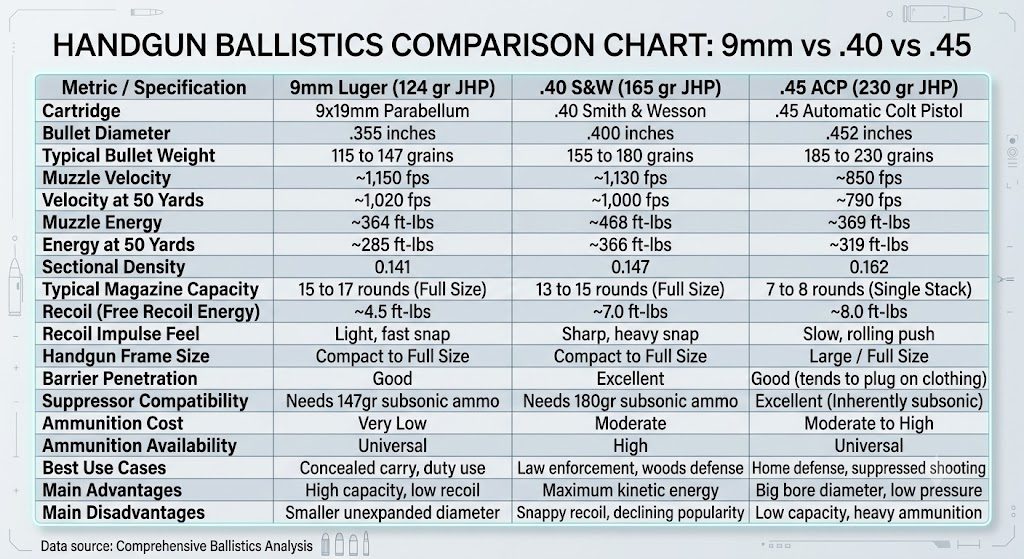
The comparison table highlights the three distinct strategies for handgun stopping power. The 9mm is the speed and volume champion. It pushes a lightweight bullet fast, creating reliable hollow-point expansion while allowing the shooter to carry 15 or more rounds in a standard magazine with minimal recoil.
The .45 ACP takes the opposite approach. It uses a massive, heavy bullet traveling relatively slowly. Even if a .45 ACP hollow point fails to expand, it is already nearly half an inch wide. It delivers its energy with a heavy, pushing recoil rather than a sharp snap. However, the sheer size of the cartridge limits magazine capacity, often restricting shooters to 8 rounds in classic platforms like the 1911.
The .40 S&W represents the mathematical compromise. By taking a 10mm bullet and shortening the casing to fit inside a 9mm-sized pistol frame, the .40 S&W generates more kinetic energy than both the 9mm and the standard .45 ACP. It excels at barrier penetration (such as auto glass or heavy clothing). The trade-off is that it operates at high pressures, resulting in a very sharp, snappy recoil that can be difficult for some shooters to control during rapid fire.
Detailed Comparison Sections
The FBI Protocol and Modern Bullet Technology
To understand these three calibers, you must understand modern bullet design. In the 1980s and 90s, hollow-point bullets were unreliable. Because the 9mm sometimes failed to expand, the FBI transitioned to the larger 10mm, and eventually the .40 S&W, to guarantee a larger wound channel. However, bullet engineering has advanced massively in the last two decades. Today’s premium 9mm defensive ammunition penetrates the FBI-mandated 12 to 18 inches of ballistic gelatin and expands just as reliably as the .40 and .45. This technological leap is the primary reason law enforcement agencies globally have transitioned back to the 9mm.
Velocity Comparison
The 9mm relies on speed. Standard 115-grain and 124-grain 9mm bullets comfortably exceed 1,100 feet per second. The .40 S&W is also a high-pressure, high-velocity cartridge, pushing heavier 165-grain bullets at similar speeds. The .45 ACP is a low-pressure cartridge. Pushing a massive 230-grain bullet requires sacrificing speed, resulting in muzzle velocities around 850 fps.
Energy Comparison
Kinetic energy measures raw hitting power. The .40 S&W is the undisputed winner here, frequently producing over 450 foot-pounds of energy at the muzzle. Interestingly, standard pressure 9mm and .45 ACP produce very similar kinetic energy—hovering around 360 foot-pounds. The 9mm achieves this through speed, while the .45 ACP achieves it through mass.
Recoil Comparison
Recoil dictates how quickly and accurately you can deliver follow-up shots under stress.
- 9mm Luger: Generates the least recoil (roughly 4.5 ft-lbs). It is easy to control, making it perfect for beginners and allowing for incredibly fast, accurate rapid fire.
- .40 S&W: Generates sharp, snappy recoil (roughly 7.0 ft-lbs). Because it squeezes high-pressure energy into a medium-sized pistol frame, it has the most abrupt and violent recoil impulse of the three.
- .45 ACP: Generates heavy recoil (roughly 8.0 ft-lbs), but because the cartridge operates at low pressure and is typically fired from heavy steel handguns, the recoil feels like a slow, rolling push rather than a sharp snap.
Magazine Capacity Comparison
If multiple attackers are involved, capacity is a critical metric. A standard full-size 9mm pistol (like a Glock 17) holds 17 rounds. A similarly sized .40 S&W pistol will hold 15 rounds. A traditional .45 ACP pistol holds between 7 and 8 rounds in a single-stack magazine, or up to 13 rounds in a very wide, bulky double-stack frame. The 9mm offers a distinct advantage in volume of fire.
Accuracy Potential
All three cartridges are mechanically more accurate than the humans firing them. However, practical accuracy—the ability to shoot well under stress—heavily favors the 9mm. The low recoil and mild muzzle blast make it much easier for the average shooter to keep their sights on target and avoid flinching.
Stopping Power Myth
“Stopping power” in handguns is largely a myth. Handguns do not have the kinetic energy to cause hydrostatic shock like a high-velocity rifle. Handguns stop threats through blood loss or central nervous system hits. Therefore, shot placement and adequate penetration (12 to 18 inches) are vastly more important than caliber size. A 9mm in the vital zone will stop a threat much faster than a .45 ACP in the shoulder.
Suppressor Compatibility
The .45 ACP is the absolute best caliber for suppressed shooting. Because standard 230-grain .45 ACP ammunition travels at 850 fps, it is inherently subsonic (below the speed of sound, which is ~1,125 fps). This means it will not produce a loud supersonic crack when fired. To shoot 9mm or .40 S&W quietly through a suppressor, you must buy specialized, heavy subsonic ammunition.
Ammunition Cost Comparison
The 9mm is the cheapest centerfire pistol cartridge in the world. Because it is used by military and police forces globally, it is manufactured in staggering volumes. You can practice with 9mm for a fraction of the cost of the other two. The .40 S&W and .45 ACP require more brass and lead to manufacture, meaning their practice ammunition will consistently cost more.
Pros and Cons of 9mm
Pros:
- High magazine capacity.
- Very low recoil allows for fast, accurate follow-up shots.
- Incredibly cheap and abundant practice ammunition.
- Modern hollow points offer exceptional terminal performance.
Cons:
- Smaller unexpanded diameter if the hollow point fails.
- Lacks the raw barrier-blind energy of larger calibers.
Pros and Cons of .40 S&W
Pros:
- Exceptional kinetic energy and stopping power.
- Excellent barrier penetration through glass and car doors.
- Fits into medium-sized handgun frames.
Cons:
- Sharp, snappy recoil can induce flinching.
- Accelerates wear and tear on pistol components.
- Decreasing in popularity, meaning fewer new gun models are available.
Pros and Cons of .45 ACP
Pros:
- Massive bullet diameter creates a large wound channel.
- Operates at low chamber pressures (less muzzle blast).
- Inherently subsonic, making it perfect for suppressors.
- “Pushing” recoil is preferred by many traditionalists over a “snap.”
Cons:
- Severely limited magazine capacity.
- Ammunition is heavy to carry and expensive to shoot.
- Requires a large handgun grip that may not fit small hands.
Which Cartridge Is Better for Beginners?
The 9mm is the undisputed champion for beginners. The mild recoil prevents the shooter from developing a flinch, the high capacity means fewer reloads at the range, and the cheap ammunition allows a new shooter to afford the hundreds of rounds of practice necessary to become proficient.
Which Cartridge Is Better for Concealed Carry?
The 9mm is currently the gold standard for concealed carry. Because the cartridges are small, manufacturers have been able to design incredibly thin, lightweight “micro-compact” pistols (like the SIG P365 or Glock 43X) that still hold 10 to 15 rounds of 9mm. Attempting to conceal a .45 ACP usually means carrying a bulky, heavy gun or sacrificing your capacity down to 5 or 6 rounds.
Which Cartridge Is Better for Home Defense?
All three are excellent choices for home defense, but they serve different preferences. A full-size 9mm provides 17+ rounds to deal with multiple intruders. A .45 ACP is highly favored for home defense if you plan to use a suppressor to protect your hearing indoors, as the heavy, subsonic rounds hit hard without the concussive blast of supersonic ammo.
Which Cartridge Should You Choose?
Choose the 9mm if you want the most versatile, cost-effective, and easy-to-shoot defensive handgun available. Choose the .45 ACP if you want to shoot suppressed, prefer heavy 1911-style pistols, and believe in big-bore terminal ballistics. Choose the .40 S&W if you specifically want a compromise that maximizes kinetic energy and barrier penetration without stepping up to a massive frame size.
Verdict
The caliber war is effectively over, and the 9mm won. While the .40 S&W and .45 ACP are phenomenal, battle-proven cartridges, the advancements in 9mm hollow-point technology have rendered the sacrifices in recoil and magazine capacity unnecessary for the average civilian. The 9mm offers terminal performance that matches its bigger brothers, but allows you to carry twice as much ammo, shoot faster, and practice cheaper. The .45 ACP will always hold a legendary place in American history and remains the king of suppressed heavy-hitters. The .40 S&W remains a potent, high-energy cartridge for those who already own and shoot it well. However, for a modern shooter looking for the ultimate balance of capacity, shootability, and lethal efficiency, the 9mm is the objective standard.
FAQs
Is .40 S&W a dying caliber?
While it is declining in popularity, it is not “dying.” Over the last decade, the FBI and almost all major police departments have transitioned away from the .40 S&W back to the 9mm. Because police drive the civilian market, gun manufacturers have largely stopped developing new .40 S&W pistols. However, millions of .40 S&W guns exist, and ammunition will be widely available for decades to come.
Is 9mm more powerful than .45 ACP?
No, but it is just as lethal. The .45 ACP fires a much heavier bullet and makes a wider hole, while the 9mm relies on speed to force its hollow point to expand. With modern defensive ammunition, both penetrate the same depth into soft tissue and cause catastrophic damage.
Why did the FBI switch from .40 to 9mm?
The FBI switched back to 9mm because their testing concluded that modern 9mm ammunition performs identically to .40 S&W in ballistic gelatin. Furthermore, they found their agents qualified with higher scores, shot faster, and experienced less wear and tear on their duty weapons when using the lower-recoiling 9mm.
Can a 9mm stop a bear?
A 9mm can stop a black bear if loaded with specialized heavy, hard-cast ammunition (like 147-grain solid flat-nose rounds) that penetrates deeply. However, it is entirely inadequate for large grizzly or brown bears. For bear defense, calibers like the 10mm Auto or large magnum revolvers (.44 Magnum) are highly recommended.