The main difference between the .17 Hornet and the .22 Hornet is that the .17 Hornet utilizes a modern necked down case to push an ultra lightweight projectile at blistering velocities for a practically flat trajectory out to 300 yards, whereas the classic .22 Hornet relies on a slightly heavier and wider bullet traveling at lower speeds, making it a highly effective but more arched short range option for varmint hunting. When comparing these two legendary small caliber centerfire cartridges, hunters must balance the explosive speed and wind resistance of the modern 17 caliber against the historical reliability and slightly deeper penetration of the original 22 caliber design. In this comprehensive guide, we compare velocity, muzzle energy, trajectory, bullet drop, recoil, penetration, expansion, effective range, ammunition cost, and reloading potential to help you select the perfect companion for your next predator hunt.
.17 Hornet vs .22 Hornet Comparison Table
To accurately compare these two varmint cartridges, we must examine their physical dimensions and baseline ballistic performance. The data below represents standard premium factory loads, comparing a 20 grain V-MAX load for the .17 Hornet against a 35 grain V-MAX load for the .22 Hornet fired from standard rifle barrels.
| Specification | .17 Hornet | .22 Hornet |
| Cartridge Type | Centerfire Rifle | Centerfire Rifle |
| Parent Case | .22 Hornet (Necked down) | None (Original Design 1930) |
| Bullet Diameter | .172 inches | .224 inches |
| Case Length | 1.340 inches | 1.403 inches |
| Overall Length | 1.720 inches | 1.723 inches |
| Typical Bullet Weights | 15 grains to 25 grains | 35 grains to 45 grains |
| Muzzle Velocity (Rifle bbl) | 3,650 fps (20gr V-MAX) | 3,100 fps (35gr V-MAX) |
| Muzzle Energy (Rifle bbl) | 592 foot pounds | 747 foot pounds |
| Maximum Pressure | 50,000 psi (SAAMI) | 43,000 CUP (SAAMI) |
| Effective Range | 250 to 300 yards | 150 to 200 yards |
| Trajectory | Flat | Arced |
| Bullet Drop (200 yds) | Approx. 1.6 inches | Approx. 3.5 inches |
| Wind Drift | Low (Fast moving bullet) | Moderate |
| Recoil | Practically Zero | Very Mild |
| Barrel Length Performance | Excels in 20 to 24 inch barrels | Excels in 20 to 24 inch barrels |
| Suppressor Performance | Good | Good |
| Short Barrel Performance | Rare | Rare |
| Accuracy | High (Centerfire consistency) | High (Centerfire consistency) |
| Penetration | Shallow (Explosive fragmentation) | Moderate |
| Expansion | Devastating | Devastating |
| Hunting Performance | Elite (Prairie dogs, foxes) | Elite (Coyotes, woodchucks) |
| Home Defense | Not Recommended | Not Recommended |
| Tactical Use | None | None |
| Action Size | Micro Short Action | Micro Short Action |
| Ammunition Cost | High | High |
| Ammo Availability | Specialty or Online | Specialty or Online |
| Reloading | Yes (Can be tedious) | Yes (Highly popular) |
| Best Uses | Long range precision varmint hunting | Reloading, medium range predator hunting |
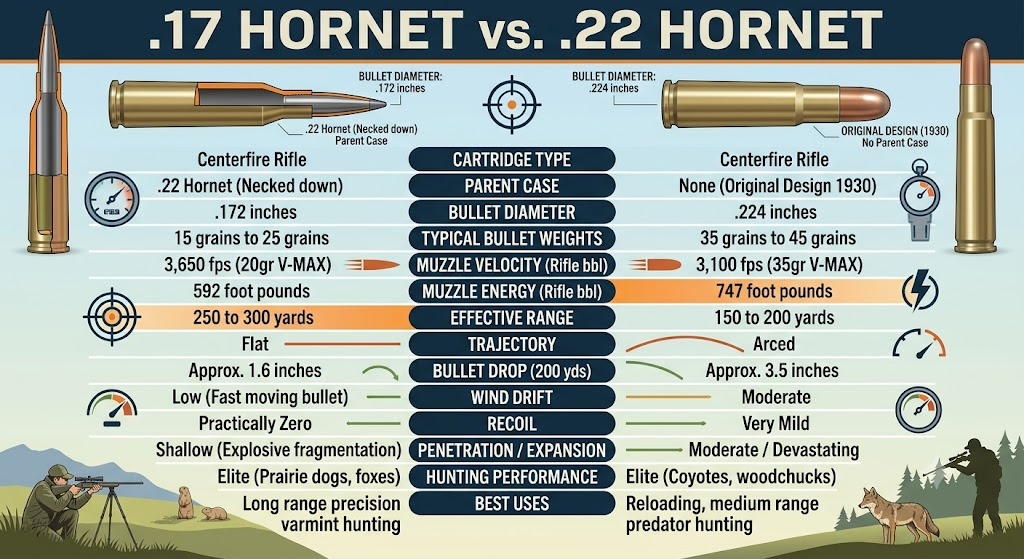
Understanding the Numbers
The technical differences between these cartridges are rooted entirely in their historical development. The .22 Hornet was introduced in 1930 and is widely considered one of the first dedicated modern varmint cartridges. It utilizes a slightly tapered case and a rimmed base, safely containing 43,000 CUP of pressure to drive lightweight .224 caliber bullets. In 2012, Hornady modernized this classic design by necking down the .22 Hornet case to accept a tiny .172 caliber bullet, creating the .17 Hornet. By utilizing modern propellants and a thicker brass web, the .17 Hornet safely operates at a much higher 50,000 psi, unlocking massive velocity gains over its parent cartridge.
Velocity Comparison
Velocity dictates the trajectory flatness and the kinetic energy delivered to the target. When pushing a modern 20 grain V-MAX bullet, the .17 Hornet is an absolute speed demon. It leaves the muzzle at a blistering 3,650 feet per second. The .22 Hornet, pushing a heavier 35 grain V-MAX bullet, tops out at approximately 3,100 feet per second. The .17 Hornet achieves nearly 550 feet per second more velocity simply because it forces expanding gases through a much narrower opening at a higher internal chamber pressure.
Muzzle Energy Comparison
Muzzle energy measures the absolute kinetic force transferred to a target upon impact. Because kinetic energy relies on both mass and velocity, the heavier bullet of the .22 Hornet actually gives it a distinct advantage. A 35 grain .22 Hornet bullet generates 747 foot pounds of energy at the muzzle. The 20 grain .17 Hornet generates roughly 592 foot pounds of energy. While the .17 Hornet is much faster, the extra 15 grains of mass allow the .22 Hornet to hit small game with slightly more raw kinetic power at close ranges.
Trajectory Comparison
A flat trajectory minimizes the margin of error when estimating range in the field. Because the .17 Hornet drives its bullets much faster, it shoots significantly flatter than the .22 Hornet. A hunter using a 20 grain .17 Hornet can hold the crosshairs directly on the vitals of a groundhog out to 250 yards. The .22 Hornet arches noticeably more as the heavy bullet sheds its velocity, requiring careful holdover estimation past 150 yards.
Bullet Drop Comparison
Assuming a 100 yard zero for both rifles, the mathematical bullet drop at 200 yards illustrates the trajectory differences clearly. The .17 Hornet will drop approximately 1.6 inches at 200 yards. The .22 Hornet will drop roughly 3.5 inches at the exact same distance. At 300 yards, the .22 Hornet drops completely off the target, whereas the .17 Hornet drops a highly manageable 7.5 inches.
Wind Drift Comparison
Wind deflection is mitigated by a bullet’s velocity and its aerodynamic profile. Because both cartridges fire lightweight bullets, they are highly susceptible to wind drift. However, because the .17 Hornet reaches the target nearly a full second faster at extended ranges, it spends far less time exposed to crosswinds. At 200 yards in a 10 mph crosswind, the .17 Hornet will drift noticeably less than the slow moving .22 Hornet, resulting in a much higher hit probability in open fields.
Recoil Comparison
Recoil dictates a shooter’s ability to spot their own impacts through a rifle scope. Both of these cartridges are famous for practically non existent recoil. The .17 Hornet generates less than one foot pound of free recoil, while the .22 Hornet generates roughly 1.5 foot pounds. Both feel like a very light tap against the shoulder. They are absolute joys to shoot and are perfect training tools for young beginners.
Stopping Power Comparison
For varmint hunting, stopping power refers to explosive fragmentation and instant energy transfer. Both cartridges deliver excellent stopping power on small game and pests. The .17 Hornet relies on extreme velocity to cause the tiny 20 grain bullet to detonate upon impact, turning the projectile into shrapnel instantly. The .22 Hornet relies on slightly more mass to crush tissue, anchoring predators very effectively at close ranges.
Penetration Comparison
Penetration is critical for ensuring the bullet reaches vital organs on quartering shots. Because the .17 Hornet relies on a highly frangible, tiny bullet traveling at 3,650 feet per second, it offers very shallow penetration. The bullet is designed to explode on contact. The .22 Hornet utilizes a slightly heavier, wider bullet that will penetrate slightly deeper before fully expanding, giving it a marginal advantage on larger varmints like coyotes.
Expansion Comparison
To accurately test bullet expansion, the ballistics industry relies on calibrated ordinance gel. Both cartridges expand violently when loaded with polymer tipped V-MAX ammunition. The .17 Hornet creates a massive but shallow temporary wound cavity, whereas the .22 Hornet pushes its expansion cavity slightly deeper into the target block.
Accuracy Comparison
Both cartridges are capable of excellent accuracy. Because they are centerfire cartridges, they provide highly consistent ignition compared to rimfire ammunition. However, modern .17 Hornet rifles are typically built with extremely tight chamber tolerances to maximize the ballistic potential of the new cartridge, often allowing off the shelf rifles to routinely shoot sub MOA groups. Many older .22 Hornet rifles feature varying twist rates that can sometimes complicate load development.
Effective Range Comparison
The .17 Hornet is a highly effective 300 yard hunting cartridge in the hands of a skilled marksman. It retains plenty of velocity to ethically harvest prairie dogs and foxes at that distance. The .22 Hornet is a dedicated short to medium range cartridge. Its steeper trajectory and rapidly decreasing velocity limit its ethical effective hunting range on predators to roughly 150 to 200 yards.
Suppressor Performance Comparison
Suppressors are highly recommended for both of these cartridges to mitigate their loud muzzle blast. Both cartridges are entirely supersonic and push expanding gas. They perform identically well when suppressed. Adding a quality titanium suppressor will tame the acoustic signature of both cartridges beautifully, though the supersonic crack of the bullet breaking the sound barrier will always remain.
Ammo Cost Comparison
To become proficient with a hunting rifle, you must practice frequently. Both the .17 Hornet and the .22 Hornet are premium, specialty centerfire rounds. Boxes of 25 or 50 rounds typically cost significantly more than standard rimfire ammunition or bulk .223 Remington. Pricing between the two is generally identical, as they require similar manufacturing processes and components.
Ammo Availability Comparison
Walk into a local rural hardware store, and you might struggle to find either cartridge. Both are specialty varmint rounds produced in seasonal batches. However, because the .22 Hornet has existed for nearly a century, it enjoys slightly broader historical support from multiple manufacturers. The .17 Hornet is primarily supported by Hornady, making it slightly more difficult to source during supply chain shortages.
Reloading Comparison
This is a fundamental category for both cartridges. Because factory ammunition is so expensive, reloading is practically mandatory for high volume shooters. The .22 Hornet is a classic handloader’s favorite, utilizing microscopic powder charges to achieve extreme economy. The .17 Hornet is also highly economical to reload, but the tiny .172 caliber case neck requires specialized funnels and meticulous care to avoid crushing the brass during the seating process.
Pros and Cons
.17 Hornet
Pros
- Shoots significantly flatter for long range varmint hunting.
- Extreme velocity ensures explosive fragmentation on small game.
- Spends less time in the wind, minimizing crosswind drift.
- Practically zero recoil allows shooters to spot their own hits.
Cons
- Ammunition is highly specialized and often difficult to find locally.
- Tiny case neck makes the reloading process tedious for large fingers.
- Very shallow penetration on larger predators.
.22 Hornet
Pros
- Generates slightly more kinetic energy at the muzzle.
- Heavier bullets provide slightly deeper penetration on coyotes.
- Decades of historical load data and reloading components available.
- Excellent stopping power at close to medium ranges.
Cons
- Trajectory drops significantly past 150 yards.
- Slower velocity makes wind estimation difficult at extended ranges.
- Factory ammunition is often produced in limited seasonal batches.
Final Verdict
Choosing between the .17 Hornet and the .22 Hornet comes down entirely to the distance of your typical shots.
- For Long Range Varmints: Choose the .17 Hornet. It provides the blistering velocity and flat trajectory necessary to anchor prairie dogs and foxes at 300 yards.
- For Close Range Coyotes: Choose the .22 Hornet. The extra bullet mass provides the kinetic energy and deeper penetration required to ethically harvest heavier predators inside 150 yards.
- For the Handloader: Choose the .22 Hornet. The slightly larger case neck makes the mechanical reloading process vastly easier and more forgiving than the microscopic dimensions of the .17 caliber case.
FAQ
Is the .17 Hornet more powerful than the .22 Hornet?
No. Because kinetic energy factors in bullet mass, the heavier 35 grain to 45 grain bullets of the .22 Hornet actually generate more kinetic energy at the muzzle than the ultra light 20 grain bullets of the .17 Hornet.
Can a .17 Hornet kill a coyote?
Yes. The .17 Hornet is highly effective on coyotes at close to medium ranges with perfect shot placement. However, hunters must be aware that the highly frangible bullet offers very shallow penetration.
Can I shoot .22 Hornet ammo in a .17 Hornet rifle?
Absolutely not. The .22 Hornet uses a .224 caliber bullet, which is physically too wide to fit down the .172 caliber barrel of a .17 Hornet rifle. Attempting to fire it will cause a catastrophic explosion.
Is the .22 Hornet obsolete?
Commercially, it is considered a niche cartridge today because the .223 Remington has largely dominated the market. However, ballistically it remains a highly effective, low recoil varmint cartridge with a very loyal following.