The main difference between the cartridges is that the .50 BMG is a heavy-duty, combat-proven military anti-materiel cartridge designed to disable vehicles and hard targets using massive mass, whereas the .416 Barrett is a necked-down precision cartridge engineered specifically to provide flat-shooting, supersonic performance past 2,500 yards with significantly less recoil and drop than the .50 BMG.
Both cartridges were developed for military applications to push the boundaries of extreme long-range (ELR) sniper engagements. The .50 Browning Machine Gun (.50 BMG) has dominated anti-materiel roles for over a century since its introduction in 1921. However, by the early 2000s, military snipers desired a cartridge that could match or exceed the long-range trajectory of the .50 BMG while complying with anti-armor restrictions in certain jurisdictions and reducing the massive weight of .50-caliber weapon systems. Chris Barrett (son of Ronnie Barrett) developed the .416 Barrett in 2005 by necking down the .50 BMG case to accept a smaller 0.416-inch projectile. This created a high-velocity, extremely aerodynamic projectile capable of outperforming standard .50 BMG ball ammunition at extreme distances.
.416 Barrett vs .50 BMG Comparison
| Feature | .416 Barrett | .50 BMG |
| Bullet Diameter | 0.416 inches (10.57 mm) | 0.510 inches (12.95 mm) |
| Typical Bullet Weight | 398 gr to 450 gr (typically 419 gr) | 650 gr to 800 gr (typically 660 or 750 gr) |
| Muzzle Velocity | 3,150 to 3,250 fps (32-inch barrel) | 2,750 to 3,000 fps (29 to 32-inch barrel) |
| Muzzle Energy | ~9,000 to 9,500+ ft-lbs | ~12,000 to 15,000+ ft-lbs |
| Momentum | ~185 to ~195 lb-fps | ~260 to ~290 lb-fps |
| Maximum Pressure | 65,000 psi (SAAMI) | 65,000 psi (MIL-SPEC / SAAMI) |
| Case Capacity | ~265 grains of water | ~290 grains of water |
| Ballistic Coefficient | Extreme (0.950 to 1.120+ G1) | High to Very High (0.650 to 1.050 G1) |
| Effective Range | 2,000 to 2,500+ yards | 1,500 to 2,500+ yards (Anti-materiel out to 2,000+) |
| Recoil | Substantial (~40 to 50 ft-lbs in a heavy rifle) | Brutal (~55 to 70+ ft-lbs in a heavy rifle) |
| System Weight | 30 to 35 lbs (Long-range sniper rifle) | 30 to 38+ lbs (Heavy sniper/anti-materiel rifle) |
| Ammo Availability | Low to Moderate (Specialty ELR production runs) | Moderate to High (Military surplus and commercial match) |
| Ammo Cost | Extremely Expensive ($4.00 to $8.00+/rd) | Expensive ($3.00 to $7.00+/rd) |
| Best Use | Extreme long-range target shooting, anti-personnel ELR | Anti-materiel, vehicle disabling, heavy military defense |
The table above illustrates the mechanical relationship between the two rounds. The .416 Barrett is built directly upon a shortened, necked-down .50 BMG case. Because it retains much of the massive powder capacity (roughly 265 grains of water) while pushing a significantly lighter projectile, it generates blistering muzzle velocities exceeding 3,150 feet per second. This high velocity combined with extreme aerodynamic efficiency gives the .416 Barrett an exceptionally flat trajectory.
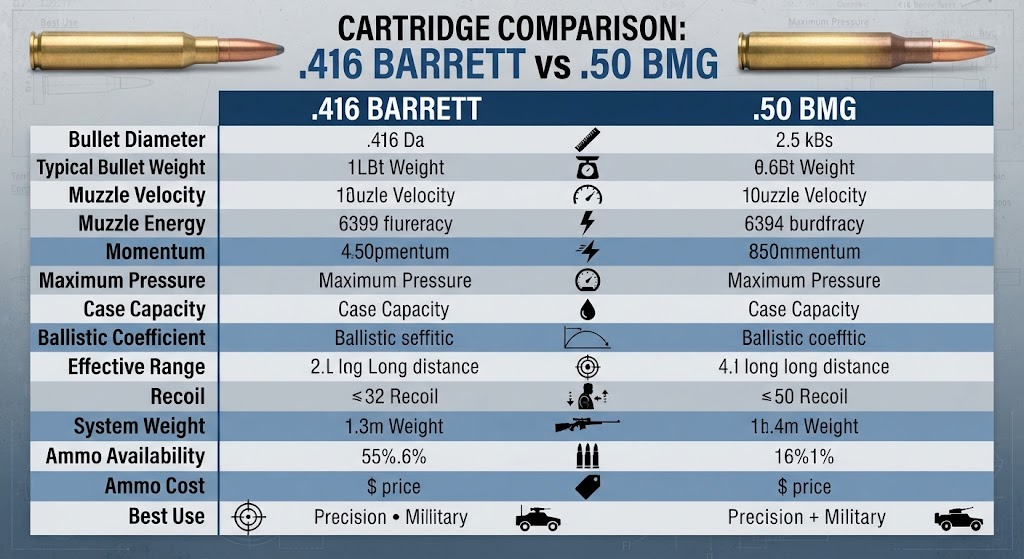
.416 Barrett vs .50 BMG Ballistics
To objectively evaluate the ballistic capabilities, we must examine match-grade factory ammunition fired from heavy professional ELR rifle platforms equipped with long 32-inch match barrels.
- Load A (.416 Barrett Solid Match): Barrett 419-grain Solid Machined Bronze. Tested from a 32-inch barrel. Muzzle velocity is 3,150 feet per second. Muzzle energy is 9,234 foot-pounds. Ballistic Coefficient (G1) is 1.061.
- Load B (.416 Barrett High-Velocity): Cutting Edge 400-grain MTH. Tested from a 32-inch barrel. Muzzle velocity is 3,225 feet per second. Muzzle energy is 9,238 foot-pounds. Ballistic Coefficient (G1) is 0.985.
- Load C (.50 BMG Military Standard): M33 Ball 660-grain FMJ. Tested from a 29-inch barrel. Muzzle velocity is 2,910 feet per second. Muzzle energy is 12,427 foot-pounds. Ballistic Coefficient (G1) is 0.670.
- Load D (.50 BMG Match Grade): Hornady 750-grain A-MAX Match. Tested from a 30-inch barrel. Muzzle velocity is 2,820 feet per second. Muzzle energy is 13,248 foot-pounds. Ballistic Coefficient (G1) is 1.050.
.416 Barrett Vs .50 BMG Velocity
Velocity is where the .416 Barrett pulls ahead of standard .50 BMG loads. While standard military .50 BMG ball ammo typically leaves the muzzle at roughly 2,910 feet per second, the .416 Barrett effortlessly drives its lighter, streamlined projectiles at 3,150 to 3,250 feet per second.
More importantly, the .416 Barrett’s high initial speed paired with an exceptionally high Ballistic Coefficient means it retains its velocity over distance much more efficiently than standard .50 BMG military ball ammunition. It stays supersonic deeper into its flight path, maintaining stability past 2,500 yards.
.416 Barrett Vs .50 BMG Muzzle Energy
Muzzle energy represents the raw kinetic work capacity of a projectile.
The .416 Barrett generates an impressive 9,000 to 9,500 foot-pounds of muzzle energy. This makes it one of the most powerful cartridges available to civilian and military shooters outside of the .50-caliber class.
However, the .50 BMG easily wins the raw power category, generating between 12,000 and 15,000+ foot-pounds of muzzle energy. That extra 3,000 to 5,000 foot-pounds of energy is why the .50 BMG remains the military’s choice for anti-materiel work—destroying engine blocks and concrete bunkers with sheer kinetic force.
.416 Barrett Vs .50 BMG Momentum
Momentum calculates mass in motion, dictating a projectile’s ability to drive through heavy structural barriers.
Because momentum relies heavily on bullet weight, the .50 BMG dominates this metric.
A 419-grain .416 Barrett bullet traveling at 3,150 feet per second yields approximately 188.4 pound-feet per second of linear momentum.
A heavy 750-grain .50 BMG bullet traveling at 2,820 feet per second yields roughly 302.1 pound-feet per second of linear momentum.
The .50 BMG carries substantially more mass-in-motion, allowing it to shatter heavy steel and concrete structures far more effectively than the lighter .416 projectile.
.416 Barrett Vs .50 BMG Trajectory
Understanding external ballistics highlights why the .416 Barrett was designed for precision long-range shooting. The calculations below assume a high-profile ELR optic height of 2.5 inches above the bore and a 300-yard zero.
| Distance | .416 Barrett (419 gr at 3,150 fps) Drop | .50 BMG (750 gr at 2,820 fps) Drop |
| Muzzle | -2.5 inches | -2.5 inches |
| 300 Yards | 0.0 inches (Zero) | 0.0 inches (Zero) |
| 600 Yards | -18.5 inches | -23.1 inches |
| 1000 Yards | -81.0 inches | -101.4 inches |
| 1500 Yards | -240.5 inches | -305.5 inches |
| 2000 Yards | -540.0 inches | -715.0 inches |
The trajectory data demonstrates the .416 Barrett’s distinct advantage in flat-shooting performance. Because it leaves the muzzle faster and features a high-BC streamlined profile, it drops significantly less than standard military .50 BMG ball ammunition over long distances. At 2,000 yards, the .416 Barrett drops over 170 inches (more than 14 feet) less than standard .50 BMG ball rounds, making it much more forgiving for a sniper calculating elevation and windage.
.416 Barrett Vs .50 BMG Recoil
Recoil management for both cartridges requires massive, highly efficient muzzle brakes and heavy rifle chassis systems.
The .50 BMG produces brutal, bone-jarring recoil, generating roughly 55 to 70+ foot-pounds of free recoil energy in a heavy rifle.
The .416 Barrett generates noticeably less recoil, producing roughly 40 to 50 foot-pounds of free recoil energy. While it is still a massive shoulder punch that requires strict shooting discipline, it is slightly more manageable than the .50 BMG, helping shooters maintain better sight picture stability through the scope.
.416 Barrett Vs .50 BMG Penetration & Anti-Materiel Performance
When evaluating anti-materiel performance, the .50 BMG remains the undisputed king. Its massive mass and specialized military payloads (such as Armor-Piercing Incendiary rounds) allow it to defeat heavy armor and detonate unexploded ordnance behind cover.
The .416 Barrett is primarily a precision anti-personnel and extreme long-range target cartridge. While its solid bronze match bullets will punch deep through light barriers and body armor, it lacks the massive payload capacity required for heavy anti-materiel destruction.
.416 Barrett Vs .50 BMG Self Defense & Concealed Carry
Neither cartridge is remotely suitable for civilian self-defense, home defense, or concealed carry. Both require specialized, multi-mile shooting ranges and heavy, 30+ pound weapon systems.
Which Has More Stopping Power: .416 Barrett Vs .50 BMG?
On human-sized targets at extreme distances (past 1,500 yards), the .416 Barrett possesses superior precision stopping power because its flat trajectory and high retained velocity allow for consistent, accurate hits.
Against vehicles, walls, and hard targets, the .50 BMG possesses unmatched anti-materiel stopping power.
Which Is More Powerful: .416 Barrett Vs .50 BMG?
Based on raw muzzle energy, momentum, and mass, the .50 BMG is vastly more powerful than the .416 Barrett.
.416 Barrett Pros And Cons
Pros
- Exceptional muzzle velocity (3,200+ fps) and ultra-flat trajectory out to 2,500+ yards
- Higher Ballistic Coefficient and less drop at extreme range compared to standard .50 BMG ball ammo
- Generates less recoil and muzzle blast than the .50 BMG
- Designed specifically to maximize precision shooting performance
Cons
- Ammunition is extremely expensive and harder to find than .50 BMG
- Lacks true heavy anti-materiel capabilities (armor-piercing/incendiary payloads)
- Limited rifle platform options compared to the massive global market for .50 BMG rifles
.50 BMG Pros And Cons
Pros
- Legendary combat-proven anti-materiel performance (disables vehicles, equipment, and barriers)
- Massive kinetic energy and momentum (12,000+ ft-lbs)
- Widespread availability of rifles (bolt-action and semi-automatic like the Barrett M82)
- Abundant military surplus and commercial match ammunition supplies
Cons
- Brutal, punishing recoil and severe concussive blast
- Heavier trajectory drop at extreme range when utilizing standard military ball ammunition
- Banned on many commercial shooting ranges due to extreme safety templates
Final Comparison
| Category | Winner | Reason |
| Velocity | .416 Barrett | Lighter projectiles and large powder capacity drive speeds past 3,200 fps |
| Muzzle Energy | .50 BMG | Massive powder capacity yields 12,000 to 15,000+ ft-lbs of energy |
| Momentum | .50 BMG | Heavy 750-grain bullets carry nearly double the physical mass-in-motion |
| Penetration | .50 BMG | Specialized military rounds defeat armor and hardened materials effectively |
| Expansion | .416 Barrett | Solid match bullets are precision-engineered for extreme long-range accuracy |
| Trajectory | .416 Barrett | Higher initial velocity and extreme BC drastically reduce drop past 1,000 yards |
| Recoil Control | .416 Barrett | Generates noticeably less felt recoil than the heavy .50 BMG |
| Effective Range | Tie | Both successfully reach out past 2,000 to 2,500+ yards |
| Self Defense | Neither | Both are extreme long-range military and target calibers |
| Concealed Carry | Neither | Both require massive 30-pound weapon systems |
| Ammo Cost | .50 BMG | Greater commercial and surplus production offers better pricing variety |
| Ammo Availability | .50 BMG | Widely available through military surplus and numerous commercial manufacturers |
| Overall Performance | Depends on Mission | .50 BMG for anti-materiel/vehicle destruction; .416 Barrett for flat-shooting extreme long-range precision |
.416 Barrett Vs .50 BMG: Which Should You Choose?
Selecting between the .416 Barrett and the .50 BMG depends on whether your extreme long-range goals prioritize flat-shooting ballistic precision or heavy anti-materiel power.
Choose the .416 Barrett if your primary objective is extreme long-range (ELR) precision shooting, king-of-two-mile competitions, or hitting small targets at extreme distances with minimal bullet drop and manageable wind drift.
Choose the .50 BMG if you want the undisputed heavyweight king of commercial anti-materiel power, widespread rifle and ammunition availability, and iconic semi-automatic Barrett M82 ownership.
FAQs
Is .416 Barrett more powerful than .50 BMG?
No, the .50 BMG is significantly more powerful. It generates roughly 13,000 to 15,000 foot-pounds of muzzle energy, whereas the .416 Barrett generates roughly 9,000 to 9,500 foot-pounds.
Which has a flatter trajectory?
The .416 Barrett shoots noticeably flatter than standard military .50 BMG ball ammunition, resulting in significantly less bullet drop at extreme distances past 1,500 yards.
Can .50 BMG shoot .416 Barrett ammunition?
No. They are entirely different calibers with incompatible case dimensions, bolt faces, and barrel diameters.
Why was .416 Barrett invented if .50 BMG already existed?
The .416 Barrett was invented to provide military snipers with a cartridge that exceeded the long-range trajectory and wind resistance of standard .50 BMG ball ammunition, while offering slightly reduced recoil and avoiding certain international restrictions on .50-caliber military use.
Which has more recoil?
The .50 BMG produces noticeably more recoil and a harsher concussive blast than the .416 Barrett, though both require massive muzzle brakes to be fired comfortably.
Which should you choose?
Choose the .416 Barrett for flat-shooting extreme long-range precision target shooting. Choose the .50 BMG for ultimate anti-materiel power, semi-automatic Barrett ownership, and historic military clout.