The main difference between the .224 Valkyrie and the 6mm ARC is their primary design focus and projectile sizing. The .224 Valkyrie was engineered by Federal to push ultra-high-ballistic-coefficient .224 caliber bullets at blistering velocities to stay supersonic past 1,000 yards in an AR-15 platform, while the 6mm ARC was developed by Hornady for the United States Department of Defense to utilize heavier, wider 6mm match bullets for superior long-range wind resistance, barrier penetration, and multi-role tactical performance.
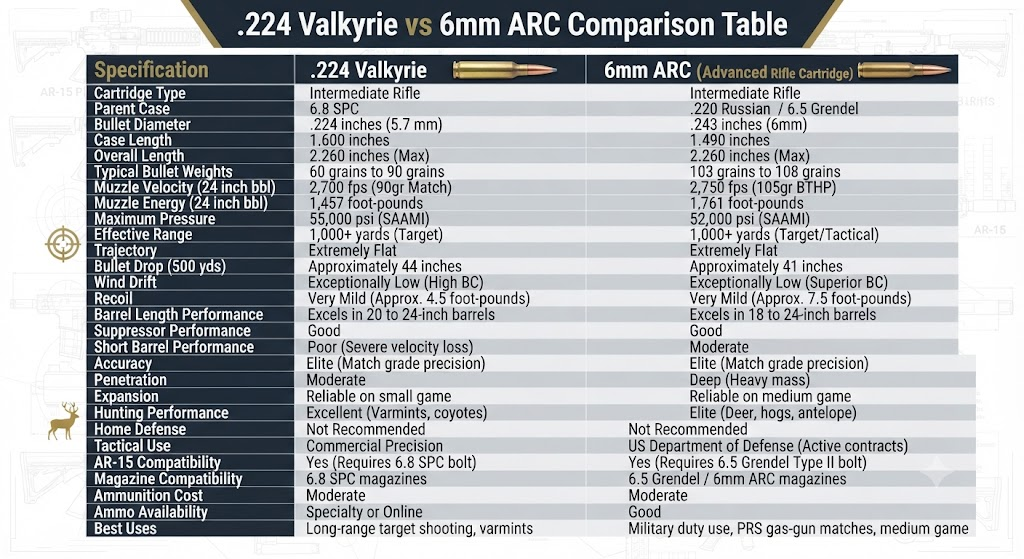
.224 Valkyrie vs 6mm ARC Comparison Table
To accurately compare these two advanced AR-15 precision cartridges, we must examine their physical dimensions, pressure limits, and baseline ballistic performance. The data below represents standard premium factory loads, comparing the 90-grain Match load for the .224 Valkyrie against the 108-grain ELD Match load for the 6mm ARC fired from 24-inch barrels.
| Specification | .224 Valkyrie | 6mm ARC (Advanced Rifle Cartridge) |
| Cartridge Type | Intermediate Rifle | Intermediate Rifle |
| Parent Case | 6.8 SPC | .220 Russian / 6.5 Grendel |
| Bullet Diameter | .224 inches (5.7 mm) | .243 inches (6mm) |
| Case Length | 1.600 inches | 1.490 inches |
| Overall Length | 2.260 inches (Max) | 2.260 inches (Max) |
| Typical Bullet Weights | 60 grains to 90 grains | 103 grains to 108 grains |
| Muzzle Velocity (24 inch bbl) | 2,700 fps (90gr Match) | 2,750 fps (105gr BTHP) |
| Muzzle Energy (24 inch bbl) | 1,457 foot-pounds | 1,761 foot-pounds |
| Maximum Pressure | 55,000 psi (SAAMI) | 52,000 psi (SAAMI) |
| Effective Range | 1,000+ yards (Target) | 1,000+ yards (Target/Tactical) |
| Trajectory | Extremely Flat | Extremely Flat |
| Bullet Drop (500 yds) | Approximately 44 inches | Approximately 41 inches |
| Wind Drift | Exceptionally Low (High BC) | Exceptionally Low (Superior BC) |
| Recoil | Very Mild (Approx. 4.5 foot-pounds) | Very Mild (Approx. 7.5 foot-pounds) |
| Barrel Length Performance | Excels in 20 to 24-inch barrels | Excels in 18 to 24-inch barrels |
| Suppressor Performance | Good | Good |
| Short Barrel Performance | Poor (Severe velocity loss) | Moderate |
| Accuracy | Elite (Match grade precision) | Elite (Match grade precision) |
| Penetration | Moderate | Deep (Heavy mass) |
| Expansion | Reliable on small game | Reliable on medium game |
| Hunting Performance | Excellent (Varmints, coyotes) | Elite (Deer, hogs, antelope) |
| Home Defense | Not Recommended | Not Recommended |
| Tactical Use | Commercial Precision | US Department of Defense (Active contracts) |
| AR-15 Compatibility | Yes (Requires 6.8 SPC bolt) | Yes (Requires 6.5 Grendel Type II bolt) |
| Magazine Compatibility | 6.8 SPC magazines | 6.5 Grendel / 6mm ARC magazines |
| Ammunition Cost | Moderate | Moderate |
| Ammo Availability | Specialty or Online | Good |
| Best Uses | Long-range target shooting, varmints | Military duty use, PRS gas-gun matches, medium game |
Understanding the Engineering
The technical differences between these cartridges reflect how designers chose to maximize performance within the strict 2.260-inch overall length constraint of the standard AR-15 magazine well.
The .224 Valkyrie was introduced by Federal Premium in 2017. They took the 6.8 SPC case and necked it down to accept slender, ultra-long .224 caliber bullets. The primary design goal was to create an intermediate cartridge that could stay supersonic past 1,300 yards, a feat previously restricted to heavy bolt-action magnum rifles.
The 6mm ARC was developed by Hornady in close collaboration with the U.S. military and released in 2020. Instead of using the 6.8 SPC, Hornady utilized the fatter, shorter 6.5 Grendel parent case and necked it down to 6mm (.243 inches). Because the Grendel case is wider, it holds powder more efficiently while leaving ample room inside the magazine well to seat heavy, high-BC 108-grain match bullets entirely outside the powder column.
Velocity Comparison
Velocity dictates initial trajectory flatness and time-to-target over extended distances.
When fired from matching 24-inch barrels, both cartridges achieve impressive speeds. The .224 Valkyrie pushes a heavy 90-grain match bullet at approximately 2,700 feet per second. The 6mm ARC pushes an even heavier 105-grain to 108-grain match bullet at roughly 2,750 feet per second.
Despite firing a significantly heavier projectile, the 6mm ARC matches or slightly exceeds the muzzle velocity of the Valkyrie due to its more efficient powder column and optimized case geometry.
Muzzle Energy Comparison
Muzzle energy measures the absolute kinetic force transferred to a target upon impact.
Because kinetic energy scales with projectile mass, the 6mm ARC holds a clear advantage. The 6mm ARC generates approximately 1,761 foot-pounds of energy at the muzzle. The .224 Valkyrie generates roughly 1,457 foot-pounds.
The 6mm ARC delivers nearly 20 percent more kinetic energy. This extra energy, combined with a wider frontal diameter, is why the 6mm ARC is fully capable of ethical harvests on medium game like whitetail deer, whereas the .224 Valkyrie is strictly a varmint and predator cartridge.
Trajectory Comparison
A flat trajectory minimizes the margin of error when estimating range for a shooter in the field.
Both cartridges shoot exceptionally flat because they utilize elite match-grade bullets with very high Ballistic Coefficients. Inside 500 yards, their trajectories are nearly identical, with the .224 Valkyrie holding a very slight initial drop advantage due to its hyper-efficient 90-grain bullet profile. However, as distances stretch past 800 yards, the superior momentum and retained velocity of the 6mm ARC allow it to maintain its trajectory with greater consistency.
Bullet Drop Comparison
Assuming a standard 100-yard zero for both rifles, the mathematical bullet drop at extended distances highlights their long-range capabilities.
At 500 yards, the .224 Valkyrie drops approximately 44 inches. The 6mm ARC drops roughly 41 inches.
If pushed to 1,000 yards, both cartridges require massive elevation adjustments (over 300 inches of drop), but the 6mm ARC punches through the transonic barrier with greater stability due to its heavier mass.
Wind Drift Comparison
Wind deflection is the absolute greatest enemy of the long-range precision shooter. Wind drift is mitigated strictly by a bullet’s velocity, mass, and aerodynamic profile (Ballistic Coefficient).
This is a key category where the 6mm ARC shines. While the .224 Valkyrie features a high-BC 90-grain bullet (.563 G1 BC), the heavy 108-grain Hornady ELD Match bullet used in the 6mm ARC boasts an even more dominant aerodynamic profile (.536 G1 BC, but with significantly more mass and sectional density to buck crosswinds). At 1,000 yards in a 10 mph crosswind, the heavier 6mm ARC resists deflection noticeably better than the lighter .224 Valkyrie.
Recoil Comparison
Recoil dictates a shooter’s ability to spot their own impacts through a rifle scope and fire rapid follow-up shots.
Both cartridges produce exceptionally mild recoil, making them absolute joys to shoot from a semi-automatic gas gun. The .224 Valkyrie generates roughly 4.5 foot-pounds of free recoil. The 6mm ARC generates approximately 7.5 foot-pounds due to its heavier powder charge and heavier projectile mass.
While the 6mm ARC kicks slightly more than the Valkyrie, both generate less than half the recoil of a standard .308 Winchester, allowing shooters to easily watch their impacts on steel targets.
Stopping Power Comparison
Stopping power on game animals requires massive energy transfer and deep tissue disruption.
The .224 Valkyrie offers elite stopping power on coyotes, prairie dogs, and small varmints. The .224 caliber bullets expand rapidly, creating devastating temporary wound cavities on small game, but it lacks the mass required for reliable stopping power on large animals.
The 6mm ARC delivers superior stopping power across a wider spectrum. Backed by military testing requirements for terminal performance, the 6mm ARC is fully qualified to harvest medium game like deer, antelope, and feral hogs with ethical authority.
Penetration Comparison
Penetration is critical for ensuring the bullet reaches vital organs on quartering angles.
Sectional Density (SD) measures a bullet’s weight relative to its diameter. The 108-grain 6mm bullet features a solid sectional density of .261, while the 90-grain .224 bullet boasts an SD of .256.
While their sectional densities are close, the heavier raw mass and greater momentum of the 6mm ARC ensure it punches deeper through heavy muscle and bone than the lighter .224 Valkyrie.
Accuracy Comparison
Both cartridges are capable of elite, sub-MOA mechanical accuracy and were purpose-built for extreme precision.
When fired from high-quality match barrels, both cartridges will easily shoot tight groups at 100 yards. In competitive Precision Rifle Series (PRS) gas-gun matches, the 6mm ARC has largely dominated the .224 Valkyrie in recent years due to its superior wind resistance and bullet stability at extreme distances.
Effective Range Comparison
The effective range of an intermediate rifle cartridge is severely limited by wind deflection and retained energy.
For target shooting on steel plates, both cartridges are capable of reaching 1,000 to 1,200 yards. However, the 6mm ARC maintains predictable, stable flight through the transonic zone much better than the .224 Valkyrie.
For hunting, the 6mm ARC is an ethical 400-yard deer cartridge, whereas the .224 Valkyrie should be restricted to hunting predators inside 400 yards.
Suppressor Performance Comparison
Suppressors are highly recommended for both cartridges to protect hearing and reduce muzzle flash.
Both cartridges are strictly supersonic and push immense volumes of expanding powder gases. Adding a quality suppressor will tame the concussive blast, but the supersonic crack of the bullet breaking the sound barrier will always remain loud.
Short Barrel Performance Comparison
Modern tactical and hunting applications frequently require maneuverable short-barreled rifles (SBRs).
The .224 Valkyrie performs poorly in short barrels. It requires a long 20 to 24-inch barrel to burn its slow-burning powder completely and reach its advertised velocity. Chopping a Valkyrie barrel down severely ruins its long-range potential.
The 6mm ARC was explicitly designed with military SBR requirements in mind. While it performs best in 20 to 24-inch barrels, it maintains surprising efficiency and velocity even when chopped down to 18 inches, making it far more viable for compact tactical carbines.
AR-15 Platform Compatibility
Both cartridges fit perfectly into the standard AR-15 platform, utilizing a standard mil-spec upper and lower receiver.
However, neither cartridge can use a standard 5.56 NATO bolt carrier group.
- To shoot the .224 Valkyrie, you must purchase a dedicated 6.8 SPC bolt and a .224 Valkyrie barrel.
- To shoot the 6mm ARC, you must purchase a dedicated 6.5 Grendel Type II bolt and a 6mm ARC barrel. Furthermore, because the 6mm ARC was adopted by the U.S. military, finding factory barrels, bolts, and complete uppers is exceptionally easy.
Ammo Availability and Cost Comparison
Both cartridges are moderately priced modern specialty rounds.
However, the 6mm ARC holds a massive advantage in commercial availability and institutional support. Because Hornady developed it alongside military requirements, factory match and hunting ammunition is widely stocked by major retailers. The .224 Valkyrie enjoyed a burst of early popularity, but factory ammunition support has dwindled over the years, making it more of a niche reloading endeavor.
Pros and Cons
.224 Valkyrie
Pros
- Exceptionally mild recoil allows for effortless impact spotting.
- Flattest trajectory available in a .22-caliber intermediate gas gun.
- Uses lightweight, affordable .224 caliber bullets for handloaders.
- Fits into a standard, lightweight AR-15 platform.
Cons
- Requires a long 20 to 24-inch barrel to achieve advertised speeds.
- Lacks the kinetic energy and mass for hunting medium game.
- Factory ammunition and component support have declined commercially.
6mm ARC
Pros
- Official military adoption ensures long-term industry support and parts availability.
- Superior wind resistance and terminal ballistics compared to .224-caliber options.
- Fully capable of ethical medium-game hunting (deer, hogs).
- Performs well in moderately shortened barrels.
- Massive ecosystem of factory match and hunting ammunition.
Cons
- Generates slightly more recoil than the .224 Valkyrie (though still very mild).
- Requires a specialized 6.5 Grendel Type II bolt head and dedicated magazines.
Final Verdict
Choosing between the .224 Valkyrie and the 6mm ARC comes down to choosing between a niche varmint round and a proven tactical standard.
- For Long-Range Precision Competition: Choose the 6mm ARC. Its superior wind bucking ability, heavy match bullets, and military backing make it the undisputed king of AR-15 long-range gas-gun shooting.
- For Medium-Game Hunting: Choose the 6mm ARC. The heavier 6mm projectiles provide the kinetic energy and deep penetration required to ethically harvest deer and hogs, which the .224 Valkyrie cannot do.
- For Predator and Varmint Control: Choose the .224 Valkyrie. If your primary targets are coyotes and prairie dogs across wide-open fields, the blistering speed and explosive terminal performance of the light .22-caliber bullets are highly effective.
- For Practical Support and Ammo Availability: Choose the 6mm ARC. Thanks to military adoption, finding factory ammunition, barrels, and spare parts is vastly easier for the 6mm ARC than for the Valkyrie.