A 17 HMR bullet drop chart provides the precise trajectory data required for highly accurate small game hunting and varmint control. Your rimfire bullet’s drop depends heavily on the specific load, bullet weight, muzzle velocity, ballistic coefficient, your chosen zero distance, and environmental conditions. Reviewing a reliable ballistic chart helps shooters understand exactly how much their lightweight projectile arcs over distance. The chart below breaks down the critical flight metrics needed to master this exceptionally flat-shooting rimfire cartridge.
17 HMR Bullet Drop Chart
| Distance (Yards) | Velocity (fps) | Energy (ft-lbs) | Bullet Drop (Inches) | Drop (MOA) | Drop (MIL) |
| 50 | 2194 | 181 | +0.1 | 0.0 | 0.0 |
| 100 | 1875 | 132 | 0.0 | 0.0 | 0.0 |
| 150 | 1588 | 95 | -2.6 | 1.7 | 0.5 |
| 200 | 1337 | 68 | -8.5 | 4.1 | 1.2 |
| 250 | 1135 | 48 | -18.7 | 7.1 | 2.1 |
| 300 | 992 | 37 | -35.0 | 11.1 | 3.2 |
The parameters for the table above are based on standard ballistic data for the highly popular Hornady 17-grain V-MAX load. This provides an excellent and widely applicable baseline for standard .17 Hornady Magnum Rimfire ammunition.
Ballistic Parameters:
- Ammunition Load: Hornady V-MAX 17 HMR
- Bullet Weight & Type: 17-grain V-MAX (Polymer Tip)
- Muzzle Velocity: 2550 feet per second (fps)
- Ballistic Coefficient (G1): 0.125
- Zero Distance: 100 Yards
- Sight Height: 1.5 inches above bore
- Test Barrel Length: 24 inches
- Environmental Assumptions: Sea level altitude, 59 degrees Fahrenheit
Note: Velocity and energy figures are sourced from standard Hornady manufacturer ballistic charts. Drop figures and extended data out to 300 yards are calculated using a 0.125 ballistic coefficient under standard atmospheric conditions.
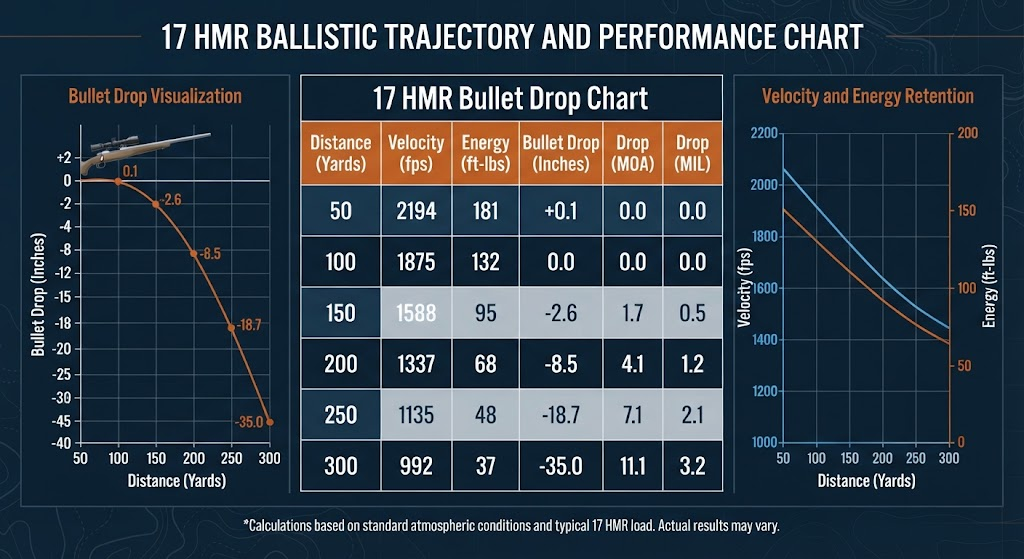
Understanding The 17 HMR Bullet Drop Chart
17 HMR Bullet Drop At 50 Yards
At 50 yards, the lightweight 17-grain projectile sits approximately 0.1 inches above your line of sight when utilizing a 100-yard zero. It travels at a blisteringly fast 2194 fps and carries 181 foot-pounds of energy. Because the .17 HMR shoots so incredibly flat, there is practically no need to adjust your aim for any targets between the muzzle and 100 yards.
17 HMR Bullet Drop At 100 Yards
When the bullet reaches 100 yards, it intersects your optic’s line of sight perfectly, resulting in zero bullet drop. The velocity has slowed to 1875 fps, and the kinetic energy sits at 132 foot-pounds. This is the gold standard zeroing distance for the .17 HMR, providing a highly predictable baseline for small game hunting and precision target shooting.
17 HMR Bullet Drop At 150 Yards
At 150 yards, the trajectory requires a minor holdover as the bullet drops 2.6 inches. You will need to make an elevation correction of 1.7 MOA or 0.5 MIL. Velocity slows to 1588 fps, and energy drops slightly below 100 foot-pounds. The cartridge remains highly lethal on small varmints like prairie dogs and ground squirrels at this range, but wind reading becomes critical.
17 HMR Bullet Drop At 200 Yards
Crossing into 200 yards, the tiny 17-grain bullet drops 8.5 inches below the center line. A shooter must compensate by dialing 4.1 MOA or 1.2 MIL. The energy drops to just 68 foot-pounds. Due to the very low ballistic coefficient of the 17-grain bullet, a mild 5 mph crosswind will push the projectile several inches horizontally at this distance.
17 HMR Bullet Drop At 250 Yards
At 250 yards, the 17 HMR bullet experiences a steep drop of 18.7 inches. You will need a precise elevation adjustment of 7.1 MOA or 2.1 MIL. The velocity drops to 1135 fps, nearing the transonic zone. Hunting at this distance is largely discouraged, as the 48 foot-pounds of remaining energy is often insufficient for a clean harvest.
17 HMR Bullet Drop At 300 Yards
Reaching 300 yards pushes the .17 HMR far beyond its intended design. The bullet plunges 35.0 inches, requiring a turret adjustment of 11.1 MOA or 3.2 MIL. Velocity falls below the speed of sound to 992 fps, which can cause aerodynamic instability. While hitting steel targets is possible with excellent marksmanship and calm weather, it is not an effective distance for varmint control.
Frequently Asked Questions
What factors change my 17 HMR bullet drop chart?
Your specific bullet drop will shift based on your exact ammunition and barrel length. A rifle with a 16-inch barrel will produce a lower muzzle velocity than a standard 24-inch barrel, resulting in more bullet drop at every distance. Environmental factors like high altitude and warm temperatures reduce air density, which helps this lightweight rimfire bullet fly slightly flatter than it would at sea level.
How does .17 HMR bullet drop compare to .22 LR?
The .17 HMR completely outclasses the standard .22 Long Rifle in terms of trajectory. Because the .17 HMR leaves the muzzle at roughly 2550 fps compared to the .22 LR at 1200 fps, it flies dramatically flatter. At 100 yards, a standard .22 LR drops nearly 6 inches, while a properly zeroed .17 HMR experiences zero drop. This allows hunters to easily take shots out to 150 yards without complex holdovers.
What is the best zero distance for a 17 HMR rifle?
A 100-yard zero is the standard and most highly recommended zero for a .17 HMR rifle. The high velocity of the cartridge keeps the bullet’s flight path within an inch of the line of sight all the way from the muzzle out to 125 yards. This creates an exceptional point blank range for small game hunting.
Why does wind affect the 17 HMR so drastically?
The .17 HMR utilizes an incredibly light 17-grain or 20-grain bullet with a very low ballistic coefficient. While its high initial speed helps it cheat the wind at closer ranges, it loses velocity quickly. Once the bullet slows down past 100 yards, crosswinds can easily push the lightweight projectile horizontally, making 200-yard shots in windy conditions extremely difficult.