The .17 Hornady Magnum Rimfire (.17 HMR) completely revolutionized the rimfire world when it hit the market in 2002. By necking down a .22 WMR (Magnum) case to accept a lightweight, highly aerodynamic .17 caliber bullet, Hornady created a hyper-velocity, flat-shooting cartridge. It effectively extended the ethical, accurate range of rimfire varmint hunting well past 150 yards.
Shortly after, Hornady introduced its little brother, the .17 Hornady Mach 2 (.17 HM2), which applied the same concept to a standard .22 LR case.
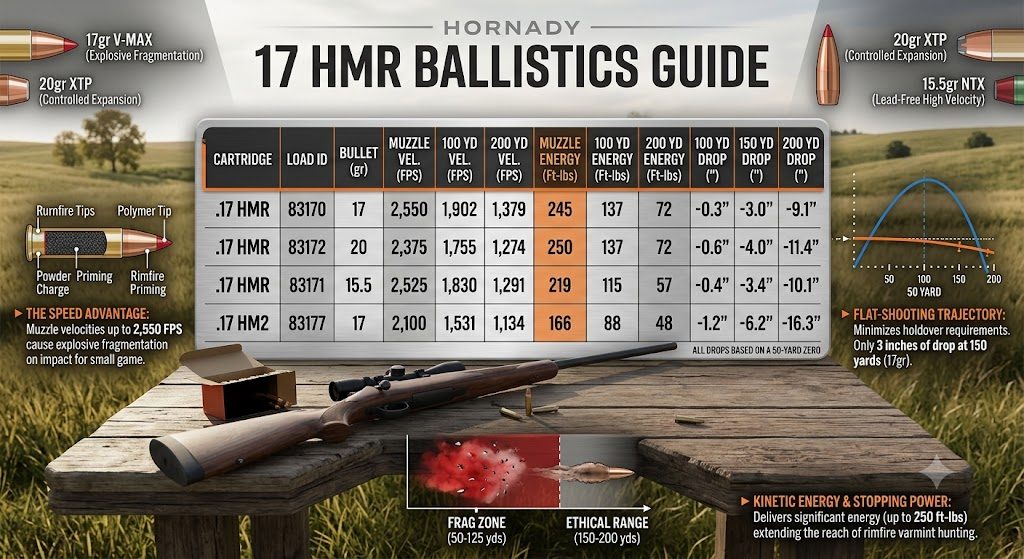
Below is a breakdown of the ballistic data for Hornady’s .17 caliber rimfire lineup, followed by an explanation of what these numbers mean for you in the field.
Hornady .17 Caliber Ballistics Profile
Velocity & Energy
Note: All loads are measured with muzzle velocity, and energy is listed in foot-pounds (ft-lbs).
| Cartridge | Load ID | Bullet (gr) | Muzzle Vel. | 100 Yds Vel. | 200 Yds Vel. | Muzzle Eng. | 100 Yds Eng. | 200 Yds Eng. |
| .17 HMR | 83170 | 17 | 2,550 fps | 1,902 fps | 1,379 fps | 245 ft-lbs | 137 ft-lbs | 72 ft-lbs |
| .17 HMR | 83172 | 20 | 2,375 fps | 1,755 fps | 1,274 fps | 250 ft-lbs | 137 ft-lbs | 72 ft-lbs |
| .17 HMR | 83171 | 15.5 | 2,525 fps | 1,830 fps | 1,291 fps | 219 ft-lbs | 115 ft-lbs | 57 ft-lbs |
| .17 HM2 | 83177 | 17 | 2,100 fps | 1,531 fps | 1,134 fps | 166 ft-lbs | 88 ft-lbs | 48 ft-lbs |
| .17 HM2 | 83176 | 15.5 | 2,050 fps | 1,450 fps | 1,070 fps | 145 ft-lbs | 72 ft-lbs | 39 ft-lbs |
Trajectory (Bullet Drop)
Note: Bullet drop is measured in inches, assuming a 50-yard zero.
| Cartridge | Load ID | Bullet (gr) | 50 Yds | 75 Yds | 100 Yds | 150 Yds | 200 Yds |
| .17 HMR | 83170 | 17 | 0.0″ | +0.1″ | -0.3″ | -3.0″ | -9.1″ |
| .17 HMR | 83172 | 20 | 0.0″ | 0.0″ | -0.6″ | -4.0″ | -11.4″ |
| .17 HMR | 83171 | 15.5 | 0.0″ | +0.1″ | -0.4″ | -3.4″ | -10.1″ |
| .17 HM2 | 83177 | 17 | 0.0″ | -0.2″ | -1.2″ | -6.2″ | -16.3″ |
| .17 HM2 | 83176 | 15.5 | 0.0″ | -0.3″ | -1.4″ | -7.1″ | -18.5″ |
Understanding the Numbers
If you are transitioning from a standard .22 LR to a .17 HMR, the ballistic charts above tell a story of massive performance upgrades across three main categories:
1. The Speed Advantage
The defining characteristic of the .17 HMR is velocity. Pushing a 17-grain bullet at 2,550 feet per second out of the muzzle makes it roughly twice as fast as a standard-velocity .22 LR. This extreme speed is what causes the polymer-tipped bullets (like the V-MAX) to expand explosively on impact. However, notice how the lightweight 15.5-grain bullet sheds speed slightly faster than the 17-grain option over distance due to having a lower Ballistic Coefficient (BC).
2. Kinetic Energy and Stopping Power
Despite firing a tiny projectile, the high velocity translates to serious kinetic energy. The 20-grain .17 HMR load generates 250 ft-lbs of energy at the muzzle. For small game and varmint hunting, energy is what dictates a humane, ethical kill.
Looking at the 200-yard mark, the energy of the .17 HMR drops to around 72 ft-lbs. This is why most hunters consider 150 to 200 yards to be the maximum ethical limit for the .17 HMR on small game; past that, the bullet lacks the energy required to guarantee explosive expansion.
3. Flat-Shooting Trajectory
This is where the .17 HMR truly shines. If you zero a 17-grain .17 HMR rifle at 50 yards, the bullet only rises a tenth of an inch at 75 yards, drops just a third of an inch at 100 yards, and drops only 3 inches at 150 yards.
For a hunter, this means “point and shoot” reliability. Unlike a .22 LR, where you have to calculate heavy holdovers for anything past 75 yards, the .17 HMR allows you to place your crosshairs directly on a prairie dog or squirrel out to 125 yards without worrying about bullet arc.
Choosing Your Bullet Weight
- 17-grain (Load 83170): The gold standard. It offers the best balance of flat trajectory, high velocity, and explosive terminal performance.
- 20-grain (Load 83172): Best for slightly larger varmints (like coyotes at close range) where you need deeper penetration and less surface fragmentation. Notice it has a heavier drop at 200 yards (-11.4″).
- 15.5-grain (Load 83171): Often loaded as a lead-free option (NTX) for areas with environmental hunting restrictions.