The main difference between a 12 gauge slug and 12 gauge buckshot is that a slug fires one large, single solid projectile, while buckshot fires multiple spherical metallic pellets simultaneously in a spreading pattern. Both are devastatingly effective shotgun rounds, but they behave completely differently in terms of ballistics, range, penetration, and energy transfer. A slug essentially turns a shotgun into a heavy-caliber rifle suitable for taking down large game at extended distances, while buckshot provides a wall of flying lead that increases hit probability on moving targets at close range. Understanding the actual ballistic performance – tested through chronographs and ballistic gelatin – is vital for hunters, law enforcement, and homeowners when deciding which shell to chamber.
12 Gauge Slug vs Buckshot Comparison
| Feature | 12 Gauge Slug | 12 Gauge Buckshot |
| Projectile Type | Single solid projectile | Multiple spherical pellets |
| Projectile Count | 1 | 8 to 27+ (varies by size) |
| Typical Projectile Weight | 300 to 492 grains (3/4 oz to 1 1/8 oz) | 486 to 540 grains total (1 1/8 oz to 1 1/4 oz) |
| Muzzle Velocity | 1,350 to 2,000 FPS | 1,100 to 1,325 FPS |
| Muzzle Energy | 2,400 to 3,000+ ft-lbs | 1,600 to 2,000 ft-lbs (total combined) |
| Total Projectile Energy | Massive single-point energy transfer | Energy divided across multiple impact points |
| Pellet Count | N/A | Varies (e.g., 9 for 00 Buck, 27 for #4 Buck) |
| Pellet Diameter | 0.729 inches (bore diameter or sabot) | 0.24 inches (#4 Buck) to 0.36 inches (000 Buck) |
| Recoil | Heavy (depending on load) | Moderate to heavy (reduced-recoil available) |
| Pattern Spread | None (single point of impact) | Expands over distance (choke dependent) |
| Penetration | Deep (17 to 20+ inches in gelatin) | Moderate (14 to 19 inches in gelatin) |
| Effective Range | 75 to 100 yds (smoothbore), 200 yds (rifled) | 30 to 50 yards (ammunition dependent) |
| Trajectory | Flat out to 100+ yards | Rapid drop and energy loss past 50 yards |
| Best Use | Big game hunting, barrier penetration | Close-range defense, brush hunting |
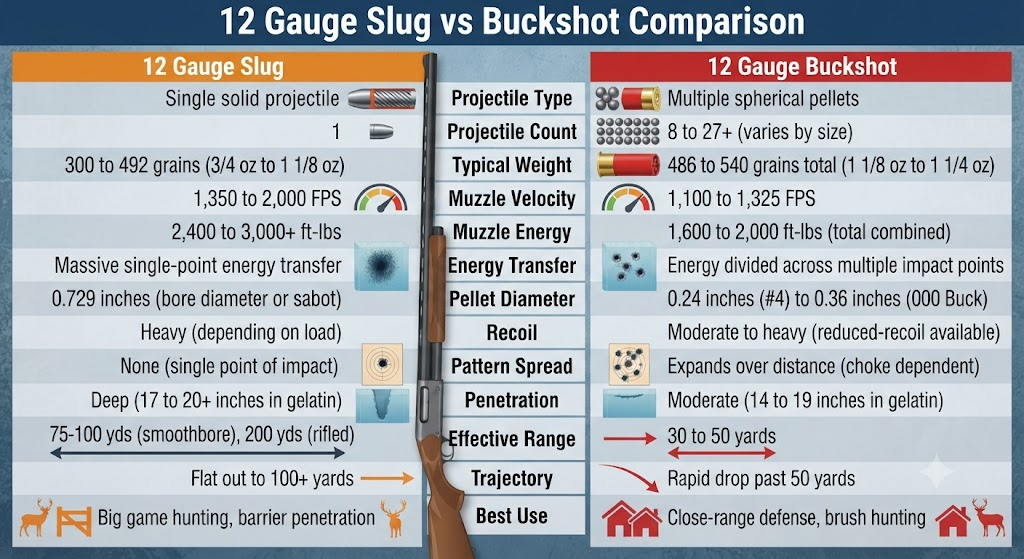
The table above illustrates the foundational differences between slugs and buckshot. A shotgun is arguably the most versatile firearm in the world specifically because it can cycle between these drastically different ammunition profiles in seconds.
To make an educated decision, however, we must look past basic overviews and dive into specific, independently measured data from manufacturers and ballistic labs.
Slug vs Buckshot Types
Before comparing performance, it is crucial to understand that not all slugs and not all buckshot shells are identical. Both categories contain specialized designs tailored to completely different firearms and operational environments.
For 12 gauge slugs, the three most common variations are:
- Foster Slugs: Sometimes called “rifled slugs,” these are solid lead projectiles with a hollow base that pushes weight to the front, helping them fly straight like a shuttlecock. The exterior features small grooves or “rifling,” which do not actually spin the slug, but rather allow the lead to safely compress if fired through a tight choke. They are designed exclusively for smoothbore barrels.
- Brenneke-Style Slugs: Invented by Wilhelm Brenneke, these slugs are solid lead but feature an attached wad at the rear that remains connected during flight. This gives them exceptional stability and massive penetration power. Like Foster slugs, they are designed for smoothbore shotguns.
- Sabot Slugs: Designed strictly for fully rifled shotgun barrels, a sabot (French for “shoe”) slug is a smaller-caliber aerodynamic projectile (often copper or polymer-tipped) encased in a plastic sleeve. The sleeve engages the barrel’s rifling to impart a spin, then falls away after leaving the muzzle. Sabot slugs boast the highest velocities and best long-range accuracy.
For 12 gauge buckshot, pellet sizes determine the payload and application:
- #4 Buck: Contains approximately 21 to 27 pellets, each measuring roughly 0.24 inches in diameter and weighing about 20 grains. It provides a massive spread of lead, making it highly effective for varmints and close-quarters defense with slightly lower risk of over-penetration.
- 00 Buck (“Double-Aught”): The absolute standard for law enforcement and deer hunting. A standard 2 3/4-inch shell holds 8 to 9 pellets, each measuring 0.33 inches in diameter and weighing around 54 grains.
- 000 Buck (“Triple-Aught”): Contains fewer, but larger pellets. Typically holding 8 pellets measuring 0.36 inches in diameter and weighing roughly 70 grains each, offering deeper penetration than 00 buck.
12 Gauge Slug vs Buckshot Ballistics
When analyzing shotgun ballistics, standard physics apply, but the calculations diverge rapidly once the projectiles leave the barrel.
A 12 gauge slug is ballistically straightforward: you are launching a massive piece of lead or copper that maintains a single, cohesive flight path. Its ballistic coefficient (a measure of aerodynamic efficiency) is generally poor compared to rifle bullets, but its sheer mass compensates for this flaw at moderate ranges.
Buckshot ballistics are much more chaotic. Upon leaving the muzzle, the payload separates into multiple independent projectiles. As these round pellets fly through the air, they battle significant aerodynamic drag. Because round balls are aerodynamically inefficient, buckshot rapidly sheds velocity and kinetic energy. Furthermore, the pellets interact with one another and the air, causing the pattern to widen the further it travels.
12 Gauge Slug vs Buckshot Velocity
Velocity is a critical factor for both loads, dictating both effective range and terminal performance upon impact.
Slugs are pushed to remarkable speeds considering their size.
- A standard Foster slug, such as the Federal Premium TruBall (1 oz / 438 grain payload), is rated at a muzzle velocity of 1,600 feet per second (FPS) from a standard test barrel.
- Heavier smoothbore options, like the 1 1/8 oz (492 grain) Brenneke Classic Magnum, are pushed slightly slower at 1,510 FPS.
- Modern Sabot slugs designed for rifled barrels, such as the Hornady SST 300-grain FTX, can reach blistering speeds of 2,000 FPS.
Buckshot generally travels at lower velocities due to the mechanics of pushing a stacked column of lead pellets out of the hull without deforming them into useless shapes before they even leave the barrel.
- A standard full-power hunting load like the Winchester Super-X 12 Gauge 00 Buck (9 pellets) leaves the muzzle at roughly 1,325 FPS.
- Tactical or “Reduced Recoil” buckshot loads – highly popular for home defense because they allow for faster follow-up shots – typically leave an 18.5-inch barrel between 1,100 and 1,150 FPS.
- Certain magnum 3-inch shells push buckshot faster (up to 1,450 FPS), but at the cost of immense, punishing recoil.
12 Gauge Slug vs Buckshot Energy
Muzzle energy is where the comparison requires careful context. We must distinguish between muzzle energy, single projectile energy, and total load energy.
Let’s look at the math. Kinetic energy is calculated using velocity and projectile weight.
A Federal TruBall 1 oz (438 grain) Foster slug at 1,600 FPS generates an incredible 2,487 foot-pounds (ft-lbs) of muzzle energy. The Hornady 300-grain Sabot slug at 2,000 FPS generates 2,664 ft-lbs of energy.
By comparison, a single pellet of Winchester Super-X 00 Buck (approx. 54 grains) traveling at 1,325 FPS generates roughly 210 ft-lbs of energy.
However, there are 9 pellets in that shell. If you multiply 210 ft-lbs by 9 pellets, the total muzzle energy of the buckshot payload is roughly 1,890 ft-lbs.
It is vital to explain why total pellet energy and energy concentrated in a single projectile are fundamentally different concepts in terminal ballistics. If a buckshot load hits a target, that 1,890 ft-lbs is distributed across nine separate wound tracks over a wider surface area. A slug takes 2,400+ ft-lbs of energy and drives it into a single, concentrated 0.729-inch point of impact, resulting in significantly deeper penetration, severe hydrostatic shock, and devastating tissue disruption that multiple smaller pellets cannot replicate.
12 Gauge Slug vs Buckshot Pellet Count
Pellet count is entirely a buckshot metric, as slugs feature a count of one.
Understanding pellet count is essential for understanding your hit probability and pattern density.
- 00 Buckshot (2 3/4-inch shell): Generally contains 8 or 9 pellets.
- 00 Buckshot (3-inch magnum shell): Can contain 12 to 15 pellets.
- #4 Buckshot (2 3/4-inch shell): Usually contains 21 to 27 pellets.
When you fire a 9-pellet 00 buck shell, you are effectively firing nine .32 caliber pistol bullets simultaneously. The advantage of a higher pellet count (like #4 buckshot’s 27 pellets) is a much denser pattern. If you are shooting at a fast-moving coyote weaving through brush at 25 yards, a 27-pellet spread provides a far greater chance of a vital hit than a single slug or a sparse 9-pellet spread.
12 Gauge Slug vs Buckshot Pattern
Because a slug is a single projectile, it does not pattern; it groups. With a quality rifled barrel and sabot slugs, modern shooters can achieve sub-2-inch groups at 100 yards, rivaling some centerfire rifles.
Buckshot patterning is arguably the most complex dynamic in shotgun ballistics. A pattern is the spread of the pellets as they fly downrange. Do not claim a universal pattern diameter for any buckshot load, because pattern size varies significantly between different firearms, barrel lengths, choke tubes, and specific ammunition brands.
Historically, the rule of thumb was that a buckshot pattern spread one inch for every yard traveled (e.g., a 10-inch spread at 10 yards). However, modern ammunition design has completely changed this.
Ammunition featuring specialized buffering (tiny plastic beads packed between the lead pellets) prevents the lead spheres from flattening out under the extreme pressure of firing. Perfectly round pellets fly truer. Furthermore, advanced wads like the Federal Premium FliteControl system utilize a rear-braking cup that holds the pellets tightly together for several yards after leaving the muzzle before peeling away.
Independent law enforcement tests often show standard, unbuffered 00 buckshot spreading 6×7 inches at 10 yards. Conversely, Federal FliteControl 00 Buckshot has been known to punch one ragged, fist-sized hole at 10 yards and maintain a spread of just 8 to 12 inches at 25 yards.
Because of this variance, every shooter must pattern their chosen buckshot through their specific shotgun and choke combination to know exactly where those pellets are going at given distances.
12 Gauge Slug vs Buckshot Penetration
Penetration data from reputable ballistic gelatin tests (calibrated 10% ordnance gel, the FBI standard) provides a clear look at terminal performance.
- Buckshot Penetration: Pellet size and velocity dictate depth. In standard law enforcement testing, #4 buckshot generally penetrates around 14 inches into bare gelatin. #1 buckshot penetrates roughly 15 to 16 inches. Standard 00 buckshot reliably penetrates 18 to 19 inches. This falls squarely within the FBI’s recommended 12-to-18-inch penetration standard for personal defense, ensuring the pellets reach vital organs without excessive risk of exiting the target.
- Slug Penetration: A 12 gauge slug is a massive penetrator. Standard 1-ounce Foster slugs average 17 to 20+ inches in gelatin, often breaking off heavy shards of lead in the wound channel. Specialized hardened slugs, like the Brenneke Classic Magnum, are specifically designed to punch straight through thick hide, heavy bone, and dense muscle. They can penetrate 30+ inches in organic tissue, making them suitable for dangerous game like bears, but highly prone to over-penetration in urban or residential settings.
Do not make universal penetration claims from a single test, as barriers like heavy clothing, drywall, or auto glass significantly alter projectile behavior. However, it is an absolute certainty that a 438-grain slug will defeat intermediate barriers and penetrate much deeper than a 54-grain 00 buck pellet.
12 Gauge Slug vs Buckshot Trajectory
A trajectory measures how a projectile drops over distance due to gravity.
Because buckshot is composed of aerodynamically poor spheres, it loses velocity rapidly. At 10 and 25 yards, the trajectory of buckshot is essentially a straight line. By 50 yards, however, the pellets are bleeding velocity so heavily that they begin to drop, and more importantly, they lose the kinetic energy required to ethically harvest game.
Slugs generally retain velocity and energy much better at distance.
- At 50 yards: A Foster slug like the Federal TruBall drops less than 2 inches from a 50-yard zero, maintaining over 1,300 ft-lbs of energy.
- At 100 yards: A Foster slug will drop 4 to 6 inches, which is still highly manageable for deer hunting.
- At 150-200 yards: Sabot slugs shine here. The Hornady SST Sabot slug, zeroed at 150 yards, only drops about 6.7 inches at 200 yards, retaining roughly 1,200 ft-lbs of energy – more than enough to ethically harvest a deer.
12 Gauge Slug vs Buckshot Effective Range
Effective range is defined not just by how far the bullet will travel, but how far it will travel while maintaining the accuracy and energy required to perform its job.
Buckshot Effective Range:
- 10 to 25 yards: The undisputed sweet spot for buckshot. Patterns are tight, energy is immense, and stopping power is absolute.
- 30 to 40 yards: The practical maximum range for hunting medium game with standard buckshot.
- 50 yards: Pushing the absolute limit. At this range, pattern spread often results in pellets completely missing the target, and individual pellet energy drops off steeply.
Slug Effective Range:
- 50 to 75 yards: Standard range for basic Foster slugs fired through a simple front-bead smoothbore shotgun.
- 100 yards: Easily achievable with quality Foster or Brenneke slugs out of a smoothbore barrel equipped with ghost ring sights or a red dot.
- 150 to 200 yards: The effective hunting range of Sabot slugs fired through a fully rifled barrel mated with a magnified optic.
12 Gauge Slug vs Buckshot Recoil
Recoil – or the physical “kick” of the firearm – changes dramatically with projectile weight, powder charge, shotgun weight, and load type.
According to basic Newtonian physics, heavy payloads pushed at high velocities generate heavy recoil.
- A high-velocity 1 1/8 oz Brenneke slug or a 3-inch magnum Sabot slug produces incredibly stout recoil, sometimes exceeding 35 foot-pounds of felt recoil (comparable to a heavy African safari rifle). This can induce flinching and slow down follow-up shots.
- Standard 2 3/4-inch 00 buckshot produces moderate to heavy recoil, usually sitting around 25 foot-pounds of felt recoil in an average pump-action shotgun.
- Low-recoil (tactical) buckshot and low-recoil slugs drop the velocity down to the 1,100 FPS range. This significantly softens the recoil impulse, cutting felt recoil by up to 30%.
While neither load is inherently “light” on the shoulder, do not claim one ammunition type always has less recoil, as a 3-inch magnum buckshot shell will kick noticeably harder than a reduced-recoil 2 3/4-inch slug.
12 Gauge Slug vs Buckshot Hunting
Shotguns are incredibly popular for hunting, especially in jurisdictions where high-powered centerfire rifles are prohibited due to population density (so-called “slug-only” states).
- Deer: Slugs are the gold standard for deer hunting in shotgun zones. Their ability to deliver over 1,500 ft-lbs of energy at 100 yards ensures an ethical, clean harvest. Buckshot is also used for deer, particularly in dense southern brush where visibility is limited to 30 yards and targets may be moving. However, legality varies by jurisdiction, and many states strictly prohibit buckshot for deer hunting to prevent non-lethal wounding. Always verify local regulations.
- Wild Hogs: Hogs are tough, thick-skinned animals. Slugs (especially Brenneke-style) are heavily favored because they can shatter the dense cartilage shield on a mature boar’s shoulder. 00 and 000 buckshot are popular for hunting hogs in thick swamps at close range, particularly when dealing with moving groups (sounders).
- Small Game/Predators: Slugs are massive overkill for small game. #4 buckshot is highly favored for coyotes and foxes, providing a dense pattern that easily drops fast-moving predators out to 40 yards without destroying the pelt entirely.
12 Gauge Slug vs Buckshot for Home Defense
When it comes to home defense, the criteria shift from long-range ballistics to close-range stopping power, pattern consistency, and over-penetration risk.
Buckshot for Home Defense:
00 buckshot, specifically in reduced-recoil loadings, is widely considered the premier home defense shotgun load. At typical indoor distances (3 to 10 yards), the pattern remains tight – usually spreading no more than a few inches. This provides a devastating, simultaneous multi-point impact that stops threats immediately. Furthermore, while 00 buckshot will easily penetrate drywall, it generally sheds energy faster than a slug when encountering structural barriers. Some experts prefer #4 buckshot for residential defense, as its 27 lighter pellets still meet penetration minimums but are significantly less likely to punch through multiple exterior walls and endanger neighbors.
Clearly explain that buckshot patterning must be tested with the specific firearm and ammunition combination. A load that patterns 5 inches at 10 yards in one gun might pattern 12 inches in another.
Slugs for Home Defense:
Slugs offer absolute, undeniable stopping power. However, they are highly prone to severe over-penetration. A 1-ounce piece of solid lead traveling 1,600 FPS will pass through a human target, exit, and easily defeat multiple residential walls. Law enforcement officers often carry slugs for specific scenarios – such as engaging a threat wearing soft body armor, or stopping a suspect inside a vehicle, because a slug easily defeats auto glass and car doors. For the average homeowner, however, a slug often presents an unacceptable liability risk in populated neighborhoods.
Neither ammunition guarantees an immediate physical stop. Shot placement remains the most critical factor in any defensive scenario.
Which Has More Stopping Power: Slug or Buckshot?
Stopping power is a subjective term, but in terminal ballistics, it refers to the ability to immediately cease a threat’s forward action.
At close range (under 15 yards), buckshot and slugs offer virtually identical, devastating stopping power. A 00 buckshot payload delivering nine .33-caliber pellets into a 5-inch circle creates massive trauma and multiple wound channels that cause rapid blood pressure loss.
However, as distance increases, the slug wins unequivocally. By 50 yards, buckshot patterns widen, meaning fewer pellets strike the target, and those that do have lost significant energy. A slug retains a massive amount of kinetic energy and delivers it all into a deep, central wound channel regardless of whether the target is at 10 yards or 100 yards.
Pros and Cons
12 Gauge Slugs
Pros:
- Maximum effective range (up to 200 yards with sabots).
- Pinpoint accuracy with rifled barrels.
- Massive single-point kinetic energy transfer.
- Exceptional penetration for large, thick-skinned game.
- Defeats intermediate barriers (auto glass, heavy doors) reliably.
Cons:
- Severe risk of over-penetration in home defense scenarios.
- Requires precise aiming; no pattern spread to compensate for movement.
- Sabot slugs are significantly more expensive than standard buckshot.
- Heavy recoil in full-power loads.
12 Gauge Buckshot
Pros:
- Multiple projectiles increase hit probability on moving targets.
- Devastating terminal performance at close range (under 25 yards).
- Slightly reduced risk of extreme over-penetration compared to slugs.
- Cost-effective and highly available.
- Vast array of specialized loads (reduced recoil, flight-control wads, varying pellet sizes).
Cons:
- Useless at long distances (past 50 yards).
- Unpredictable patterning requires individual firearm testing.
- Energy divided among pellets; poor performance on heavy bone/thick hide at distance.
- Not legal for deer hunting in all jurisdictions.
12 Gauge Slug vs Buckshot: Final Comparison
| Category | Winner | Reason |
| Muzzle Energy | 12 Gauge Slug | A 1oz slug easily surpasses 2,400 ft-lbs; total buckshot payload usually maxes out around 1,900 ft-lbs. |
| Projectile Weight | Depends on Load | A 9-pellet 00 buck load (486 gr) and a Brenneke Magnum slug (492 gr) weigh essentially the same. |
| Velocity | 12 Gauge Slug | Sabot and Foster slugs safely reach 1,600 – 2,000 FPS; buckshot is typically limited to 1,350 FPS to avoid pellet deformation. |
| Penetration | 12 Gauge Slug | A solid 438+ grain projectile carries more momentum through dense tissue and bone than a 54-grain pellet. |
| Patterning | 12 Gauge Buckshot | Slugs do not pattern; buckshot allows for a spread of projectiles to cover a larger area. |
| Effective Range | 12 Gauge Slug | Slugs are viable at 100-200 yards; buckshot drops off exponentially past 40 yards. |
| Recoil | Depends on Load | Low-recoil versions exist for both, while magnum loads for both will produce heavy, punishing recoil. |
| Hunting | Depends on Load | Slugs are superior for deer/bear; buckshot is superior for moving coyotes or brush-country hogs. |
| Home Defense | 12 Gauge Buckshot | 00 or #4 buckshot delivers extreme close-range trauma with significantly less over-penetration risk than a slug. |
| Long-Range Performance | 12 Gauge Slug | Sabot slugs fired from rifled barrels mimic centerfire rifle ballistics out to 200 yards. |
| Overall Versatility | 12 Gauge Buckshot | Between #4, 00, and 000, buckshot can be tailored for everything from small predators to tactical home defense. |
12 Gauge Slug vs Buckshot: Which Should You Choose?
The decision between a 12 gauge slug and 12 gauge buckshot entirely dictates the capability of your shotgun.
If you demand longer-range performance, the slug is the absolute winner. A modern sabot slug out of a rifled barrel allows you to confidently take deer at 150 to 200 yards. Even with a smoothbore, a Foster slug pushes your effective range to 100 yards, providing maximum single-projectile energy and deep penetration necessary for large game like deer and heavy wild hogs.
If your focus is close-range applications, home defense, or engaging fast-moving targets in thick brush, buckshot is generally better. The multiple-projectile coverage of 00 or #4 buckshot drastically increases your hit probability in stressful, high-speed situations. For home defense, reduced-recoil 00 buckshot is arguably the finest choice available, offering staggering close-quarters stopping power while keeping the risk of neighborhood over-penetration lower than that of a slug.
Ultimately, pattern consistency is the realm of buckshot (if properly tested in your gun), while raw range and penetration belong to the slug. Assess your environment, verify your local hunting laws, and choose the shell that matches your specific target distance.
FAQs
Is a 12 gauge slug more powerful than buckshot?
Yes, in terms of sheer muzzle energy. A standard 1 oz slug can generate over 2,400 ft-lbs of energy, whereas the combined energy of a standard 00 buckshot payload is usually around 1,800 to 1,900 ft-lbs. Furthermore, the slug focuses all that power into a single point.
Which has more stopping power, slug or buckshot?
At close range (inside 15 yards), both offer immediate and devastating stopping power. However, past 25 yards, the slug has significantly more stopping power because buckshot loses velocity rapidly and the pellets spread out, reducing the energy transferred to the target.
Does buckshot have more energy than a slug?
No. Even when you calculate the total combined energy of all pellets in a buckshot shell, a high-velocity 12 gauge slug generally produces more total kinetic energy at the muzzle and retains far more energy downrange.
How far is a 12 gauge slug effective?
A Foster or Brenneke slug fired from a smoothbore barrel is highly effective out to 75-100 yards. A Sabot slug fired from a fully rifled barrel can be effective out to 150-200 yards.
How far is 00 buckshot effective?
Standard 00 buckshot is generally effective out to 30 to 40 yards for hunting purposes, and up to 50 yards maximum, depending heavily on the choke and the specific ammunition’s wad technology.
Which penetrates deeper?
A slug penetrates significantly deeper than buckshot. In ballistic gelatin, 00 buckshot usually stops between 18 and 19 inches, whereas a solid slug can penetrate 20 to 30+ inches, easily passing through standard barriers.
Which has more recoil?
Recoil depends on the specific load weight and velocity. However, full-power 1 1/8 oz magnum slugs generally produce more felt recoil than standard 2 3/4-inch buckshot loads. Reduced-recoil variants of both are available.
Which is better for deer hunting?
Slugs are vastly superior for deer hunting at typical woodland ranges (50 to 150 yards) and are legally required in many states. Buckshot is only suitable for deer at very close ranges (under 30 yards) in heavy brush, and is illegal for deer in many jurisdictions.
Which is better for hog hunting?
For large, mature boars at a distance, a hard-cast slug is better due to its ability to break through the thick shoulder cartilage. For culling running sounders (groups of hogs) at close range in thick brush, 00 buckshot is often preferred.
What is the difference between 00 buckshot and a slug?
A slug is a single, heavy, solid piece of lead or copper that fires like a rifle bullet. 00 buckshot consists of multiple round lead pellets (typically 8 or 9) that spread out in a pattern after leaving the muzzle.
How many pellets are in 00 buckshot?
A standard 2 3/4-inch 12 gauge 00 buckshot shell contains 8 or 9 pellets. A 3-inch magnum shell can contain 12 to 15 pellets.
How does buckshot pattern at 25 yards?
It varies completely by firearm, choke, and ammo. Standard unbuffered buckshot might spread 15 to 20 inches at 25 yards, while premium ammunition with FliteControl wads might hold a tight 8-to-12-inch pattern at the same distance.
Which has better accuracy?
Slugs have vastly better traditional accuracy, capable of shooting 2-inch groups at 100 yards with a rifled barrel. Buckshot is not “accurate” in the traditional sense; it covers an area with a spread of pellets.
Which is better for longer distances?
The slug is infinitely better for longer distances. Buckshot is virtually useless for self-defense or large game hunting past 50 yards due to extreme pattern spread and energy loss.
Which should you choose, slug or buckshot?
Choose a slug if you need range beyond 40 yards, barrier penetration, or are hunting medium/large game. Choose buckshot for home defense to limit extreme over-penetration, or for engaging fast-moving targets at close range.