The official Weatherby Ballistics Chart serves as a comprehensive reference guide that details the real-world performance of proprietary Weatherby Magnum rifle cartridges by tracking their velocity, energy, bullet drop, trajectory, ballistic coefficient, and sectional density across extended distances. Built from verified manufacturer ballistic data and standardized testing conditions, this chart allows hunters, precision reloaders, and long-range shooters to evaluate how different factory loads retain terminal performance from the muzzle out to 500 yards. By analyzing these multi-distance metrics, shooters can accurately project downrange trajectory variations, choose appropriate grain weights for specific big-game hunting applications, and understand how the iconic high-velocity engineering of Roy Weatherby translates into raw tissue-disrupting energy downrange.
Table of Contents [Click to open]
Weatherby Ballistics Chart
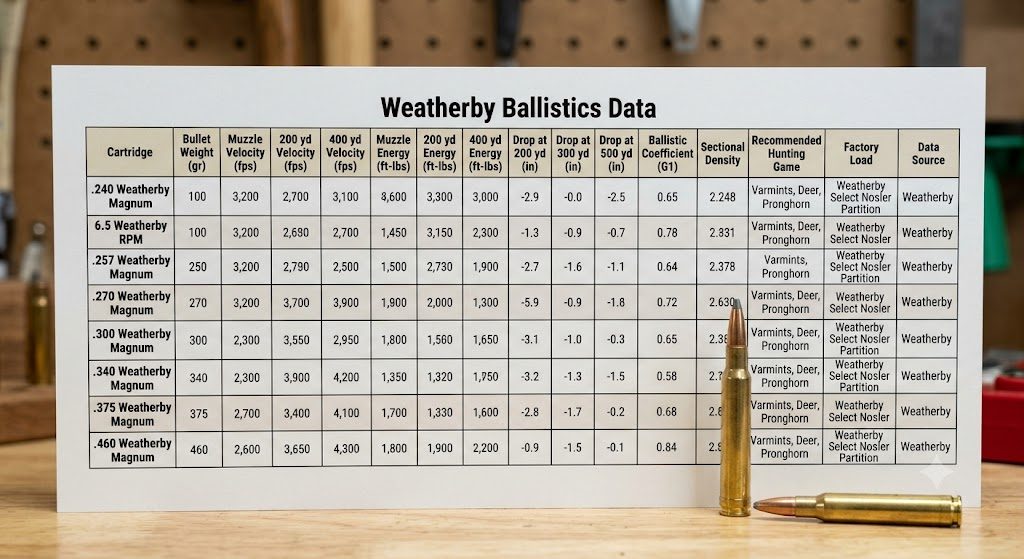
The following comprehensive ballistics table details the flight paths, energy retention, and specifications of the most popular Weatherby rifle cartridges. All values are derived from standardized factory ammunition ballistics based on a 100-yard zero under standard atmospheric conditions.
| Cartridge | Bullet Weight (gr) | Muzzle Velocity (fps) | 200 yd Velocity (fps) | 400 yd Velocity (fps) | Muzzle Energy (ft-lbs) | 200 yd Energy (ft-lbs) | 400 yd Energy (ft-lbs) | Drop at 200 yd (in) | Drop at 300 yd (in) | Drop at 500 yd (in) | Ballistic Coefficient (G1) | Sectional Density | Recommended Hunting Game | Factory Load | Data Source |
| .240 Weatherby Magnum | 100 | 3,200 | 2,740 | 2,330 | 2,273 | 1,667 | 1,205 | -2.9 | -10.8 | -38.5 | 0.382 | 0.242 | Varmints, Deer, Pronghorn | Weatherby Select Nosler Partition | Weatherby |
| 6.5 Weatherby RPM | 140 | 2,975 | 2,670 | 2,390 | 2,751 | 2,216 | 1,776 | -3.6 | -12.4 | -41.2 | 0.546 | 0.287 | Whitetail, Mule Deer, Elk | Weatherby Factory Hornady ELD-X | Weatherby |
| .257 Weatherby Magnum | 110 | 3,400 | 3,010 | 2,655 | 2,823 | 2,213 | 1,721 | -2.3 | -9.1 | -32.4 | 0.475 | 0.238 | Pronghorn, Deer, Sheep | Weatherby Select Hornady ELD-X | Weatherby |
| .270 Weatherby Magnum | 130 | 3,375 | 2,960 | 2,580 | 3,290 | 2,528 | 1,922 | -2.4 | -9.3 | -33.1 | 0.435 | 0.242 | Whitetail, Mule Deer, Caribou | Weatherby Select Nosler Partition | Weatherby |
| .300 Weatherby Magnum | 180 | 3,240 | 2,875 | 2,540 | 4,195 | 3,303 | 2,578 | -2.7 | -10.1 | -35.2 | 0.481 | 0.271 | Elk, Moose, Bear, African Game | Weatherby Select Nosler Partition | Weatherby |
| .340 Weatherby Magnum | 250 | 2,941 | 2,610 | 2,305 | 4,801 | 3,781 | 2,948 | -3.8 | -13.1 | -44.8 | 0.478 | 0.313 | Elk, Moose, Brown Bear | Weatherby Select Nosler Partition | Weatherby |
| .375 Weatherby Magnum | 300 | 2,800 | 2,395 | 2,030 | 5,224 | 3,821 | 2,745 | -4.4 | -15.6 | -55.2 | 0.380 | 0.305 | Dangerous Game, Cape Buffalo | Weatherby Select Nosler Partition | Weatherby |
| .460 Weatherby Magnum | 500 | 2,600 | 2,110 | 1,690 | 7,504 | 4,953 | 3,178 | -5.6 | -21.4 | -79.4 | 0.301 | 0.341 | Elephant, Rhino, Hippo | Weatherby Custom Round Nose | Weatherby |
Cartridge
The cartridge column names the specific metallic centerfire round evaluated in the dataset. Weatherby rifle cartridges are historically celebrated for their unique double-radius shoulders and enlarged case capacities designed to push bullets much faster than standard SAAMI alternatives. Knowing the exact cartridge is the foundational starting point because every chambering possesses a distinct physical design, bore diameter, and pressure threshold that dictates its entire performance spectrum.
Bullet Weight
Expressed in grains (gr), bullet weight directly impacts a cartridge’s velocity-to-energy ratio. Lighter bullets achieve blistering muzzle speeds but can bleed velocity faster if they feature lower ballistic profiles. Heavier bullets require more powder energy to push initially but carry exceptional inertia, resist crosswinds more efficiently, and penetrate deeply through heavy bone and thick muscle tissue on mature big game.
Muzzle Velocity
Measured in feet per second (fps), muzzle velocity represents the speed of the projectile the precise millisecond it exits the rifle barrel. High muzzle velocity is the definitive hallmark of Weatherby ammunition ballistics. Faster initial speeds translate into flatter flight paths over the first few hundred yards, minimizing the vertical margin of error for hunters who need to make rapid, ethical shots without adjusting their turrets.
Velocity at Distance
Velocity at distance reveals how efficiently a projectile sheds air resistance as it flies downrange. As a bullet travels away from the muzzle, atmospheric drag slows it down continuously. Analyzing downrange velocity at 200 and 400 yards tells a shooter whether a bullet will maintain high enough speeds to trigger proper hydraulic shock and reliable mechanical expansion upon striking a target at extended distances.
Muzzle Energy
Measured in foot-pounds (ft-lbs), muzzle energy quantifies the kinetic force generated by the bullet as it clears the muzzle. This metric is a calculated mathematical function combining bullet weight and the square of the velocity. High muzzle energy creates immense immediate hydrostatic shock, fracturing bone structures and creating vast temporary wound cavities that anchor big-game animals reliably.
Energy at Distance
Energy at distance tracks the remaining hard-hitting striking power a projectile retains along its flight path. Ethical hunting requires a projectile to deliver a minimum threshold of kinetic energy to ensure clean, humane kills—typically accepted as 1,000 ft-lbs for deer and 1,500 ft-lbs for elk. Checking these numbers ensures your chosen setup provides sufficient terminal punch at your maximum self-imposed shooting distance.
Bullet Drop
Bullet drop evaluates the physical descent of the projectile caused by gravity, measured in inches relative to a specific zero point. This Weatherby drop chart assumes a standard 100-yard zero, meaning the numbers show how many inches a shooter must hold over or dial at longer ranges. Cartridges with minimal drop drop less over long distances, making windage and elevation estimations significantly easier to manage in the field.
Ballistic Coefficient
The Ballistic Coefficient (BC) is a numerical rating of a bullet’s aerodynamic efficiency against air resistance. Higher BC values indicate a sleeker, more streamlined projectile shape that slices through the air with minimal friction. Bullets with high BCs retain velocity longer, drop less over extended distances, and display significantly less horizontal drift when pushed by unpredictable crosswinds.
Sectional Density
Sectional Density (SD) is the ratio of a bullet’s weight to its diameter squared. In ballistics analysis, SD is a premier predictor of structural penetration depth. A high sectional density means the bullet concentrates its weight over a relatively small frontal surface area, allowing it to drive deep through tough hides and dense muscle profiles instead of pancaking flat upon initial surface impact.
Recommended Hunting Game
This category translates technical raw ballistics into practical, real-world application guidelines. It outlines which animal classes a cartridge is engineered to humanely harvest based on its systemic terminal performance. Selecting the right pairing prevents over-destruction of usable meat on smaller varmints while ensuring deep, lethal destruction of vital organs on heavy, thick-skinned dangerous game.
Factory Load
The factory load column details the exact bullet brand, product line, and construction style utilized to achieve the stated performance metrics. Bullet styles like the bonded Nosler Partition or the aerodynamic Hornady ELD-X dramatically alter flight behavior and terminal expansion. Changing factory ammunition brands or bullet styles will change your real-world trajectory, requiring a re-verification of your rifle’s zero.
Data Source
The data source notes the origin of the empirical metrics used in the chart. Utilizing verified factory data ensures the statistics reflect realistic field performance out of standard sporting rifles rather than idealized, overly optimistic computer models. This transparency gives shooters an accurate baseline they can safely rely on when planning remote hunts or dialing in customized ballistics software.
Which Weatherby Cartridge Shoots the Flattest?
The .257 Weatherby Magnum holds the legendary crown as the flattest-shooting cartridge within the standard Weatherby lineup. Pushing a 110-grain Hornady ELD-X bullet at a blistering muzzle velocity of 3,400 fps, it suffers a drop of just 9.1 inches at 300 yards and only 32.4 inches out at 500 yards when utilizing a 100-yard zero.
This hyper-velocity performance creates an incredibly forgiving point-blank range, meaning a hunter can hold dead-center on a big-game animal’s vitals from the muzzle out to nearly 300 yards without calculating significant drop. The immense speed minimizes time-to-target, mitigating the effects of error in distance estimation.
Which Weatherby Cartridge Has the Most Energy?
The undisputed heavyweight champion of raw striking force is the massive .460 Weatherby Magnum. Engineered specifically to halt the world’s largest and most dangerous game, this cartridge launches an enormous 500-grain projectile at 2,600 fps, producing a staggering 7,504 ft-lbs of muzzle energy.
To put this Weatherby energy chart leader into perspective, the .460 Weatherby generates more muzzle energy than three standard .30-06 Springfield rounds fired simultaneously. Even at a distant 400 yards, it retains 3,178 ft-lbs of kinetic force—which is more energy than a .300 Win Mag produces at the muzzle—ensuring deep bone-crushing penetration against elephant, rhino, or charging cape buffalo hide.
Best Weatherby Cartridge for Deer Hunting
For pursuing whitetail and mule deer across open country, the .257 Weatherby Magnum or the modern 6.5 Weatherby RPM (Rebated Precision Magnum) represent optimal choices. The .257 offers unmatched speed and instantaneous hydrostatic shock, dropping deer in their tracks across vast beanfields or Western canyons.
If you prefer higher aerodynamic efficiency and modern high-BC bullet designs, the 6.5 Weatherby RPM delivers superb downrange performance with less barrel wear. Both options generate incredibly flat trajectories while keeping shoulder recoil entirely manageable, allowing hunters to maintain a clear sight picture through their optics upon breaking the shot.
Best Weatherby Cartridge for Elk Hunting
The iconic .300 Weatherby Magnum is widely considered the ultimate elk cartridge for North American hunters. Elk are tough, muscular animals with thick skeletal structures, often requiring shots across wide, wind-swept valleys. The .300 Weatherby pushes a heavy 180-grain projectile at 3,240 fps, packing 4,195 ft-lbs of muzzle energy.
This pairing yields a deadly combination of flat-shooting long-range ballistics and exceptional terminal energy retention, comfortably keeping over 2,500 ft-lbs of energy at 400 yards. It provides the heavy shock and deep penetration necessary to cleanly punch through an elk’s shoulder assembly from any ethical angle.
Best Weatherby Cartridge for Moose
When hunting massive, heavy-boned moose in thick willow bottoms or muskeg bogs, the hard-hitting .340 Weatherby Magnum excels. Launching a substantial 250-grain bullet at 2,941 fps with 4,801 ft-lbs of muzzle energy, it bridges the gap between fast .30-caliber magnums and slow-moving dangerous game cartridges.
Moose require massive tissue disruption and wide wound channels to anchor quickly, particularly in dense timber where tracking wounded game is treacherous. The .340 Weatherby offers an exceptionally high sectional density of 0.313, ensuring that even when striking heavy bone, the projectile drives straight into the vital cross-section of the animal’s chest cavity.
Best Weatherby Cartridge for Long-Range Shooting
For shooters looking to stretch their distances target shooting or hunting at extended ranges, the modern 6.5 Weatherby RPM or the classic .300 Weatherby Magnum equipped with modern high-BC projectiles are premier choices. The 6.5 RPM is specifically optimized for slick, heavy-for-caliber bullets that slip through crosswinds with minimal deflection while operating beautifully in lightweight mountain rifles.
For extreme long-range energy delivery, the .300 Weatherby Magnum remains an elite powerhouse. When paired with streamlined factory ammunition ballistics like modern polymer-tipped match or hunting bullets, its high initial velocity delays the transition to subsonic speeds, maintaining stable, predictable flight paths past the 1,000-yard milestone.
Factors That Affect Weatherby Ballistics
- Barrel Length: Weatherby factory velocity specifications are established using standard 26-inch test barrels. Shortening your rifle’s barrel to 24 or 22 inches for handiness reduces muzzle velocity by roughly 25–50 fps per inch, altering downrange drop.
- Elevation and Atmospheric Pressure: Air is significantly thinner at high altitudes. Shooting in mountain environments reduces aerodynamic drag on the bullet, resulting in less drop, less wind drift, and higher retained energy compared to sea-level metrics.
- Ambient Temperature: Extreme cold slows gunpowder burning rates inside the cartridge casing, reducing muzzle velocity. Conversely, high summer heat spikes internal chamber pressures, slightly increasing speeds and shifting the point of impact.
- Zero Distance: Altering your zero distance fundamentally resets your Weatherby trajectory chart. A 200-yard zero will raise your bullet path at 100 yards but significantly reduce the visible drop numbers out at 300 and 400 yards.
- Optic Height: The distance between the physical center of your rifle scope’s tube and the center of the rifle’s bore alters the initial angular trajectory. Higher scope mounts require steeper initial projection angles, affecting close-range holdovers.
- Bullet Construction: Bullet designs alter terminal and external performance. Sleek, polymer-tipped bullets track flat and resist wind, while traditional soft-point or round-nose bullets suffer from rapid velocity loss due to higher air resistance.
FAQ
What makes a Weatherby Magnum cartridge different from standard cartridges?
Weatherby Magnum cartridges feature an increased case capacity and a unique, curved double-radius shoulder design. This architecture allows the case to hold significantly more gunpowder and optimize pressure curves, driving projectiles at much higher velocities than standard hunting cartridges of the same caliber.
Do I need a 26-inch barrel to get the velocities shown on a Weatherby ballistics chart?
Yes, most factory Weatherby ballistics data is recorded using 26-inch barrels to fully burn the large volumes of slow-burning powder packed inside magnum cases. Utilizing a shorter barrel will result in a minor velocity loss, causing slightly more bullet drop at extended distances.
Is the .257 Weatherby Magnum too small for hunting elk?
While the .257 Weatherby Magnum is a high-velocity powerhouse, it is generally considered light for elk. It lacks the bullet weight and frontal surface area required for reliable penetration through a mature elk’s heavy shoulder bones. The .300 or .340 Weatherby Magnums are much safer choices for elk.
How much recoil should I expect from a .300 Weatherby Magnum?
The .300 Weatherby Magnum generates stout, noticeable recoil, typically producing around 30–35 foot-pounds of rearward energy depending on the rifle’s overall weight. This is roughly double the recoil of a standard .270 Winchester, making proper shooting technique and a quality recoil pad essential.
Can I shoot standard 6.5 Creedmoor ammunition in a 6.5 Weatherby RPM rifle?
No, you cannot. The 6.5 Weatherby RPM is a completely different, much larger cartridge with a completely unique chamber profile. Attempting to fire incorrect ammunition in any rifle creates a highly dangerous chamber failure that can cause catastrophic firearm damage and severe personal injury.
What is the difference between G1 and G7 ballistic coefficients?
The G1 coefficient is designed for traditional flat-based, short-nosed bullets, whereas the G7 standard is calculated for modern, streamlined boat-tail long-range projectiles. When reviewing long-range ballistics, G7 data provides a much more accurate prediction of a modern bullet’s flight path over long distances.
Why does a bullet drop faster after passing 300 yards?
As a bullet travels through the air, continuous atmospheric drag slows its forward velocity. Because gravity pulls downward at a constant rate, a slower-moving bullet takes longer to cover subsequent distances, causing the trajectory curve to drop much more sharply the further it travels downrange.
Does Weatherby ammunition use proprietary bullets?
Weatherby factory ammunition is loaded using premium projectiles sourced from elite manufacturers like Nosler, Hornady, and Barnes. They carefully select proven designs—such as the Partition, AccuBond, and ELD-X—and pair them with Weatherby’s hyper-velocity brass cases to ensure peak downrange accuracy and terminal performance.