The main difference between .327 Federal Magnum and .357 Magnum is that .327 Federal Magnum operates at a much higher pressure to deliver near-magnum kinetic energy with less recoil while allowing an extra round to fit in the revolver’s cylinder, whereas the .357 Magnum fires a heavier, wider bullet that delivers superior total energy and penetration for both hunting and defense.
When comparing these two excellent revolver cartridges, shooters often find themselves caught between modern ballistic engineering and almost a century of proven stopping power. The .357 Magnum, introduced in 1934, is the gold standard by which all other defensive revolver cartridges are judged. The .327 Federal Magnum, introduced in 2007 by Federal Premium and Ruger, attempted to solve the oldest problem in wheel-gun design: how to get high velocity and six rounds of capacity into a small, concealable frame. In this comprehensive guide, we compare velocity, muzzle energy, recoil, trajectory, penetration, short-barrel performance, hunting capability, cylinder capacity, and ammunition cost. By the end of this article, you will learn all of these differences in detail and know exactly which revolver cartridge suits your needs.
.327 Federal Magnum vs .357 Magnum Comparison Table
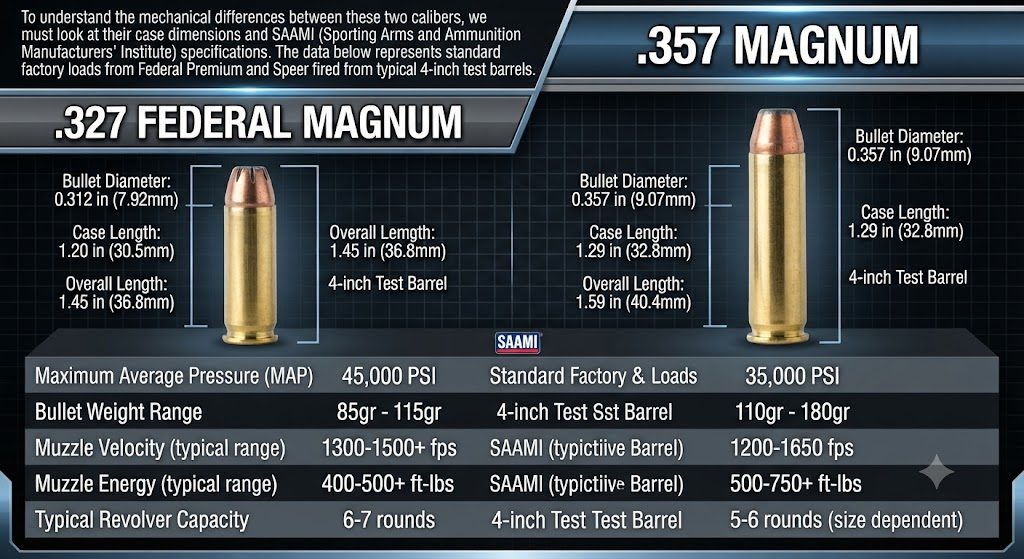
To understand the mechanical differences between these two calibers, we must look at their case dimensions and SAAMI (Sporting Arms and Ammunition Manufacturers’ Institute) specifications. The data below represents standard factory loads from Federal Premium and Speer fired from typical 4-inch test barrels.
| Specification | .327 Federal Magnum | .357 Magnum |
| Cartridge Type | Centerfire Revolver / Carbine | Centerfire Revolver / Carbine |
| Parent Case | .32 H&R Magnum | .38 Special |
| Bullet Diameter | .312 in (7.92 mm) | .357 in (9.07 mm) |
| Case Length | 1.200 in | 1.290 in |
| Overall Length | 1.470 in | 1.590 in |
| Typical Bullet Weights | 85 gr – 115 gr | 110 gr – 180 gr |
| Muzzle Velocity (4″ bbl) | 1,300 fps – 1,500 fps | 1,240 fps – 1,450 fps |
| Muzzle Energy (4″ bbl) | 431 ft-lbs – 500 ft-lbs | 539 ft-lbs – 575 ft-lbs |
| Maximum Pressure | 45,000 psi (SAAMI) | 35,000 psi (SAAMI) |
| Effective Range | 50 – 75 yds (Handgun) | 50 – 100 yds (Handgun) |
| Trajectory | Flat | Flat |
| Bullet Drop (50 yds) | ~1.5 to 2.0 inches | ~2.0 to 2.5 inches |
| Recoil | Moderate (approx. 20% less than .357) | Heavy (Sharp and concussive) |
| Snub Nose Performance | Excellent (Manageable recoil) | High blast, high recoil, velocity loss |
| Suppressor Performance | Poor (Revolver cylinder gap) | Poor (Revolver cylinder gap) |
| Penetration | Excellent (High sectional density) | Elite (Mass and velocity combined) |
| Expansion | Very Good (.50+ inches) | Devastating (.60+ inches) |
| Home Defense | Excellent (Reduced flash/recoil) | Proven but concussive |
| Concealed Carry | Elite (+1 capacity in small frames) | Good (Heavy recoil in small frames) |
| Hunting Performance | Marginal (Varmints, small predators) | Excellent (Deer, Hogs out to 75 yds) |
| Cylinder Capacity | 6 (Small Frame) / 7 (Medium Frame) | 5 (Small Frame) / 6 (Medium Frame) |
| Compatible Calibers | .32 H&R, .32 S&W Long, .32 S&W | .38 Special +P, .38 Special |
| Ammunition Cost | High | Moderate |
| Ammo Availability | Niche / Online primarily | Ubiquitous (Every gun store) |
| Best Uses | Concealed carry, recoil-sensitive shooters | Home defense, woods carry, hunting |
Understanding the Numbers
The genius of the .327 Federal Magnum lies entirely in its pressure. The .357 Magnum operates at a SAAMI maximum pressure of 35,000 psi. To get a narrower, lighter .312-caliber bullet to perform like a magnum, Federal engineered the .327 case to withstand a staggering 45,000 psi.
This extreme pressure allows the .327 Federal Magnum to push a 100-grain bullet at 1,500 fps, yielding 500 foot-pounds of energy. By comparison, a classic 125-grain .357 Magnum load pushes 1,440 fps and yields 575 foot-pounds. The .327 achieves roughly 85% of the .357 Magnum’s kinetic energy but does so using a smaller case diameter, which brings us to the most critical difference: cylinder capacity. Because the .327 is narrower (.312″ vs .357″), gunsmiths can drill six holes into a small “snub nose” cylinder that traditionally only holds five rounds of .357 Magnum.
Velocity Comparison
Velocity dictates expansion and terminal ballistics. Both cartridges rely on speed rather than pure mass.
Muzzle Velocity Data (4-inch barrel):
- .327 Federal Mag (Federal 100gr American Eagle SP): 1,500 fps
- .327 Federal Mag (Speer 115gr Gold Dot JHP): 1,300 fps
- .357 Magnum (Federal 125gr JHP): 1,440 fps
- .357 Magnum (Federal 158gr Hydra-Shok JHP): 1,240 fps
Analysis:
The .327 Federal Magnum is a blisteringly fast cartridge. Pushing a 100-grain bullet at 1,500 fps puts it in the upper echelon of handgun velocities, allowing for violent, rapid expansion of jacketed hollow points upon impact.
However, the .357 Magnum is no slouch. Driving a 125-grain bullet at 1,440 fps is exactly what earned the .357 Magnum its legendary reputation for one-shot stops in law enforcement circles during the 1970s and 80s. When stepping up to heavier 158-grain bullets, the .357 slows down to around 1,240 fps, but gains immense momentum.
Winner: .327 Federal Magnum (For Speed)
Pound-for-pound, the .327 operates at higher pressures and spits its lighter bullets out slightly faster.
Muzzle Energy Comparison
Muzzle energy (measured in foot-pounds) illustrates how much raw kinetic force the bullet strikes with.
Muzzle Energy Data (4-inch barrel):
- .327 Federal Mag (100gr American Eagle SP): 500 ft-lbs
- .327 Federal Mag (115gr Gold Dot JHP): 431 ft-lbs
- .357 Magnum (125gr JHP): 575 ft-lbs
- .357 Magnum (158gr Hydra-Shok JHP): 539 ft-lbs
Analysis:
While the .327 Federal Magnum is incredibly efficient, it cannot cheat physics. The .357 Magnum uses a wider, heavier projectile. Even though it operates at a lower 35,000 psi, the larger case capacity and heavier bullet mass result in superior kinetic energy. A standard .357 Magnum load will consistently generate between 530 and 600 ft-lbs of energy.
The .327 Federal Magnum is highly respectable, generating between 430 and 500 ft-lbs, which easily beats top-tier 9mm +P and .38 Special +P loads, but it falls roughly 10% to 15% short of true .357 Magnum power.
Winner: .357 Magnum
For maximum kinetic energy transfer, the .357 Magnum’s heavier bullet weight gives it a distinct mathematical advantage.
Recoil Comparison
Felt recoil in a revolver is dictated by the weight of the gun, the velocity of the bullet, and the mass of the powder charge.
Analysis:
Firing a full-house 125-grain .357 Magnum out of a lightweight, 25-ounce carry revolver is a punishing experience. It generates a sharp, stinging recoil impulse (often exceeding 9 to 10 foot-pounds of free recoil) combined with a massive concussive fireball. Many shooters develop a “flinch” when training with lightweight .357 Magnums.
The .327 Federal Magnum was designed specifically to bridge this gap. Because it fires a lighter bullet (85gr to 115gr), the felt recoil is roughly 20% less than a comparable .357 Magnum load. It is certainly snappier than a .38 Special, but it lacks the bone-jarring palm sting of the .357, making it vastly easier to control during rapid double-action fire.
Winner: .327 Federal Magnum
It provides near-magnum terminal ballistics with significantly less shooter fatigue.
Trajectory and Bullet Drop Comparison
Revolvers are typically used at close distances, but both of these cartridges shoot remarkably flat if called upon to stretch their legs.
Analysis:
Assuming a 25-yard zero with a 4-inch barrel, both cartridges will drop minimally at 50 yards. The hyper-velocity 100-grain .327 Federal Magnum will drop roughly 1.5 to 2.0 inches at 50 yards. The 125-grain .357 Magnum, traveling just slightly slower, will drop roughly 2.0 to 2.5 inches.
Out to 100 yards, the .357 Magnum’s heavier bullet retains its momentum slightly better, but for practical handgun shooting, both are practically laser-beams inside 50 yards.
Winner: Tie
Both cartridges shoot exceptionally flat for handguns.
Snub Nose Barrel Performance
The most popular concealed carry revolvers feature 1.87-inch to 2.25-inch “snub nose” barrels.
Analysis:
When you chop a revolver barrel down to 2 inches, magnums suffer terribly. A .357 Magnum 125-grain bullet that reaches 1,440 fps in a 4-inch barrel will often plummet to 1,150 fps in a 2-inch barrel. The unburnt powder explodes outside the muzzle, creating a blinding flash and deafening roar, meaning you suffer all the recoil of a magnum but lose up to 300 fps of velocity.
The .327 Federal Magnum also loses velocity in a short barrel, but because it operates at 45,000 psi, it burns its powder more violently and efficiently. An 85-grain .327 hollow point can still easily break 1,200 fps from a 2-inch barrel. More importantly, because the recoil is inherently lower, the .327 is vastly more manageable in a 16-ounce pocket revolver.
Winner: .327 Federal Magnum
The .327 Federal is arguably the most efficient and controllable magnum cartridge ever designed for snub nose revolvers.
Cylinder Capacity
This is the primary reason the .327 Federal Magnum was invented.
Analysis:
Revolver cylinders are bound by strict geometric constraints. A small-frame revolver (like the Ruger LCR or Smith & Wesson J-Frame) only has enough steel in the cylinder to safely bore five holes for the .357-inch diameter magnum cartridge. Five rounds is a severe tactical disadvantage compared to modern micro-9mm pistols.
Because the .327 Federal Magnum measures only .312 inches in diameter, gunsmiths can fit a sixth round into that exact same small-frame cylinder without compromising the steel’s structural integrity. In medium-frame revolvers (like the Ruger GP100), the .357 Magnum holds six rounds, but the .327 Federal Magnum holds seven.
Winner: .327 Federal Magnum
In a gunfight, a 20% increase in ammunition capacity without increasing the size of the weapon is an unparalleled advantage.
Stopping Power Comparison
“Stopping power” in handguns requires a combination of adequate penetration (12 to 18 inches in ballistic gel) and wide expansion.
Analysis:
The .357 Magnum (specifically the 125-grain jacketed hollow point) is historically revered as the ultimate man-stopper. The combination of 1,400+ fps velocity and a wide .357 starting diameter results in catastrophic temporary wound cavities and expansion often exceeding .60 inches.
The .327 Federal Magnum, using modern bullet designs like the 115-grain Speer Gold Dot, is highly effective. It reliably penetrates 13 to 15 inches of ballistic gel and expands nicely to over .50 inches. However, it simply punches a slightly narrower hole than the .357.
Winner: .357 Magnum
While the .327 is excellent, the .357 Magnum has nearly a century of proven, devastating terminal performance.
Penetration and Expansion Comparison
Analysis:
- Penetration: The .327 Federal utilizes long, narrow bullets. This gives them a high Sectional Density. Even at high velocities, a 115-grain .327 bullet penetrates deeply because it has less frontal surface area acting as a parachute in soft tissue. The .357 Magnum also penetrates exceptionally well, especially with heavy 158-grain bullets, capable of passing completely through a threat.
- Expansion: The .357 Magnum starts 14% wider than the .327 (.357″ vs .312″). When both bullets mushroom perfectly upon impact, the .357 will almost always yield a wider final diameter, cutting more tissue and causing more rapid blood loss.
Winner: .357 Magnum
The wider starting diameter naturally leads to wider final expansion.
Multi-Caliber Compatibility
One of the greatest benefits of owning a revolver is the ability to shoot shorter, lower-pressure cartridges of the same diameter for cheap practice.
Analysis:
A .357 Magnum revolver can safely chamber and fire:
- .357 Magnum
- .38 Special +P
- .38 Special
A .327 Federal Magnum revolver can safely chamber and fire:
- .327 Federal Magnum
- .32 H&R Magnum
- .32 S&W Long
- .32 S&W (Short)
Winner: Tie
Both offer incredible versatility. The .357 allows you to practice with ubiquitous .38 Special, while the .327 allows you to shoot remarkably quiet, zero-recoil .32 S&W Longs.
Suppressor / Lever-Action Carbine Performance
Suppressing a revolver is largely ineffective due to the “cylinder gap”—the small space between the cylinder and the barrel where high-pressure gasses and noise escape before reaching the suppressor. However, both of these cartridges are popular in lever-action carbines.
Analysis:
When chambered in a lever-action rifle (like a Henry or Marlin), both cartridges gain roughly 300 to 400 fps of velocity over a handgun. A 158-grain .357 Magnum out of an 18-inch barrel is a devastating 100-yard deer rifle.
For suppression in a carbine, the .357 Magnum wins easily. You can load heavy 158-grain .38 Special ammunition into a .357 lever-action rifle, which travels at roughly 950 fps (subsonic). With a suppressor attached, it sounds like a pneumatic nail gun.
Winner: .357 Magnum
The massive ecosystem of heavy .38 Special ammunition makes the .357 Magnum a far better host for a suppressed lever-action rifle.
Home Defense Comparison
Inside the home, you must balance stopping power against over-penetration, concussive blast, and weapon control.
Analysis:
Firing a .357 Magnum indoors without ear protection is physically disorienting. The 35,000 psi blast is deafening, and the muzzle flash can temporarily blind the shooter in low light. Furthermore, 158-grain magnums carry a high risk of over-penetrating drywall.
The .327 Federal Magnum is also very loud (due to the 45,000 psi pressure), but it pushes less mass and generates less physical recoil. In a medium-frame revolver (like a 7-shot Ruger GP100), the .327 provides two extra rounds over a 5-shot .357, lower recoil for faster follow-up shots, and excellent hollow-point expansion.
Winner: .327 Federal Magnum
The extra capacity and reduced recoil make it a more manageable indoor defensive tool. (Note: Many .357 owners simply load .38 Special +P for home defense to solve the blast issue, but comparing magnum to magnum, the .327 is easier to run).
Concealed Carry Comparison
Concealed carry requires a balance of lightweight firearms, comfort, and lethal efficacy.
Analysis:
The quintessential carry revolver is the small-frame snub nose. A Ruger LCR chambered in .357 Magnum is brutal to shoot, holds only 5 rounds, and takes significant practice to master.
The exact same Ruger LCR chambered in .327 Federal Magnum holds 6 rounds, kicks noticeably less, and delivers terminal ballistics that vastly outperform a .38 Special.
Winner: .327 Federal Magnum
The .327 was practically purpose-built to dominate the concealed carry revolver market.
Hunting Comparison
Handgun hunting requires massive kinetic energy to ensure ethical kills on game like whitetail deer or feral hogs.
Analysis:
The .327 Federal Magnum is a fantastic cartridge for coyotes, raccoons, and small predators out to 50 yards. However, its 100-grain bullets lack the mass to reliably punch through the heavy shoulder bones of a 200-pound deer.
The .357 Magnum, when loaded with 158-grain or 180-grain hard cast or bonded bullets, is a proven, legendary hunting cartridge. Out of a 6-inch revolver (or a lever-action carbine), it will take deer and hogs cleanly out to 75-100 yards.
Winner: .357 Magnum
The heavier bullets of the .357 Magnum are mandatory for medium-to-large game hunting.
Ammo Cost and Availability Comparison
A firearm is only useful if you can afford to feed it.
Analysis:
The .357 Magnum is a global standard. You can find practice ammunition in every sporting goods store in America, usually for moderate prices. Even if you can’t find .357, you can always buy cheap .38 Special for range days.
The .327 Federal Magnum is a niche cartridge. It is rarely stocked on the shelves of local gun stores, meaning you must order it online. Practice ammunition is expensive, and premium defensive hollow points (like Speer Gold Dot) are often priced at a premium.
Winner: .357 Magnum
The .357 Magnum completely dominates in logistical availability and cost.
Pros and Cons
.327 Federal Magnum
Pros
- Allows for 6 rounds in a 5-shot frame, or 7 rounds in a 6-shot frame.
- Generates roughly 20% less recoil than a .357 Magnum.
- Pushes a 100gr bullet to a blistering 1,500 fps.
- Can safely fire .32 H&R Mag, .32 S&W Long, and .32 S&W.
- Exceptional performance from 2-inch snub nose barrels.
Cons
- Ammunition is expensive and hard to find locally.
- 45,000 psi pressure creates a very loud muzzle report.
- Lacks the heavy bullet mass required for deer/hog hunting.
- Very few lever-action carbines currently manufactured for it.
.357 Magnum
Pros
- The gold standard for revolver stopping power and kinetic energy.
- Extremely versatile for both home defense and medium-game hunting.
- Ammunition is affordable, ubiquitous, and available globally.
- Can safely fire .38 Special and .38 Special +P.
- Massive ecosystem of handguns and lever-action carbines.
Cons
- Severe recoil and muzzle blast, especially in lightweight revolvers.
- Limited to 5 rounds in small, concealable frames.
- Heavy velocity loss when fired from 2-inch barrels.
Final Verdict
Choosing between the .327 Federal Magnum and .357 Magnum comes down to whether you prioritize cylinder capacity and recoil management, or raw power and ammunition availability.
- For Concealed Carry (Snub Nose): .327 Federal Magnum. Getting 6 rounds of magnum-level power in a pocket revolver with manageable recoil makes it the ultimate concealed carry wheel-gun cartridge.
- For Home Defense: .327 Federal Magnum. The extra capacity (7 rounds in a GP100) and faster follow-up shots give it the edge indoors.
- For Woods Carry & Hunting: .357 Magnum. The heavy 158gr to 180gr bullets are required to cleanly harvest deer, hogs, and defend against medium predators.
- For Lever-Action Carbines: .357 Magnum. The availability of heavy, subsonic .38 Special loads makes it an infinitely better suppressor host and brush gun.
- For the Budget-Conscious: .357 Magnum. You will save massive amounts of money by shooting cheap .38 Special practice ammo.
- For Recoil-Sensitive Shooters: .327 Federal Magnum. It bridges the gap perfectly between the anemic .38 Special and the punishing .357 Magnum.