The 8mm Mauser ballistics chart reveals a highly capable centerfire rifle cartridge that delivers excellent stopping power and predictable trajectories for hunting medium to large game worldwide. This legendary metric caliber pushes heavy projectiles at impressive velocities while generating deep penetration on tough animals at extended distances. Shooters reviewing the 8mm Mauser ballistics chart will notice performance levels that rival modern hunting chamberings when using full pressure European ammunition. Understanding the specific drop and energy figures provided in the 8mm Mauser ballistics chart helps marksmen maximize their accuracy and terminal performance in the field.
8mm Mauser Ballistics Chart
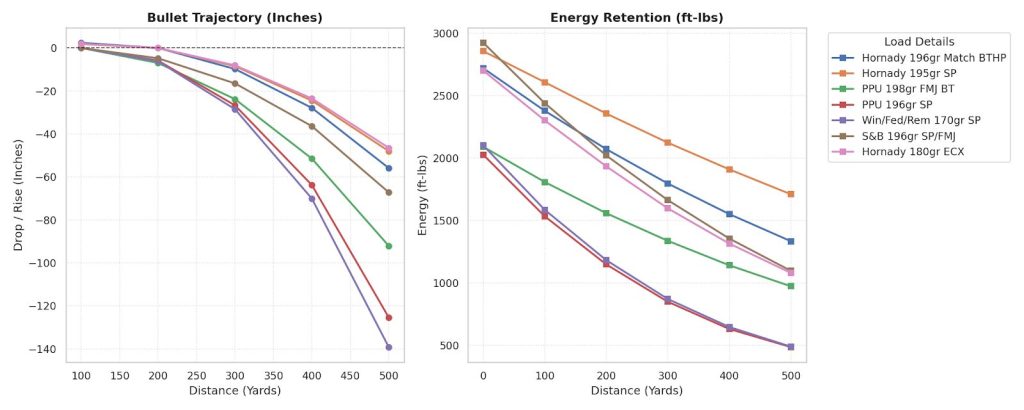
| Bullet Weight | Bullet Type | Manufacturer | Muzzle Velocity | Velocity At 100 Yards | Velocity At 200 Yards | Velocity At 300 Yards | Velocity At 400 Yards | Velocity At 500 Yards | Muzzle Energy | Energy At 100 Yards | Energy At 200 Yards | Energy At 300 Yards | Energy At 400 Yards | Energy At 500 Yards | Trajectory At 100 Yards | Trajectory At 200 Yards | Trajectory At 300 Yards | Trajectory At 400 Yards | Trajectory At 500 Yards | Ballistic Coefficient | Sectional Density |
| 196 Grain | Match BTHP | Hornady | 2500 | 2338 | 2182 | 2032 | 1888 | 1751 | 2720 | 2379 | 2072 | 1797 | 1552 | 1335 | High 2.4 | Zero | Drop 9.8 | Drop 27.9 | Drop 55.9 | 0.525 | 0.268 |
| 195 Grain | Soft Point | Hornady | 2569 | 2454 | 2333 | 2215 | 2100 | 1988 | 2857 | 2608 | 2357 | 2124 | 1910 | 1711 | High 1.8 | Zero | Drop 8.5 | Drop 24.5 | Drop 48.0 | 0.400 | 0.267 |
| 198 Grain | FMJ BT | PPU | 2181 | 2029 | 1883 | 1744 | 1612 | 1489 | 2091 | 1809 | 1559 | 1338 | 1142 | 974 | Zero | Drop 7.0 | Drop 23.8 | Drop 51.5 | Drop 92.1 | 0.517 | 0.271 |
| 196 Grain | Soft Point | PPU | 2181 | 1880 | 1625 | 1400 | 1205 | 1058 | 2027 | 1534 | 1149 | 850 | 632 | 487 | Zero | Drop 5.9 | Drop 26.7 | Drop 63.8 | Drop 125.4 | 0.350 | 0.268 |
| 170 Grain | Soft Point | Winchester | 2360 | 2050 | 1770 | 1520 | 1310 | 1140 | 2102 | 1586 | 1183 | 872 | 648 | 491 | Zero | Drop 6.2 | Drop 28.5 | Drop 70.1 | Drop 139.2 | 0.298 | 0.232 |
| 170 Grain | Soft Point | Federal | 2360 | 2050 | 1770 | 1520 | 1310 | 1140 | 2102 | 1586 | 1183 | 872 | 648 | 491 | Zero | Drop 6.2 | Drop 28.5 | Drop 70.1 | Drop 139.2 | 0.298 | 0.232 |
| 170 Grain | Core Lokt | Remington | 2360 | 2050 | 1770 | 1520 | 1310 | 1140 | 2102 | 1586 | 1183 | 872 | 648 | 491 | Zero | Drop 6.2 | Drop 28.5 | Drop 70.1 | Drop 139.2 | 0.298 | 0.232 |
| 196 Grain | Soft Point | Sellier And Bellot | 2592 | 2368 | 2155 | 1955 | 1765 | 1588 | 2924 | 2440 | 2021 | 1664 | 1356 | 1098 | Zero | Drop 4.8 | Drop 16.5 | Drop 36.4 | Drop 67.2 | 0.328 | 0.268 |
| 196 Grain | FMJ | Sellier And Bellot | 2592 | 2368 | 2155 | 1955 | 1765 | 1588 | 2924 | 2440 | 2021 | 1664 | 1356 | 1098 | Zero | Drop 4.8 | Drop 16.5 | Drop 36.4 | Drop 67.2 | 0.328 | 0.268 |
| 180 Grain | ECX | Hornady | 2600 | 2400 | 2200 | 2000 | 1815 | 1645 | 2701 | 2302 | 1934 | 1598 | 1316 | 1081 | High 1.9 | Zero | Drop 8.1 | Drop 23.5 | Drop 46.5 | 0.320 | 0.246 |
The table above details the 8mm Mauser ballistics chart data using several popular factory loads from well known ammunition manufacturers.
Understanding The Chart
The 8mm Mauser ballistics chart contains several technical measurements that strictly dictate how a bullet performs in flight and upon impact.
Studying these distinct metrics allows hunters and target shooters to select the perfect ammunition for their specific rifle.
Applying this data ensures maximum accuracy and deep terminal penetration when engaging targets in the field.
Muzzle Velocity
Muzzle velocity represents the sheer speed of the bullet the exact moment it leaves the barrel of the firearm.
This critical measurement is expressed in feet per second and directly influences every other ballistic category on the chart.
A higher muzzle velocity translates to a noticeably flatter trajectory and significantly less time for wind to push the bullet off course.
Faster bullets also initiate expansion much more reliably upon striking tough game animals.
American manufacturers often load this caliber to a lower muzzle velocity compared to traditional European brands.
Shooters seeking maximum performance should regularly test imported ammunition to see the true potential of the cartridge.
Retained Velocity
Retained velocity indicates exactly how fast the projectile continues to travel at various distances downrange after leaving the muzzle.
Bullets lose speed constantly due to unavoidable atmospheric air resistance during flight.
Knowing your retained velocity is crucial because modern hunting bullets require a minimum threshold speed to expand properly upon impact.
If the retained velocity drops too low the bullet might behave like a solid non expanding projectile.
A bullet that completely fails to expand will not create an effective wound channel and may lead to an unethical harvest.
Heavy pointed bullets retain their velocity much better than flat nosed alternatives at extreme extended ranges.
Kinetic Energy
Kinetic energy measures the true striking power of the bullet and is consistently expressed in foot pounds.
This immense physical energy transfers directly to the target upon impact and causes the vital terminal damage required for an ethical harvest.
Heavier bullets generally carry significantly more kinetic energy at long distances because they resist slowing down better than light bullets.
Massive projectiles crush through heavy bone and dense muscle tissue far more effectively.
Elk and moose hunters pay extremely close attention to kinetic energy figures when selecting their preferred field ammunition.
Reviewing the 8mm Mauser ballistics chart ensures you carry enough retained energy to humanely dispatch your chosen game species.
Trajectory
Trajectory describes the predictable curved flight path the bullet takes as gravity constantly pulls it toward the earth.
The 8mm Mauser ballistics chart usually displays this physical curve as bullet drop measured in exact inches at specific yardage markers.
A flatter trajectory makes precision aiming much easier because the shooter does not need to calculate extreme vertical holdover adjustments.
This forgiving flight path becomes incredibly valuable when rapidly judging distances over open terrain without a laser rangefinder.
Lighter bullets driven at extremely high speeds offer the absolute flattest trajectory for this caliber at moderate hunting ranges.
Heavy military style bullets feature a slightly more pronounced rainbow trajectory that strictly requires precise range estimation.
Ballistic Coefficient
Ballistic coefficient is a highly specific numerical value representing exactly how efficiently a bullet cuts through the surrounding air.
A higher mathematical number means the projectile experiences significantly less aerodynamic drag during its flight path.
Bullets with a high ballistic coefficient retain their initial velocity and kinetic energy much better at extended target ranges.
This sheer efficiency directly translates to less wind deflection and superior terminal performance upon impact.
Modern boat tail hollow point bullets typically feature the absolute highest ballistic coefficients available for this historic caliber.
Vintage round nose bullets feature terrible ballistic coefficients but perform flawlessly in heavy brush environments.
Sectional Density
Sectional density relates the total physical weight of the bullet directly to its outside diameter.
This important mathematical metric provides an excellent indicator of exactly how deeply a bullet will penetrate a large game animal.
A higher sectional density means the bullet has massive amounts of weight driving directly behind a relatively small frontal area.
This concentrated momentum allows the projectile to smash straight through heavy shoulder bones without stopping prematurely.
Heavy projectiles for this caliber feature outstanding sectional density which completely explains their legendary performance on heavy African plains game.
Hunters targeting massive animals should always select bullets with the highest possible sectional density rating.
Common Bullet Weights
The 8mm Mauser ballistics chart covers several different bullet weights designed specifically for distinct shooting applications.
Each individual weight offers unique flight characteristics and specific terminal performance capabilities.
Carefully matching the correct bullet weight to your intended target guarantees the highest chance of success.
150 Grain Bullets
The best use for this extremely light weight involves hunting medium sized game like whitetail deer and feral hogs at moderate ranges.
Advantages include minimal felt recoil and a beautifully flat trajectory inside two hundred yards.
Disadvantages include very rapid velocity loss and significantly lower kinetic energy retention at extended distances.
Typical applications are dense brush hunting and casual target practice where extreme deep penetration is not strictly required.
170 Grain Bullets
The best use focuses entirely on general purpose hunting for deer and black bear across highly varied terrain.
Advantages include a truly perfect balance of speed and terminal striking power without generating excessive recoil.
Disadvantages include somewhat limited availability from European ammunition manufacturers who strongly prefer heavier projectiles.
Typical applications involve standard American hunting scenarios where standard soft point bullets perform flawlessly every single time.
180 Grain Bullets
The best use centers entirely around hunting large game species where reliable deep penetration becomes incredibly important.
Advantages include excellent bullet weight retention and highly reliable expansion across a wide range of impact velocities.
Disadvantages include a slightly steeper parabolic trajectory compared to the lighter options previously mentioned.
Typical applications include demanding elk hunting and safari plains game where tough hide and heavy bones easily stop lighter bullets.
196 Grain Bullets
The best use involves accurately replicating original military ballistics and hunting the absolute largest non dangerous game on earth.
Advantages include maximum possible sectional density and incredible kinetic energy retention at extreme extended distances.
Disadvantages include very significant felt recoil and a heavy curving trajectory that requires careful and precise range estimation.
Typical applications include intense moose hunting and vintage military rifle matches where strict traditional performance is demanded.
Effective Range
The true effective range of this cartridge depends entirely on the chosen application and the actual skill of the marksman.
Different shooting disciplines require vastly different levels of kinetic energy and velocity retention.
Understanding these physical limitations ensures you never take an unethical or impossible shot.
Hunting
The highly effective hunting range for deer sized game easily extends to four hundred yards when utilizing proper optics.
For significantly larger game like elk the effective range typically stops around three hundred yards to ensure completely adequate penetration.
European hunters routinely harvest massive wild boar at these exact distances using heavy soft point projectiles.
Perfect shot placement always strictly dictates the true ethical range for any hunting scenario regardless of caliber.
Target Shooting
Target shooters can easily and repeatedly strike steel plates at eight hundred yards using high quality match grade ammunition.
The extremely heavy bullets actively resist wind deflection exceptionally well at these extended distances.
Shooters must accurately know their exact scope adjustments to properly compensate for the significant vertical bullet drop.
Vintage military rifle competitions frequently feature stationary steel targets placed securely at five hundred yards.
Competition Shooting
Competition shooting with this specific caliber usually involves highly specific historical firearm matches.
Competitors routinely engage paper targets from two hundred to six hundred yards using strictly original iron sights.
Heavy match bullets actively provide the extreme consistency needed to win these incredibly demanding accuracy challenges.
The inherent mechanical precision of the cartridge really shines when paired with meticulously crafted handloaded ammunition.
Long Range Shooting
Extreme long range shooting beyond one thousand yards is definitely possible but strictly requires substantial elevation turret adjustments.
The heavy bullet will highly likely drop completely below the speed of sound just past the one thousand yard marker.
Transonic flight causes severe bullet instability that can entirely ruin extreme long range accuracy.
Modern chassis rifles chambered specially in this caliber perform admirably if the shooter truly understands wind reading.
Self Defense
Self defense is a highly unusual and generally impractical application for a full powered vintage battle rifle cartridge.
The truly massive kinetic energy presents a very severe over penetration risk in typical urban environments.
The incredibly bright muzzle flash and heavy felt recoil make rapid follow up shots extremely difficult to execute.
Other intermediate modern cartridges serve this highly specialized role much more effectively and safely.
Factors That Affect Ballistics
Numerous external environmental and internal mechanical factors actively influence the specific numbers found on an 8mm Mauser ballistics chart.
Understanding these complex variables thoroughly helps shooters properly correct their aim in challenging weather conditions.
Ignoring these critical factors will consistently result in entirely missed targets at long distances.
Barrel Length
Barrel length directly impacts the final muzzle velocity achieved by the expanding powder gases trapped behind the projectile.
A longer barrel actively provides more time for the high pressure combustion to continuously accelerate the bullet before it exits the muzzle.
Short carbine barrels will produce noticeably lower velocities and considerably brighter muzzle flashes than full length sporting rifles.
Losing velocity at the muzzle means the bullet will heavily experience more drop and increased wind drift as it travels downrange.
Shooters using vintage cavalry carbines should definitely expect their numbers to fall slightly below the factory published 8mm Mauser ballistics chart.
Bullet Weight
Bullet weight rapidly changes the entire ballistic profile of the cartridge from the exact moment of primer ignition.
Heavy projectiles leave the muzzle noticeably slower but retain their forward momentum far better over very long distances.
Light projectiles start extremely fast but shed their speed very quickly due to overwhelming air resistance.
Shooters must carefully match the exact bullet weight to their specific target to achieve absolutely optimal terminal results.
Selecting the wrong weight can lead to very poor accuracy or totally insufficient tissue penetration.
Bullet Design
Bullet design plays a massive fundamental role in aerodynamic efficiency and terminal tissue expansion.
Pointed polymer tipped bullets slice through the heavy wind gracefully and fly incredibly flat.
Round nose flat base bullets create tremendous initial impact trauma but suffer from terrible aerodynamic drag.
Solid copper projectiles offer extreme deep penetration but strictly require higher impact velocities to open reliably.
Choosing the proper design is just as vital as selecting the correct bullet weight.
Altitude
Altitude directly changes the physical density of the air the bullet must actively travel through.
Higher mountain elevations feature very thin air which creates significantly less aerodynamic drag on the flying projectile.
A hunting rifle carefully zeroed at sea level will shoot noticeably higher when taken into thin mountain air.
Hunters must absolutely verify their rifle zero when traveling to high elevation hunting camps.
Failing to account for altitude changes often results in shooting directly over the back of the intended animal.
Temperature
Temperature strictly affects both the outside air density and the internal burn rate of the gunpowder inside the cartridge.
Cold winter air is incredibly dense and forces the bullet to lose velocity much faster than warm summer air.
Freezing temperatures can also highly lower the internal chamber pressure resulting in noticeably slower initial muzzle speeds.
Shooters should always field test their preferred loads in the exact weather conditions they expect to encounter.
Modern temperature stable powders highly reduce this issue but do not entirely eliminate it.
Humidity
Humidity plays a remarkably small but thoroughly measurable role in extreme long range ballistics calculations.
Humid air is actually slightly less dense than perfectly dry air because water vapor is physically lighter than atmospheric gases.
Bullets experience slightly less drag on very humid days though the physical difference is very minimal inside five hundred yards.
Precision target shooters actively track this specific metric primarily to maintain perfect consistency across highly varied ranges.
General hunters can safely ignore humidity unless shooting at extremely long distances.
Wind
Wind creates the absolute most difficult external environmental challenge for any rifle shooter to properly overcome.
A strong lateral crosswind will heavily push the bullet laterally away from the strictly intended point of impact.
Heavy bullets with extremely high ballistic coefficients actively resist this wind deflection better than light aerodynamic options.
Learning to accurately read ground mirage and vegetation movement is completely essential for placing accurate shots in windy conditions.
Wind estimation remains more of an acquired art than a perfect science.
Twist Rate
Twist rate refers specifically to the spiral rifling inside the barrel that actively spins the bullet for gyroscopic stability.
A noticeably faster twist rate is strictly required to properly stabilize very long and heavy projectiles in flight.
Using a bullet that is far too heavy for a specific twist rate causes complete accuracy destroying tumbling.
Most rifles chambered specially for this caliber feature a twist rate perfectly suited for heavy traditional bullets.
Shooters rarely need to worry about twist rate unless utilizing highly experimental custom bullets.
Zero Distance
Zero distance is the exact yardage where the optical point of aim perfectly matches the physical point of impact.
Choosing the perfectly correct zero distance greatly simplifies vertical holdover calculations in the field.
A very short zero strictly requires holding high on distant targets while a long zero requires holding low on close targets.
Most hunters strongly prefer a maximum point blank range zero to entirely eliminate aiming math under stress.
Understanding your exact zero distance is completely vital for hunting success.
Best Zero Distance
Selecting the optimal optical zero distance depends entirely on the typical ranges encountered during a shooting session.
Different specific distances offer distinct mechanical advantages and definite drawbacks for the marksman.
Tailoring your zero to your exact hunting environment guarantees much faster target acquisition.
One Hundred Yard Zero
Advantages strictly include absolute perfect precision for close range woodland hunting and quick target verification.
Disadvantages definitely include very significant bullet drop requiring vertical holdover adjustments at anything past two hundred yards.
The absolute best use case involves hunting in very dense forests where shots rarely exceed one hundred paces.
Highly recommended users strongly include heavy brush hunters and shooters using strictly original military iron sights.
Two Hundred Yard Zero
Advantages actively provide a highly versatile maximum point blank range for mixed open country hunting.
Disadvantages strictly require remembering that the bullet will intentionally impact slightly high at exactly one hundred yards.
The absolute best use case involves highly mixed terrain hunting where a sudden long shot might quickly present itself.
Highly recommended users strongly include western deer hunters and general purpose marksmen wanting a totally flexible setup.
Three Hundred Yard Zero
Advantages actively allow direct center holds on very distant targets without ever dialing elevation turrets.
Disadvantages clearly include strange mid range trajectories that deliberately peak several inches above the line of sight.
The absolute best use case is completely dedicated long range open plain hunting on very large target areas.
Highly recommended users are extremely advanced marksmen who completely understand exactly where their bullet peaks in mid flight.
Comparison With Similar Cartridges
Comparing the 8mm Mauser ballistics chart to other highly popular chamberings clearly highlights its true enduring capability.
The following data table perfectly contrasts this famous caliber with several incredibly famous hunting and military cartridges.
Reviewing these comparative metrics helps shooters properly understand exactly where this cartridge fits in modern applications.
| Cartridge | Muzzle Velocity | Muzzle Energy | Trajectory At 300 Yards | Recoil Level | Effective Range | Long Range Performance | Hunting Performance |
| 8×57 IS | 2592 | 2924 | Drop 16.5 | Moderate | 500 Yards | Excellent | Outstanding |
| 308 Winchester | 2600 | 2625 | Drop 17.0 | Moderate | 800 Yards | Excellent | Excellent |
| 7mm Mauser | 2660 | 2199 | Drop 15.8 | Light | 400 Yards | Good | Great |
| 7.62x54R | 2650 | 2300 | Drop 16.0 | Moderate | 600 Yards | Excellent | Great |
| 270 Winchester | 3060 | 2702 | Drop 11.5 | Moderate | 600 Yards | Superior | Excellent |
The legendary 8×57 IS clearly excels when extreme deep penetration and maximum striking power are strictly required on large tough game.
The popular 308 Winchester actively offers very similar trajectory curves but falls slightly behind in sheer bullet weight capacity.
The classic 7mm Mauser produces significantly less felt recoil but completely lacks the heavy kinetic energy needed for massive animals.
The reliable 7.62x54R perfectly mirrors these ballistics very closely but utilizes a strange rimmed case design that complicates magazine feeding.
The modern 270 Winchester shoots incredibly flat and absolutely dominates open country hunting but uses much lighter projectiles overall.
Ultimately the European metric classic remains an absolutely top tier choice for very serious big game hunters everywhere.
Frequently Asked Questions
Many new shooters have highly specific questions after carefully reviewing an 8mm Mauser ballistics chart for the very first time.
These highly common inquiries effectively cover safety performance and practical field applications.
Reading these answers quickly resolves the most prevalent misconceptions regarding this famous caliber.
What Is The True Diameter Of An 8mm Mauser Bullet?
The standard modern diameter is exactly zero point three two three inches across all modern brands.
Some very early vintage rifles actively used a slightly smaller zero point three one eight inch bore.
Can This Cartridge Effectively Harvest A Grizzly Bear?
Yes when properly loaded with heavy premium bullets this caliber carries plenty of raw kinetic energy.
It can highly ethically harvest the absolute largest bears on the continent when placed accurately.
Why Does American Ammunition Show Lower Velocity On The 8mm Mauser Ballistics Chart?
Domestic manufacturers deliberately download their ammunition to reliably remain perfectly safe in extremely old vintage military actions.
These highly older firearms might completely lack the modern metallurgical strength required for full pressure loads.
Is This Caliber Considered A Good Choice For A Beginner?
The physical recoil might prove slightly too heavy for a completely inexperienced novice shooter.
It definitely remains highly manageable for anyone possessing basic fundamentals and proper shooting form.
How Does The Recoil Compare To Modern Magnum Cartridges?
The physical felt recoil is substantially lower than modern belted magnums.
This absolutely makes it much more pleasant to shoot during extended range sessions or very long hunting trips.
What Is The Difference Between JS And IS Designations?
These specific letters mean the exact same thing and are completely interchangeable worldwide.
They simply indicate that the loaded ammunition uses the modern larger bullet diameter designed for updated military rifle specifications.
Does A Shorter Barrel Ruin The Ballistics Of This Cartridge?
A short barrel will actively reduce muzzle velocity slightly but the extremely heavy bullets retain plenty of momentum.
The true terminal energy remains highly effective at standard hunting distances despite the slight speed loss.
Are Boat Tail Bullets Necessary For Hunting With This Caliber?
Boat tail bullets are completely unnecessary for typical hunting ranges inside heavy brush.
Flat base bullets reliably deliver outstanding accuracy and perfectly reliable terminal expansion inside three hundred yards.
Why Do European Loads Perform So Much Better On Paper?
European manufacturers actively load their ammunition to the original full pressure military specifications.
Their modern sporting rifles are built specifically to fully handle the authentic massive power of the cartridge.
Can I Use Military Surplus Ammunition For Hunting?
Military surplus ammunition utilizes fully jacketed projectiles that completely fail to expand upon animal impact.
This severe lack of expansion makes them completely unethical and illegal for hunting big game in most jurisdictions.