A PowerBelt Bullet Ballistics Chart is a specialized numerical data table that meticulously tracks the velocity energy bullet drop and aerodynamic efficiency of these modern muzzleloader projectiles. This comprehensive visual reference helps traditional hunters and primitive weapons enthusiasts understand exactly how different bullet styles and weights perform under realistic field conditions. By studying these specific flight metrics marksmen can calculate precise optical holdovers while ensuring massive terminal knockdown power on large game animals. Utilizing this extensive ballistic data guarantees supreme accuracy and absolute ethical harvesting when participating in restricted muzzleloader hunting seasons.
PowerBelt Bullet Ballistics Chart
| Manufacturer | Bullet Weight | Bullet Type | Ballistic Coefficient | Sectional Density | Muzzle Velocity | Velocity At 50 Yards | Velocity At 100 Yards | Velocity At 150 Yards | Velocity At 200 Yards | Velocity At 250 Yards | Muzzle Energy | Energy At 50 Yards | Energy At 100 Yards | Energy At 150 Yards | Energy At 200 Yards | Energy At 250 Yards | Trajectory At 50 Yards | Trajectory At 100 Yards | Trajectory At 150 Yards | Trajectory At 200 Yards | Trajectory At 250 Yards |
| PowerBelt | 245 gr | 50 Cal Copper AeroTip | 0.170 | 0.140 | 1750 fps | 1550 fps | 1360 fps | 1195 fps | 1065 fps | 965 fps | 1666 ft lbs | 1307 ft lbs | 1006 ft lbs | 777 ft lbs | 617 ft lbs | 507 ft lbs | 1.2 in High | 0.0 in | 4.5 in Low | 13.8 in Low | 30.5 in Low |
| PowerBelt | 295 gr | 50 Cal Copper AeroTip | 0.186 | 0.168 | 1670 fps | 1501 fps | 1350 fps | 1223 fps | 1126 fps | 1054 fps | 1827 ft lbs | 1476 ft lbs | 1194 ft lbs | 980 ft lbs | 831 ft lbs | 728 ft lbs | 1.5 in High | 0.0 in | 5.5 in Low | 15.5 in Low | 33.2 in Low |
| PowerBelt | 348 gr | 50 Cal Copper AeroTip | 0.205 | 0.199 | 1550 fps | 1410 fps | 1285 fps | 1180 fps | 1095 fps | 1030 fps | 1857 ft lbs | 1536 ft lbs | 1276 ft lbs | 1076 ft lbs | 926 ft lbs | 820 ft lbs | 2.0 in High | 0.0 in | 6.8 in Low | 19.5 in Low | 40.0 in Low |
| PowerBelt | 250 gr | 50 Cal AeroLite | 0.210 | 0.143 | 1850 fps | 1650 fps | 1470 fps | 1310 fps | 1175 fps | 1065 fps | 1900 ft lbs | 1511 ft lbs | 1199 ft lbs | 953 ft lbs | 766 ft lbs | 630 ft lbs | 1.0 in High | 0.0 in | 3.8 in Low | 11.5 in Low | 25.0 in Low |
| PowerBelt | 300 gr | 50 Cal AeroLite | 0.230 | 0.171 | 1700 fps | 1530 fps | 1380 fps | 1245 fps | 1135 fps | 1045 fps | 1925 ft lbs | 1559 ft lbs | 1269 ft lbs | 1033 ft lbs | 858 ft lbs | 728 ft lbs | 1.4 in High | 0.0 in | 5.0 in Low | 14.5 in Low | 30.5 in Low |
| PowerBelt | 270 gr | 50 Cal Platinum AeroTip | 0.190 | 0.154 | 1750 fps | 1560 fps | 1385 fps | 1235 fps | 1110 fps | 1015 fps | 1836 ft lbs | 1459 ft lbs | 1150 ft lbs | 915 ft lbs | 739 ft lbs | 618 ft lbs | 1.3 in High | 0.0 in | 4.8 in Low | 14.2 in Low | 31.0 in Low |
| PowerBelt | 300 gr | 50 Cal Platinum AeroTip | 0.210 | 0.171 | 1650 fps | 1485 fps | 1335 fps | 1205 fps | 1100 fps | 1015 fps | 1813 ft lbs | 1469 ft lbs | 1187 ft lbs | 967 ft lbs | 806 ft lbs | 686 ft lbs | 1.6 in High | 0.0 in | 5.8 in Low | 16.5 in Low | 34.5 in Low |
| PowerBelt | 225 gr | 45 Cal Copper AeroTip | 0.190 | 0.157 | 1850 fps | 1640 fps | 1450 fps | 1285 fps | 1145 fps | 1035 fps | 1710 ft lbs | 1344 ft lbs | 1050 ft lbs | 825 ft lbs | 655 ft lbs | 535 ft lbs | 1.1 in High | 0.0 in | 4.2 in Low | 12.5 in Low | 27.5 in Low |
| PowerBelt | 285 gr | 45 Cal ELR AeroTip | 0.333 | 0.200 | 1750 fps | 1625 fps | 1510 fps | 1400 fps | 1300 fps | 1210 fps | 1938 ft lbs | 1671 ft lbs | 1443 ft lbs | 1240 ft lbs | 1069 ft lbs | 926 ft lbs | 1.2 in High | 0.0 in | 4.0 in Low | 11.2 in Low | 22.5 in Low |
| PowerBelt | 270 gr | 50 Cal ELR AeroTip | 0.312 | 0.154 | 1800 fps | 1665 fps | 1540 fps | 1420 fps | 1315 fps | 1220 fps | 1942 ft lbs | 1662 ft lbs | 1422 ft lbs | 1208 ft lbs | 1037 ft lbs | 893 ft lbs | 1.0 in High | 0.0 in | 3.5 in Low | 10.5 in Low | 21.0 in Low |
Evaluating the provided data reveals that minor variations in bullet shape and powder charges create massive differences in downrange authority across open fields.
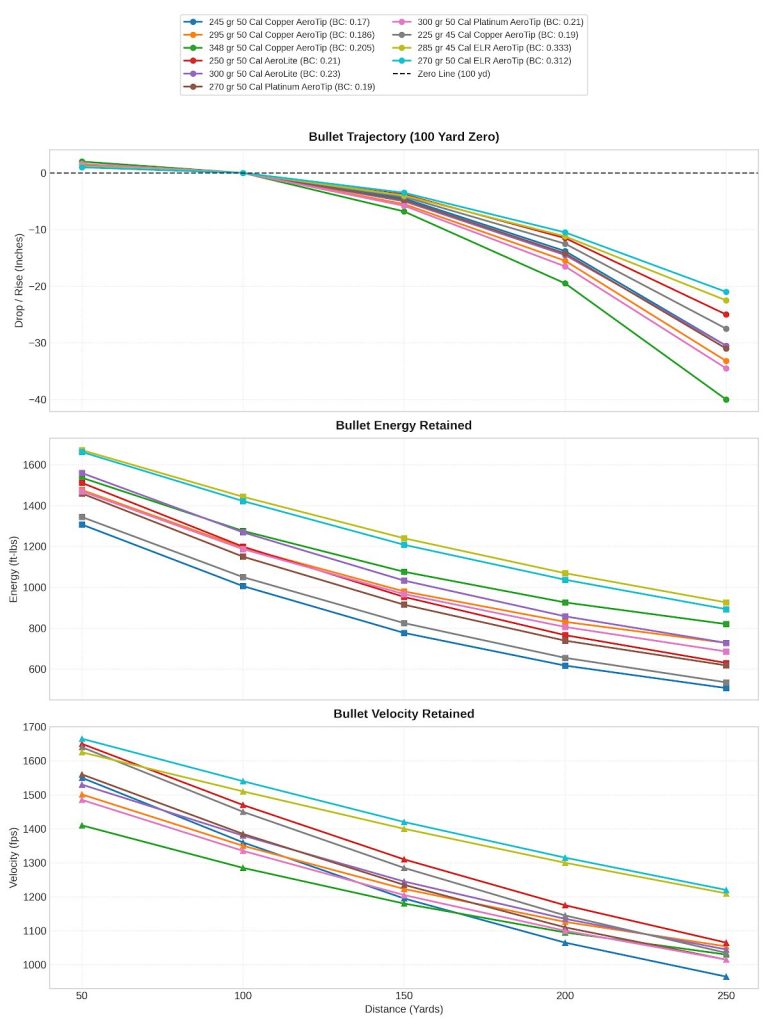
Velocity Analysis
Evaluating the velocity metrics within the table shows that the fifty caliber two hundred and fifty grain AeroLite is the absolute fastest projectile listed.
It leaves the muzzle at an impressive 1850 feet per second which gives it a massive advantage across the first one hundred yards of open air flight.
However examining the heavier bullets reveals a completely different velocity profile designed exclusively for maximum momentum retention.
The forty five caliber two hundred and eighty five grain ELR AeroTip starts at 1750 feet per second and impressively retains 1510 feet per second at the two hundred yard mark.
This specific velocity data proves that for extended hunting shots these aerodynamically superior modern projectiles preserve their supersonic stability far better than traditional blunt nose designs.
Energy Analysis
Muzzle energy dictates the sheer physical shock delivered to a heavy target upon initial bullet impact in the deep woods.
The table data highlights that the fifty caliber two hundred and seventy grain ELR AeroTip produces an incredibly high initial strike force with 1942 foot pounds of muzzle energy.
Heavy duty hunting options like the fifty caliber three hundred grain AeroLite also start incredibly strong generating 1925 foot pounds of energy at the barrel exit.
Downrange energy retention is where this modern muzzleloader system shows its massive practical superiority across vast open spaces.
By the time the projectiles reach the two hundred yard line the forty five caliber two hundred and eighty five grain ELR bullet retains 1443 foot pounds of lethal kinetic force.
High retained energy values guarantee that these specialized bullets maintain enough momentum to crush thick bones and ethically harvest heavy bodied animals at extended distances.
Trajectory Analysis
Reviewing the trajectory profile with a standard one hundred yard zero demonstrates the incredibly flat curve this advanced platform experiences at extended ranges.
The flattest shooting factory load in the chart at two hundred yards is the fifty caliber two hundred and seventy grain ELR AeroTip which exhibits a bullet drop of only 10.5 inches.
The fifty caliber two hundred and fifty grain AeroLite also provides a relatively stellar trajectory dropping just 11.5 inches at the exact same distance.
As distance increases beyond the one hundred and fifty yard line heavier blunt projectile designs begin to fall rapidly due to massive air drag.
The fifty caliber three hundred and forty eight grain Copper AeroTip plunges drastically dropping an incredible 40.0 inches by the time it reaches the two hundred and fifty yard target.
Practical holdover estimates using these chart values indicate that shooters utilizing this system require significantly less optical dialing than those firing traditional round balls.
Ballistic Coefficient Analysis
The ballistic coefficient values listed in the table reveal the incredible aerodynamic advantages of these specialized modern hunting projectiles.
The forty five caliber two hundred and eighty five grain ELR AeroTip holds the absolute highest aerodynamic rating in this specific category with a stellar score of 0.333.
Traditional heavy configurations like the fifty caliber two hundred and forty five grain Copper AeroTip feature a noticeably lower aerodynamic rating of just 0.170.
These incredibly high numbers explain exactly why the modern ELR projectiles maintain velocity and energy so efficiently when flying through open air.
The aggressively tapered nose profiles effortlessly slice through atmospheric resistance preventing them from acting like deployed parachutes in the harsh blowing wind.
According to the chart data this aerodynamic advantage guarantees that these bullets experience significantly flatter pathways and heavily reduced lateral wind drift at extended distances.
Sectional Density Analysis
Sectional density directly influences how stable a hunting bullet remains during flight and how deeply it penetrates thick muscle and bone upon arrival.
The chart confirms that the fifty caliber three hundred and forty eight grain projectile possesses an excellent sectional density rating of 0.199.
The incredibly fast fifty caliber two hundred and forty five grain option exhibits a noticeably lower sectional density value of just 0.140.
A higher sectional density means the bullet concentrates its massive physical weight over a relatively small cross sectional area forcing it incredibly deep into the vital cavity.
This specific data confirms that hunters pursuing deep straight line penetration should completely rely on the heavier projectiles to maximize their kinetic impact inside heavy brush.
Best Factory Loads Based On The Chart
For Extreme Long Range Target Shooting the forty five caliber two hundred and eighty five grain ELR AeroTip offers the flattest possible flight path available.
For Precision Deer Hunting the fifty caliber two hundred and fifty grain AeroLite provides a perfectly balanced trajectory with an exceptionally reliable terminal expansion profile.
If Maximum Initial Velocity is your primary goal the fifty caliber two hundred and fifty grain AeroLite takes the absolute top spot by reaching 1850 feet per second.
When seeking Maximum Retained Energy at extended distances the forty five caliber two hundred and eighty five grain ELR AeroTip wins easily by preserving 1443 foot pounds of strike force at two hundred yards.
For Heavy Brush Hunting the fifty caliber three hundred and forty eight grain Copper AeroTip offers unmatched mass for smashing through thick barriers without deflecting.
Key Takeaways From The Chart
The fastest projectile in the entire chart at the muzzle is the fifty caliber two hundred and fifty grain AeroLite at 1850 feet per second.
The highest initial muzzle energy is produced by the fifty caliber two hundred and seventy grain ELR AeroTip at 1942 foot pounds.
The highest retained kinetic energy at two hundred yards belongs to the forty five caliber two hundred and eighty five grain ELR AeroTip at 1443 foot pounds.
The flattest trajectory at two hundred and fifty yards is achieved by the fifty caliber two hundred and seventy grain ELR AeroTip with 21.0 inches of total bullet drop.
The highest overall ballistic coefficient listed is found on the forty five caliber two hundred and eighty five grain ELR AeroTip at 0.333.
The best overall extreme penetration performer based on combined mass and energy retention metrics is the forty five caliber two hundred and eighty five grain ELR AeroTip.
Common PowerBelt Bullet Weights
245 Grain
The two hundred and forty five grain projectile weight is a highly specialized lightweight offering designed specifically for maximum muzzle velocity and extremely flat mid range flight.
Typical muzzle velocity for this specific weight easily breaks the 1700 feet per second barrier creating a laser accurate flight path inside one hundred yards.
The primary advantage of this weight is the significantly reduced bullet drop making it exceptionally easy to use on fast moving whitetail deer.
The main disadvantage is that the smaller overall mass limits initial shock value on heavy quartering shots involving thick bone.
This specific weight is best applied in general target practice and open field deer hunting where extreme penetration is not entirely mandatory.
250 Grain
The two hundred and fifty grain AeroLite projectile represents a perfectly balanced lightweight option for shooters wanting classic performance with enhanced expansion.
Typical muzzle velocity sits comfortably around 1850 feet per second generating an immense hydrostatic shock upon initial target impact.
The single biggest advantage of this caliber is its massive hollow point cavity which ensures incredibly rapid expansion upon striking soft tissue.
The primary disadvantage is that these specific bullets are strictly designed for standard powder charges and should never be pushed to super magnum velocities.
This weight class is the ultimate choice for marksmen carrying a modern inline rifle for versatile wildlife harvesting across varied terrain.
270 Grain
The two hundred and seventy grain projectile weight represents the absolute gold standard sweet spot for perfectly balanced medium game hunting utilizing modern polymer tipped bullets.
Typical muzzle velocity is roughly 1750 feet per second which translates into incredibly consistent accuracy and heavy terminal bone crushing force.
The single biggest advantage of this weight is its traditional copper plated design which holds together beautifully when encountering heavy shoulder muscles.
The primary disadvantage is a slightly steeper initial trajectory arc when compared to the hyper fast lightweight hollow point options on the market.
This weight is the ultimate choice for hunters who require deep reliable penetration on deer alongside highly predictable trajectory patterns.
285 Grain
The two hundred and eighty five grain ELR bullet is a premium hunting option designed to guarantee absolutely perfect weight retention and massive energy transfer on tough targets.
Typical muzzle velocity hovers around 1750 feet per second maintaining immense structural momentum without fragmenting into small pieces upon striking heavy bone.
The advantage of this specialized bullet is its unmatched ability to cleanly pass completely through large deer leaving a massive exit wound for easy tracking.
The main disadvantage is the incredibly tight barrel twist rate required to properly stabilize this extra long projectile during flight.
This extreme weight is universally recommended for pursuing large game animals across wide open agricultural fields where deep reliable penetration is absolutely essential.
295 Grain
The two hundred and ninety five grain projectile represents the historical standard and the most popular traditional loaded weight for this specific primitive weapon platform.
Typical muzzle velocity is roughly 1670 feet per second generating an immense hydrostatic shock upon initial target impact.
The single biggest advantage of this massive bullet is its unmatched ability to cleanly pass completely through large deer leaving a massive blood trail.
The primary disadvantage is a noticeably steeper initial trajectory arc when compared to the hyper fast lightweight aero tip options.
This extreme weight is universally recommended for pursuing large tough feral hogs in dense brush where deep reliable penetration is absolutely mandatory.
300 Grain
The three hundred grain bullet represents the absolute heaviest mainstream option for commercial standard velocity ammunition in this unique caliber.
Typical muzzle velocity drops down to around 1650 feet per second yielding incredible close quarters momentum and massive terminal shock.
The major benefit is that it provides massive sectional density guaranteeing the bullet will smash straight through heavy brush without deflecting entirely off course.
The disadvantage is the massive rainbow trajectory arc making rapid follow up shots on distant targets incredibly difficult without making huge elevation adjustments.
This heavyweight class is universally recommended for dedicated thick timber hunters pursuing game in environments where complete brush busting power is heavily prioritized.
Effective Range
Target Shooting
For standard paper targets the effective range easily spans from fifty yards all the way out to two hundred yards using quality factory projectiles.
At these moderate distances the heavy straight walled projectile remains comfortably stable keeping its flight path highly predictable through varying atmospheric conditions.
Professional shooters highly recommend utilizing modern tipped bullets to guarantee maximum consistency when shooting across open agricultural fields.
Open Field Hunting
When participating in open field hunting activities expert marksmen absolutely love this system because it perfectly mimics centerfire rifle performance.
Shooting out to two hundred yards is highly encouraged because the bullet retains incredible velocity and delivers ethical terminal hunting energy.
The heavy aggressively tapered projectile possesses the necessary aerodynamic efficiency to reach these extreme distances reliably under real world conditions.
Heavy Brush Hunting
Within incredibly thick timber environments the massive heavy cast bullets provide unmatched straight line tracking through light brush and heavy muscle tissue.
The incredible mass ensures that minor twigs and leaves do not drastically alter the trajectory of the projectile before it reaches the target.
Hunters operating in these dense jungles rely entirely on the heaviest available projectiles to guarantee absolute deep straight line penetration.
Competition Shooting
Within local muzzleloader matches the platform performs admirably at all standard distances out to roughly two hundred meters in capable hands.
At extreme distances the massive bullet drop requires veteran shooters to utilize specialized optical scopes with custom bullet drop compensating reticles.
Firing this heavy caliber in formal dynamic competitions requires significant physical endurance and excellent fundamental recoil management techniques.
Factors That Affect PowerBelt Ballistics
Powder Charge Volume
Powder charge volume dictates the core fundamental relationship between quick initial exit speed and late flight momentum conservation over open hunting ground.
Utilizing magnum charges of one hundred and fifty grains by volume pushes the bullet much faster delivering exceptional flat trajectories.
Lower standard hunting charges start the bullet noticeably slower but generate significantly less recoil for smaller framed shooters.
Powder Type
Modern synthetic powder substitutes produce drastically higher velocities and much cleaner burns than traditional black powder options.
Utilizing loose powder allows for precise granular tuning while utilizing preformed pellets provides incredible convenience in the field.
Hunters must carefully match their specific powder type to their chosen bullet weight to ensure absolute perfect internal combustion.
Barrel Twist Rate
Barrel twist rate plays a critical role in determining exactly how well the heavy projectile stabilizes before it exits into the open atmosphere.
A fast twist rate allows the aggressively tapered modern bullets to completely stabilize maximizing downrange accuracy and precision.
Slower traditional twist rates will cause a massive loss of accuracy which noticeably diminishes ethical harvesting capabilities at long range.
Bullet Construction
The physical exterior design of the projectile heavily affects its aerodynamic flight efficiency and terminal performance upon striking an animal.
The exclusive polycarbonate tip preserves aerodynamic integrity and absolutely prevents premature expansion during high velocity flight.
The large hollow point cavity reduces core weight allowing the bullet to be significantly longer for a vastly improved ballistic coefficient.
Ballistic Coefficient
The ballistic coefficient measures exactly how easily a bulky bullet overcomes raw air resistance during its journey to the distant target.
A higher ballistic coefficient directly reduces vertical bullet drop mathematically and massively minimizes the lateral drift caused by harsh crosswinds.
Because these bullets possess an excellent aerodynamic rating shooters can aggressively engage targets across open valleys with supreme confidence.
Altitude
High altitude mountain environments feature incredibly thin air which drastically reduces the aerodynamic drag forces acting against a flying bullet in motion.
Shooters operating in elevated mountain ranges will notice slightly flatter overall pathways and much higher retained velocities than those shooting near sea level.
Temperature
Air temperature heavily impacts atmospheric density with freezing cold temperatures creating denser air that slows down flying projectiles much faster over distance.
Additionally extreme temperature fluctuations can completely alter powder burn rates inside the barrel causing unexpected changes in initial muzzle velocity.
Wind
Due to the incredibly large physical profile of half inch bullets crosswinds have a profound and massive effect on the downrange trajectory.
A strong continuous crosswind will push the bullet sideways over long distances requiring precise windage alignment based on detailed ballistic chart evaluations.
Zero Distance
The specific distance at which a hunting rifle is physically zeroed determines the entire mathematical arc of the flight trajectory relative to the optical sights.
An inappropriate zero distance can cause the heavy bullet to impact several inches high at close range leading to frustrating misses on small deer vitals.
Best Zero Distance
50 Yard Zero
A fifty yard zero is highly popular and considered the absolute gold standard among civilian hunters operating in incredibly dense timber environments.
The primary advantage is that it aligns the sights perfectly for close quarters engagements where the vast majority of deep woods harvests occur.
The main disadvantage is that the heavy bullet will drop noticeably when taking unexpected shots at game standing near the one hundred and fifty yard line.
This zero is best for general target practice baseline rifle testing and ensuring total mathematical simplicity when hunting in thick overgrown brush.
100 Yard Zero
A one hundred yard zero serves as an exceptional general purpose baseline for hunters anticipating shots across small open fields or clear cuts.
Utilizing a one hundred yard zero keeps the bullet path relatively flat through the first one hundred and fifty yards of travel without requiring complex mental math.
The disadvantage is a significant mid range bullet drop near two hundred yards which requires the hunter to aim slightly high to hit the exact center of the vital zone.
This zero is highly recommended for field marksmen who require instant readiness out to one hundred and fifty yards without adjusting their optical elevation turrets.
150 Yard Zero
A one hundred and fifty yard zero is an incredibly specialized configuration utilized only by hunters operating in open woods with modern magnum muzzleloaders.
The massive advantage is that it completely eliminates the need to hold high when engaging distant animals right at the extreme edge of the effective hunting range.
The severe disadvantage is that the bullet flies significantly higher than the line of sight at close distances which guarantees high misses on small targets.
This approach is best reserved for dedicated medium range field shooting where target distances are consistently uniform and always relatively far away.
200 Yard Zero
A two hundred yard zero is entirely impractical for standard muzzleloader platforms due to the massive rainbow trajectory arc it forcefully creates.
The major detriment of attempting this zero is that the bullet trajectory would fly extremely high at mid range making practical hits mathematically impossible.
The heavy blunt projectile simply lacks the velocity and aerodynamic efficiency to ever maintain a flat path across this extreme distance.
This zero is strictly an academic absurdity and should never be applied to practical tactical shooting scenarios or standard big game hunting operations.
PowerBelt Compared To Traditional Sabots
| Projectile Type | Loading Effort | Accuracy | Trajectory At 150 Yards | Retained Energy | Sabot Fouling | Overall Performance |
| PowerBelt AeroTip | Extremely Easy | Superb | 4.5 in Low | Excellent | None | Ultimate Modern Muzzleloader Standard |
| Traditional Sabot | Difficult | Excellent | 5.5 in Low | Very Good | Severe | Classic Inline Performance |
| Full Bore Conical | Moderate | Good | 8.0 in Low | Massive | None | Unmatched Heavy Bone Penetration |
| Round Ball | Very Easy | Fair | 15.0 in Low | Poor | None | Traditional Primitive Harvesting |
| PowerBelt ELR | Very Easy | Match Grade | 4.0 in Low | Maximum | None | Supreme Extreme Long Range Domination |
The major difference shown above is that the modern full bore projectile absolutely dominates older traditional sabot designs in terms of loading convenience and bore cleanliness. It delivers incredible medium bore mass making it the premier choice when massive tissue damage is prioritized while entirely eliminating plastic sabot fouling. When compared to the massive traditional conical bullets the modern aerodynamic option delivers vastly superior flight paths while providing nearly identical terminal performance on standard white tailed deer.
Frequently Asked Questions
What exactly is the main purpose of this ballistic chart?
It is used to predict exactly how much an advanced muzzleloader bullet will fall due to gravity at specific distances allowing hunters to adjust their aim accordingly.
Why do traditional round balls drop much faster than these modern bullets at long range?
Traditional round balls start with poor aerodynamics and experience massive atmospheric drag causing them to fall towards the earth much quicker than elongated hunting rounds.
Does a heavy hunting bullet always drop more than a light bullet?
Not necessarily because heavy sleek bullets maintain their momentum incredibly well over long distances resulting in flatter downrange trajectories.
How does wind affect the numbers listed on a standard drop chart?
A drop chart strictly measures vertical gravitational pull but shooters must also calculate horizontal wind deflection separately using specialized windage data tables.
Do I absolutely need a completely different chart for different powder charges?
Yes because lower powder charges generate significantly lower muzzle velocities which mathematically alters the entire trajectory profile across all measured distances.
Can I completely trust the ballistic data printed on the packaging?
Factory printed data provides an excellent baseline estimate but actual real world environmental conditions and specific rifle variations require shooters to physically verify the exact drops.
What does the term ballistic coefficient specifically mean on these charts?
It is a specific mathematical numerical value representing exactly how efficiently a tapered bullet slices through the dense air and resists atmospheric drag during its flight.
Why is retained energy retention incredibly important for hunting applications?
High retained kinetic energy ensures the heavy bullet hits the animal with enough physical force to penetrate deeply and expand reliably creating a highly ethical harvest.
Does the temperature of my powder change the drop chart numbers significantly?
Yes extremely hot powder generates slightly higher internal chamber pressures which increases muzzle velocity and makes the bullet strike slightly higher than expected.
How often should I manually update my personal ballistic drop chart?
You should completely update your specific drop chart whenever you change your powder volume zero distance optical scope or travel to a drastically different geographic altitude.