The main pros of IMI 9mm Luger ammo 115 grain jacketed hollow point are its highly reliable military specification primers, consistent feeding in semi-automatic pistols, and affordable price for bulk defensive practice, while the main cons are its older hollow point design that can clog on heavy clothing and less consistent expansion compared to premium bonded ammunition. This Israeli manufactured load offers shooters a cost-effective way to train with the exact same ammunition they use for personal defense. While it provides adequate terminal performance for concealed carry, it lacks the advanced jacket to core bonding found in top tier defensive rounds, meaning it may fragment or under-penetrate through difficult barriers.
Table of Contents [Click to open]
IMI 9mm Luger Ammo 115 Grain Jacketed Hollow Point Pros And Cons
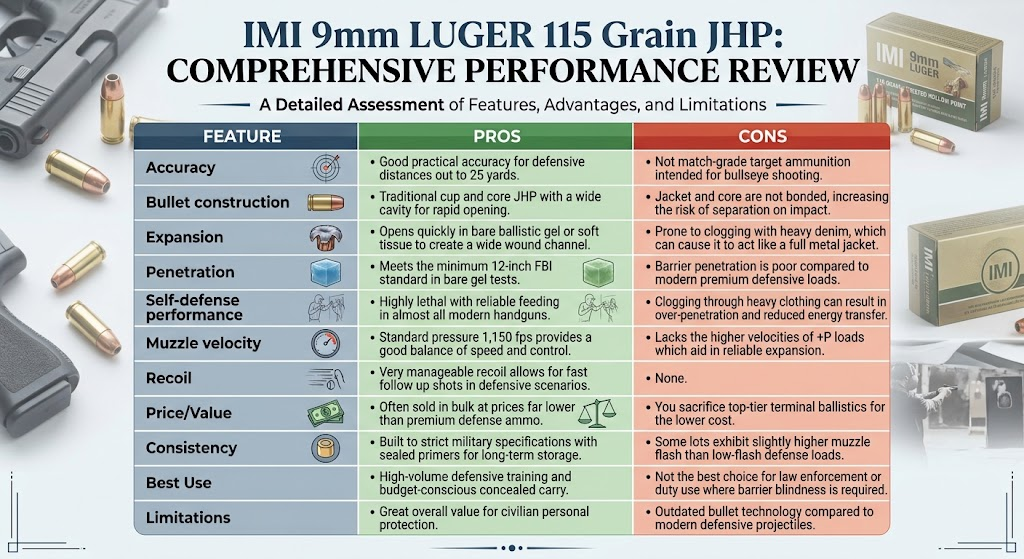
| Feature | Pros | Cons |
| Accuracy | Good practical accuracy for defensive distances out to 25 yards. | Not match-grade target ammunition intended for bullseye shooting. |
| Bullet construction | Traditional cup and core JHP with a wide cavity for rapid opening. | Jacket and core are not bonded, increasing the risk of separation on impact. |
| Expansion | Opens quickly in bare ballistic gel or soft tissue to create a wide wound channel. | Prone to clogging with heavy denim, which can cause it to act like a full metal jacket. |
| Weight retention | Retains enough mass for adequate penetration in unobstructed soft targets. | Tends to shed fragments and lose weight when striking intermediate barriers. |
| Penetration | Meets the minimum 12-inch FBI standard in bare gel tests. | Barrier penetration is poor compared to modern premium defensive loads. |
| Self-defense performance | Highly lethal with reliable feeding in almost all modern handguns. | Clogging through heavy clothing can result in over-penetration and reduced energy transfer. |
| Muzzle velocity | Standard pressure 1,150 fps provides a good balance of speed and control. | Lacks the higher velocities of +P loads which aid in reliable expansion. |
| Muzzle energy | Generates approximately 338 ft-lbs of energy at the muzzle for solid terminal effect. | Less kinetic energy than heavier 124-grain or 147-grain defensive loads. |
| Trajectory | Shoots flat and true at standard pistol engagement ranges. | The light 115-grain bullet loses velocity quickly past 50 yards. |
| Effective range | Excellent for close quarters personal defense inside 15 yards. | Energy and expansion reliability drop off quickly beyond 25 yards. |
| Performance from shorter barrels | Feeds flawlessly in micro-compact concealed carry pistols. | Short barrels lower the velocity, which further hampers expansion reliability. |
| Recoil | Very manageable recoil allows for fast follow up shots in defensive scenarios. | None. |
| Price/value | Often sold in bulk at prices far lower than premium defense ammo. | You sacrifice top-tier terminal ballistics for the lower cost. |
| Consistency | Built to strict military specifications with sealed primers for long-term storage. | Some lots exhibit slightly higher muzzle flash than low-flash defense loads. |
| Best use | High-volume defensive training and budget-conscious concealed carry. | Not the best choice for law enforcement or duty use where barrier blindness is required. |
| Limitations | Great overall value for civilian personal protection. | Outdated bullet technology compared to modern defensive projectiles. |
Accuracy
Independent tests show that IMI 9mm 115-grain JHP delivers excellent combat accuracy. At standard defensive distances of 7 to 15 yards, it will easily group within a few inches, which is more than sufficient for center mass hits. While it is not designed to be match-grade target ammunition, its consistency is generally on par with standard full metal jacket practice rounds, allowing you to train accurately.
Bullet Construction And Expansion
This ammunition uses a traditional cup and core jacketed hollow point design, often referred to by IMI as a “Di-Cut” hollow point. The jacket features skives or cuts around the rim to help initiate expansion when it hits fluid. In bare ballistic gel, it performs very well, opening rapidly to create a substantial wound cavity. However, because the lead core and copper jacket are not mechanically or chemically bonded, there is a higher risk of the bullet breaking apart during expansion.
Penetration And Weight Retention
In ideal conditions, this 115-grain load penetrates to the FBI recommended depth of 12 to 18 inches. The weakness of this older bullet design shows up when intermediate barriers are introduced. If the bullet strikes auto glass, sheet metal, or even heavy bone, the lack of bonding often causes the jacket to separate from the core. This results in poor weight retention and shallow penetration compared to modern defensive rounds.
Self-Defense Performance
For a budget-friendly concealed carry load, the IMI 115-grain JHP is highly effective. Its strongest attribute is its feeding reliability. The bullet profile closely mimics a standard ball round, ensuring it cycles flawlessly in almost all modern semi-automatic handguns. The main concern for self-defense is the heavy clothing test. If the hollow point cavity fills with denim or thick jacket material, the bullet can fail to expand and over-penetrate the target like a solid projectile.
Velocity And Energy
IMI loads this ammunition to standard 9x19mm Parabellum pressures. It advertises a muzzle velocity of 1,150 feet per second and 338 foot-pounds of muzzle energy from a standard 4-inch test barrel. This provides a great balance of speed and control, ensuring the bullet has enough velocity to expand without generating excessive recoil.
Trajectory And Range
Like most standard pressure 9mm loads, the practical range of this ammunition is dictated by the shooter’s ability rather than the bullet’s trajectory. Inside of 25 yards, the bullet path is virtually flat. At 50 yards and beyond, the lightweight 115-grain projectile will begin to drop noticeably and bleed off the velocity required to ensure hollow point expansion.
Recoil
The 115-grain weight is on the lighter end of the 9mm spectrum, resulting in a snappy but very manageable recoil impulse. Because it is a standard pressure load, shooters will find it very comfortable to shoot out of compact and full-size handguns. This low recoil makes it much easier to acquire the sights quickly for rapid follow up shots during a defensive encounter.
Price And Value
The greatest advantage of IMI 9mm JHP is its value proposition. It is frequently sold in 50-round boxes or large bulk cases for significantly less money than premium defense ammunition like Federal HST or Speer Gold Dot. This allows concealed carriers to actually train with their self-defense ammunition rather than practicing with cheap full metal jacket rounds and carrying expensive hollow points that they rarely test in their gun.
Main Drawbacks
The most meaningful disadvantages of the IMI 115-grain JHP revolve around its outdated bullet technology. The lack of a bonded core limits its performance through barriers, and the cavity design is highly susceptible to clogging when passing through heavy winter clothing. Additionally, some shooters report that IMI ammunition utilizes powders that produce a brighter muzzle flash in low-light conditions compared to specialized low-flash defensive rounds.
Final Verdict
Is IMI 9mm Luger ammo 115 grain jacketed hollow point good?
Yes, it is a good and highly reliable option for shooters on a budget.
This load is best suited for civilians looking to stock up on bulk defensive ammunition or those who want to run high-volume training sessions using hollow points to verify feeding reliability in their carry gun. It features excellent military-grade primers and consistent quality control.
However, shooters looking for the absolute best terminal performance, consistent expansion through heavy clothing, and barrier-blind capabilities would be better served spending the extra money on a modern premium bonded hollow point for their daily carry magazine.
Frequently Asked Questions (FAQs)
1. Is IMI 9mm ammunition corrosive?
No. IMI manufactures this 9mm ammunition using modern, non-corrosive Boxer primers. It is completely safe to shoot in your handguns without worrying about corrosive salt damage to the barrel.
2. Where is IMI ammunition made?
IMI stands for Israel Military Industries. The ammunition is manufactured in Israel and is built to strict military specifications.
3. What does “Di-Cut” mean regarding IMI hollow points?
“Di-Cut” refers to the specific manufacturing process IMI uses to cut the skives into the copper jacket around the hollow point cavity. These cuts are designed to weaken the jacket specifically at the tip to help initiate rapid expansion upon impact.
4. Is this ammunition rated as +P?
No, this specific 115-grain load is loaded to standard 9mm pressures. It is safe to use in any modern 9mm handgun rated for standard ammunition.
5. Will this feed well in a micro-compact concealed carry gun?
Yes. The rounded profile of the IMI hollow point closely mimics standard full metal jacket ammunition, making it highly reliable when feeding up the feed ramp of steep micro-compact pistol barrels.
6. Does the IMI 115-grain JHP pass the FBI heavy clothing test?
It struggles with this specific test. Like many older traditional hollow point designs, the cavity tends to plug up with heavy denim or winter clothing, which can prevent the bullet from expanding.
7. Are the primers sealed on IMI ammunition?
Yes. Because it is manufactured by a military contractor, IMI often applies a visible sealant around the primer pocket to protect the powder charge from moisture and oil during long-term storage.
8. Can I reload the brass casings?
Yes. IMI uses high-quality brass casings and standard Boxer primers, making them excellent candidates for reloading once they have been fired.
9. Is this a good round for target practice?
Absolutely. Because it is priced much lower than premium defensive ammunition, it is an excellent choice for target practice, allowing you to verify that your carry gun cycles hollow points reliably.
10. Is the bullet jacket bonded to the core?
No. This is a traditional cup and core bullet. The lead core is simply swaged into the copper jacket, meaning they can separate if the bullet strikes a hard barrier like bone or glass.