Twist rate is simply the distance it takes for the rifling inside your barrel to complete one full 360-degree rotation. A 1:10 twist means the bullet completes one full spin every 10 inches it travels down the barrel.
Before you can calculate if a bullet will stabilize, you need to know your barrel’s actual twist rate. You can either measure the barrel you already have, or use math to calculate what twist rate a specific bullet requires.
Table of Contents [Click to open]
How to Measure Your Current Barrel (The Cleaning Rod Method)
If you don’t know the twist rate of your rifle, you don’t need a gunsmith to figure it out. You can measure it yourself using a rotating cleaning rod, a tight-fitting patch, and a marker.
1.Prep the Rod:
Attach a jag and a tight-fitting patch to a cleaning rod that has a freely rotating handle. Insert it into the barrel from the breech end until it engages the rifling.
2.Mark the Starting Point:
Wrap a piece of tape around the rod right where it enters the action or the back of the receiver. Draw a line on the tape at the 12 o’clock position (top center).
3.Push and Rotate:
Slowly push the rod forward. Because the patch is tight, the rifling will force the rod to spin. Watch your mark carefully.
4.Mark the Finish Line:
Stop pushing the exact moment your mark completes one full rotation and returns to the 12 o’clock position. Make a second mark on the rod right where it enters the action.
5.Measure the Distance:
Pull the rod out and measure the distance between your two marks with a tape measure. If the distance is 8 inches, you have a 1:8 twist rate.
How to Calculate the Required Twist Rate for a Bullet
If you are building a rifle or buying a custom barrel, you need to calculate the ideal twist rate for the specific bullet you plan to shoot.
The Greenhill Formula (The Classic Method)
Developed in 1879, the Greenhill Formula is the oldest mathematical model for determining twist rate. While it is less accurate for modern, highly aerodynamic boat-tail bullets, it is still a fantastic baseline for standard flat-base projectiles.
The formula relies primarily on the bullet’s length, not its weight.
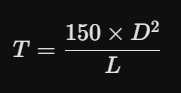
$$T = \frac{150 \times D^2}{L}$$
- T = Required Twist Rate (inches)
- D = Bullet Diameter (inches)
- L = Bullet Length (inches)
- 150 = A constant used for muzzle velocities under 2,800 fps. (Note: If your velocity exceeds 2,800 fps, replace 150 with 180).
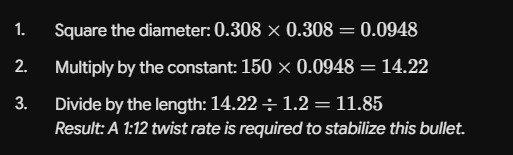
Example Calculation: A .308 caliber bullet that is 1.2 inches long traveling at 2,600 fps.
Conversational Step-by-Step
- Square the diameter: 0.308 times 0.308 equals 0.0948.
- Multiply by the constant: 150 times 0.0948 equals 14.22.
- Divide by the length: 14.22 divided by 1.2 equals 11.85.
- Result: A 1-in-12 twist rate is required to stabilize this bullet.
The Miller Twist Rule (The Modern Method)
For modern long-range shooters using long, sleek boat-tail bullets (like the Sierra MatchKing or Hornady ELD), the Miller Twist Rule is the industry standard. It corrects the flaws of the Greenhill formula by factoring in bullet weight and atmospheric conditions.
To use the Miller rule manually, you calculate for Gyroscopic Stability (SG). You want an SG between 1.5 and 2.0.
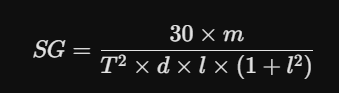
$$SG = \frac{30 \times m}{T^2 \times d \times l \times (1 + l^2)}$$
- m = Bullet weight in grains
- T = Twist rate in inches
- d = Bullet diameter in inches
- l = Bullet length in calibers (Physical length ÷ Diameter)
Because the math here gets incredibly complex once you factor in velocity and altitude corrections, most shooters rely on the Twist Rate Calculator we built previously rather than crunching this equation by hand.