Looking for a complete and reliable 340 weatherby magnum ballistics chart to understand the true long range capabilities of this powerhouse cartridge? You have found the right guide. We break down the authentic downrange trajectory, kinetic energy retention, and wind drift data for Roy Weatherby’s famous big game round. Whether you are preparing for an Alaskan brown bear hunt or an African safari, this data will show you exactly how this magnum performs and why it remains a top tier choice for serious hunters worldwide.
340 Weatherby Magnum Ballistics Chart
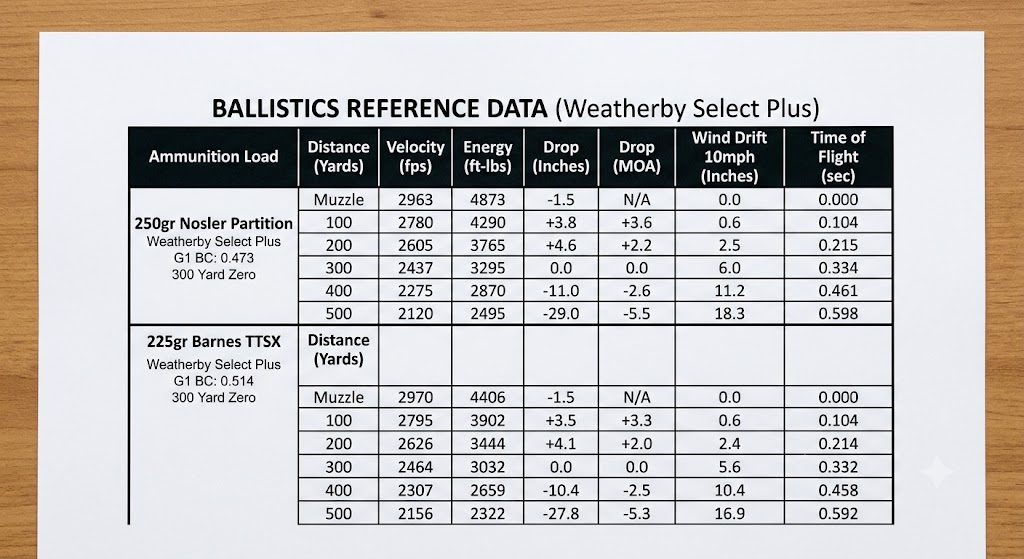
The following chart details the downrange performance of two premium factory loads: the Weatherby Select Plus 250 grain Nosler Partition and the 225 grain Barnes TTSX. The calculations use a standard 300 yard zero, a 1.5 inch sight height, and a 10 mph crosswind.
| Ammunition Load | Distance (Yards) | Velocity (fps) | Energy (ft-lbs) | Drop (Inches) | Drop (MOA) | Wind Drift 10mph (Inches) | Time of Flight (sec) |
| 250gr Nosler Partition | Muzzle | 2963 | 4873 | -1.5 | N/A | 0.0 | 0.000 |
| (Weatherby Select Plus) | 100 | 2780 | 4290 | +3.8 | +3.6 | 0.6 | 0.104 |
| G1 BC: 0.473 | 200 | 2605 | 3765 | +4.6 | +2.2 | 2.5 | 0.215 |
| 300 Yard Zero | 300 | 2437 | 3295 | 0.0 | 0.0 | 6.0 | 0.334 |
| 400 | 2275 | 2870 | -11.0 | -2.6 | 11.2 | 0.461 | |
| 500 | 2120 | 2495 | -29.0 | -5.5 | 18.3 | 0.598 | |
| 225gr Barnes TTSX | Muzzle | 2970 | 4406 | -1.5 | N/A | 0.0 | 0.000 |
| (Weatherby Select Plus) | 100 | 2795 | 3902 | +3.5 | +3.3 | 0.6 | 0.104 |
| G1 BC: 0.514 | 200 | 2626 | 3444 | +4.1 | +2.0 | 2.4 | 0.214 |
| 300 Yard Zero | 300 | 2464 | 3032 | 0.0 | 0.0 | 5.6 | 0.332 |
| 400 | 2307 | 2659 | -10.4 | -2.5 | 10.4 | 0.458 | |
| 500 | 2156 | 2322 | -27.8 | -5.3 | 16.9 | 0.592 |
Ammunition Load
This column specifies the bullet weight and the exact projectile used. Bullet weight is measured in grains. The 250 grain Nosler Partition provides maximum weight for deep penetration on heavy bone. The lighter 225 grain Barnes TTSX is a solid copper bullet that retains nearly all of its weight upon impact while offering a slightly flatter trajectory.
Distance
Distance is measured in yards from the muzzle of the rifle. The table provides data at intervals up to 500 yards. This covers the practical ethical hunting distances for this cartridge on large game animals.
Velocity
Velocity is the speed of the bullet measured in feet per second (fps). The cartridge launches both bullet weights at nearly 3,000 fps. Because of the aerodynamic efficiency of these bullets, they both stay well above the 1,800 fps threshold required for reliable expansion even at 500 yards.
Energy
Energy measures the kinetic knockdown power of the bullet, calculated in foot pounds (ft-lbs). Muzzle energy is massive, starting between 4,400 and 4,800 ft-lbs. A generally accepted minimum for elk is 1,500 ft-lbs. Both loads easily carry over 2,300 ft-lbs at 500 yards, guaranteeing devastating terminal performance on the largest game.
Drop in Inches
Bullet drop shows the physical height of the bullet relative to your line of sight. The negative 1.5 inches at the muzzle accounts for the height of the rifle scope above the bore. With a 300 yard zero, the bullet arcs upward, peaking around 4.6 inches high at 200 yards before dropping back to the crosshairs at 300 yards.
Drop in MOA
MOA stands for Minute of Angle. This statistic tells you exactly how much to adjust your rifle scope turrets for a precise shot at distance. If the target is 400 yards away, you simply dial your elevation turret down 2.5 or 2.6 MOA to place the bullet exactly on your crosshairs.
Wind Drift
Wind drift measures how far a 10 mph full value crosswind will push the bullet laterally off target. Because these bullets are heavy and fast, they resist the wind exceptionally well. At 300 yards, the wind only moves the bullet about 6 inches, making field corrections highly manageable.
Time of Flight
Time of flight is the exact fraction of a second it takes the bullet to travel from the muzzle to the target. This statistic is critical for hunters who need to estimate lead on a moving animal. At 300 yards, the bullet reaches the target in just over one third of a second.
Ballistic Coefficient
The Ballistic Coefficient (BC) is a numerical rating of how efficiently the bullet cuts through the air. A higher number indicates less aerodynamic drag. The Barnes TTSX has a higher G1 BC of 0.514 compared to the Nosler at 0.473. This is why the Barnes load drops slightly less and resists wind better at extended ranges.
Zero Distance
The zero distance is the exact yardage where the rifle sights are aligned with the bullet impact. A 300 yard zero is standard for fast magnum cartridges. This specific zero distance maximizes the point blank range, allowing a hunter to aim directly at the center of the vitals on a large animal from zero to 350 yards without needing to hold over.
Cartridge Overview
Introduced in 1962, this cartridge was created by Roy Weatherby to offer maximum performance in the .338 caliber space. It is based on a blown out .300 H&H Magnum case shortened to fit standard magnum actions. The enormous powder capacity allows it to push heavy hunting bullets much faster than standard magnums, resulting in a remarkably flat trajectory and massive kinetic energy.
Hunting Performance and Effective Range
This round is built for the largest and toughest game on the planet. It is highly favored by guides in Alaska for massive coastal brown bears and giant Yukon moose. It is also a premier choice for African plains game like eland and kudu. The effective ethical range easily extends to 600 yards for a skilled marksman using modern rangefinders and dialing optics.
Comparison to the .338 Winchester Magnum
While the .338 Winchester Magnum is far more common, the Weatherby version dominates it in sheer power. Both cartridges use the exact same diameter bullets. However, the Weatherby case holds significantly more powder. This results in an extra 150 to 200 fps of velocity. The Weatherby shoots flatter and hits harder, though ammunition is more expensive and harder to find.
Recoil Characteristics
The immense power of this cartridge comes with a heavy physical penalty. The recoil is severe. Firing a 250 grain bullet at nearly 3,000 fps generates over 45 ft-lbs of felt recoil in a standard weight hunting rifle. This is roughly double the recoil of a standard .270 Winchester. A high quality recoil pad and a properly installed muzzle brake are strongly recommended to tame the rifle and prevent the shooter from developing a flinch.
Best Factory Ammunition Options
Factory ammunition is premium grade and priced accordingly. Weatherby Select Plus is the primary source for high quality loaded ammunition. The 250 grain Nosler Partition remains the traditional favorite for heavy bone penetration. The 225 grain Barnes TTSX is the modern favorite for shooters who want 100 percent weight retention and slightly less recoil. Hornady also produces excellent loads for this caliber in their Custom line.
Frequently Asked Questions
Is this cartridge good for long range precision shooting?
While it is incredibly accurate and shoots flat, it is rarely used for high volume target shooting due to the high cost of ammunition, rapid barrel wear, and punishing recoil. It is purely a specialized hunting cartridge.
Do I need a 26 inch barrel for this caliber?
To achieve the advertised velocities listed in the ballistics chart, a 26 inch barrel is required. The slow burning powder needs that extra length to fully combust. Using a 24 inch barrel will result in a velocity loss of approximately 50 to 75 fps.
Can I form this brass from other cartridges?
Yes. Experienced reloaders often form the brass by necking up .300 Weatherby Magnum cases. This is a common practice since factory loaded ammunition and dedicated factory brass can sometimes be difficult to find in local sporting goods stores.