General Dynamics Ordnance and Tactical Systems, known as GD-OTS, builds military small calibre ammunition in Canada, and its published ballistics cover 17 loads in four calibres: 5.56mm, 7.62mm, 9 x 19 mm and 40 x 46 mm. Every figure the company prints is a muzzle velocity in metres per second, and the fastest load is the 5.56mm SRTA ToxFree training round at 1,180 m/s.
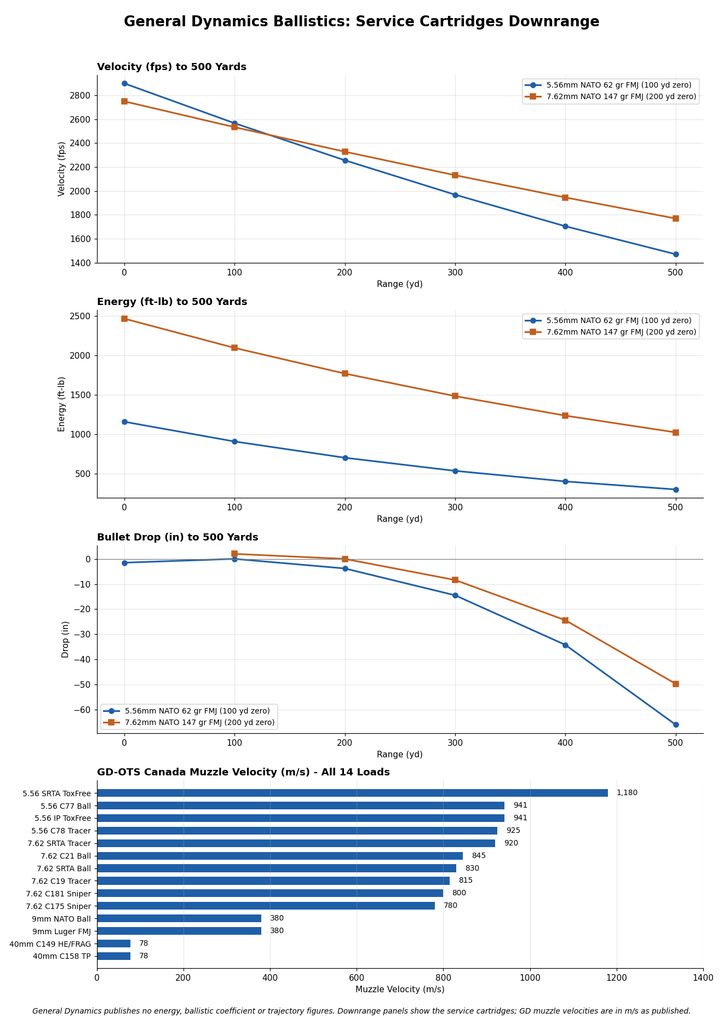
GD publishes no muzzle energy, no ballistic coefficient and no trajectory table for any load, so this chart opens with the downrange picture of the three service cartridges it builds, 5.56mm NATO, 7.62mm NATO and 9mm NATO, then gives the company’s own published muzzle figures in full. All GD figures below are metric, exactly as printed in the Canadian datasheets and product pages.
Table of Contents [Click to minimize]
General Dynamics Ballistics: Velocity and Energy Chart: Service Rifle Loads to 500 Yards
| Load | Bullet Weight | B.C. | Zero | Vel Muzzle (fps) | Vel 100 yd (fps) | Vel 200 yd (fps) | Vel 300 yd (fps) | Vel 400 yd (fps) | Vel 500 yd (fps) | Energy Muzzle (ft-lb) | Energy 100 yd (ft-lb) | Energy 200 yd (ft-lb) | Energy 300 yd (ft-lb) | Energy 400 yd (ft-lb) | Energy 500 yd (ft-lb) | Drop Muzzle (in) | Drop 100 yd (in) | Drop 200 yd (in) | Drop 300 yd (in) | Drop 400 yd (in) | Drop 500 yd (in) |
|---|---|---|---|---|---|---|---|---|---|---|---|---|---|---|---|---|---|---|---|---|---|
| 5.56mm NATO 62 gr FMJ | 62 gr | 0.274 | 100 yd | 2900 | 2567 | 2257 | 1969 | 1705 | 1471 | 1158 | 907 | 701 | 534 | 400 | 298 | -1.5 | 0.01 | -3.81 | -14.49 | -34.22 | -65.98 |
| 7.62mm NATO 147 gr FMJ | 147 gr | 0.422 | 200 yd | 2750 | 2534 | 2329 | 2132 | 1946 | 1770 | 2468 | 2096 | 1770 | 1484 | 1236 | 1023 | – | 2 | 0 | -8.4 | -24.4 | -49.7 |
The 5.56mm row uses a 100 yard zero with a 1.5 inch sight height and a G1 ballistic coefficient of 0.274 at 2,900 fps. The 7.62mm row uses a 200 yard zero with a G1 ballistic coefficient of 0.422 from a 24 inch barrel. Both rows cover the standard NATO service cartridges General Dynamics loads as the C77 Ball and the C21 Ball. The 5.56mm load holds 1,471 fps and 298 ft-lb at 500 yards with 66.0 inches of drop on its 100 yard zero, while the 7.62mm load holds 1,770 fps and 1,023 ft-lb at 500 yards with 49.7 inches of drop on its 200 yard zero.
General Dynamics Ballistics: The 9mm Service Load to 100 Yards
| Load | Bullet Weight | B.C. | Zero | Vel Muzzle (fps) | Vel 25 yd (fps) | Vel 50 yd (fps) | Vel 75 yd (fps) | Vel 100 yd (fps) | Energy Muzzle (ft-lb) | Energy 25 yd (ft-lb) | Energy 50 yd (ft-lb) | Energy 75 yd (ft-lb) | Energy 100 yd (ft-lb) | Drop Muzzle (in) | Drop 25 yd (in) | Drop 50 yd (in) | Drop 75 yd (in) | Drop 100 yd (in) |
|---|---|---|---|---|---|---|---|---|---|---|---|---|---|---|---|---|---|---|
| 9mm 115 gr FMJ | 115 gr | 0.155 | 25 yd | 1145 | 1091 | 1047 | 1010 | 977 | 335 | 304 | 280 | 260 | 244 | – | 0 | -1.8 | -5.6 | -11.6 |
The 9mm row is the 115 grain full metal jacket load from a 4 inch barrel on a 25 yard zero, with a G1 ballistic coefficient of 0.155. It matches the 9 x 19 mm NATO Ball load GD lists at 115 grains, and it keeps 977 fps and 244 ft-lb at 100 yards with 11.6 inches of drop.
General Dynamics Ballistics: Every Load GD-OTS Canada Publishes
| Cartridge | Load | Line | Projectile Weight | Muzzle Velocity (m/s) | Cartridge Length (mm) | Other Published Specs |
|---|---|---|---|---|---|---|
| 5.56mm | C77 Ball | Small Caliber Ammunition | 4.0 g | 941 | 57 | – |
| 5.56mm | C78 Tracer | Small Caliber Ammunition | 4.0 g | 925 | 57 | – |
| 5.56mm | IP ToxFree® | Small Caliber Ammunition | 3.9 g | 941 | 57 | Cartridge weight 12.1 g; projectile 3.9 g (60 grains) |
| 5.56mm | C79A1 Short Blank | Small Caliber Ammunition | n/a | – | 48 | – |
| 5.56mm | Long Blank | Small Caliber Ammunition | n/a | – | 57 | – |
| 5.56mm | SRTA ToxFree® | Small Caliber Ammunition | 2.25 g | 1180 | 57 | – |
| 7.62mm | C21 Ball | Small Caliber Ammunition | 9.5 g | 845 | 71 | Velocity at 24 m from muzzle: 838 m/s |
| 7.62mm | C19 Tracer | Small Caliber Ammunition | 9.3 g | 815 | 71 | – |
| 7.62mm | C24 Blank | Small Caliber Ammunition | n/a | – | 68 | – |
| 7.62mm | C175 Sniper | Small Caliber Ammunition | 168 grains | 780 | 71 | Sierra HPBT projectile |
| 7.62mm | C181 Sniper | Small Caliber Ammunition | 175 grains | 800 | 71 | Web prose prints 790 m/s; table and PDF print 800 m/s |
| 7.62mm | SRTA Ball | Small Caliber Ammunition | 62 grains | 830 | 68 | – |
| 7.62mm | SRTA Tracer | Small Caliber Ammunition | 60 grains | 920 | 68 | – |
| 9 x 19 mm | NATO Ball (Parabellum) CDN MK1 | Small Caliber Ammunition | 115 grains | 380 | – | Accuracy: extreme spread at 25 m under 7.6 cm |
| 9 x 19 mm | Luger Full Metal Jacket (FMJ) | Small Caliber Ammunition | 115 grains | 380 | – | Accuracy: extreme spread at 25 m under 7.6 cm |
| 40 x 46 mm | C149 High Explosive/Fragmentation (HE/FRAG) | Medium Caliber Ammunition | – | 78 | – | Maximum range 400 m |
| 40 x 46 mm | Target Practice (TP) Marking C158 | Medium Caliber Ammunition | – | 78 | – | Maximum range 400 m |
Projectile weights are printed in grams, except the sniper, SRTA and 9mm rows, which the source itself prints in grains under a column headed (g). The 5.56mm datasheet header prints Cartridge Length (m) for values of 57 and 48; the 7.62mm datasheet and the web materials treat the same figures as millimetres, and they are shown here as millimetres. Blank cartridges print n/a for projectile weight and muzzle velocity. The Canada web page prints 790 m/s in prose for the 175 grain sniper load while its own table and the PDF print 800 m/s; the table figure is shown. The web table also lists a Short Stop (RRA) row the PDF does not contain, and the PDF lists SRTA Ball and SRTA Tracer rows the web table omits; the PDF table was used and the rows were not merged. The .50 calibre RRA datasheet prints a bullet weight of about 45 g (644 grains) but no muzzle velocity, so it has no row here. The United States GD-OTS site publishes no ballistics tables at all.
Fastest General Dynamics Loads
The quickest load in the set is the 5.56mm SRTA ToxFree at 1,180 m/s, a short range training round with a 2.25 g plastic bullet. Next come the 5.56mm C77 Ball and the 5.56mm IP ToxFree at 941 m/s each, then the 5.56mm C78 Tracer at 925 m/s and the 7.62mm SRTA Tracer at 920 m/s. The fastest ball load in 7.62mm is the C21 Ball at 845 m/s.
The 5.56mm Line
Six 5.56mm loads are listed. The C77 Ball carries a 4.0 g bullet at 941 m/s, the C78 Tracer the same weight at 925 m/s, and the IP ToxFree a 3.9 g bullet at 941 m/s. The SRTA ToxFree is the light, fast training round at 2.25 g and 1,180 m/s. Two blanks, the C79A1 Short Blank and the Long Blank, print no velocity. Cartridge length is 57 mm for all six except the short blank at 48 mm.
The 7.62mm Sniper Loads
The two sniper loads are the C175 at 168 grains and 780 m/s and the C181 at 175 grains and 800 m/s. The C175 uses a Sierra hollow point boat tail bullet. The C181 carries a conflict in the source: the Canada web page prints 790 m/s in its prose while its own table and the PDF print 800 m/s, and the table figure is the one shown here.
Why This Chart Has No Energy Column
General Dynamics publishes no energy figure for any load, so the word Energy in the title has no company data behind it. The energy figures in the first tables belong to the service cartridges shown there, not to GD’s own chart. No energy value has been calculated for a GD load from its velocity and weight, because the company does not publish one.
What General Dynamics Does Not Publish
GD publishes no ballistic coefficient, no test barrel length and no trajectory or bullet drop table for any load. Its United States site publishes no ballistics tables at all; every figure here comes from GD-OTS Canada. The .50 calibre RRA datasheet prints a bullet weight of about 45 g but no muzzle velocity, so that round has no row in the table.
The 9mm and 40mm Loads
The two 9mm loads, the NATO Ball CDN MK1 and the Luger FMJ, both carry a 115 grain bullet at 380 m/s, and both print an accuracy figure of an extreme spread under 7.6 cm at 25 m. The two 40mm grenade rounds, the C149 HE/FRAG and the C158 TP Marking, both leave the muzzle at 78 m/s with a maximum range of 400 m, and neither prints a projectile weight.
Frequently Asked Questions
What is General Dynamics Ordnance and Tactical Systems?
It is the General Dynamics subsidiary that makes military ammunition, and the figures in this chart come from its Canadian arm, GD-OTS Canada.
What is the fastest General Dynamics load?
The 5.56mm SRTA ToxFree training round, at 1,180 m/s with a 2.25 g bullet.
Does General Dynamics publish muzzle energy?
No. GD publishes no energy figure for any load, so this chart has no energy column for the company’s own loads.
Does General Dynamics publish bullet drop or trajectory?
No. GD publishes no trajectory table, no ballistic coefficient and no test barrel length for any load.
What is the C77 Ball load?
It is GD’s 5.56mm ball load, with a 4.0 g bullet at a muzzle velocity of 941 m/s and a cartridge length of 57 mm.
What is the difference between the C175 and C181 sniper loads?
The C175 is a 168 grain load at 780 m/s and the C181 is a 175 grain load at 800 m/s, both in 7.62mm.
Does General Dynamics make 9mm ammunition?
Yes. It lists a 9 x 19 mm NATO Ball CDN MK1 and a 9 x 19mm Luger FMJ, both 115 grains at 380 m/s.
What is the 40mm C149 round?
It is a 40 x 46 mm high explosive and fragmentation grenade round, with a muzzle velocity of 78 m/s and a maximum range of 400 m.
Why are the figures in metres per second?
GD-OTS Canada prints its datasheets in metric units, and the figures here are kept exactly as printed, with no conversion.
Does the American General Dynamics site publish ballistics?
No. The United States GD-OTS site carries descriptive prose only, with no ballistics tables for any product.