When hunters and precision shooters search for a Burris Eliminator 3 ballistic chart, they are often looking for a single, universal drop table. However, the Burris Eliminator III does not rely on a static chart to calculate holdovers. Instead, this advanced laser rangefinding scope features a built-in ballistic computer that generates personalized firing solutions. Because every cartridge, bullet weight, and rifle setup performs differently, there is no single ballistic chart for every rifle. Shooters must program the scope using a specific Drop Number and Ballistic Coefficient (BC) matching their exact ammunition. This guide explains how to locate your data, program your scope, and utilize the Burris ballistic system effectively.
Burris Eliminator 3 Ballistic Chart
| Parameter | Purpose | Example | Required? |
| Bullet Weight | Identifies projectile mass | 143 grains | No |
| Ballistic Coefficient (BC) | Measures aerodynamic drag | .625 (G1) | Yes |
| Muzzle Velocity | Speed of bullet leaving the barrel | 2700 fps | No |
| Zero Distance | Baseline calibration range | 100 yards | Yes |
| Sight Height | Distance from bore center to scope center | 1.5 inches | No |
| Drop Number | Burris-specific trajectory code at 750 yards | 143 | Yes |
| Temperature | Affects air density and drag | 59°F | No |
| Altitude | Affects air pressure | 1000 ft | No |
| Pressure | True barometric pressure | 29.92 inHg | No |
| Humidity | Affects air density slightly | 50% | No |
| Wind | Affects horizontal bullet drift | 10 mph | No |
| Cartridge | Specifies the chambering | 6.5 Creedmoor | No |
| Factory Load | Identifies commercial ammunition | Hornady ELD-X | No |
Burris Eliminator III Programming Example
Note: The following is an example trajectory using standard atmospheric conditions and a 100-yard zero, not a universal Burris ballistic chart. Actual results will vary based on your specific rifle and environment.
Ammunition: Hornady Precision Hunter 6.5 Creedmoor 143 gr ELD-X
| Range (yards) | Velocity (fps) | Energy (ft-lbs) | Bullet Drop (in) | MOA | Wind Drift (10 mph) | Time of Flight (seconds) |
| 0 | 2700 | 2315 | -1.5 | N/A | 0.0 | 0.00 |
| 100 | 2562 | 2084 | 0.0 | 0.0 | 0.6 | 0.11 |
| 200 | 2428 | 1871 | -4.4 | -2.1 | 2.5 | 0.23 |
| 300 | 2298 | 1677 | -14.9 | -4.7 | 5.8 | 0.36 |
| 400 | 2171 | 1496 | -32.3 | -7.7 | 10.7 | 0.49 |
| 500 | 2048 | 1331 | -57.5 | -11.0 | 17.5 | 0.64 |
| 600 | 1928 | 1180 | -91.8 | -14.6 | 26.5 | 0.79 |
| 750 | 1756 | 979 | -163.6 | -20.8 | 44.1 | 1.04 |
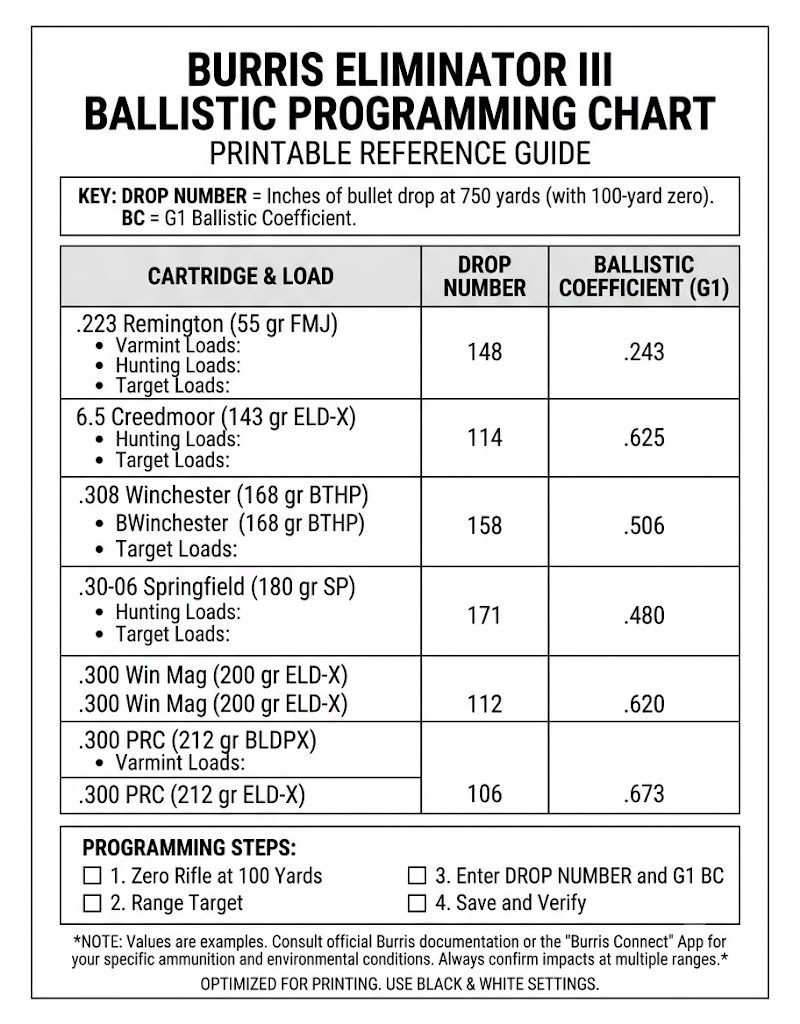
Burris Eliminator 3 Ballistic Chart Image
How the Burris Eliminator III Ballistic System Works
The Burris Eliminator III combines several technologies to streamline long-range shooting:
- Integrated laser rangefinder: Measures the exact distance to the target at the push of a button.
- Built-in ballistic computer: Processes the programmed BC and Drop Number against the laser-ranged distance.
- Automatic illuminated aiming point: Instantly lights up the correct holdover dot on the vertical crosshair.
- Angle compensation: Automatically adjusts the drop solution for steep uphill or downhill shots.
- Wind reference display: Provides a numerical value to help shooters calculate windage holds based on their reticle.
What Is the Burris Drop Number?
The Burris Drop Number is a proprietary two-digit or three-digit code used specifically for Eliminator scope programming.
It represents the bullet’s drop in inches at exactly 750 yards when zeroed at 100 yards (or 100 meters). Because standard bullet drop charts show complex trajectory curves, Burris simplifies this into a single Drop Number. The scope’s internal software uses this specific number, paired with the bullet’s aerodynamic profile, to reverse-engineer your exact trajectory curve without requiring you to input muzzle velocity or environmental data directly.
Ballistic Coefficient (BC) Explained
The Ballistic Coefficient is a numerical measurement of a bullet’s ability to overcome air resistance in flight.
- G1 BC: The traditional drag model used for flat-based bullets.
- G7 BC: A more accurate drag model for modern, aerodynamic boat-tail bullets.
- The higher the BC, the less the bullet drops and the less it drifts in the wind.
- The Eliminator III requires you to input the G1 BC during programming so the computer understands how rapidly your specific bullet will lose velocity downrange.
How to Program the Burris Eliminator III
- Zero the rifle: Sight in your rifle perfectly at 100 yards (or 50 yards for rimfire/slugs).
- Select yards or meters: Enter the setup menu and choose your preferred unit of measurement.
- Enter zero distance: Confirm your baseline zero range within the scope’s programming interface.
- Obtain the correct Drop Number: Use the Burris Connect app or website to find the Drop Number for your exact factory load.
- Enter BC: Input the G1 Ballistic Coefficient for your projectile.
- Save settings: Lock the parameters into the scope’s memory.
- Confirm trajectory at the range: Shoot at a known distance (e.g., 400 or 500 yards) using the illuminated dot to verify the programming perfectly matches your real-world ballistics.
How to Find the Correct Burris Ballistic Chart
Shooters can find their specific Eliminator III setup data through several trusted methods:
- Burris Ballistic Tools: The official online calculator on the Burris website allows you to select your exact factory ammunition to generate the Drop Number and BC.
- Burris Connect App: A mobile application containing an extensive factory ammunition database for quick field reference.
- Manual ballistic input: For handloaders, you can use a standard ballistic calculator to find your bullet drop at 750 yards, converting that directly into your custom Drop Number.
Common Burris Eliminator III Ballistic Tables
| Cartridge | Typical Bullet Weight | Typical BC (G1) | Typical Muzzle Velocity | Recommended Use |
| .223 Remington | 55 grains | .243 | 3240 fps | Varmints / Predators |
| .243 Winchester | 95 grains | .375 | 3100 fps | Deer / Antelope |
| 6.5 Creedmoor | 143 grains | .625 | 2700 fps | Medium Game / Target |
| .270 Winchester | 130 grains | .433 | 3060 fps | Deer / Sheep |
| 7mm Remington Magnum | 162 grains | .625 | 2950 fps | Elk / Mule Deer |
| .308 Winchester | 168 grains | .450 | 2650 fps | Medium Game |
| .30-06 Springfield | 180 grains | .480 | 2700 fps | Elk / Bear |
| .300 Winchester Magnum | 200 grains | .620 | 2850 fps | Large Game / Extended Range |
| .300 PRC | 212 grains | .673 | 2860 fps | Large Game / Extreme Range |
Factors That Affect Burris Ballistic Calculations
Even with correct scope programming, real-world trajectory can deviate due to external variables:
- Barrel length: Shorter barrels produce less muzzle velocity, increasing the Drop Number.
- Bullet weight: Heavier bullets typically drop faster but retain energy better at range.
- Ballistic coefficient: Variations in bullet design alter how effectively it cuts through the air.
- Elevation: Higher altitudes have thinner air, resulting in less drag and flatter trajectories.
- Temperature: Hotter air is less dense (flatter trajectory), while colder powder burns slower (reduced velocity).
- Humidity: Has a very minor effect on air density.
- Air pressure: Lower barometric pressure reduces drag.
- Wind: The Eliminator gives a wind value, but the shooter must manually hold for horizontal drift.
- Zero distance: An imperfect 100-yard zero will multiply errors exponentially at 500+ yards.
Troubleshooting Incorrect Ballistic Readings
If the illuminated dot is not aligning with your impacts, check these common issues:
- Wrong BC: Ensure you entered the G1 BC, not the G7.
- Incorrect muzzle velocity: The box velocity is often tested in 24-inch barrels. If your barrel is 20 inches, your actual velocity is lower, meaning you need a higher Drop Number.
- Improper zero: A zero that is off by just 1 inch at 100 yards can result in a 5-inch miss at 500 yards.
- Wrong Drop Number: Verify you selected the exact factory load; different bullet weights in the same caliber have vastly different Drop Numbers.
- Environmental changes: Sighting in during summer and hunting in freezing winter will alter your trajectory.
- Different ammunition lots: Powder charges can vary slightly from box to box.
Frequently Asked Questions
Does the Burris Eliminator III have a universal ballistic chart?
No. The scope requires you to program a specific Drop Number and Ballistic Coefficient based on the exact ammunition you are shooting.
How do I find my Drop Number?
You can find it by using the Burris Ballistic Calculator online, the Burris Connect mobile app, or by physically checking your bullet drop at 750 yards if you are a handloader.
Can I use handloads?
Yes. You will need to calculate your true muzzle velocity and run it through a standard ballistic calculator to find your drop in inches at 750 yards. That number becomes your Drop Number.
Does altitude change the trajectory?
Yes. Significant changes in altitude alter air density. If you program the scope at sea level and hunt at 10,000 feet, your bullet will impact high because there is less air drag. You should ideally reprogram the Drop Number for your hunting altitude.
Can I update the scope for different ammunition?
Yes. You can override the saved settings at any time by entering a new Drop Number and BC if you switch cartridges or bullet weights.
How accurate is the Burris Eliminator III?
When programmed with verified ballistic data and paired with a precision rifle, the Eliminator III is exceptionally accurate at delivering reliable aiming points out to its maximum processing range.