The main difference between calibers in terms of aerodynamics is easily visible when comparing their G1 and G7 values. While heavy, long, and sleek bullets offer exceptional wind resistance, shorter bullets often struggle to maintain energy at extended distances. Compared to traditional flat-base designs, modern boat-tail projectiles boast vastly superior drag profiles. The better choice depends on your specific rifle twist rate and terminal performance needs. If your goal is maximizing downrange precision, evaluating a ballistic coefficient chart by caliber is the most effective way to select the right projectile. Our comprehensive comparison allows readers to compare BC values across different calibers for hunting, target shooting, and long-range shooting.
Ballistic Coefficient Chart by Caliber
| Caliber | Manufacturer | Bullet | Bullet Weight (gr) | Bullet Type | G1 Ballistic Coefficient | G7 Ballistic Coefficient | Recommended Twist Rate | Typical Application |
| .17 HMR | Hornady | V-MAX | 17 | Polymer Tip | .125 | N/A | 1:9″ | Varmint |
| .22 LR | CCI | Standard LRN | 40 | Lead Round Nose | .120 | N/A | 1:16″ | Target |
| .22 Cal (.224) | Sierra | BlitzKing | 55 | Polymer Tip | .271 | .136 | 1:12″ | Varmint |
| .22 Cal (.224) | Barnes | TTSX | 62 | Solid Copper Tip | .274 | N/A | 1:9″ | Hunting |
| .22 Cal (.224) | Hornady | ELD Match | 73 | Boat Tail Polymer | .398 | .200 | 1:8″ | Match |
| .22 Cal (.224) | Berger | FULLBORE Target | 80.5 | Boat Tail Target | .441 | .226 | 1:8″ | Target |
| 6mm (.243) | Hornady | ELD-X | 103 | Polymer Tip BT | .512 | .258 | 1:8″ | Hunting |
| 6mm (.243) | Berger | Hybrid Target | 105 | Hybrid Target | .536 | .274 | 1:8″ | Target |
| 6mm (.243) | Sierra | MatchKing | 107 | HPBT | .527 | .260 | 1:8″ | Match |
| 6.5mm (.264) | Barnes | LRX | 127 | Solid Copper BT | .468 | .236 | 1:8″ | Hunting |
| 6.5mm (.264) | Lapua | Scenar | 139 | HPBT | .578 | .290 | 1:8″ | Match |
| 6.5mm (.264) | Berger | Hybrid Target | 140 | Hybrid Target | .607 | .311 | 1:8″ | Target |
| 6.5mm (.264) | Nosler | AccuBond LR | 142 | Bonded Polymer BT | .625 | .317 | 1:8″ | Hunting |
| 6.5mm (.264) | Hornady | ELD-X | 143 | Polymer Tip BT | .625 | .315 | 1:8″ | Hunting |
| 6.5mm (.264) | Hornady | ELD Match | 147 | Polymer Tip BT | .697 | .351 | 1:8″ | Match |
| .270 Cal (.277) | Hornady | ELD-X | 145 | Polymer Tip BT | .536 | .270 | 1:10″ | Hunting |
| .270 Cal (.277) | Berger | EOL Elite Hunter | 170 | Hybrid Hunting | .662 | .339 | 1:8″ | Hunting |
| 7mm (.284) | Nosler | AccuBond | 150 | Bonded Polymer Tip | .493 | .248 | 1:9″ | Hunting |
| 7mm (.284) | Hornady | ELD-X | 162 | Polymer Tip BT | .630 | .317 | 1:9″ | Hunting |
| 7mm (.284) | Berger | Hybrid Target | 180 | Hybrid Target | .680 | .349 | 1:9″ | Target |
| 7mm (.284) | Sierra | MatchKing | 183 | HPBT | .707 | .345 | 1:8″ | Match |
| .30 Cal (.308) | Lapua | Scenar | 155 | HPBT | .460 | .230 | 1:12″ | Match |
| .30 Cal (.308) | Sierra | MatchKing | 175 | HPBT | .505 | .250 | 1:11″ | Match |
| .30 Cal (.308) | Barnes | LRX | 175 | Solid Copper BT | .508 | .256 | 1:10″ | Hunting |
| .30 Cal (.308) | Hornady | ELD-X | 178 | Polymer Tip BT | .552 | .278 | 1:10″ | Hunting |
| .30 Cal (.308) | Berger | Juggernaut Target | 185 | Boat Tail Target | .555 | .284 | 1:11″ | Target |
| .30 Cal (.308) | Nosler | AccuBond LR | 190 | Bonded Polymer BT | .640 | .322 | 1:10″ | Hunting |
| .30 Cal (.308) | Hornady | ELD Match | 208 | Polymer Tip BT | .690 | .348 | 1:10″ | Match |
| .30 Cal (.308) | Berger | Hybrid Target | 215 | Hybrid Target | .691 | .354 | 1:10″ | Target |
| .338 Cal (.338) | Lapua | Scenar | 250 | HPBT | .648 | .322 | 1:10″ | Match |
| .338 Cal (.338) | Hornady | BTHP Match | 250 | HPBT | .670 | .335 | 1:10″ | Match |
| .338 Cal (.338) | Berger | OTM Tactical | 300 | Hybrid Target | .818 | .419 | 1:10″ | Tactical |
| .338 Cal (.338) | Lapua | Scenar | 300 | HPBT | .736 | .368 | 1:10″ | Match |
| .375 Cal (.375) | Barnes | TTSX | 250 | Solid Copper Tip | .424 | N/A | 1:12″ | Hunting |
| .375 Cal (.375) | Berger | LRHT | 377 | Hybrid Target | .923 | .473 | 1:8″ | Target |
| .375 Cal (.375) | Hornady | A-TIP Match | 390 | Aluminum Tip BT | 1.040 | .523 | 1:8″ | Match |
| .416 Cal (.416) | Barnes | TSX | 400 | Solid Copper BT | .436 | N/A | 1:14″ | Hunting |
| .416 Cal (.416) | Hornady | BTHP Match | 450 | HPBT | .731 | .368 | 1:14″ | Match |
Ballistic Coefficient Chart by Caliber Image
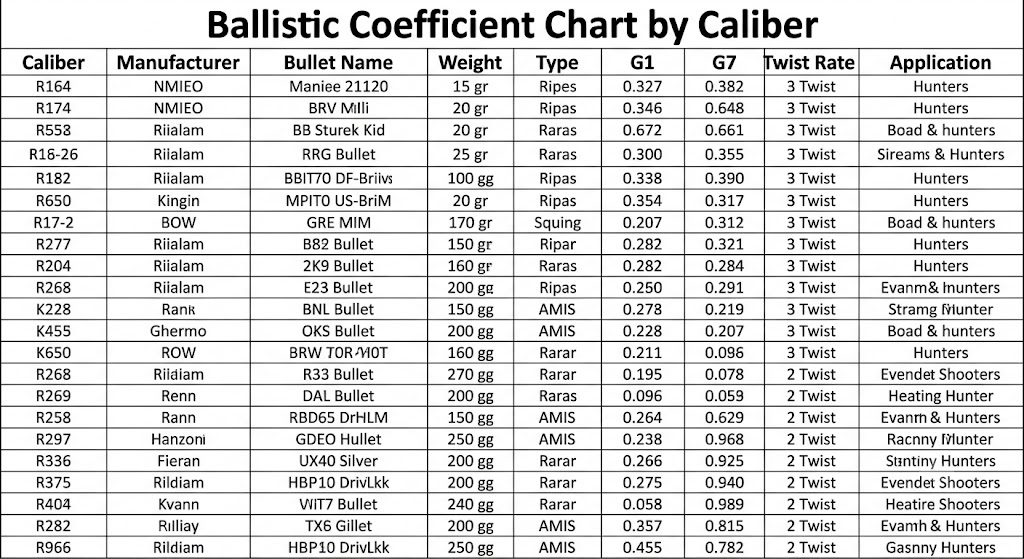
Ballistic Coefficient Comparison by Caliber
When examining bullet aerodynamics, caliber heavily dictates the potential ballistic coefficient (BC). Smaller rimfire calibers like .17 HMR and .22 LR have very low BCs, generally falling between .100 and .130. Because they lack the mass and length to cut through the wind efficiently, they shed velocity rapidly.
As you move up to centerfire calibers like 6mm, 6.5mm, and 7mm, the BC values climb drastically. These calibers are widely known for featuring high BC bullets that often exceed a .500 G1 ballistic coefficient. Heavy-for-caliber bullets in .30 caliber, .338 caliber, and .375 caliber push the boundaries even further, with specialized target bullets crossing the remarkable 1.000 G1 threshold.
G1 vs G7 Ballistic Coefficients
In the firearms industry, manufacturers typically publish two drag models to quantify how well a bullet flies: the G1 ballistic coefficient and the G7 ballistic coefficient.
- G1 measures: A standard projectile with a flat base and a short, blunt nose. It represents older, traditional bullet designs.
- G7 measures: A standard projectile featuring a long boat tail and a sharp, secant or tangent ogive. It accurately represents modern long-range bullets.
Long-range shooters strongly prefer the G7 model because modern boat tail bullets closely mirror the G7 standard shape. This makes the G7 drag prediction much more consistent across varying velocities.
| Feature | G1 | G7 |
| Best For | Flat-base bullets, older designs | Boat tail bullets, modern long-range designs |
| Velocity Sensitivity | High (changes significantly with speed) | Low (remains consistent across speeds) |
| Standard Shape | Short nose, flat base | Long pointed nose, 7.5° boat tail |
Which Calibers Have the Highest Ballistic Coefficients?
The highest ballistic coefficients belong to large magnum calibers shooting exceptionally heavy bullets. The .338 Lapua Magnum, .375 CheyTac, and .416 Barrett utilize projectiles weighing between 300 and 450 grains. For example, the Hornady .375 caliber 390-grain A-TIP boasts a G1 BC of 1.040.
In standard short-action rifles, the 6.5mm and 7mm calibers routinely showcase the highest BCs relative to their recoil. Bullets like the 7mm 183-grain Sierra MatchKing (G1 .707) resist wind drift and retain velocity much better than lighter bullets, resulting in flatter trajectories.
Hunting Bullets vs Match Bullets
A ballistic coefficient chart reveals a clear divide between hunting bullets and match bullets. Match bullets are designed with one primary goal: maximizing aerodynamic efficiency. They feature extremely tight meplats (tips), elongated boat tails, and thin jackets.
Hunting bullets must compromise slightly on aerodynamics to ensure reliable terminal performance. To achieve controlled expansion and weight retention, they require thicker jackets and specific nose geometries (like exposed lead or large polymer tips). However, modern options like the Hornady ELD-X and Nosler AccuBond LR bridge this gap, offering near-match BCs with devastating hunting performance.
Why Ballistic Coefficient Changes
You may notice some manufacturers publish multiple BC values for the same bullet. This happens because bullet drag is not entirely static; a bullet’s ballistic coefficient changes during its flight based on several factors:
- Velocity: As a bullet slows down, its drag profile shifts. G1 BCs are especially sensitive to these velocity bands.
- Mach Number: Transonic flight (approaching the speed of sound) heavily disrupts drag.
- Bullet Shape: Meplat deformation from aerodynamic heating can lower BC (which is why manufacturers now use heat-resistant polymer tips).
- Atmospheric Conditions: While the bullet’s inherent shape doesn’t change, the effective drag changes based on air density, altitude, and temperature, which your ballistic calculator must account for.
Does Higher Ballistic Coefficient Mean Better Performance?
A higher ballistic coefficient generally translates to superior exterior ballistics. By cutting through the air with less resistance, a high-BC bullet yields distinct advantages:
- Less Wind Drift: The bullet reaches the target faster, giving the wind less time to push it off course.
- Higher Retained Velocity: The bullet stays supersonic much longer.
- Greater Retained Energy: Essential for ethical hunting, high-BC bullets carry more foot-pounds of energy to the target.
- Flatter Trajectory: Less bullet drop requires less scope dial adjustment.
The limitation? High BC bullets are incredibly long and often require custom barrel twist rates (e.g., 1:8″ or faster) to stabilize properly.
Which Ballistic Coefficient Is Best for Long-Range Shooting?
For precision shooting past 800 yards, a G7 ballistic coefficient above .300 (roughly a .600 G1) is the benchmark. Calibers like 6.5 Creedmoor, 6.5 PRC, and 7mm PRC excel here. The heavier .338 caliber bullets with G7 values over .400 represent the gold standard for Extreme Long Range (ELR) shooting, as they cheat the wind and maintain supersonic speeds past one mile.
Which Ballistic Coefficient Is Best for Hunting?
For practical hunting situations (typically under 500 yards), an astronomical BC is helpful but not strictly necessary.
A G1 ballistic coefficient between .400 and .550 is perfect for medium-to-large game. This range allows hunters to utilize standard weight-for-caliber bullets (like a .308 caliber 165-grain or 178-grain) that stabilize in factory rifles while still providing excellent retained energy and minimal wind deflection in the field.