When exploring different types of 9mm bullets, it is important to distinguish the projectile itself from the overall cartridge casing and powder charge. A 9mm bullet is the physical projectile that travels down the barrel and strikes the target, whereas the cartridge encompasses the entire loaded round. Various bullet designs alter how a round functions, feeds, and performs upon impact, serving specific roles from target practice to personal defense.
Types of 9mm Bullets
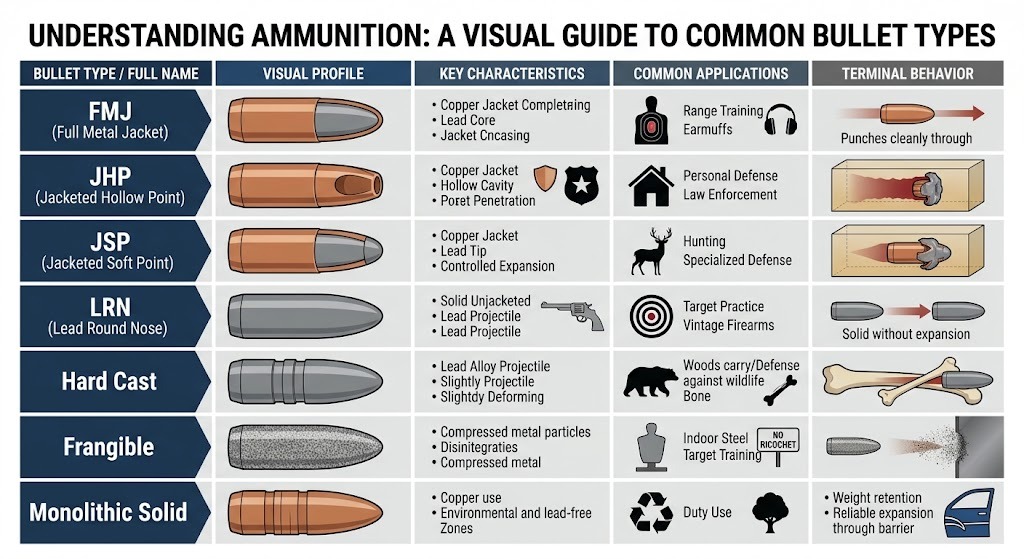
The table below outlines the major established bullet designs used in 9mm ammunition.
| Bullet Type | Full Name | General Characteristics | Common Applications | Terminal Behavior |
| FMJ | Full Metal Jacket | Lead core fully encased in a harder copper or gilding metal shell | Target practice, range training, plinking | Does not expand; passes cleanly through soft targets |
| JHP | Jacketed Hollow Point | Lead core with a hollowed-out nose cavity designed for hydraulic expansion | Personal defense, law enforcement duty | Expands rapidly upon impact to create a wider wound channel |
| JSP | Jacketed Soft Point | Lead core partially exposed at the tip with a partial copper jacket | Hunting, specialized defensive applications | Provides controlled, delayed expansion with deeper penetration |
| LRN | Lead Round Nose | Solid lead construction without a jacket; lower manufacturing cost | Target shooting, vintage firearm use | Solid projectile without expansion properties |
| Hard Cast | Hard Cast Lead | High-hardness lead alloy designed to resist deformation under high stress | Woods carry, defense against large wildlife | Deep, straight-line penetration through bone and heavy muscle |
| Frangible | Frangible Projectile | Compressed metal powder designed to disintegrate upon hitting hard surfaces | Indoor steel target training, close-quarters training | Pulverizes into fine dust upon high-velocity impact |
| Monolithic Solid | Solid Copper / Cupronickel | Solid metal projectile without a lead core, often featuring cutting edges | Duty use, strict environmental/lead-free zones | Retains weight completely and expands reliably through barriers |
Most Common 9mm Bullet Type: Full Metal Jacket (FMJ) for training and Jacketed Hollow Point (JHP) for self-defense.
What Does 9mm Bullet Mean?
The term “9mm bullet” refers specifically to the projectile portion of a centerfire cartridge measuring approximately 9 millimeters in diameter. For standard modern rounds like the 9mm Luger, the actual bullet diameter is 0.355 inches (9.02 mm).
It is a common error to confuse the bullet with the entire round. The bullet is only the projectile that exits the barrel, whereas a complete 9mm cartridge also includes the brass or steel case, the primer, and the gunpowder propellant. Different bullet designs dictate how the round behaves ballistically and how it interacts with soft or hard targets.
FMJ vs JHP 9mm Bullets
While numerous bullet designs exist, Full Metal Jacket (FMJ) and Jacketed Hollow Point (JHP) represent the two primary categories used by modern shooters. Understanding their differences is essential for selecting the correct load for your intended application.
- Full Metal Jacket (FMJ): Designed to feed smoothly and resist deformation. Because the lead core is wrapped in a hard metal shell, FMJ projectiles do not expand upon impact. This makes them ideal for high-volume target shooting where deep expansion is unnecessary.
- Jacketed Hollow Point (JHP): Engineered with an open cavity at the nose. When a JHP projectile strikes fluid-dense targets, hydraulic pressure forces the jacket to peel outward, creating a mushroom shape. This maximizes energy transfer and limits over-penetration in self-defense scenarios.
| Feature | Full Metal Jacket (FMJ) | Jacketed Hollow Point (JHP) |
| Primary Purpose | Range training and target practice | Personal defense and law enforcement |
| Expansion | None (solid pass-through) | Controlled expansion (mushrooming) |
| Cost | Economical and widely available | Premium pricing |
| Barrier Penetration | Excellent through light cover | Optimized for soft-target defense |
Common 9mm Bullet Weights
Bullet weight, measured in grains (gr), significantly influences velocity, recoil impulse, and point of impact. Most 9mm bullets fall into three standard weight classes:
- 115-Grain: The classic lightweight standard for 9mm Luger. It offers higher muzzle velocity and flatter trajectory, making it a popular choice for economical range training.
- 124-Grain: Considered an intermediate weight standard, mirroring military loads like 9mm NATO. It provides a balanced blend of velocity and momentum.
- 147-Grain: A heavy projectile weight often utilized for subsonic ammunition loads. It moves slower than lighter bullets, reducing muzzle flip and making it optimal for suppressed shooting.
9mm Bullet Design and Performance Factors
The physical shape and composition of a 9mm bullet dictate its internal, external, and terminal ballistics.
- Feeding Reliability: Bullet shapes like round nose (RN) or truncated cone (TC) feed reliably up feed ramps in semi-automatic pistols. Aggressive hollow points require modern feed ramp geometry to prevent jams.
- Weight Retention: Premium bonded JHP bullets chemically fuse the lead core to the jacket, preventing separation when passing through barriers like automotive glass or heavy clothing.
- Accuracy: Match-grade 9mm bullets feature uniform weight distribution, concentric jackets, and precise boat-tail or flat-base profiles to maximize aerodynamic stability downrange.
Different Types of 9mm Bullets FAQs
What are the different types of 9mm bullets?
Different 9mm bullet designs include Full Metal Jacket (FMJ), Jacketed Hollow Point (JHP), Jacketed Soft Point (JSP), Lead Round Nose (LRN), Hard Cast, Frangible, and Monolithic Solid projectiles.
What is the most common 9mm bullet type?
The most common 9mm bullet type for practice and target shooting is the Full Metal Jacket (FMJ), while Jacketed Hollow Point (JHP) is the most common for self-defense.
Are all 9mm bullets the same size?
No. While standard 9mm Luger and .380 ACP bullets measure 0.355 inches in diameter, other cartridges like the 9mm Makarov use a wider bullet diameter measuring 0.365 inches.
What is the difference between FMJ and JHP 9mm bullets?
FMJ bullets feature a solid metal shell over a lead core and do not expand upon impact, making them ideal for target practice. JHP bullets feature a hollow cavity designed to expand upon impact for self-defense.
What is a frangible 9mm bullet?
A frangible bullet is made of compressed metal powder designed to disintegrate into tiny particles upon striking a hard surface, reducing the risk of ricochets during indoor steel-target training.
Why do 9mm bullet weights matter?
Bullet weight affects recoil, muzzle velocity, and point of impact. Lighter bullets like 115-grain travel faster, while heavier bullets like 147-grain offer deeper momentum and quieter subsonic performance.
Can I use defense bullets at the shooting range?
Yes, but it is uncommon due to cost. Most shooters use cheaper FMJ ammunition for high-volume range practice and reserve JHP ammunition for defensive carry.
What is a subsonic 9mm bullet?
A subsonic 9mm bullet travels below the speed of sound, typically achieved using heavier 147-grain or specialized heavy projectiles to prevent a loud sonic crack when used with a suppressor.
Do 9mm bullets expand in soft targets?
Jacketed Hollow Point (JHP) and expanding monolithic bullets are specifically engineered to expand in soft targets, whereas FMJ and solid lead bullets pass straight through without expanding.
Are 9mm bullets interchangeable across different 9mm cartridges?
No. Loading the wrong bullet diameter or weight into an incompatible cartridge case or firearm chamber can cause dangerous pressure spikes or mechanical malfunctions.