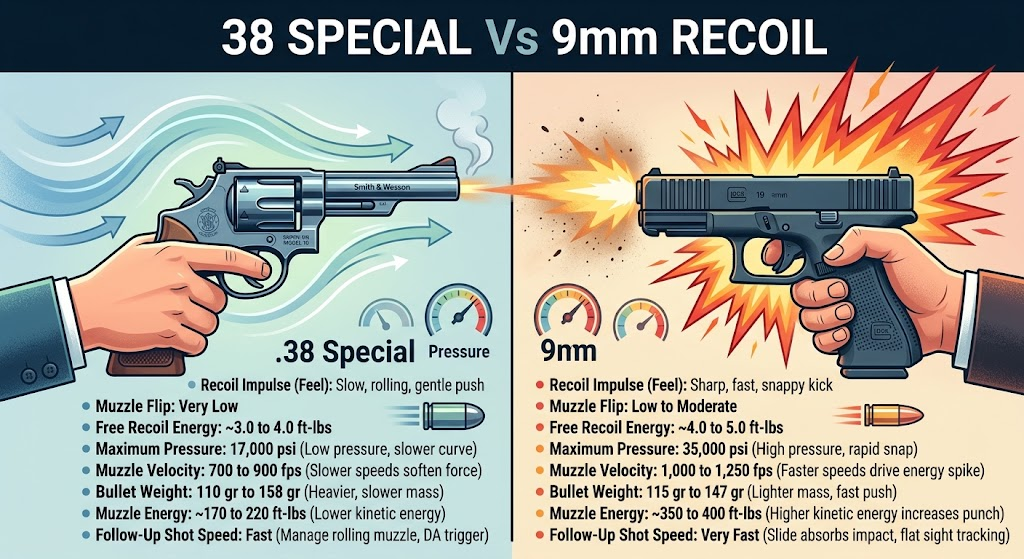
The main difference in 38 Special Vs 9mm Recoil is the total free recoil energy transferred to the shooter’s hands upon firing. The 38 Special typically produces an exceptionally mild 3.0 to 4.0 foot-pounds of recoil energy, resulting in a gentle, rolling push. The 9mm typically generates a slightly heavier 4.0 to 5.0 foot-pounds of recoil energy, delivering a faster, snappier impulse to the shooter’s wrist.
38 Special Vs 9mm Recoil Comparison
| Feature | 38 Special | 9mm |
| Free Recoil Energy | ~3.0 to 4.0 ft-lbs | ~4.0 to 5.0 ft-lbs |
| Recoil Impulse (Feel) | Slow, rolling, gentle push | Sharp, fast, snappy kick |
| Muzzle Flip | Very Low | Low to Moderate |
| Maximum Pressure | 17,000 psi (Low internal pressure creates a slower, smoother recoil curve) | 35,000 psi (High internal pressure cycles the slide violently, creating a sharper snap) |
| Muzzle Velocity | 700 to 900 fps (Slower speeds soften the overall rearward recoil force) | 1,000 to 1,250 fps (Faster speeds drive the sharp recoil energy spike) |
| Bullet Weight | 110 gr to 158 gr (Heavier, slower mass contributes to a sluggish push) | 115 gr to 147 gr (Lighter mass pushed fast creates a quick, aggressive snap) |
| Muzzle Energy | ~170 to 220 ft-lbs (Lower kinetic energy results in less equal-and-opposite reaction force) | ~350 to 400 ft-lbs (Higher kinetic energy directly increases the rearward recoil punch) |
| Follow-Up Shot Speed | Fast (Requires managing a rolling muzzle while pulling a long double-action trigger) | Very Fast (Semi-auto slide absorbs some impact, making flat sight tracking easier) |
The Physics of the Recoil Difference
To objectively evaluate why the recoil differs, we calculate the “Free Recoil Energy” using standard factory ammunition. These calculations assume both cartridges are fired from similarly weighted 25-ounce handguns.
- Load A (38 Special Standard Target): 130-grain bullet traveling at 800 fps. The powder charge is roughly 4 grains. This generates approximately 3.2 foot-pounds of free recoil energy.
- Load B (38 Special +P Defensive): 125-grain bullet traveling at 950 fps. The powder charge is roughly 5 grains. This generates approximately 4.6 foot-pounds of free recoil energy.
- Load C (9mm Standard Target): 115-grain bullet traveling at 1,150 fps. The powder charge is roughly 5 grains. This generates approximately 4.2 foot-pounds of free recoil energy.
- Load D (9mm +P Defensive): 124-grain bullet traveling at 1,200 fps. The powder charge is roughly 6 grains. This generates approximately 5.4 foot-pounds of free recoil energy.
Perceived Feel: The Push vs The Snap
“Felt recoil” is highly subjective and depends on how the pressure curve translates into your hand.
The 38 Special is widely described as a “push.” Because the cartridge operates at a very low maximum pressure, the recoil impulse is spread out over a slightly longer millisecond duration. It feels like a smooth, heavy shove. Most shooters find it incredibly comfortable, allowing them to ride the recoil without flinching.
The 9mm is widely described as a “snap.” The high pressure and high velocity create a sudden, sharp impulse. In a semi-automatic pistol, this extreme pressure cycles the slide backward rapidly. When the slide bottoms out against the frame, the gun tries to quickly twist upward out of the shooter’s grip, requiring firmer wrist locking to control.
Firearm Platform Factor
The type of firearm drastically alters how these two recoil impulses are felt.
The 38 Special is fired from revolvers, which have a fixed barrel and no moving slide. This means 100% of the recoil energy is transferred directly into the web of the shooter’s hand instantly. If fired from a heavy steel revolver, the recoil is practically non-existent. If fired from a 12-ounce ultralight snub-nose, the recoil becomes very harsh.
The 9mm is fired primarily from semi-automatic pistols. The reciprocating slide and the recoil spring act as a mechanical buffer. They absorb a fraction of the initial recoil spike and stretch the kinetic transfer over a longer period, making the 9mm feel remarkably smooth in modern polymer-framed handguns.
38 Special Pros And Cons
Pros
- Incredibly soft, rolling recoil impulse that does not induce flinching
- Ideal for teaching beginners the fundamentals of handgun marksmanship
- Fired from revolvers, meaning no slide to rack for shooters with weak grip strength
- Standard pressure loads cause practically zero wear and tear on the shooter’s joints
Cons
- Fixed-barrel revolvers transfer all recoil directly to the hand without mechanical buffering
- Ultralight snub-nose revolvers magnify the recoil, making it uncomfortable to practice with
9mm Pros And Cons
Pros
- Semi-automatic recoil spring absorbs and softens the initial recoil spike
- Snappy but highly manageable recoil allows for blisteringly fast follow-up shots
- Low recoil impulse makes it easy to track a red dot sight during rapid fire
- Can be fired all day in high-volume training classes without causing hand fatigue
Cons
- High-pressure snap can feel aggressive to absolute beginners
- Micro-compact 9mm pistols can be difficult to grip, exaggerating the muzzle flip
Final Recoil Summary
| Category | Winner | Reason |
| Lowest Recoil Energy | 38 Special | Generates roughly 1 to 2 ft-lbs less free recoil energy on average |
| Smoothest Impulse | 38 Special | Low pressure yields a rolling push rather than a violent snap |
| Mechanical Buffering | 9mm | Recoil springs absorb the shock that a fixed revolver transfers |
| Follow-Up Shots | 9mm | Snappy recoil is over faster, allowing quicker sight realignment |
| Shooter Fatigue | Tie | Both are universally considered low-recoil, all-day shooting calibers |
Which Should You Choose?
Selecting the winner depends entirely on your sensitivity to sharp movements and your preferred firearm platform.
Choose the 38 Special if you are highly sensitive to sharp, snappy recoil or if you lack the hand strength to rack the slide of a semi-automatic pistol. Fired from a medium-weight steel revolver, the 38 Special is arguably the most comfortable centerfire handgun cartridge in existence, offering a gentle push that makes target shooting a joy.
Choose the 9mm if you want to carry a modern semi-automatic pistol for self-defense or target shooting. While the recoil impulse is slightly faster and snappier, the mechanical buffer of the recoil spring makes it incredibly easy to manage. The 9mm offers the perfect balance of low recoil, fast follow-up shots, and modern tactical efficiency.
FAQs
Does the 9mm kick harder than the 38 Special?
Yes, generally speaking, the 9mm produces slightly more free recoil energy (roughly 4.0 to 5.0 foot-pounds compared to the 38 Special’s 3.0 to 4.0 foot-pounds). The 9mm also feels sharper and snappier due to its higher operating pressure.
Why does my lightweight 38 Special revolver kick so hard?
Recoil is heavily dependent on firearm weight. A 12-ounce “airweight” snub-nose revolver lacks the physical mass necessary to absorb the 38 Special’s recoil energy. As a result, all of that energy is driven directly into your hand, making it feel surprisingly harsh despite the cartridge’s low pressure.
Will a heavier gun reduce 9mm recoil?
Yes, significantly. A heavy steel-framed 9mm pistol (like a CZ-75 or Beretta 92) adds physical mass that absorbs the rearward momentum before it hits your hand. Firing a 9mm from a heavy steel gun feels almost like shooting a .22 caliber pistol.
How does +P ammunition affect recoil?
+P (Overpressure) ammunition utilizes more gunpowder to achieve higher velocities. This creates a more violent internal explosion, which directly increases the rearward recoil force. Both 38 Special +P and 9mm +P will feel noticeably harsher and snappier than their standard-pressure counterparts.