The main difference between 22 LR and 22 Short is the physical length of the cartridge case and the total weight of the projectile.Because the 22 LR features a longer case, it holds more gunpowder to launch a heavier 40-grain bullet at significantly higher velocities.This speed advantage generates roughly double the muzzle energy, allowing the 22 LR to easily reach an effective range of 100 yards, while the 22 Short is practically limited to 50 yards for quiet pest control.Although both cartridges produce practically zero recoil, they differ wildly in ammunition cost, as the highly popular 22 LR is mass-produced and costs a fraction of the price of the niche 22 Short.While some older manually operated rifles can fire both sizes, modern shooting heavily favors the 22 LR for all training, small game hunting, and target applications.
22 LR vs 22 Short
| Feature | 22 LR | 22 Short |
| Full Name | .22 Long Rifle | .22 Short |
| Cartridge Type | Rimfire | Rimfire |
| Bullet Weight | 30 to 40 grains | 27 to 29 grains |
| Bullet Diameter | 0.223 to 0.2255 inches | 0.222 to 0.224 inches |
| Case Length | 0.613 inches | 0.421 inches |
| Overall Cartridge Length | 1.000 inches | 0.695 inches |
| Typical Muzzle Velocity | 1,070 to 1,640 fps | 710 to 1,100 fps |
| Typical Muzzle Energy | 100 to 191 ft-lbs | 32 to 77 ft-lbs |
| Effective Range | 50 to 100 yards | 25 to 50 yards |
| Recoil | Extremely low | Extremely low |
| Ammunition Cost | $0.06 to $0.12 per round | $0.14 to $0.30 per round |
| Common Uses | Plinking, training, small game, competition | Quiet pest control, antique gallery guns |
| Source | SAAMI / Federal Premium | SAAMI / CCI Ammunition |
The Main Difference Between 22 LR And 22 Short
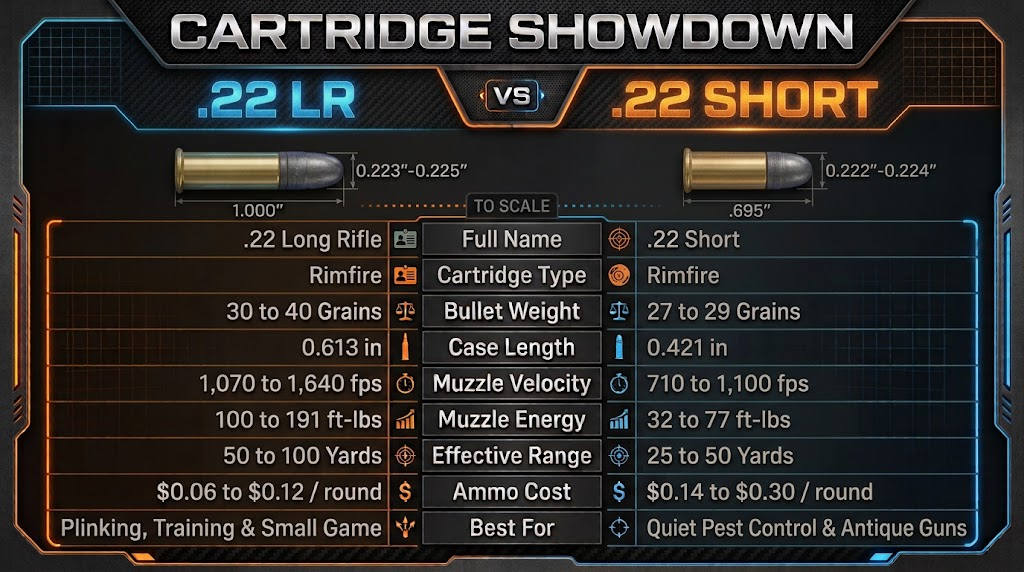
When comparing 22 LR vs 22 Short, the most defining difference is the physical dimension of the cartridge case. The 22 LR utilizes a brass case that is considerably longer than the 22 Short case.Because the 22 LR is longer, it safely contains a much larger powder charge.
This larger powder charge allows the 22 LR to push a 40-grain bullet at speeds completely unreachable by the smaller cartridge. The elevated velocity directly yields superior kinetic energy, a much flatter bullet trajectory, and an extended practical hunting range.While a 22 Short projectile experiences severe bullet drop beyond 50 yards, a 22 LR bullet delivers lethal energy and accurate hits out to 100 yards.The 22 Short produces an even quieter muzzle blast and creates slightly less recoil than the 22 LR, but it lacks the power for serious small game hunting at a distance. Ammunition cost is another massive difference for the consumer. The 22 LR is highly mass-produced, making it a fraction of the cost of the niche 22 Short.
22 LR vs 22 Short Dimensions
Cartridge dimensions dictate powder capacity, chamber compatibility, and magazine requirements. Although both cartridges utilize projectiles in the .22-caliber rimfire class, their brass casings have completely different lengths.
Based on specifications published by the Sporting Arms and Ammunition Manufacturers’ Institute (SAAMI), the 22 LR measures:
- Bullet diameter: 0.223 to 0.2255 inches
- Case length: 0.613 inches
- Rim diameter: 0.278 inches
- Case diameter: 0.226 inches
- Overall cartridge length: 1.000 inches
The 22 Short measures:
- Bullet diameter: 0.222 to 0.224 inches
- Case length: 0.421 inches
- Rim diameter: 0.278 inches
- Case diameter: 0.226 inches
- Overall cartridge length: 0.695 inches
The 22 LR is vastly longer in both the case length and the overall cartridge length. While the rim diameter and the case diameter remain identical between the two cartridges, the significant length difference prevents the 22 LR from fitting into any firearm chambered specifically for the 22 Short.
22 LR vs 22 Short Velocity
Velocity controls both trajectory and kinetic energy. The 22 LR is fundamentally faster than the 22 Short because its longer casing accommodates a much larger powder charge.
Comparing representative factory loads tested from standard rifle barrels yields the following figures:
- CCI CB Short 22 Short (29-grain solid): 710 fps.
- CCI Target 22 Short (29-grain solid): 830 fps.
- CCI High Velocity 22 Short (29-grain solid): 1,080 fps.
- CCI Standard Velocity 22 LR (40-grain solid): 1,070 fps.
- Federal AutoMatch 22 LR (40-grain solid): 1,200 fps.
You will notice conflicting data when researching 22 Short velocity. Some sources list the 22 Short at a sluggish 710 fps, while others list it over 1,080 fps. This happens because manufacturers load the 22 Short in different variations. The low-noise “CB” loads use minimal powder to remain subsonic and extremely quiet, while “High Velocity” loads maximize the tiny case’s potential. However, even the fastest 22 Short loads barely match the slowest 22 LR standard velocity loads, and the 22 LR achieves these speeds while pushing a heavier bullet.
22 LR vs 22 Short Energy
Muzzle energy measures the striking force of the bullet, which is a critical metric for hunting applications. Energy relies on both bullet weight and velocity. Because the 22 LR operates at significantly higher speeds with a heavier bullet, it produces much greater kinetic energy.
Representative muzzle energy figures based on manufacturer specifications include:
- CCI CB Short 22 Short (29-grain): 32 ft-lbs.
- CCI Target 22 Short (29-grain): 44 ft-lbs.
- CCI High Velocity 22 Short (29-grain): 75 ft-lbs.
- CCI Standard Velocity 22 LR (40-grain): 102 ft-lbs.
- Federal AutoMatch 22 LR (40-grain): 128 ft-lbs.
This energy gap drastically alters practical performance in the field. A standard 22 LR delivers roughly double the muzzle energy of a high-velocity 22 Short. The 22 Short lacks the necessary kinetic energy to guarantee an ethical kill on larger small game at extended distances, making the 22 LR far more effective for anchoring squirrels and rabbits cleanly. Do not use energy alone as a universal measure of effectiveness, but for rimfire hunting, the 22 LR is clearly the more capable round.
22 LR vs 22 Short Range
When evaluating 22 LR vs 22 Short range, shooters must clearly differentiate practical range, effective range, and maximum projectile travel. Maximum projectile travel denotes the absolute distance the bullet can fly if launched at an optimal upward angle. Both of these projectiles can travel well over a mile under ideal circumstances, requiring a safe and reliable backstop for every shot. Maximum projectile travel is never equivalent to an effective shooting range.
Effective range specifies the maximum distance at which a bullet retains sufficient accuracy, velocity, and energy to ethically dispatch game or reliably hit a target. For the 22 Short, the effective hunting range maxes out around 25 to 40 yards on thin-skinned pests. The light 29-grain bullet sheds velocity rapidly and is easily pushed off target by the wind.
The 22 LR retains functional velocity and striking energy much further downrange. Because it exits the muzzle faster and uses a heavier, more aerodynamic bullet, the 22 LR effectively resists wind drift.A shooter can zero a 22 LR rifle at 50 yards and effectively strike small targets out to 100 yards with predictable holdovers.
22 LR vs 22 Short Accuracy
Accuracy relies heavily on the quality of the firearm and the consistency of the ammunition. Today, the 22 LR is vastly more accurate than the 22 Short, entirely because of modern manufacturing priorities.
In documented independent testing, the 22 LR frequently produces incredibly tight groups at 50 yards simply due to the existence of highly specialized, match-grade rimfire ammunition. Brands like Eley and Lapua manufacture extreme-precision 22 LR loads designed specifically for Olympic competitions. Fired from a premium bolt-action rifle under controlled testing conditions, this ammunition can routinely stack five shots into groups measuring under 0.5 inches at 50 yards.
The 22 Short is no longer produced with match-grade accuracy in mind. Ammunition manufacturers produce 22 Short in very limited batches intended strictly for casual plinking or pest control. Because of the lack of premium ammunition options, the 22 Short cannot compete with the 22 LR in documented accuracy testing. Rifle and ammunition quality will always have a greater effect on accuracy than cartridge choice alone.
22 LR vs 22 Short Recoil
Both of these cartridges are celebrated for their exceptionally light recoil, and the practical difference between them is virtually zero. Cartridge energy and the overall weight of the firearm dictate the perceived recoil impulse.
When discharged from a standard 6-pound rifle, a 22 LR produces approximately 0.2 foot-pounds of free recoil energy. A 22 Short fired from a similar rifle generates roughly 0.1 foot-pounds of recoil energy.
Both cartridges generate a tiny fraction of a foot-pound of recoil force, making the physical sensation completely imperceptible to the shooter. Both are entirely comfortable for shooters of all ages and sizes to fire all day without any shoulder fatigue. The only noticeable difference is that the 22 Short produces an even quieter muzzle report than the 22 LR.
22 LR vs 22 Short Ammunition Cost
Ammunition cost heavily favors the 22 LR, which remains the most affordable factory ammunition available worldwide. Current retail prices dictate how often a shooter can practice without financial strain.
As of September 2026, representative retail prices for common factory loads indicate:
- Federal AutoMatch 22 LR (40-grain, 325-round bulk box): $19.50 to $26.00 per box, equating to $0.06 to $0.08 per round.
- CCI Standard Velocity 22 LR (40-grain, 50-round box): $4.50 to $6.00 per box, equating to $0.09 to $0.12 per round.
- CCI High Velocity 22 Short (29-grain, 100-round box): $14.00 to $20.00 per box, equating to roughly $0.14 to $0.20 per round.
- Remington 22 Short (29-grain, 50-round box): $10.00 to $15.00 per box, equating to $0.20 to $0.30 per round.
Practicing with a 22 Short typically costs two to three times as much per trigger pull as practicing with standard 22 LR ammunition. The 22 Short is an older, niche cartridge, meaning it does not benefit from the massive economies of scale that keep 22 LR prices incredibly low. Clearly distinguish normal retail pricing from bulk sale pricing when shopping.
22 LR vs 22 Short For Hunting
Hunting highlights the most practical differences between 22 LR and 22 Short ballistics. The 22 LR serves as a phenomenal small game cartridge for harvesting squirrels, rabbits, and grouse. At distances inside 50 to 75 yards, a standard 40-grain solid bullet or a 36-grain hollow point will cleanly anchor small game without ruining edible meat.
The 22 Short is generally considered too weak for modern hunting applications beyond very close ranges. While its 29-grain bullet is lethal to small rodents, rats, and pests at distances under 30 yards, it lacks the kinetic energy required to guarantee an ethical kill on larger small game at extended distances. The 22 Short is favored heavily by farmers and gardeners who need very quiet pest control near populated areas, but modern hunters universally choose the 22 LR over the 22 Short for a day in the woods. Always check local regulations to ensure rimfire calibers are legal for your intended game species.
22 LR vs 22 Short For Target Shooting
For plinking, skills training, and recreational target shooting, the 22 LR is the undisputed champion. The combination of practically zero recoil, low noise, and incredibly inexpensive ammunition makes it the ideal choice for high-volume range sessions. Formal competitive shooting disciplines, including Rimfire Benchrest and NRL22, are structured entirely around the 22 LR cartridge.
The 22 Short is poorly suited for modern target shooting. The ammunition is expensive and highly difficult to find at local retail stores.More importantly, the light 29-grain bullet and low chamber pressure do not cycle reliably in modern semi-automatic 22 LR firearms, leading to constant jams and malfunctions on the range. The 22 Short is generally reserved for antique gallery guns and older lever-action rifles.
22 LR vs 22 Short For Beginners
For new shooters, the 22 LR stands as the absolute best choice. The complete absence of recoil and the very mild report prevent inexperienced shooters from developing a flinch response. A beginner can dedicate hours to mastering sight alignment, breathing, and trigger control without physical fatigue or heavy financial costs. The 22 LR enjoys massive rifle availability, allowing a beginner to choose from thousands of affordable models.
The 22 Short offers the same low recoil and an even quieter report, but it is a poor choice for a beginner simply because of logistical issues.A beginner will struggle to find ammunition, will pay a premium for it when they do find it, and will likely experience frustrating feeding issues if they attempt to use it in a modern semi-automatic rifle. The most practical recommendation is to learn the fundamentals strictly on a dedicated 22 LR platform.
22 LR vs 22 Short Firearms
Firearm manufacturers support the 22 LR with a vast array of platforms. Consumers can select from bolt-action rifles, semi-automatic rifles, lever-action rifles, pump-action rifles, single-action revolvers, double-action revolvers, and semi-automatic pistols. The 22 LR market remains massive and universally accessible.
Firearms chambered specifically for the 22 Short are almost entirely historical antiques. Before the 22 LR became the industry standard in the early 20th century, companies like Winchester and Remington built pump-action gallery guns and single-shot rifles chambered specifically for the 22 Short. Today, virtually no major manufacturer produces a new firearm exclusively chambered for the 22 Short.
Can 22 LR And 22 Short Use The Same Gun?
In many specific cases, a single firearm can shoot both cartridges safely, but you must read the barrel stamping carefully. Because both cartridges share the exact same case diameter and rim diameter, a 22 Short will fit perfectly into a 22 LR chamber.
Many older manually operated rifles (like bolt-actions, pump-actions, and lever-actions) are specifically stamped on the barrel to safely fire “.22 Short, Long, and Long Rifle”. In these manually operated guns, or in single-action revolvers, you can freely load and shoot 22 Short ammunition. Conversely, modern semi-automatic rifles and pistols chambered in 22 LR will usually fail to cycle 22 Short ammunition.The 22 Short lacks the required recoil energy to push the heavy bolt backward, and the shorter overall length causes severe feeding jams in box magazines designed for the longer 22 LR cartridge. Do not encourage experimentation in firearms that are not explicitly documented to handle both.
22 LR vs 22 Short Ammunition Compatibility
While you can often fire a 22 Short in a 22 LR firearm, the reverse is incredibly dangerous.
- You can generally fire .22 Short in a manually operated .22 LR firearm.
- You must never fire .22 LR in a firearm stamped exclusively for .22 Short.
If you own an antique rifle or revolver chambered exclusively for the 22 Short, attempting to load and fire a 22 LR cartridge is extremely dangerous. The chamber of a dedicated 22 Short firearm is not cut deep enough to accommodate the longer case and bullet of the 22 LR. Forcing a 22 LR into that short chamber will press the bullet into the rifling prematurely, which can cause a catastrophic pressure spike upon firing, potentially destroying the antique firearm and causing severe injury. Use manufacturer documentation where possible and respect the barrel stamping.
Pros And Cons
22 LR Pros And Cons
Pros:
- Exceptionally low ammunition cost enables affordable high-volume practice.
- Massive availability of firearms and ammunition worldwide.
- Extremely quiet operation and negligible recoil.
- Perfect for target training and hunting small game out to 100 yards.Cons:
- Low velocity and energy limit terminal performance on larger predators.
- Severe bullet drop heavily limits effective hunting range compared to centerfire cartridges.
22 Short Pros And Cons
Pros:
- Extremely quiet report, making it highly useful for discreet pest control.
- Produces virtually zero recoil.
- Can be safely fired in most manually operated 22 LR firearms.Cons:
- Factory ammunition costs significantly more per round than 22 LR.
- Will not cycle reliably in modern semi-automatic firearms.
- Lacks the kinetic energy and range for serious small game hunting.
Manufacturer Data vs Independent Testing
When reviewing ballistics, readers must understand the difference between promotional manufacturer specifications and independent chronograph testing. Because the 22 Short is largely a legacy cartridge, there is very little modern independent testing heavily publicized for it. Manufacturers often test rimfire velocity using specialized 24-inch laboratory test barrels, which yield higher speeds than a consumer will achieve using a standard 16 or 18-inch field rifle.
Independent chronograph testing provides a highly realistic baseline for actual field performance. When evaluating these cartridges in real-world conditions, the 22 LR consistently outperforms the 22 Short in velocity, energy, and accuracy across every barrel length. When sources provide conflicting figures for older rimfire cartridges, controlled independent testing through the exact barrel length of the consumer’s chosen firearm represents the most practical data source to determine true ballistics.
FAQs
What is the main difference between 22 LR and 22 Short?
The main difference is the case length and bullet weight. The 22 LR utilizes a longer brass case that holds more powder, allowing it to push a heavier bullet faster and further than the older 22 Short.
Is 22 LR more powerful than 22 Short?
Yes. Because the 22 LR fires a heavier bullet at much greater speeds, it generates roughly double the kinetic energy of the 22 Short at the muzzle.
Is 22 LR faster than 22 Short?
Yes. While standard velocity loads for the 22 Short often sit between 710 and 1,080 feet per second, standard and high-velocity 22 LR loads comfortably operate between 1,070 and 1,400 feet per second.
Which has more range, 22 LR or 22 Short?
The 22 LR has a substantially longer effective range. The heavier, faster bullet of the 22 LR resists wind drift better and hits with authority out to 100 yards, while the 22 Short is practically limited to 50 yards.
Which is more accurate, 22 LR or 22 Short?
The 22 LR is vastly more accurate because modern ammunition manufacturers produce highly specialized, precision match-grade ammunition specifically for the 22 LR.
Which has less recoil?
Both cartridges produce virtually zero recoil. The physical difference in recoil is mathematically tiny and completely imperceptible to the shooter.
Which is cheaper to shoot?
The 22 LR is significantly cheaper. It generally costs between 6 and 12 cents per round, while the harder-to-find 22 Short typically costs between 14 and 30 cents per round.
Is 22 LR better for hunting?
Yes. The 22 LR delivers more kinetic energy and superior accuracy at a distance, making it vastly superior for ethically hunting small game like squirrels and rabbits. The 22 Short is reserved for close-range pest control.
Can a 22 Short shoot 22 LR?
No. Never fire a 22 LR cartridge in an antique firearm chambered exclusively for 22 Short. The 22 LR case is too long for the chamber and can cause a highly dangerous pressure spike.
Can a 22 LR shoot 22 Short?
Yes, if the 22 LR firearm is manually operated, such as a bolt-action, pump-action, or revolver. However, 22 Short ammunition will usually fail to cycle in a 22 LR semi-automatic rifle or pistol.
Are 22 LR and 22 Short interchangeable?
No. While a manually operated 22 LR gun can safely fire a 22 Short cartridge, a dedicated 22 Short gun cannot safely fire a 22 LR cartridge. They are not strictly interchangeable.
Which is better for beginners?
The 22 LR is the undisputed best choice for beginners. The low noise, lack of recoil, massive availability, and highly affordable ammunition make it the perfect training cartridge for any new shooter.