The main difference between the cartridges is that the 6mm Advanced Rifle Cartridge (ARC) is an intermediate cartridge designed specifically to maximize the long-range ballistic potential of the standard AR-15 platform with minimal recoil, whereas the 6mm Creedmoor is a full-power short-action cartridge that utilizes a massive powder column to push the exact same heavy projectiles at significantly higher velocities for extreme long-range precision and hunting.
Both cartridges represent the absolute cutting edge of modern 6mm ammunition engineering from Hornady. Both were designed from their inception to utilize fast-twist barrels capable of stabilizing the heaviest, highest Ballistic Coefficient (BC) 6mm bullets on the market. The difference lies entirely in the mechanical constraints of the firearms they were designed to feed. The 6mm ARC is restricted by the 2.260-inch maximum magazine length and the thinner bolt lugs of the AR-15, capping its maximum pressure at 52,000 psi. The 6mm Creedmoor fits into a standard 2.825-inch short-action receiver (or an AR-10) and operates at a robust 62,000 psi, giving it a massive horsepower advantage.
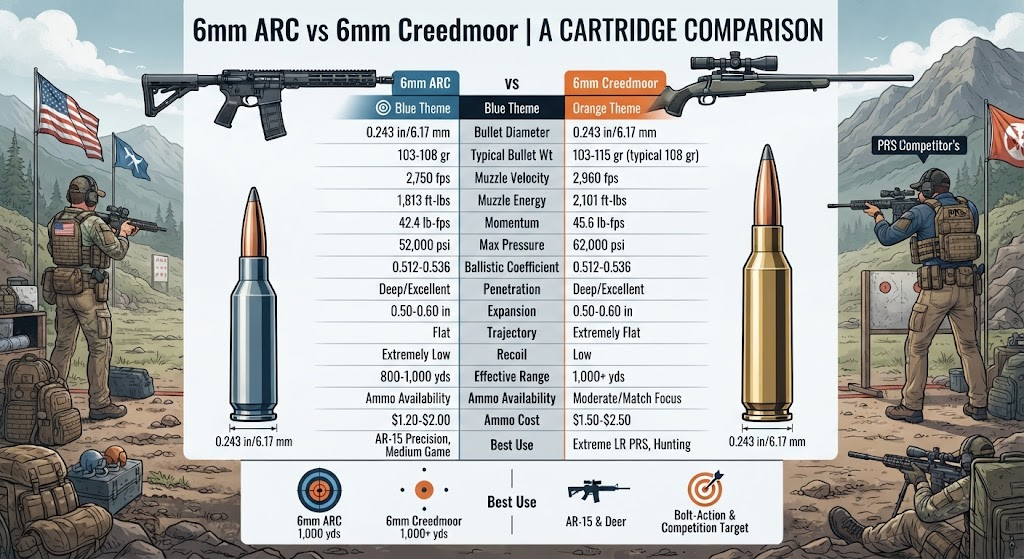
6mm ARC vs 6mm Creedmoor Comparison
| Feature | 6mm ARC | 6mm Creedmoor |
| Bullet Diameter | 0.243 inches (6.17 mm) | 0.243 inches (6.17 mm) |
| Typical Bullet Weight | 103 gr to 108 gr (typically 108 gr) | 103 gr to 115 gr (typically 108 gr) |
| Muzzle Velocity | 2,750 fps (24-inch barrel) | 2,960 fps (24-inch barrel) |
| Muzzle Energy | 1,813 ft-lbs | 2,101 ft-lbs |
| Momentum | ~42.4 lb-fps (108 gr at 2,750 fps) | ~45.6 lb-fps (108 gr at 2,960 fps) |
| Maximum Pressure | 52,000 psi (SAAMI) | 62,000 psi (SAAMI) |
| Ballistic Coefficient | Very High (0.512 to 0.536) | Very High (0.512 to 0.536) |
| Penetration | Deep (Excellent on deer/antelope) | Deep (Excellent on deer/antelope) |
| Expansion | 0.50 to 0.60 inches | 0.50 to 0.60 inches |
| Trajectory | Flat, excellent wind resistance | Extremely flat, superior wind resistance |
| Recoil | Extremely Low (~7.5 ft-lbs) | Low (~10.5 ft-lbs) |
| Effective Range | 800 to 1,000 yards (Target) | 1,000+ yards (Target) |
| Ammo Availability | Moderate (Growing commercial runs) | Moderate (Precision match focus) |
| Ammo Cost | Expensive ($1.20 to $2.00 per round) | Expensive ($1.50 to $2.50 per round) |
| Best Use | AR-15 precision shooting, medium game | Extreme long-range PRS competition, hunting |
The table above illustrates the mechanical frameworks of two cartridges sharing an identical design philosophy but operating in different weight classes. The 6mm ARC utilizes a modified 6.5 Grendel case to hold roughly 34 grains of water capacity. The 6mm Creedmoor utilizes a necked-down 6.5 Creedmoor case to hold roughly 52 grains of water capacity. This massive difference in internal volume is the sole reason the 6mm Creedmoor achieves higher velocities.
6mm ARC vs 6mm Creedmoor Ballistics
To objectively evaluate the ballistic capabilities of the 6mm ARC against the 6mm Creedmoor, we must examine real-world factory ammunition across their most common applications in precision target shooting and medium-game hunting. Because both cartridges were developed by Hornady and share identical projectile options, comparing their flagship loads provides a perfect, scientifically accurate benchmark.
For a completely fair comparison reflecting their maximum potential, all loads listed below are recorded from standard 24-inch test barrels. Shooters utilizing shorter 16-inch or 18-inch tactical barrels (highly common with the 6mm ARC) will experience proportionally lower velocities.
- Load A (6mm ARC Precision Hunter): Hornady 103-grain ELD-X. Tested from a 24-inch barrel. Muzzle velocity is 2,800 feet per second. Muzzle energy is 1,793 foot-pounds. Ballistic Coefficient (G1) is 0.512.
- Load B (6mm ARC Heavy Match): Hornady 108-grain ELD Match. Tested from a 24-inch barrel. Muzzle velocity is 2,750 feet per second. Muzzle energy is 1,813 foot-pounds. Ballistic Coefficient (G1) is 0.536.
- Load C (6mm Creedmoor Precision Hunter): Hornady 103-grain ELD-X. Tested from a 24-inch barrel. Muzzle velocity is 3,050 feet per second. Muzzle energy is 2,127 foot-pounds. Ballistic Coefficient (G1) is 0.512.
- Load D (6mm Creedmoor Heavy Match): Hornady 108-grain ELD Match. Tested from a 24-inch barrel. Muzzle velocity is 2,960 feet per second. Muzzle energy is 2,101 foot-pounds. Ballistic Coefficient (G1) is 0.536.
6mm ARC vs 6mm Creedmoor Velocity
Velocity dictates how flat a projectile shoots across unknown distances and how effectively expanding bullets open upon impacting soft tissue. High initial velocity also drastically reduces the time of flight to the target.
When analyzing velocity, the 6mm Creedmoor holds an insurmountable advantage due to its much larger powder capacity and higher operating pressure limit. Firing the identical 103-grain ELD-X hunting bullet, the 6mm Creedmoor achieves 3,050 feet per second at the muzzle. The 6mm ARC manages 2,800 feet per second.
This means the 6mm Creedmoor is pushing the exact same bullet exactly 250 feet per second faster. When utilizing the heavier 108-grain Match bullet, the velocity gap remains consistent (2,960 fps vs 2,750 fps). While the 6mm ARC is remarkably efficient for a cartridge designed to fit inside a standard AR-15, it simply cannot overcome the physical reality of a smaller combustion chamber.
6mm ARC vs 6mm Creedmoor Muzzle Energy
Muzzle energy represents the kinetic work capacity of a projectile. The kinetic energy generated by a cartridge is a direct mathematical reflection of both the speed of the bullet and its physical mass. Because both cartridges fire the exact same weight projectiles, the kinetic energy comparison is decided entirely by velocity.
The 6mm Creedmoor generates immense kinetic energy. A standard 103-grain hunting load produces roughly 2,127 foot-pounds of energy at the muzzle. This places it firmly in the same energy bracket as traditional short-action hunting cartridges like the .243 Winchester, making it highly effective on deer, antelope, and feral hogs at extended distances.
The 6mm ARC produces roughly 1,793 foot-pounds of kinetic energy at the muzzle. This translates to a deficit of over 300 foot-pounds of kinetic energy compared to the 6mm Creedmoor. However, 1,800 foot-pounds of energy is still a massive upgrade over the standard 5.56 NATO/.223 Remington (which typically generates roughly 1,300 ft-lbs). The 6mm ARC successfully transforms the AR-15 from a small-caliber varmint rifle into a highly capable medium-game hunting platform, even if it cannot match the sheer brute force of the larger Creedmoor case.
6mm ARC vs 6mm Creedmoor Momentum
Momentum is a linear measurement calculating mass in motion. In terminal ballistics, high momentum correlates closely with the ability of a bullet to crush through dense bone, heavy winter hides, and thick shoulder muscles without being deflected.
Because both cartridges utilize identically constructed heavy 6mm bullets, their momentum profiles are highly similar, but the faster 6mm Creedmoor hits slightly harder.
A 108-grain bullet traveling at 2,960 feet per second from a 6mm Creedmoor yields approximately 45.6 pound-feet per second of linear momentum.
The identical 108-grain bullet traveling at 2,750 feet per second from a 6mm ARC yields approximately 42.4 pound-feet per second of linear momentum.
Both cartridges possess exceptional momentum for 6mm bores due to their heavy bullet weights. They will easily track straight through the shoulder structure of a mule deer and reach the vital organs from challenging angles, ensuring ethical kills in the field.
6mm ARC vs 6mm Creedmoor Trajectory
Understanding external ballistics and predictable bullet drop is critical for any precision shooter attempting to hit targets beyond 400 yards. Because both cartridges utilize the exact same highly aerodynamic Hornady ELD Match bullets, the trajectory difference is caused purely by initial velocity.
The calculations below assume a standard high-profile rifle optic height of 1.5 inches above the bore and a zero distance of 200 yards. We will compare the identical 108-grain ELD Match bullet fired from both cartridges to demonstrate their respective flight paths.
| Distance | 6mm Creedmoor (108 gr at 2,960 fps) Drop | 6mm ARC (108 gr at 2,750 fps) Drop |
| Muzzle | -1.5 inches | -1.5 inches |
| 100 Yards | +1.4 inches | +1.8 inches |
| 200 Yards | 0.0 inches (Zero) | 0.0 inches (Zero) |
| 300 Yards | -6.2 inches | -7.8 inches |
| 400 Yards | -17.9 inches | -22.5 inches |
| 500 Yards | -36.2 inches | -45.5 inches |
At 500 yards, the 6mm Creedmoor shoots significantly flatter, dropping roughly 36.2 inches compared to the 45.5 inches of the 6mm ARC. A 9-inch difference in vertical drop at 500 yards provides the 6mm Creedmoor shooter with a vastly more forgiving margin of error when estimating distance.
Assuming a direct 10 mile per hour crosswind, the faster 6mm Creedmoor bullet will drift approximately 15.8 inches at 500 yards. The slower 6mm ARC bullet will drift approximately 17.5 inches at the exact same distance. While the 6mm ARC is spectacular for its size, the 6mm Creedmoor remains mechanically superior for long-distance marksmanship in windy environments.
6mm ARC vs 6mm Creedmoor Recoil
Recoil management is arguably the most important factor for rapid follow-up shots and sustained accuracy in precision rifle competitions. A shooter who flinches in anticipation of heavy recoil will inevitably pull their shots.
Both cartridges are considered incredibly mild, but the 6mm ARC is exceptionally soft.
Fired from a standard 8-pound bolt-action rifle, a full-power 6mm Creedmoor load generates roughly 10.5 foot-pounds of free recoil energy. This is a very comfortable level of recoil that allows shooters to practice all day without developing a flinch, which is exactly why it dominates the Precision Rifle Series (PRS).
The 6mm ARC was engineered to be fired from gas-operated AR-15 platforms. Not only does the cartridge utilize roughly 15 to 20 grains less powder than the Creedmoor, but the reciprocating bolt carrier group inside the AR-15 absorbs a massive portion of the rearward energy. Fired from an identical 8-pound rifle, the 6mm ARC generates approximately 7.5 foot-pounds of free recoil energy. This recoil is so minimal that shooters can effortlessly watch their own bullet impacts strike the target through a highly magnified optic.
6mm ARC vs 6mm Creedmoor Penetration
Terminal penetration is rigorously evaluated to ensure the ethical harvesting of game animals. Because both cartridges utilize identical bullets, their penetration profiles are highly predictable.
When firing the 103-grain ELD-X bullet, both cartridges will provide deep, reliable straight-line penetration on medium-sized game animals like whitetail deer, mule deer, and feral hogs. A premium hunting bullet will consistently penetrate 16 to 22 inches in soft tissue. Because the 6mm Creedmoor drives the bullet slightly faster, it carries more kinetic energy and momentum, which will generally result in slightly deeper penetration through heavy bone structures.
6mm ARC vs 6mm Creedmoor Expansion
Bullet expansion dictates the physical diameter of the permanent wound channel inside the target animal. Wide expansion increases the likelihood of severing major arteries and causing rapid incapacitation.
Because the 6mm Creedmoor strikes targets at significantly higher velocities, the initial expansion is more violent. The intense hydraulic pressure forces the lead core and copper jacket to peel back instantly into a classic mushroom shape. The 6mm ARC expands beautifully as well, though the slightly lower impact velocities generally result in a slightly narrower expansion cavity at extreme distances. A premium 103-grain bullet fired from either cartridge will typically open to roughly 0.50 to 0.60 inches in diameter inside 300 yards.
6mm ARC vs 6mm Creedmoor Effective Range
The 6mm ARC vs 6mm Creedmoor effective range comparison clearly highlights their different operational envelopes.
For deer hunting, both cartridges are highly effective. The 6mm ARC maintains enough kinetic energy (roughly 1,000 foot-pounds) to ethically harvest deer out to approximately 400 yards. The 6mm Creedmoor retains that same lethal kinetic energy out past 500 yards.
For precision target shooting on steel plates, the 6mm Creedmoor is vastly superior. The heavy, high-BC bullets launched at nearly 3,000 feet per second allow the 6mm Creedmoor to remain supersonic and predictable well past 1,000 yards. While the 6mm ARC can certainly ring steel at 1,000 yards, the slower initial velocity requires significantly more vertical elevation adjustment on the optic and is slightly more susceptible to being pushed off target by wind at extreme limits.
6mm ARC vs 6mm Creedmoor Self Defense
Neither the 6mm ARC nor the 6mm Creedmoor is optimal for standard urban home defense.
The 6mm ARC is chambered in the AR-15 platform, which provides standard-capacity detachable box magazines and rapid semi-automatic fire. However, the heavy 108-grain bullets are designed to retain their mass and penetrate deeply, meaning they present a severe over-penetration hazard in a residential environment. A missed shot will easily pass through multiple interior drywall partitions and exterior walls, presenting a severe danger to neighbors.
The 6mm Creedmoor is almost exclusively chambered in heavy, long-barreled bolt-action hunting rifles holding only four or five rounds. Operating a bolt-action rifle under panic in a confined hallway is extremely difficult, and the massive kinetic energy guarantees extreme over-penetration. Both cartridges are far better suited for rural property defense or long-range tactical engagements than close-quarters home defense.
6mm ARC vs 6mm Creedmoor Concealed Carry
Concealed carry with either cartridge is physically impossible. Both are centerfire rifle cartridges measuring over 2.26 inches in overall length. They require long rifle actions, heavy receivers, and substantial barrel lengths to safely contain their operating pressures. There are no practical handguns manufactured that can chamber these rounds for concealed carry.
Which Has More Stopping Power: 6mm ARC or 6mm Creedmoor?
On medium-sized game animals like whitetail deer, the 6mm Creedmoor possesses slightly more stopping power due to its higher velocity. Striking an animal with over 2,100 foot-pounds of kinetic energy creates a more violent temporary stretch cavity that induces rapid hydrostatic shock and massive tissue disruption. The 6mm ARC provides excellent, ethical stopping power, but it simply cannot match the sheer blunt force trauma delivered by the faster Creedmoor cartridge.
Which Is More Powerful: 6mm ARC or 6mm Creedmoor?
Based on the laws of physics and the raw ballistic data, the 6mm Creedmoor is vastly more powerful than the 6mm ARC.
The 6mm Creedmoor generates roughly 2,100 foot-pounds of muzzle energy depending on the specific factory load. The 6mm ARC generates roughly 1,800 foot-pounds of muzzle energy. The 6mm Creedmoor delivers over 300 more foot-pounds of kinetic energy to the target and boasts a massive advantage in linear momentum due to its faster muzzle velocity.
6mm ARC Pros and Cons
Pros
- Engineered specifically to maximize the long-range ballistic performance of the standard AR-15 platform.
- Produces practically zero felt recoil, allowing shooters to easily watch their own bullet impacts.
- Utilizes incredibly aerodynamic heavy 6mm bullets that retain velocity and resist wind drift far better than standard AR-15 calibers like the .223 Remington or 6.5 Grendel.
- Transforms the AR-15 into a highly capable medium-game deer and antelope hunting rifle.
Cons
- Requires a specialized 6.5 Grendel bolt face and proprietary magazines that are completely incompatible with standard 5.56 NATO components.
- Lacks the raw kinetic energy and velocity required to match the flat trajectory of short-action bolt rifles.
- Ammunition is currently expensive and limited to premium match or precision hunter product lines.
6mm Creedmoor Pros and Cons
Pros
- Exceptional velocity provides an incredibly flat trajectory out to 1,000 yards, making long-range hits effortless.
- Heavy 108-grain bullets combined with high velocity aggressively resist wind deflection across open plains.
- Delivers massive kinetic energy, ensuring faster ethical kills on deer and antelope at extended distances.
- The absolute dominant standard for competitive Precision Rifle Series (PRS) shooting.
Cons
- Extreme velocities combined with massive powder charges significantly accelerate throat erosion, resulting in famously short barrel life (often 1,200 to 1,500 rounds).
- Ammunition is expensive and heavily focused on precision match-grade options rather than cheap hunting soft points.
- Cannot fit into standard AR-15 receivers, requiring heavier AR-10 platforms or bolt-action rifles.
Final Comparison
| Category | Winner | Reason |
| Velocity | 6mm Creedmoor | Larger powder capacity effortlessly drives heavy bullets over 200 fps faster |
| Muzzle Energy | 6mm Creedmoor | Generates roughly 300 more ft-lbs of kinetic energy than the 6mm ARC |
| Momentum | 6mm Creedmoor | Faster velocity applied to identical bullet weights yields superior momentum |
| Penetration | 6mm Creedmoor | Higher momentum pushes heavy projectiles slightly deeper through dense resistance |
| Expansion | 6mm Creedmoor | Higher impact velocities create more violent hydraulic pressure upon impact |
| Trajectory | 6mm Creedmoor | Extreme velocity produces a significantly flatter curve out to 1,000 yards |
| Recoil Control | 6mm ARC | Generates minimal felt recoil, especially mitigated by AR-15 buffer systems |
| Effective Range | 6mm Creedmoor | Superior retained energy confidently extends ethical shots out to extreme ranges |
| Self Defense | Neither | Both present unique over-penetration hazards indoors |
| Concealed Carry | Neither | Both are centerfire rifle cartridges entirely unsuitable for concealment |
| Ammo Cost | Tie | Both are premium modern cartridges carrying expensive retail price tags |
| Ammo Availability | Tie | Both require specialty orders or visits to dedicated precision gun shops |
| Overall Performance | Depends on Firearm | 6mm ARC for AR-15 platforms; 6mm Creedmoor for bolt-action precision |
6mm ARC vs 6mm Creedmoor: Which Should You Choose?
Selecting between the 6mm ARC and the 6mm Creedmoor requires a practical assessment of your preferred rifle platform and your intended shooting distances.
Choose the 6mm ARC if you prioritize tactical versatility and prefer hunting or shooting with a modern semi-automatic AR-15 platform. The 6mm ARC gives you the ability to rival traditional short-action ballistics while utilizing high-capacity detachable box magazines in a lightweight, maneuverable rifle. It provides more than enough power to ethically harvest deer inside 400 yards, and its practically nonexistent recoil allows you to watch the animal drop immediately through your scope.
Choose the 6mm Creedmoor if your primary goal is building the ultimate long-range bolt-action precision rifle. The ability to launch highly aerodynamic 108-grain projectiles at nearly 3,000 feet per second provides incredibly flat trajectories that make hitting steel plates at 1,000 yards effortless. The massive kinetic energy ensures instant ethical kills on medium game at extended distances. It is the absolute premier choice for competitive PRS shooters who demand maximum ballistic performance and extreme wind resistance from a short-action receiver.
FAQs
Is 6mm ARC more powerful than 6mm Creedmoor?
No, the 6mm Creedmoor is significantly more powerful. It generates approximately 300 more foot-pounds of muzzle energy and substantially higher linear momentum than the 6mm ARC due to its massive case capacity and higher velocities.
Which has more muzzle energy?
The 6mm Creedmoor easily generates over 2,100 foot-pounds of muzzle energy with standard loads. The 6mm ARC generates roughly 1,800 foot-pounds of muzzle energy depending on the bullet weight.
Which has more stopping power?
The 6mm Creedmoor provides superior stopping power on deer and antelope due to its higher velocity and massive kinetic energy transfer, ensuring rapid incapacitation and more violent terminal expansion.
Which has more recoil?
The 6mm Creedmoor produces slightly more recoil. Fired from a standard lightweight hunting rifle, the 6mm Creedmoor generates roughly 10.5 foot-pounds of free recoil energy, whereas the 6mm ARC generates a highly manageable 7.5 foot-pounds of recoil. Both are considered extremely mild.
Which has better penetration?
The 6mm Creedmoor penetrates slightly deeper on heavy resistance. Its extreme velocity and higher momentum allow heavy projectiles to punch through dense muscle without halting prematurely.
Which expands more?
Because it travels at a higher velocity, a premium 6mm Creedmoor expanding bullet will generally experience more violent hydraulic pressure upon impact, leading to slightly wider expansion than the 6mm ARC.
Which has a flatter trajectory?
The 6mm Creedmoor has a significantly flatter trajectory. The velocity advantage allows it to drop roughly 9 inches less than the 6mm ARC at the 500-yard marker.
Which is better for self defense?
Neither cartridge is ideal for urban home defense due to extreme over-penetration risks. However, the 6mm ARC is better for rural property defense simply because it is chambered in modern AR-15 rifles, offering high-capacity magazines and rapid reloading.
Which is better for concealed carry?
Neither. Both are large centerfire rifle cartridges fired from long, heavy rifles that absolutely cannot be concealed on the human body.
Is 6mm ARC faster than 6mm Creedmoor?
No, the 6mm Creedmoor is substantially faster. The 6mm Creedmoor typically launches a heavy 108-grain bullet at roughly 2,960 fps, while the 6mm ARC launches the identical bullet at roughly 2,750 fps.
Is 6mm Creedmoor stronger than 6mm ARC?
Yes, in terms of sheer kinetic energy, operating pressure, and momentum crushing through tissue, the 6mm Creedmoor is drastically stronger than the 6mm ARC.
Which is cheaper to shoot?
Both cartridges are generally priced similarly as premium long-range hunting ammunition. Neither offers the cheap bulk practice ammunition commonly found in standard military calibers like 5.56 NATO.
Which has better ballistics?
The 6mm Creedmoor features vastly superior external ballistics. Its extreme velocity pushes high Ballistic Coefficient projectiles much faster, aggressively resisting wind deflection and retaining lethal kinetic energy past 1,000 yards.
Which is easier to shoot?
The 6mm ARC is slightly easier to shoot due to its exceptionally mild recoil impulse, making it highly preferred for teaching new shooters, youth hunters, and individuals sensitive to loud blast and recoil.
Which should you choose?
Choose the 6mm Creedmoor for a highly capable, extreme long-range precision bolt-action rifle. Choose the 6mm ARC for absolute minimal recoil and fantastic intermediate-range performance inside an AR-15.