The main difference between 22 LR and 9mm is the cartridge design and intended application, with the 22 LR being a small rimfire round and the 9mm being a much larger centerfire round. The 9mm pushes a heavier 115-grain to 147-grain bullet that generates roughly three times the muzzle energy of a 22 LR, making it the global standard for personal defense and law enforcement. In contrast, the tiny 22 LR offers virtually no recoil, a quieter report, and an extremely low cost per round, making it ideal for target practice and small game hunting. While the 9mm is heavily favored for stopping threats at close range, the 22 LR dominates high-volume training and recreational plinking. Both are immensely popular, but their physical sizes dictate completely different capabilities.
22 LR vs 9mm
| Feature | 22 LR | 9mm |
| Full Name | .22 Long Rifle | 9x19mm Parabellum (9mm Luger) |
| Cartridge Type | Rimfire | Centerfire |
| Bullet Weight | 30 to 40 grains | 115 to 147 grains |
| Bullet Diameter | 0.223 to 0.2255 inches | 0.355 inches |
| Case Length | 0.613 inches | 0.754 inches (19.15 mm) |
| Overall Cartridge Length | 1.000 inches | 1.169 inches (29.69 mm) |
| Typical Muzzle Velocity | 1,070 to 1,640 fps | 990 to 1,350 fps |
| Typical Muzzle Energy | 100 to 191 ft-lbs | 320 to 450 ft-lbs |
| Effective Range | 50 to 100 yards (rifle) | 25 to 50 yards (handgun) |
| Recoil | Extremely low | Moderate |
| Ammunition Cost | $0.06 to $0.12 per round | $0.22 to $0.35 per round (FMJ) |
| Common Uses | Plinking, training, small game | Self-defense, law enforcement, competition |
| Source | SAAMI / Federal Premium | SAAMI / Winchester |
The Main Difference Between 22 LR And 9mm
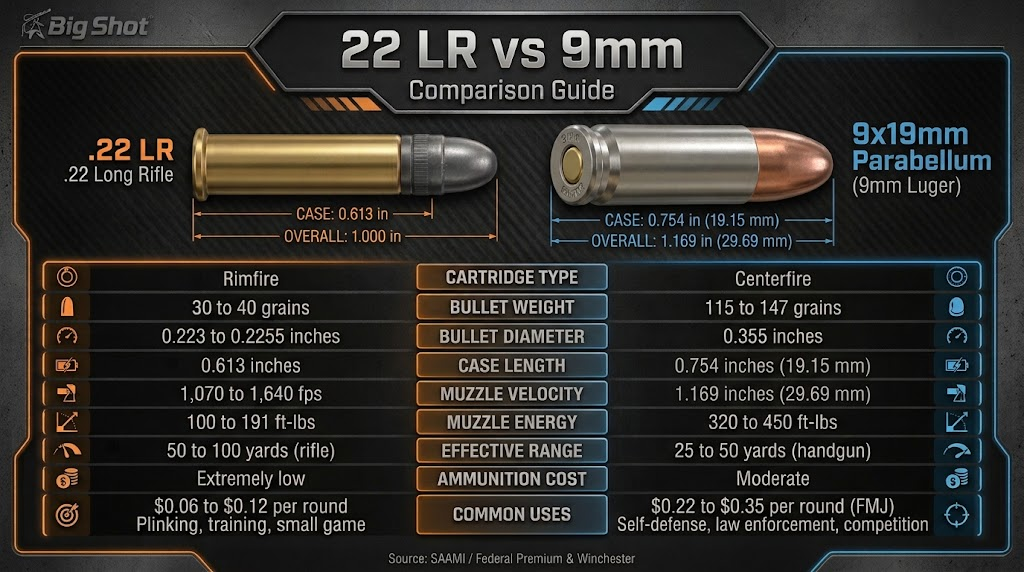
When comparing 22 LR vs 9mm, the most defining difference is the ignition system and overall size. The 22 LR is a rimfire cartridge, meaning the firing pin strikes the rim of the thin brass case to ignite the primer compound spun inside. The 9mm is a centerfire cartridge, utilizing a replaceable primer seated in the center of a much thicker, stronger brass base.
Because the 9mm case is wider and much stronger, it holds more gunpowder and safely contains vastly higher chamber pressures. This allows the 9mm to fire a bullet that is roughly three times heavier than a 22 LR bullet while maintaining high velocities. The result is significantly higher kinetic energy, making the 9mm highly effective for self-defense. However, this power results in noticeably more recoil and a louder muzzle blast. Ammunition cost is another primary difference, as 9mm requires more raw materials to manufacture, making it considerably more expensive than 22 LR. Therefore, the intended use dictates the better choice. The 22 LR is the superior tool for teaching fundamentals and hunting squirrels, while the 9mm is the superior tool for concealed carry and home defense.
22 LR vs 9mm Dimensions
Cartridge dimensions dictate chamber compatibility, magazine capacity, and overall firearm size. Although both are commonly fired from handguns, their cases and projectiles are entirely different.
According to Sporting Arms and Ammunition Manufacturers’ Institute (SAAMI) specifications, the 22 LR measures:
- Bullet diameter: 0.223 to 0.2255 inches
- Case length: 0.613 inches
- Rim diameter: 0.278 inches
- Case diameter: 0.226 inches
- Overall cartridge length: 1.000 inches
The 9mm (formally 9x19mm Parabellum) measures:
- Bullet diameter: 0.355 inches
- Case length: 0.754 inches (19.15 mm)
- Rim diameter: 0.392 inches
- Case base diameter: 0.391 inches
- Overall cartridge length: 1.169 inches
The 9mm is substantially wider and noticeably longer than the 22 LR. A 9mm bullet alone is wider than the entire 22 LR cartridge case.
22 LR vs 9mm Velocity
Velocity varies significantly depending on bullet weight and the length of the barrel used to fire the cartridge. While standard 9mm handguns have 3 to 5-inch barrels, 22 LR is frequently fired from 16 to 18-inch rifle barrels.
To compare representative factory ammunition fired from standard test barrels:
- CCI Standard Velocity 22 LR (40-grain lead round nose): 1,070 fps.
- Federal AutoMatch 22 LR (40-grain lead round nose): 1,200 fps.
- Speer Gold Dot 9mm (147-grain jacketed hollow point): 985 fps.
- Federal HST 9mm (124-grain jacketed hollow point): 1,150 fps.
- Winchester White Box 9mm (115-grain full metal jacket): 1,190 fps.
Although the velocities overlap heavily, the 9mm achieves these speeds while pushing a bullet that is over three times heavier. The 22 LR requires a very light 40-grain projectile to reach 1,200 fps, whereas the 9mm can propel a 115-grain projectile to the exact same speed.
22 LR vs 9mm Energy
Muzzle energy measures the striking force of the bullet. Energy is calculated using bullet weight and velocity, and because the 9mm fires a drastically heavier bullet at similar speeds to the 22 LR, it generates much greater kinetic energy.
Representative muzzle energy figures based on manufacturer specifications:
- CCI Standard Velocity 22 LR (40-grain): 102 ft-lbs.
- Federal AutoMatch 22 LR (40-grain): 128 ft-lbs.
- Speer Gold Dot 9mm (147-grain): 317 ft-lbs.
- Winchester White Box 9mm (115-grain): 362 ft-lbs.
- Federal HST 9mm (124-grain): 364 ft-lbs.
The 9mm routinely delivers three times the kinetic energy of a standard 22 LR. This energy difference changes practical performance dramatically. The 9mm carries enough energy to reliably penetrate heavy clothing and reach vital organs in self-defense scenarios, which is why it is the standard issue caliber for the FBI and military forces worldwide. The 22 LR lacks the energy and penetration reliability to be recommended as a primary self-defense caliber.
22 LR vs 9mm Range
When comparing 22 LR vs 9mm range, shooters must clearly differentiate the platform being used. Maximum projectile travel for both cartridges exceeds one mile, meaning a safe backstop is always required.
Effective range refers to the distance at which the bullet maintains accuracy and terminal performance. The 22 LR is typically fired from a rifle, giving it an effective hunting and target range of 50 to 100 yards. When fired from a short-barreled pistol, the practical accuracy of the 22 LR drops to roughly 25 yards for most shooters.
The 9mm is primarily a handgun cartridge. In defensive scenarios, its practical effective range is generally considered to be 25 yards, extending to 50 yards in the hands of a highly skilled marksman. However, when the 9mm is fired from a pistol-caliber carbine (PCC) with a 16-inch barrel, its effective range for target shooting and competition easily stretches out to 100 yards.
22 LR vs 9mm Accuracy
Accuracy relies more on the firearm platform, barrel quality, and ammunition consistency than on the caliber itself. Neither cartridge is universally more accurate than the other, but they are used in different competitive environments.
In independent accuracy testing, a premium bolt-action 22 LR rifle firing match-grade ammunition can routinely shoot 5-shot groups under 0.5 inches at 50 yards. The 22 LR dominates precision bullseye competitions.
The 9mm is optimized for combat accuracy and practical action shooting, such as USPSA or IDPA. A high-quality 9mm pistol fired from a bench rest will typically produce 2 to 3-inch groups at 25 yards. Pistol-caliber carbines in 9mm often shoot 2 to 3-inch groups at 100 yards. The mechanical quality of the firearm and the shooter’s trigger control will always dictate accuracy more than the specific cartridge.
22 LR vs 9mm Recoil
Recoil is heavily dependent on the firearm’s weight and the cartridge’s energy. There is a massive practical difference in felt recoil between the two calibers.
A 22 LR fired from a 6-pound rifle generates less than 0.2 foot-pounds of free recoil energy, which is virtually imperceptible. When fired from a standard 24-ounce handgun, the 22 LR produces almost zero muzzle flip, allowing for incredibly fast follow-up shots.
A 9mm fired from a similar 24-ounce handgun generates roughly 4 to 5 foot-pounds of recoil energy. While the 9mm is considered a moderate and highly manageable centerfire cartridge, it produces significantly more muzzle rise, blast, and felt recoil than the 22 LR. Shooters require proper grip technique and training to control a 9mm pistol effectively during rapid fire.
22 LR vs 9mm Ammunition Cost
Ammunition cost heavily favors the 22 LR, which is consistently the most affordable factory ammunition on the market. The 9mm is the most affordable centerfire pistol ammunition, but it is still noticeably more expensive than rimfire.
As of September 2026, representative normal retail prices for common factory loads indicate:
- CCI Standard Velocity 22 LR (40-grain, 50-round box): $4.50 to $6.00 per box, equating to $0.09 to $0.12 per round.
- Federal AutoMatch 22 LR (40-grain, 325-round bulk box): $19.50 to $26.00 per box, equating to $0.06 to $0.08 per round.
- Winchester White Box 9mm (115-grain FMJ, 50-round box): $11.00 to $15.00 per box, equating to $0.22 to $0.30 per round.
- Federal HST 9mm (124-grain JHP, 50-round box): $30.00 to $45.00 per box, equating to $0.60 to $0.90 per round.
Practicing with 9mm full metal jacket (FMJ) ammunition costs roughly three to four times as much as practicing with 22 LR. Premium 9mm defensive ammunition is even more expensive, often costing ten times as much as 22 LR per shot.
22 LR vs 9mm For Hunting
The 22 LR is an outstanding small game hunting cartridge. Inside of 50 yards, a standard 40-grain solid bullet or a 36-grain hollow point will cleanly harvest squirrels, rabbits, and grouse without destroying excessive meat. It is arguably the most popular small game cartridge in the world.
The 9mm is not traditionally recognized as a hunting cartridge. Most jurisdictions legally prohibit the use of 9mm handguns for hunting medium game like deer due to the cartridge lacking the requisite energy for an ethical kill at typical hunting distances. However, in states where it is legal, some hunters use 9mm pistol-caliber carbines loaded with specialized hunting ammunition to harvest feral hogs or predators at very close ranges (under 50 yards).
22 LR vs 9mm For Target Shooting
For plinking, fundamentals training, and recreational target shooting, the 22 LR is the undisputed champion. The combination of practically zero recoil, low noise, and incredibly inexpensive ammunition makes it perfect for extended range sessions. Competitive target shooting disciplines like Rimfire Benchrest are built entirely around the 22 LR.
The 9mm is the king of practical action shooting. Competitions such as USPSA, IDPA, and 3-Gun rely heavily on the 9mm due to its reliable knockdown power on steel targets, manageable recoil, and high magazine capacities. While 9mm costs more than 22 LR, it is the cheapest centerfire option for shooters who need to train with a duty-sized or defensive firearm.
22 LR vs 9mm For Beginners
For brand new shooters, the 22 LR is the best possible introduction to firearms. The complete absence of recoil and the very mild report prevent inexperienced shooters from developing a flinch. A beginner can dedicate hours to mastering sight alignment and trigger control without physical fatigue.
The 9mm is often the second caliber a beginner purchases, usually when they decide to pursue concealed carry or home defense. While the 9mm is manageable, the louder blast and noticeable recoil can be intimidating for someone who has never fired a gun. A highly practical recommendation is to learn the core safety rules and marksmanship fundamentals on a 22 LR pistol or rifle, and then transition to a 9mm once the shooter has developed good habits and confidence.
22 LR vs 9mm Firearms
Firearms chambered in 22 LR encompass almost every action type imaginable. Shooters can choose from bolt-action rifles, semi-automatic rifles, lever-action rifles, single-action revolvers, double-action revolvers, and semi-automatic pistols. Popular trainers like the Ruger Mark IV or the Smith & Wesson M&P 15-22 dominate the market.
Firearms chambered in 9mm are predominantly semi-automatic pistols, ranging from micro-compacts designed for concealed carry (like the SIG Sauer P365) to full-size duty pistols (like the Glock 17). The 9mm is also extremely popular in pistol-caliber carbines and submachine gun platforms. Revolvers chambered in 9mm do exist, but they are less common and typically require moon clips to properly hold the rimless cartridges in the cylinder.
Can 22 LR And 9mm Use The Same Gun?
Generally, 22 LR and 9mm cannot use the same gun because the chamber, barrel, bolt, and magazines are completely different sizes.
However, manufacturers offer caliber conversion kits that allow a single firearm frame to shoot both calibers safely. For example, a shooter can buy a dedicated 22 LR conversion slide for a Glock 19. The user removes the 9mm slide, barrel, and recoil spring, and installs the 22 LR slide and barrel onto the same grip frame. Similarly, companies like CMMG offer drop-in 22 LR bolt carrier groups for 9mm or 5.56mm AR-15s, allowing users to train with cheap rimfire ammunition using their standard centerfire rifle. Outside of these specific, manufacturer-designed conversion kits, the cartridges can never share a barrel.
22 LR vs 9mm Ammunition Compatibility
Ammunition compatibility is strictly determined by the exact cartridge name stamped on the barrel of the firearm.
- .22 LR is not interchangeable with 9mm.
- 9mm is not interchangeable with .22 LR.
If a shooter attempts to insert a 9mm cartridge into a standard 22 LR chamber, it physically will not fit because the 9mm is vastly wider. If a shooter drops a 22 LR into a 9mm chamber, it will drop straight through the barrel or fit so loosely that it cannot be fired. Attempting to fire incorrect ammunition is extremely dangerous and can result in catastrophic firearm failure and severe injury.
Pros And Cons
22 LR Pros And Cons
Pros:
- Lowest ammunition cost allows for affordable high-volume practice.
- Virtually no recoil prevents shooters from developing a flinch.
- Extremely quiet operation, especially when suppressed.
- Highly effective for small game hunting.Cons:
- Lacks the kinetic energy and penetration required for reliable self-defense.
- Rimfire ignition is inherently slightly less reliable than centerfire ignition.
9mm Pros And Cons
Pros:
- Excellent terminal ballistics and penetration for self-defense.
- High magazine capacity in modern semi-automatic pistols.
- Centerfire primers offer maximum ignition reliability.
- Most affordable centerfire pistol ammunition available.Cons:
- Ammunition costs roughly three times more than 22 LR.
- Noticeably louder report and more recoil require focused grip training.
- Not suitable for small game hunting due to excessive meat destruction.
Manufacturer Data vs Independent Testing
When reviewing ballistics, readers must differentiate between promotional manufacturer specifications and independent testing. Ammunition manufacturers often measure 9mm velocity using 4-inch or 5-inch laboratory test barrels, which yield higher speeds than a consumer will achieve using a 3-inch micro-compact carry pistol.
Independent chronograph testing provides a highly realistic baseline for actual street performance. When reputable firearms publications test defensive 9mm ammunition out of short barrels, the recorded velocities are frequently slower than the figures printed on the retail box, which can affect whether a hollow-point bullet expands properly. When reputable sources provide conflicting figures, controlled independent testing through the exact barrel length of the consumer’s chosen firearm is always the most practical data source.
FAQs
What is the main difference between 22 LR and 9mm?
The main difference is their size and purpose. The 22 LR is a tiny rimfire cartridge designed for target shooting and small game, while the 9mm is a larger, more powerful centerfire cartridge designed for self-defense and law enforcement.
Is 9mm more powerful than 22 LR?
Yes. The 9mm pushes a much heavier bullet at similar or greater speeds, generating roughly three times the kinetic energy of a standard 22 LR.
Is a 9mm faster than a 22 LR?
Not always. Standard 9mm ammunition typically travels between 990 and 1,250 feet per second. High-velocity 22 LR ammunition fired from a rifle can travel between 1,200 and 1,600 feet per second.
Which has more recoil, 22 LR or 9mm?
The 9mm has significantly more recoil. The 22 LR produces almost zero felt recoil, making it extremely comfortable for new shooters.
Which is cheaper to shoot?
The 22 LR is much cheaper. It generally costs between 6 and 12 cents per round, while 9mm training ammunition typically costs between 22 and 35 cents per round.
Is 9mm better for self-defense?
Yes. The 9mm is globally recognized as an excellent self-defense caliber due to its reliability, penetration, and terminal performance. The 22 LR is generally not recommended for self-defense.
Is 22 LR better for hunting?
Yes, for small game. The 22 LR is perfect for hunting squirrels and rabbits. The 9mm is not a standard hunting cartridge and will destroy too much meat on small animals.
Can a 9mm shoot 22 LR?
No. A 22 LR cartridge will not fit properly in a 9mm chamber and cannot be fired safely unless the user installs a dedicated caliber conversion kit.
Are 22 LR and 9mm interchangeable?
No. The ammunition is never interchangeable. You must only load the specific ammunition that is stamped on the barrel of your firearm.
Which is better for beginners?
The 22 LR is the best choice for beginners. The low noise, lack of recoil, and affordable ammunition allow a new shooter to practice fundamental marksmanship skills comfortably.