A twist rate bullet weight chart is the ultimate tool for matching your rifle’s barrel to the perfect ammunition for peak precision. Generally, heavier and longer bullets require a faster twist rate (like 1:7 or 1:8) to stabilize, while lighter, shorter bullets perform flawlessly in slower twists (like 1:10 or 1:12). Twist rate represents the barrel length required for one full projectile rotation, directly dictating gyroscopic stability in flight. Because modern monolithic copper and high-BC match bullets are exceptionally long for their weight, they demand faster spins than traditional lead-core rounds. Always remember that specific barrel dynamics, muzzle velocities, and atmospheric conditions will produce varying downrange results.
Twist Rate Bullet Weight Chart
| Caliber | Common Twist Rates | Optimal Bullet Weights | General Suitability |
| 5.56 NATO / .223 | 1:7, 1:8, 1:9 | 55 – 77 grain | Military standard, varmint, and target shooting |
| .308 Winchester | 1:10, 1:12 | 150 – 185 grain | Universal hunting and tactical applications |
| 6.5 Creedmoor | 1:8 | 120 – 147 grain | Long-range precision and medium game hunting |
| 300 Blackout | 1:5, 1:7, 1:8 | 110 – 220 grain | Heavy suppressed subsonic and lightweight supersonic |
| .300 Win Mag | 1:9, 1:10 | 180 – 230 grain | Big game hunting and extreme long-range (ELR) |
| .22 LR | 1:16 | 32 – 40 grain | Standard target, plinking, and small game hunting |
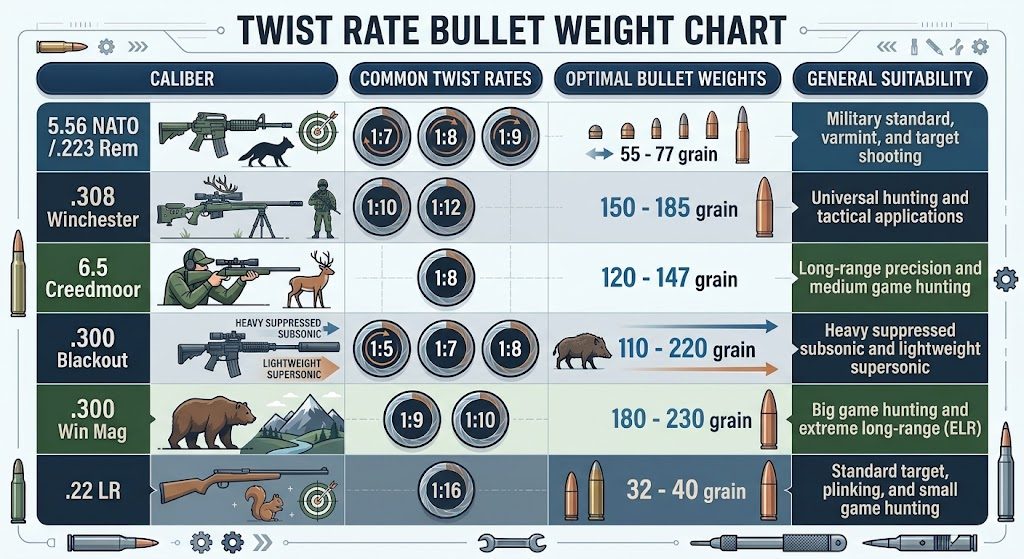
Explaining The Chart
A twist rate bullet weight chart illustrates the ratio of barrel length required for the internal rifling to force the bullet to complete one full 360-degree rotation.
- What a 1:7 twist means: The bullet rotates once every 7 inches. This is a “fast” twist rate, heavily utilized in 5.56 NATO AR-15s to stabilize long, heavy 77-grain match projectiles and in 300 Blackout to spin ultra-heavy 220-grain subsonics.
- What a 1:9 twist means: A versatile intermediate twist. In .223 Remington, it perfectly stabilizes standard 55-grain bullets. In large magnums (like .300 Win Mag), it is considered a very fast twist for stabilizing ultra-heavy 220+ grain target bullets.
- What a 1:10 twist means: The universal standard for .30-caliber rifles (such as .308 Win and .30-06 Springfield). It provides ideal gyroscopic stability for 150-grain to 180-grain hunting loads without over-spinning them.
Twist rate stabilizes the projectile by creating gyroscopic stability, identical to how a precisely thrown football flies in a tight spiral rather than tumbling end-over-end.
Crucially, bullet length matters as much as weight. The longer a bullet is, the more aerodynamic leverage the air has to try and flip the bullet backward. A long, sleek bullet requires a much faster twist rate to maintain its point-forward orientation than a short, blunt bullet of the exact same weight.
Twist Rate By Bullet Weight Comparison
| Caliber | Bullet Weight | Recommended Twist | Stability |
| 5.56 / .223 | 55 grain | 1:9 or 1:8 | Excellent |
| 5.56 / .223 | 77 grain | 1:7 or 1:8 | Excellent (Requires fast twist) |
| .308 Win | 150 grain | 1:10 or 1:12 | Excellent |
| .308 Win | 175 grain | 1:10 | Excellent |
| 6.5 Creedmoor | 140 grain | 1:8 | Excellent (Optimized for high-BC) |
| 300 Blackout | 220 grain | 1:5 or 1:7 | Good (Fast twist required for low velocity) |
Use real factory ammunition data when assessing your needs. Do not assume bullet weight alone determines the required twist rate. A 150-grain monolithic copper solid in .308 is physically longer than a 150-grain lead soft-point, meaning the copper bullet utilizes the rifling differently and demands a faster spin to achieve stability.
What Is The Best Twist Rate?
There is no single “best” twist rate; it is entirely dependent on your caliber, the aerodynamic profile of your projectile, and your target velocity. The modern firearms industry is shifting heavily toward fast twist rates to accommodate the rise of long, high-BC (Ballistic Coefficient) projectiles designed to cheat wind deflection over extreme distances.
5.56 / .223 Twist Rate Bullet Weight
The AR-15 platform features highly debated twist rates because of the vast array of available bullet weights (from 35-grain to 77-grain).
- 1:7 Twist: The military standard. Best for long, heavy bullets (69gr to 77gr) and monolithic copper rounds.
- 1:8 Twist: The modern “Goldilocks” twist. It safely stabilizes heavy 77gr match bullets while maintaining extreme accuracy with affordable 55gr plinking ammo.
- 1:9 Twist: The older civilian standard. Excellent for 55gr and 62gr ammunition, but frequently fails to stabilize long 77gr match bullets, especially in dense, cold air.
.308 Winchester Twist Rate Bullet Weight
The .308 Winchester is traditionally offered in two primary twist rates:
- 1:10 Twist: The modern standard. It effortlessly stabilizes the widely popular 168-grain and 175-grain match bullets, as well as standard 150-grain to 180-grain hunting loads.
- 1:12 Twist: Often found on older hunting rifles. It is incredibly accurate with 150-grain bullets but struggles with modern, ultra-long 185+ grain high-BC bullets.
Bullet Types
The physical construction of your projectile dramatically alters how it interacts with your rifle’s twist rate:
- Standard FMJ / Soft Point: Traditional lead-core range and hunting ammo. These feature standard lengths and stabilize easily in moderate twists.
- HPBT / ELD (Match): Match ammunition designed for long-range precision. The sleek ogive and boat tail make these much longer than standard FMJs, heavily rewarding a faster twist.
- Monolithic Solid (Copper): 100% copper bullets (like the Barnes TSX). Because copper is lighter and less dense than lead, these bullets must be manufactured physically longer to achieve the same weight, demanding a faster twist rate.
- Subsonic: Heavy bullets traveling below the speed of sound. They rely purely on mass for terminal energy, making them extremely long for their caliber. Without high velocity to generate RPMs, they require the fastest twist rates available (like the 1:5 in 300 BLK).
Twist Rate And Bullet Stability
Gyroscopic stability is achieved through a scientific relationship between several physical factors. When a bullet leaves the muzzle, it needs an optimal RPM (Rotations Per Minute) to overcome aerodynamic drag. This is determined by:
- Twist Rate: The mechanical rate of spin inside the barrel.
- Bullet Length: The primary aerodynamic factor; longer bullets act like a longer lever against the wind, needing faster twists.
- Bullet Weight: Used as a shorthand for length, but denser materials (lead) are shorter than lighter materials (copper) at the exact same weight.
- Velocity: Higher velocities naturally generate higher RPMs. A bullet fired at 3,200 fps might stabilize in a slow twist, while the same bullet fired at 1,000 fps (subsonic) will tumble violently from the exact same barrel.
- Atmosphere: Dense, cold air at sea level requires more rotational stability to cut through than thin, hot air at high altitudes.
Do not claim that every bullet of the same weight requires exactly the same twist rate. Length, physical construction, and velocity are the true deciding factors.
Barrel Length
A persistent myth in the ballistics world is that barrel length changes your twist rate. It does not.
Twist rate is the physical, mechanical spiraling cut into the steel of the bore. A 10.3-inch barrel with a 1:7 twist imparts the exact same rate of rotation relative to distance traveled as a 20-inch barrel with a 1:7 twist. Barrel length only determines how long the expanding gasses push the bullet (which dictates muzzle velocity). While velocity slightly impacts total RPMs upon exit, it does not change the physical, mechanical twist rate of the barrel itself. Do not confuse barrel length with twist rate.
Accuracy
Matching your twist rate bullet weight chart to your ammunition is the foundational step for precision accuracy.
If a bullet is insufficiently stabilized (shot through a barrel with too slow of a twist), it will yaw in flight. This drastically opens up group sizes before eventually causing the bullet to “keyhole”—striking the paper target sideways.
If a bullet is excessively stabilized (spun far faster than mathematically necessary), centrifugal force can magnify microscopic imperfections in the bullet’s jacket or lead core. This causes the bullet to wobble slightly off its axis, degrading precision at extreme ranges. Extreme over-stabilization of highly frangible, thin-jacketed varmint bullets can even cause them to rip apart in mid-air from the sheer rotational force.
Best Twist Rate By Use
| Caliber / Use Case | Recommended Twist Rate | Typical Bullet Weight |
| 5.56 NATO (All-Purpose) | 1:8 | 55 – 77 grain |
| 5.56 NATO (Heavy Match) | 1:7 | 69 – 77 grain |
| 300 Blackout (Subsonic) | 1:5 or 1:7 | 200 – 220 grain |
| 6.5 Creedmoor (Precision) | 1:8 | 140 – 147 grain |
| .308 Win (Hunting/Match) | 1:10 | 150 – 175 grain |
| .300 Win Mag (Heavy Target) | 1:9 | 210 – 230 grain |
Pros And Cons
Slower Twist Rates
(Examples: 1:12 in .308, 1:9 in 5.56)
- Pros: Highly accurate with traditional, lightweight, and standard-length hunting ammunition; prevents the over-spinning and mid-air destruction of highly frangible, thin-jacketed varmint bullets.
- Cons: Will completely fail to stabilize modern, ultra-long, high-BC match bullets and heavy monolithic copper hunting rounds, resulting in keyholing and totally lost accuracy.
Faster Twist Rates
(Examples: 1:7 in 5.56, 1:8 in 6.5 Creedmoor)
- Pros: Safely and accurately stabilizes the longest, heaviest, most aerodynamic projectiles on the market; an absolute necessity for extreme long-range (ELR) shooting and dedicated subsonic suppressed weapon systems.
- Cons: Can slightly degrade the extreme accuracy of cheap, lightweight range ammo by magnifying bullet imperfections; can cause ultra-light frangible bullets to self-destruct from excess centrifugal force.
Twist Rate Bullet Weight Chart: Which Twist Rate Is Best?
When referencing a twist rate bullet weight chart, the final verdict is that you must select a twist rate tailored specifically to the length and velocity of the ammunition you intend to shoot the most. The current industry trend favors faster twists due to the ballistic advantages of long, aerodynamic projectiles.
- For 5.56 NATO Shooters: The 1:8 twist is the best all-around choice. It handles 55gr range ammo flawlessly while retaining the ability to shoot premium 77gr defensive and match loads accurately.
- For .308 Winchester Shooters: The 1:10 twist is the undisputed standard. It perfectly balances 150-grain hunting loads and 175-grain sniper ammunition.
- For Long-Range Precision (6.5 CM): Stick with the industry standard 1:8 twist to maximize the extreme aerodynamic efficiency of long VLD (Very Low Drag) bullets out past 1,000 yards.
- For Subsonic Shooters (300 BLK): For maximum subsonic stability, especially in short barrels, a 1:7 or 1:5 twist is absolutely mandatory to prevent heavy 220-grain bullets from keyholing.
FAQs
What is a twist rate bullet weight chart?
A twist rate bullet weight chart is a reference guide that helps shooters match their rifle’s specific barrel rifling (twist rate) to the optimal weight and length of a bullet to ensure gyroscopic stability.
How does bullet weight affect twist rate?
Heavier bullets are generally longer, and it is the physical length of the bullet that requires a faster twist rate to maintain gyroscopic stability in flight against air resistance.
Does bullet length matter more than weight?
Yes. Bullet length is the primary aerodynamic factor in stabilization. Longer, sleeker bullets demand a faster rate of twist to keep from tumbling end-over-end, regardless of their total weight.
What is the best twist rate for 55 grain 5.56?
The standard 55-grain 5.56mm or .223 bullet stabilizes flawlessly in a 1:9 or 1:8 twist barrel.
What is the best twist rate for 77 grain 5.56?
Heavy, long 77-grain match bullets require a faster twist to stabilize. A 1:7 or 1:8 twist is considered the best choice for these premium projectiles.
What twist rate is best for 150 grain 308?
A 1:10 or 1:12 twist barrel handles standard 150-grain .308 hunting bullets exceptionally well, delivering the stability needed for accurate shots on medium game.
What twist rate is best for 175 grain 308?
The industry standard 1:10 twist is the best and most universally accepted twist rate for heavy 175-grain .308 match ammunition.
What happens if my twist rate is too slow?
If a twist rate is too slow, the bullet will not spin fast enough to overcome aerodynamic drag. It will yaw in flight, lose accuracy rapidly, and eventually tumble, hitting the target sideways (keyholing).
What happens if my twist rate is too fast?
If a twist rate is unnecessarily fast, it can over-spin a lightweight bullet, magnifying microscopic imperfections in the bullet’s weight distribution and mildly degrading extreme long-range precision.
Does barrel length change twist rate?
No. Twist rate is the physical machining inside the barrel. Barrel length determines how long the bullet spends in the bore (which affects muzzle velocity), not the mechanical rate of twist.
Why do copper bullets need faster twist rates?
Copper is less dense than lead. To make a monolithic copper bullet weigh the same as a lead bullet, it must be manufactured physically longer. This added length requires a faster twist to properly stabilize.
What is a 1:8 twist good for?
A 1:8 twist is a highly versatile modern twist rate used primarily in 5.56 NATO to stabilize a wide array of bullet weights (55gr to 77gr) and is the industry standard for the 6.5 Creedmoor.
What is a 1:10 twist good for?
A 1:10 twist is the gold standard for .30-caliber rifles (like the .308 Win and .30-06 Springfield), perfectly stabilizing traditional 150-grain to 180-grain hunting and match bullets.