The .44 Magnum produces roughly 15 to 25 foot-pounds of free recoil energy depending on the firearm weight and load, placing it firmly in the heavy recoil category for handguns and the moderate category for rifles. Developed to deliver massive stopping power for hunting and defense, its kick is sharp, authoritative, and fast-acting. The exact amount of .44 Magnum recoil you experience will always vary depending on your specific firearm weight, barrel length, bullet weight, muzzle velocity, and powder charge.
.44 Magnum Recoil Chart
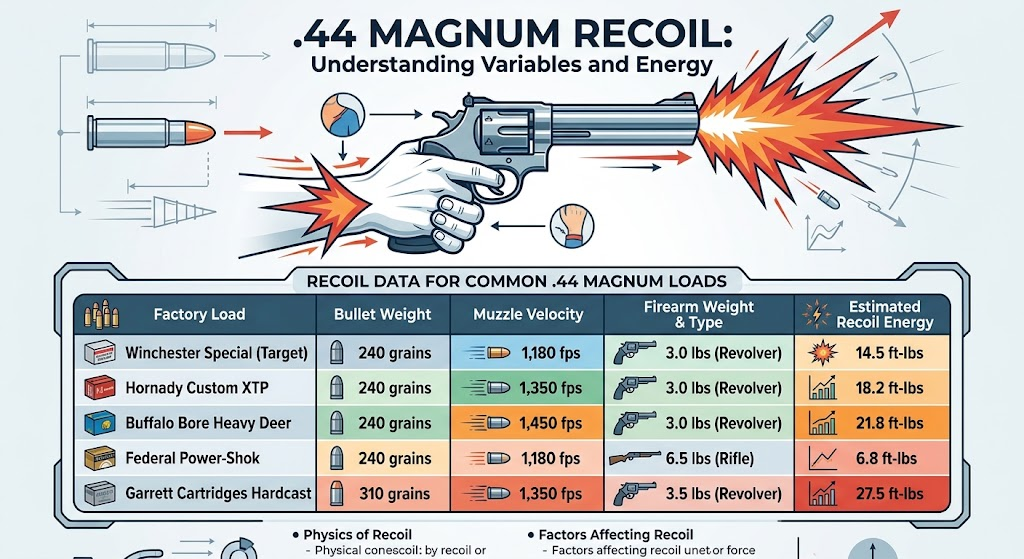
The following table displays estimated free recoil energy for popular .44 Magnum factory loads across different platform weights. Because this cartridge is chambered in both heavy revolvers and lightweight lever-action rifles, recoil scales noticeably based on the weight of the gun.
| Factory Load | Bullet Weight | Muzzle Velocity | Firearm Weight & Type | Estimated Recoil Energy |
| Winchester Special (Target) | 240 grains | 1,180 fps | 3.0 lbs (Revolver) | 14.5 ft-lbs |
| Hornady Custom XTP | 240 grains | 1,350 fps | 3.0 lbs (Revolver) | 18.2 ft-lbs |
| Buffalo Bore Heavy Deer | 240 grains | 1,450 fps | 3.0 lbs (Revolver) | 21.8 ft-lbs |
| Federal Power-Shok | 240 grains | 1,180 fps | 6.5 lbs (Rifle) | 6.8 ft-lbs |
| Garrett Cartridges Hardcast | 310 grains | 1,350 fps | 3.5 lbs (Revolver) | 27.5 ft-lbs |
How Much Recoil Does .44 Magnum Have?
In practical terms, a standard 240-grain .44 Magnum hunting load generates an average of 18 to 22 foot-pounds of free recoil energy in a typical 3-pound revolver, paired with a recoil velocity of roughly 13 to 15 feet per second. Recoil energy dictates the physical rearward force delivered to your hands, while recoil velocity determines how fast, sharp, and snappy that impact feels.
Because the .44 Magnum combines heavy bullets with high chamber pressures in a relatively light handgun platform, the physical forces are substantial. The recoil impulse arrives almost instantaneously, creating a sharp upward flip that strains the shooter’s wrists and grip.
What Does .44 Magnum Recoil Feel Like?
During a hunt, adrenaline masks most of the discomfort, but a full-power .44 Magnum load delivers an aggressive, jarring snap that instantly twists the revolver muzzle upward toward the sky. It is universally classified as a heavy-recoiling handgun cartridge that demands a firm, locked-wrist grip.
At the shooting range, the .44 Magnum requires respect. Firing a full cylinder of heavy hunting ammunition from a bench rest can cause hand fatigue, stinging palms, and potential trigger-guard bite if the shooter’s grip slips. The violent muzzle flip makes rapid follow-up shots difficult without practice. Fortunately, almost all .44 Magnum revolvers can safely chamber and fire mild .44 Special ammunition, allowing shooters to practice comfortably without beating up their hands.
.44 Magnum Recoil Compared To Other Cartridges
To understand how the .44 Magnum fits into the broader handgun and rifle landscape, it helps to compare it against other popular chamberings. The data below assumes a standard handgun weight of 3.0 pounds for revolvers to ensure an accurate comparison.
| Cartridge | Platform | Common Bullet Weight | Muzzle Velocity | Estimated Recoil Energy |
| .357 Magnum | Revolver (2.8 lbs) | 158 grains | 1,250 fps | 9.5 ft-lbs |
| .44 Magnum | Revolver (3.0 lbs) | 240 grains | 1,350 fps | 18.2 ft-lbs |
| .454 Casull | Revolver (3.5 lbs) | 300 grains | 1,650 fps | 29.8 ft-lbs |
| .450 Bushmaster | Rifle (7.5 lbs) | 250 grains | 2,200 fps | 24.5 ft-lbs |
| .500 S&W Magnum | Revolver (4.0 lbs) | 400 grains | 1,600 fps | 41.0 ft-lbs |
What Affects .44 Magnum Recoil?
Because the .44 Magnum operates at high pressures, minor changes in your setup dramatically alter the felt recoil.
- Firearm Weight: This is a crucial factor. Heavy-framed revolvers with long 7.5-inch barrels absorb significantly more momentum and tame muzzle flip better than lightweight, short-barreled snub-nosed revolvers.
- Bullet Weight & Construction: Pushing heavy 240-grain to 300-grain hardcast or jacketed bullets increases the opposite rearward force transferred to your hands.
- Muzzle Velocity: Pushing a 240-grain bullet past 1,300 fps spikes the recoil velocity, making the snap feel much sharper.
- Grip Design and Material: Ergonomic rubber grips that fill the backstrap help cushion the web of the hand, whereas smooth wooden single-action grips allow the gun to roll in the hand, which alters how the energy is absorbed.
- Platform Type: When chambered in a rifle rather than a revolver, the heavier weight and stock contact against the shoulder drop the felt recoil of a .44 Magnum down to levels comparable to a mild .243 Winchester.
How To Reduce .44 Magnum Recoil
Taming a .44 Magnum requires a mix of equipment choices and disciplined shooting technique.
The simplest and most cost-effective way to manage recoil during range practice is to shoot standard .44 Special ammunition through your revolver. A .44 Special load produces a fraction of the recoil, allowing you to build excellent trigger control without developing a flinch.
When firing full-power .44 Magnum loads, upgrading to oversized, shock-absorbing rubber grips helps distribute the pressure across a wider surface area of your hand. Additionally, maintaining a high, locked-wrist grip prevents the gun from slamming backward into your thumb bones. If you are shooting a .44 Magnum lever-action rifle, recoil is rarely an issue due to the gun’s weight and stock design.
Is .44 Magnum Recoil Too Much For Hunting?
The .44 Magnum is one of the most legendary handgun hunting cartridges ever created, and its recoil is entirely manageable for experienced hunters who practice regularly. It delivers extraordinary terminal performance on deer, hogs, and black bears within reasonable handgun ranges.
However, newer shooters or individuals sensitive to heavy recoil should avoid starting with full-power .44 Magnum loads. The punishing, sharp snap can easily induce a flinch in novices. Starting with .44 Special loads and gradually working up to magnum ammunition is the best way to master the cartridge safely.
Frequently Asked Questions
Does the .44 Magnum kick harder than the .357 Magnum?
Yes, significantly harder. A full-power .44 Magnum generates roughly double the free recoil energy of a standard .357 Magnum, and its heavier bullet delivers a much more forceful push to the hand.
Can I shoot .44 Special in a .44 Magnum revolver?
Yes. All .44 Magnum revolvers are engineered to safely chamber and fire standard .44 Special ammunition. This is a popular feature because .44 Special rounds produce mild, comfortable recoil for affordable range practice.
Is .44 Magnum recoil worse than a .454 Casull?
No. The .44 Magnum has noticeably less recoil than the .454 Casull. While the .44 Magnum sits around 18 foot-pounds of energy, the extreme high-pressure .454 Casull easily exceeds 25 to 30 foot-pounds, delivering a much sharper and more violent snap.