The .38 Special produces roughly 2 to 5 foot-pounds of free recoil energy in a standard handgun, making it one of the mildest and most comfortable centerfire cartridges available. Developed over a century ago as a duty and self-defense round, its kick is exceptionally gentle and easily managed by virtually any shooter. The exact amount of .38 Special recoil you experience will always vary depending on your specific firearm weight, bullet weight, muzzle velocity, and whether you are shooting standard-pressure loads or high-pressure +P rounds.
.38 Special Recoil Chart
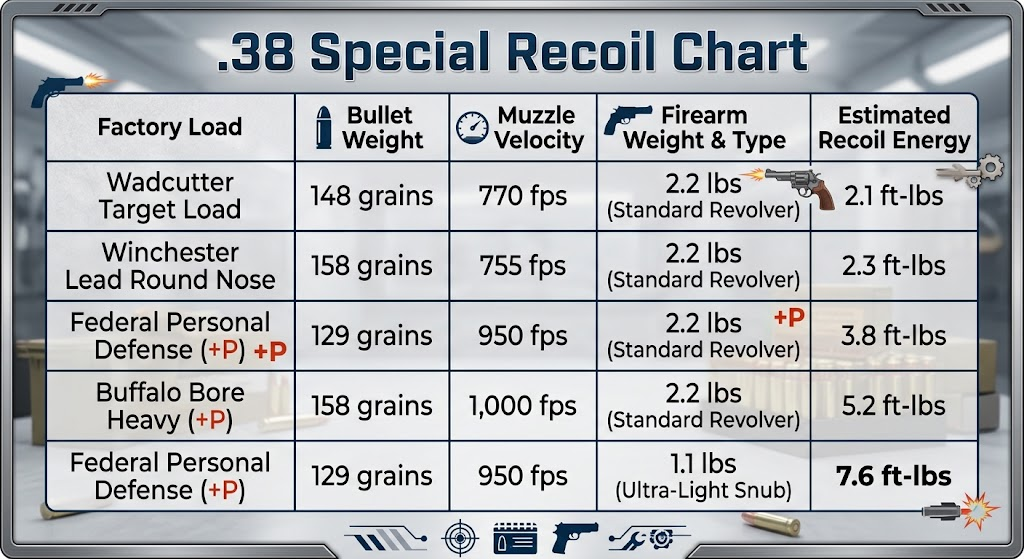
The following table displays estimated free recoil energy for popular .38 Special factory loads. Because this cartridge is chambered in everything from ultra-lightweight snub-nosed concealed carry revolvers to heavy target handguns, recoil scales noticeably based on the weight of the firearm.
| Factory Load | Bullet Weight | Muzzle Velocity | Firearm Weight & Type | Estimated Recoil Energy |
| Wadcutter Target Load | 148 grains | 770 fps | 2.2 lbs (Standard Revolver) | 2.1 ft-lbs |
| Winchester Lead Round Nose | 158 grains | 755 fps | 2.2 lbs (Standard Revolver) | 2.3 ft-lbs |
| Federal Personal Defense (+P) | 129 grains | 950 fps | 2.2 lbs (Standard Revolver) | 3.8 ft-lbs |
| Buffalo Bore Heavy (+P) | 158 grains | 1,000 fps | 2.2 lbs (Standard Revolver) | 5.2 ft-lbs |
| Federal Personal Defense (+P) | 129 grains | 950 fps | 1.1 lbs (Ultra-Light Snub) | 7.6 ft-lbs |
How Much Recoil Does .38 Special Have?
In practical terms, a standard-pressure .38 Special load generates an average of 2 to 3.5 foot-pounds of free recoil energy in a typical steel-framed revolver, paired with a very low recoil velocity of around 5 to 7 feet per second. Recoil energy dictates the physical rearward force delivered to your hands, while recoil velocity determines how fast that impact feels.
Because both of these metrics are exceptionally low, standard .38 Special loads generate very little rearward thrust. The recoil impulse is completely smooth and free of any harsh, violent snap, making it an ideal cartridge for developing proper marksmanship fundamentals.
What Does .38 Special Recoil Feel Like?
During self-defense practice or a range session with a standard steel revolver, the recoil of a .38 Special feels like a soft, polite nudge. It is universally classified as a mild-recoiling cartridge that causes zero hand fatigue or discomfort.
However, the experience changes dramatically if you shoot +P defensive loads out of an ultra-lightweight, aluminum- or titanium-framed snub-nosed revolver (weighing around 13 to 15 ounces). In a featherweight gun, snappy +P loads concentrate a sharp, stinging push directly into the web of the hand, making the recoil feel surprisingly stout for such a small cartridge. In a standard steel-framed gun, it remains a total pleasure to shoot.
.38 Special Recoil Compared To Other Cartridges
To understand how the .38 Special fits into the broader handgun landscape, it helps to compare it directly to other popular revolver and semi-automatic chamberings. The data below assumes a standard steel revolver weight of 2.2 pounds to ensure a fair, direct comparison.
| Cartridge | Platform | Common Bullet Weight | Muzzle Velocity | Estimated Recoil Energy |
| .22 Long Rifle | Revolver (2.0 lbs) | 40 grains | 1,200 fps | 0.8 ft-lbs |
| .38 Special | Revolver (2.2 lbs) | 158 grains | 755 fps | 2.3 ft-lbs |
| 9mm Luger | Semi-Auto (1.8 lbs) | 115 grains | 1,150 fps | 4.2 ft-lbs |
| .38 Special (+P) | Revolver (2.2 lbs) | 129 grains | 950 fps | 3.8 ft-lbs |
| .357 Magnum | Revolver (2.8 lbs) | 158 grains | 1,250 fps | 9.5 ft-lbs |
| .44 Magnum | Revolver (3.0 lbs) | 240 grains | 1,350 fps | 18.2 ft-lbs |
What Affects .38 Special Recoil?
While standard .38 Special recoil is inherently mild, several physical factors determine exactly how much kick your specific firearm will produce.
- Firearm Weight: This is the single biggest variable. A heavy steel-framed revolver acts as a massive sponge for energy, whereas an ultra-lightweight concealed carry pocket revolver multiplies felt recoil significantly.
- Ammunition Pressure (+P): Standard-pressure loads operate at low velocities and mild pressures. “+P” (plus-P) loads operate at higher pressures to increase terminal velocity, resulting in a noticeably sharper kick.
- Bullet Weight: Traditional target loads use 148-grain wadcutters at very low speeds, while defense loads use heavier or faster projectiles that increase rearward momentum.
- Grip Design: Small, minimalist wooden grips on vintage or pocket revolvers concentrate force into a tiny surface area of your hand. Ergonomic rubber combat grips distribute that pressure across your palm, drastically reducing perceived snap.
How To Reduce .38 Special Recoil
Because standard .38 Special recoil is already negligible, mitigation is rarely needed. However, if you or a new shooter are sensitive to the snap of +P loads in a lightweight carry gun, you can easily smooth out the experience.
The best approach is to practice exclusively with standard-pressure 148-grain target wadcutter loads, which produce almost zero felt recoil. If you carry a lightweight snub-nosed revolver, replacing the factory grip with a slightly larger, rubberized ergonomic grip (such as a Hogue Bantam or Pachmayr grip) will completely eliminate hand sting during defensive training sessions.
Is .38 Special Recoil Too Much For Hunting?
The .38 Special is not designed for hunting medium or large game, and its recoil is certainly not too much for its intended purposes of target shooting, training, and concealed carry. In fact, its exceptionally gentle recoil profile is why it remains the premier recommendation for absolute beginners, youth shooters, and individuals with hand strength or joint sensitivities.
Because the cartridge induces zero flinching, shooters can easily master sight alignment, trigger control, and double-action trigger pulls without physical apprehension.
Frequently Asked Questions
Does the .38 Special kick more than a 9mm?
In comparable firearms, they are very close, but a standard-pressure .38 Special usually kicks slightly less than a 9mm Luger. However, if you step up to a high-pressure .38 Special +P load out of a lightweight snub-nosed revolver, it can feel noticeably snappier than a standard 9mm pistol.
Can I shoot .38 Special in a .357 Magnum revolver?
Yes. All .357 Magnum revolvers are engineered to safely chamber and fire .38 Special ammunition. This is a very popular practice because .38 Special rounds produce virtually no recoil in a heavy .357 Magnum frame, making for an extremely relaxing and affordable range session.
What is the softest-shooting .38 Special load available?
Target wadcutter loads (typically 148-grain hollow-base or solid wadcutters traveling around 750 feet per second) produce the absolute lowest recoil energy of any centerfire revolver cartridge, offering a sensation barely louder or harder-hitting than a .22 LR.