The .277 SIG Fury produces approximately 16 to 23 foot-pounds of free recoil energy in a standard rifle, placing it in the moderate recoil category. Born from military testing to replace the 5.56 NATO, this cartridge introduces a unique dynamic because recoil levels shift dramatically between its standard brass ammunition and its extreme high-pressure hybrid ammunition. Ultimately, the exact amount of .277 Fury recoil you experience will always vary depending on your specific rifle weight, bullet weight, muzzle velocity, and which load you choose to fire.
277 Fury Recoil Chart
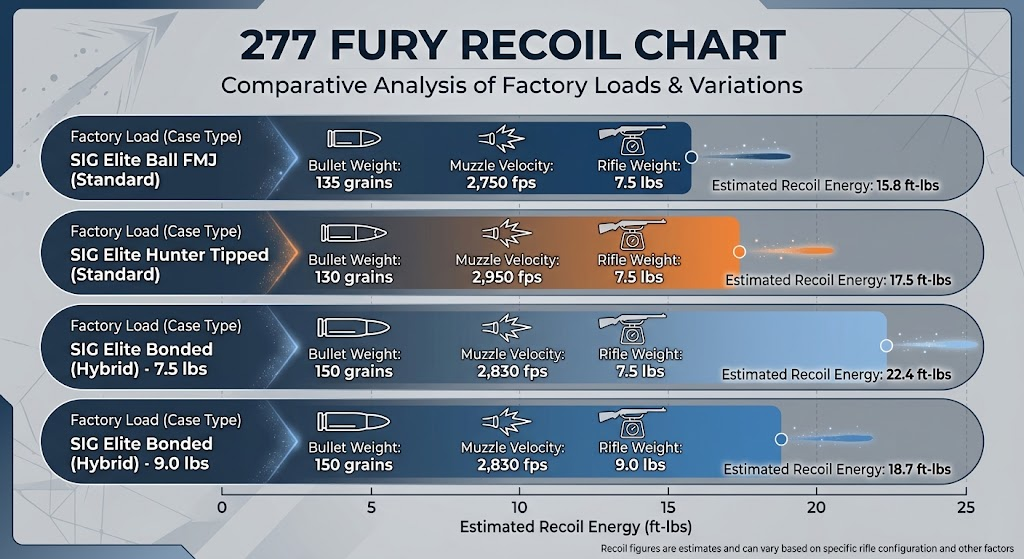
The following table displays estimated free recoil energy for popular .277 Fury factory loads, distinguishing between standard brass cases and the high-pressure three-piece hybrid cases. Because this cartridge is most famously chambered in the lightweight SIG Cross and the MCX Spear, these calculations use a baseline 7.5-pound rifle weight to ensure a consistent comparison.
| Factory Load (Case Type) | Bullet Weight | Muzzle Velocity | Rifle Weight | Estimated Recoil Energy |
| SIG Elite Ball FMJ (Standard) | 135 grains | 2,750 fps | 7.5 lbs | 15.8 ft-lbs |
| SIG Elite Hunter Tipped (Standard) | 130 grains | 2,950 fps | 7.5 lbs | 17.5 ft-lbs |
| SIG Elite Bonded (Hybrid) | 150 grains | 2,830 fps | 7.5 lbs | 22.4 ft-lbs |
| SIG Elite Bonded (Hybrid) | 150 grains | 2,830 fps | 9.0 lbs | 18.7 ft-lbs |
How Much Recoil Does 277 Fury Have?
In practical terms, the recoil of the .277 Fury depends entirely on the ammunition you feed it. Standard brass loads generate an average of 16 foot-pounds of free recoil energy, which is virtually identical to a traditional .308 Winchester. However, if you load the 150-grain hybrid-cased ammunition, the free recoil energy jumps to over 22 foot-pounds in a 7.5-pound rifle, accompanied by a rapid recoil velocity of roughly 13.5 feet per second.
Recoil energy dictates the physical rearward force delivered to your shoulder, while recoil velocity determines how fast that impact feels. Because the hybrid cases are designed to withstand an astonishing 80,000 psi of chamber pressure, they drive heavy bullets to high velocities out of short 16-inch barrels. This immense pressure spike creates a noticeably sharper and faster recoil impulse than traditional short-action cartridges.
What Does 277 Fury Recoil Feel Like?
During a hunt, the physical sensation of the .277 Fury recoil is generally ignored due to adrenaline. Shooters typically describe standard loads as a comfortable push, while the hybrid loads feel like a very fast, authoritative snap. It is classified as a moderate recoiling cartridge, but the hybrid loads punch above their weight class in terms of felt sharpness.
At the shooting range, the experience is highly dependent on your rifle. If you are shooting the hybrid loads out of a featherweight 6.5-pound hunting rifle from a bench rest, the sharp recoil impulse will become fatiguing after a box of ammunition. The high chamber pressure causes the rifle to jump aggressively, meaning you will likely lose your sight picture through the scope unless your shooting fundamentals are perfectly solid.
277 Fury Recoil Compared To Other Cartridges
To understand where the .277 Fury sits in the broader cartridge landscape, we must compare it against the classic and modern hunting chamberings. The data below assumes a standard rifle weight of 8.0 pounds for all cartridges to ensure a fair and accurate baseline.
| Cartridge | Common Bullet Weight | Muzzle Velocity | Estimated Recoil Energy |
| 6.5 PRC | 143 grains | 2,960 fps | 15.8 ft-lbs |
| .308 Winchester | 150 grains | 2,820 fps | 16.0 ft-lbs |
| .277 Fury (Standard) | 135 grains | 2,750 fps | 14.8 ft-lbs |
| .277 Fury (Hybrid) | 150 grains | 2,830 fps | 21.0 ft-lbs |
| .30-06 Springfield | 180 grains | 2,700 fps | 20.1 ft-lbs |
| 7mm Rem Mag | 160 grains | 2,950 fps | 23.1 ft-lbs |
| .300 Win Mag | 180 grains | 2,950 fps | 27.4 ft-lbs |
What Affects 277 Fury Recoil?
Several distinct physical and mechanical factors dictate exactly how much recoil a .277 Fury rifle will produce.
- Ammunition Type: This is the most unique factor for this caliber. Standard brass cases operate at normal pressures and yield mild recoil. Hybrid stainless-steel/brass cases operate at 80,000 psi, driving heavier bullets faster and significantly increasing the rearward kick.
- Rifle Weight: A heavier rifle absorbs more rearward momentum. A heavy AR-10 style platform like the civilian MCX Spear will soak up more energy than a stripped-down bolt-action SIG Cross.
- Bullet Weight: Pushing a heavier 150-grain bullet requires more force than a 135-grain bullet, which directly increases the opposite rearward kick.
- Muzzle Velocity: Faster bullets generate more recoil. The hybrid cases achieve velocities from a 16-inch barrel that normally require a 24-inch barrel, resulting in a fierce rocket effect at the muzzle.
- Suppressors and Brakes: Muzzle devices trap or redirect escaping high-pressure gases, effectively pulling the rifle forward to counteract the sharp rearward snap.
How To Reduce 277 Fury Recoil
If the recoil level of the high-pressure loads is too sharp for comfortable practice, you can apply several practical methods to tame the rifle.
The absolute easiest way to reduce .277 Fury recoil at the range is to simply shoot standard brass ammunition instead of the expensive hybrid loads. This instantly drops the recoil by nearly 30 percent, placing it perfectly in line with a soft-shooting .308 Winchester.
Because the .277 Fury was developed alongside modern suppression technology for the military, threading on a high-quality suppressor is the ideal hardware upgrade. A suppressor adds physical weight to the short barrels typical of this caliber, eats the massive concussive blast of the 80,000 psi loads, and drops the felt recoil down to extremely manageable levels. Adding a thick, premium rubber recoil pad will also lengthen the duration of the sharp impact.
Is 277 Fury Recoil Too Much For Hunting?
The .277 Fury is an excellent hunting cartridge for medium to large game like whitetail deer, mule deer, and elk. For experienced shooters, the recoil is entirely manageable in the field. The massive advantage of the .277 Fury is that it delivers magnum-level hunting performance out of very short, maneuverable 16-inch barrels, making it an incredible brush and timber cartridge.
However, the high-pressure hybrid loads are not recommended for newer shooters or youth hunters using lightweight rifles. The sharp snap is enough to induce a flinch in novices. If a newer shooter is using the .277 Fury, they should stick strictly to standard brass ammunition for deer hunting, which offers plenty of knockdown power with a much friendlier recoil profile.
Frequently Asked Questions
Does the 277 Fury kick more than a .308 Winchester?
If you are shooting standard brass .277 Fury ammunition, it kicks the same or slightly less than a .308 Winchester. If you are shooting the high-pressure hybrid ammunition, the .277 Fury kicks noticeably harder than a standard .308 Winchester.
Why does the hybrid ammunition recoil so much faster?
The three-piece hybrid case allows the cartridge to handle 80,000 psi of chamber pressure, which is vastly higher than traditional hunting cartridges. This extreme pressure spike creates a faster, sharper recoil velocity, making the kick feel more like a sudden snap than a slow push.
Do I need a muzzle brake for a 277 Fury?
You do not strictly need a muzzle brake, especially if you are shooting standard brass loads. However, if you plan to shoot a high volume of the full-power hybrid loads out of a lightweight hunting rifle, a muzzle brake or a suppressor will make the experience significantly more comfortable.