The main difference in the 38 Special + P Vs 357 Magnum comparison is internal pressure and case length, with the magnum featuring a longer case to safely hold massive powder charges. While the overpressure .38 variant delivers excellent self-defense performance with manageable recoil in small concealed carry revolvers, the magnum delivers crushing kinetic energy suited for hunting and duty use. Fortunately, modern revolvers chambered for the magnum can safely fire both cartridges, offering shooters ultimate versatility.
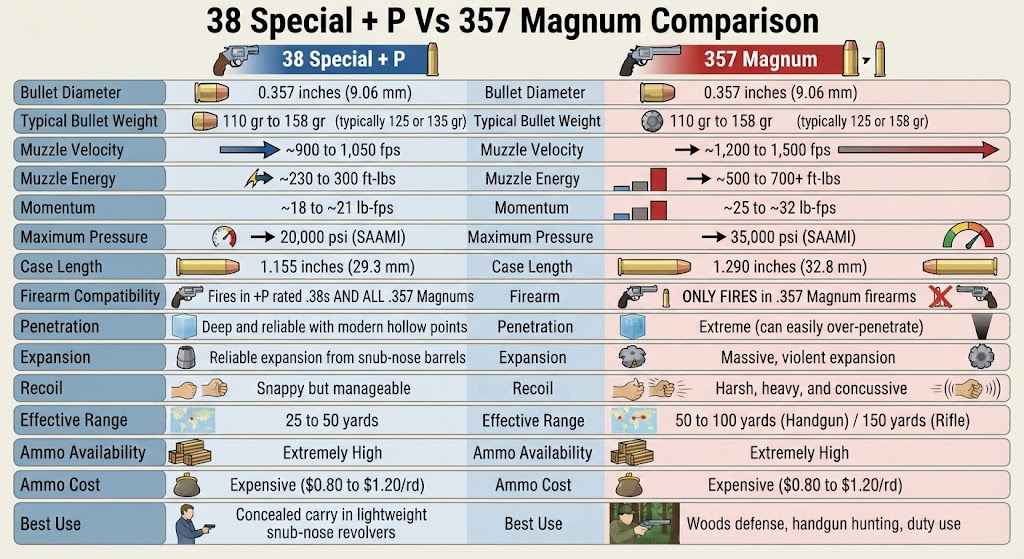
38 Special + P Vs 357 Magnum Comparison
| Feature | 38 Special + P | 357 Magnum |
| Bullet Diameter | 0.357 inches (9.06 mm) | 0.357 inches (9.06 mm) |
| Typical Bullet Weight | 110 gr to 158 gr (typically 125 or 135 gr) | 110 gr to 158 gr (typically 125 or 158 gr) |
| Muzzle Velocity | ~900 to 1,050 fps | ~1,200 to 1,500 fps |
| Muzzle Energy | ~230 to 300 ft-lbs | ~500 to 700+ ft-lbs |
| Momentum | ~18 to ~21 lb-fps | ~25 to ~32 lb-fps |
| Maximum Pressure | 20,000 psi (SAAMI) | 35,000 psi (SAAMI) |
| Case Length | 1.155 inches (29.3 mm) | 1.290 inches (32.8 mm) |
| Firearm Compatibility | Fires in +P rated .38s and all .357 Magnums | ONLY fires in .357 Magnum firearms |
| Penetration | Deep and reliable with modern hollow points | Extreme (can easily over-penetrate) |
| Expansion | Reliable expansion from snub-nose barrels | Massive, violent expansion |
| Recoil | Snappy but manageable | Harsh, heavy, and concussive |
| Effective Range | 25 to 50 yards | 50 to 100 yards (Handgun) / 150 yards (Rifle) |
| Ammo Availability | Extremely High | Extremely High |
| Ammo Cost | Expensive ($0.80 to $1.20/rd) | Expensive ($0.80 to $1.20/rd) |
| Best Use | Concealed carry in lightweight snub-nose revolvers | Woods defense, handgun hunting, duty use |
The table above illustrates one of the most famous ballistic evolutions in history. In 1934, Smith & Wesson and Winchester sought to create a cartridge capable of penetrating the heavy car doors and early ballistic vests used by organized crime syndicates. They took the standard .38 Special case, lengthened it by exactly 0.135 inches, and packed it with enough powder to generate a massive 35,000 psi of pressure. The lengthened case was a brilliant safety feature: it physically prevented the high-pressure .357 Magnum rounds from being chambered in older, weaker .38 Special revolvers that would explode under the stress.
Decades later, ammunition manufacturers created the 38 Special + P (meaning “Overpressure”). It retains the shorter 1.155-inch case length but is loaded to 20,000 psi instead of the standard 17,000 psi. This provides a middle ground: it delivers the extra velocity needed for modern hollow points to expand reliably from short barrels, without inflicting the punishing recoil and deafening blast of a full-house magnum.
38 Special + P Vs 357 Magnum Ballistics
To objectively evaluate the ballistic capabilities, we must examine real-world ammunition fired from the most common platform for these calibers: a standard 4-inch revolver barrel.
- Load A (38 Special + P Defense): Speer Gold Dot 135-grain +P JHP. Muzzle velocity is roughly 980 feet per second. Muzzle energy is roughly 288 foot-pounds.
- Load B (38 Special + P Heavy): Remington 158-grain +P Lead Semi-Wadcutter Hollow Point. Muzzle velocity is roughly 890 feet per second. Muzzle energy is roughly 278 foot-pounds.
- Load C (357 Magnum Defense): Federal Premium 125-grain JHP. Muzzle velocity is roughly 1,450 feet per second. Muzzle energy is roughly 583 foot-pounds.
- Load D (357 Magnum Heavy Woods): Buffalo Bore 158-grain Hard Cast JHC. Muzzle velocity is roughly 1,400 feet per second. Muzzle energy is roughly 688 foot-pounds.
38 Special + P Vs 357 Magnum Velocity
Velocity dictates terminal performance, and the magnum operates in an entirely different tier.
Even when loaded to higher +P pressures, the shorter .38 Special case can only push a 125-grain bullet to roughly 950 or 1,000 feet per second from a standard handgun barrel.
The .357 Magnum easily pushes that exact same 125-grain bullet at blistering speeds of 1,400 to 1,500 feet per second. This extreme velocity is what gives the magnum its legendary reputation for hydrostatic shock and barrier penetration.
38 Special + P Vs 357 Magnum Muzzle Energy
Muzzle energy represents the raw kinetic work capacity of a projectile.
The overpressure .38 Special generates between 250 and 300 foot-pounds of energy. This is widely considered the baseline requirement for reliable self-defense, offering enough power to reach vital organs and force hollow points to open.
The .357 Magnum generates a massive 550 to 700+ foot-pounds of energy. It hits with roughly double the kinetic force of the .38 Special +P. This immense energy is what allows the magnum to be used effectively for handgun hunting (taking deer and wild hogs) and defense against dangerous predators like black bears.
38 Special + P Vs 357 Magnum Momentum
Momentum calculates mass in motion, which dictates a bullet’s ability to drive through heavy clothing, auto glass, or dense bone without being deflected.
Because both cartridges can fire identical bullet weights (e.g., 158 grains), the momentum advantage goes entirely to the faster magnum. A 158-grain bullet traveling at 1,400 fps yields roughly 31.6 pound-feet per second of linear momentum, whereas the same bullet traveling at 890 fps yields only 20.0 lb-fps. The magnum simply crushes through obstacles with far more driving mass.
38 Special + P Vs 357 Magnum Recoil
Recoil management is the primary reason why many shooters choose not to carry magnum ammunition in their self-defense revolvers.
The 38 Special + P produces a snappy but highly manageable recoil impulse. In a lightweight concealed carry revolver, it will jump in your hand, but an average shooter can quickly bring the sights back on target for a follow-up shot.
The .357 Magnum is notorious for its punishing recoil and deafening muzzle blast. Fired from a lightweight snub-nose revolver, the magnum generates tremendous pain in the web of the hand and a concussive shockwave that can disorient the shooter. Unless the firearm is a heavy, full-sized steel revolver (like a Smith & Wesson 686), magnum recoil severely degrades a shooter’s ability to fire rapidly and accurately.
38 Special + P Vs 357 Magnum Penetration & Expansion
For urban self-defense, the 38 Special + P is often the superior choice due to penetration mechanics. Modern +P hollow points (like the Federal HST or Speer Gold Dot) are specifically engineered to penetrate 12 to 16 inches into soft tissue and expand reliably.
The .357 Magnum is so fast and powerful that it presents a severe over-penetration risk in urban environments. A magnum hollow point can pass entirely through an attacker and retain enough energy to injure a bystander on the other side. However, for wilderness defense against heavy animals, that extreme, deep penetration is exactly what is required.
Which Has More Stopping Power: 38 Special + P Vs 357 Magnum?
The .357 Magnum possesses vastly superior stopping power. Its extreme velocity, massive kinetic energy, and dramatic hydrostatic shock make it one of the most proven one-shot stoppers in handgun history.
Which Is More Powerful: 38 Special + P Vs 357 Magnum?
Based on raw internal pressure, kinetic energy, and momentum, the .357 Magnum is roughly twice as powerful as the overpressure .38 Special.
38 Special + P Pros And Cons
Pros
- Generates highly manageable recoil, allowing for fast and accurate follow-up shots
- Provides the necessary velocity for reliable hollow-point expansion without over-penetration risks
- Maximizes the defensive capability of lightweight, 5-shot snub-nose concealed carry revolvers
- Significantly less muzzle blast and flash compared to full magnums
Cons
- Lacks the kinetic energy required for reliable defense against large wilderness predators
- Not powerful enough for ethical medium-game hunting
- Can cause accelerated wear in older, vintage revolvers not rated for overpressure ammunition
357 Magnum Pros And Cons
Pros
- Legendary, proven stopping power for both two-legged threats and wilderness predators
- Double the kinetic energy of standard defensive revolver calibers
- Incredible versatility: a .357 Magnum firearm can safely shoot both .357 Mag and .38 Special +P ammo
- Delivers rifle-like ballistic performance when fired out of a lever-action carbine
Cons
- Brutal, punishing recoil in lightweight concealed carry revolvers
- Deafening muzzle blast can cause extreme disorientation if fired indoors without hearing protection
- High risk of over-penetration in urban self-defense scenarios
Final Comparison
| Category | Winner | Reason |
| Velocity | 357 Magnum | Massive powder capacity drives identical bullets 400+ fps faster |
| Muzzle Energy | 357 Magnum | Higher speeds yield double the kinetic stopping power |
| Momentum | 357 Magnum | Faster velocities create drastically superior linear driving mass |
| Penetration | 357 Magnum | Extreme speeds punch through auto glass, barriers, and heavy bone |
| Expansion | 357 Magnum | High impact velocities force hollow points to peel back violently |
| Recoil Control | 38 Special + P | Generates vastly softer and more manageable felt recoil |
| Urban Defense | 38 Special + P | Reduces over-penetration risks and allows for faster follow-up shots |
| Woods Defense | 357 Magnum | Delivers the crushing penetration required to stop bears and hogs |
| Firearm Versatility | 357 Magnum | A magnum revolver safely chamber and fires both cartridges |
| Ammo Cost | Tie | Both premium defensive options carry roughly identical price tags |
| Overall Performance | Depends on Role | .38 +P for urban concealed carry; .357 for maximum power and woods defense |
38 Special + P Vs 357 Magnum: Which Should You Choose?
Selecting the winner in the 38 Special + P Vs 357 Magnum matchup depends entirely on where you carry your firearm and the weight of the gun itself.
Choose the 38 Special + P if you are carrying a lightweight, snub-nose revolver for daily concealed carry in an urban environment. When your life is on the line, you need to put multiple shots on target quickly. The +P ammunition gives you excellent terminal expansion without the blinding flash, deafening boom, and wrist-snapping recoil that causes shooters to miss their follow-up shots with full magnums.
Choose the 357 Magnum if you carry a heavy, full-sized steel revolver (like a Ruger GP100) or if you are heading into the backcountry. The magnum delivers the extreme kinetic energy and deep barrier penetration required for handgun hunting, defending against bears, or utilizing a lever-action carbine.
Note: The best choice for many shooters is to purchase a revolver chambered in .357 Magnum, practice with cheap standard .38 Special, carry 38 Special + P for daily defense, and load .357 Magnum when hiking in the woods—giving you the ultimate versatile platform.
FAQs
Can a .357 Magnum shoot 38 Special + P ammunition?
Yes, absolutely. A revolver chambered in .357 Magnum is built to withstand massive pressures (35,000 psi) and features a cylinder long enough to accommodate the magnum cartridge. It will safely and effortlessly chamber and fire the shorter, lower-pressure .38 Special and .38 Special +P ammunition.
Can a .38 Special shoot .357 Magnum ammunition?
No. The .357 Magnum cartridge is intentionally manufactured to be 0.135 inches longer than the .38 Special. This prevents it from fully seating inside the cylinder of a .38 Special revolver. Attempting to force or modify a .38 revolver to fire magnum ammunition will result in a catastrophic, potentially lethal explosion.
Is 38 Special + P the same as .357 Magnum?
No. While they fire the exact same diameter bullet (0.357 inches), the .38 Special +P is loaded into a shorter case and operates at a maximum pressure of 20,000 psi. The .357 Magnum uses a longer case and operates at 35,000 psi, generating roughly double the kinetic energy.
Which cartridge has more recoil?
The .357 Magnum generates significantly more recoil and muzzle blast. Fired from identical firearms, the magnum will produce a sharp, punishing kick, whereas the .38 Special +P will produce a brisk but manageable jump.
Why do police no longer carry the .357 Magnum?
For decades, the .357 Magnum was the gold standard for American law enforcement. However, police transitioned to high-capacity 9mm semi-automatic pistols in the late 1980s and 1990s. The 9mm offers 15 to 17 rounds per magazine, much faster reload speeds, and softer recoil for better qualification scores compared to a 6-shot magnum revolver.