The main difference in the 6mm GT Vs 6mm Creedmoor comparison is that the 6mm Creedmoor utilizes a larger case capacity to achieve blistering velocities for long-range hunting and target shooting, whereas the 6mm GT is a purpose-built competition cartridge engineered to provide flawless magazine feeding, longer barrel life, and ultra-low recoil. While the 6mm Creedmoor delivers flatter trajectories and more kinetic energy, the 6mm GT dominates the Precision Rifle Series by perfectly balancing ballistic efficiency with match-grade consistency.
6mm GT Vs 6mm Creedmoor Comparison
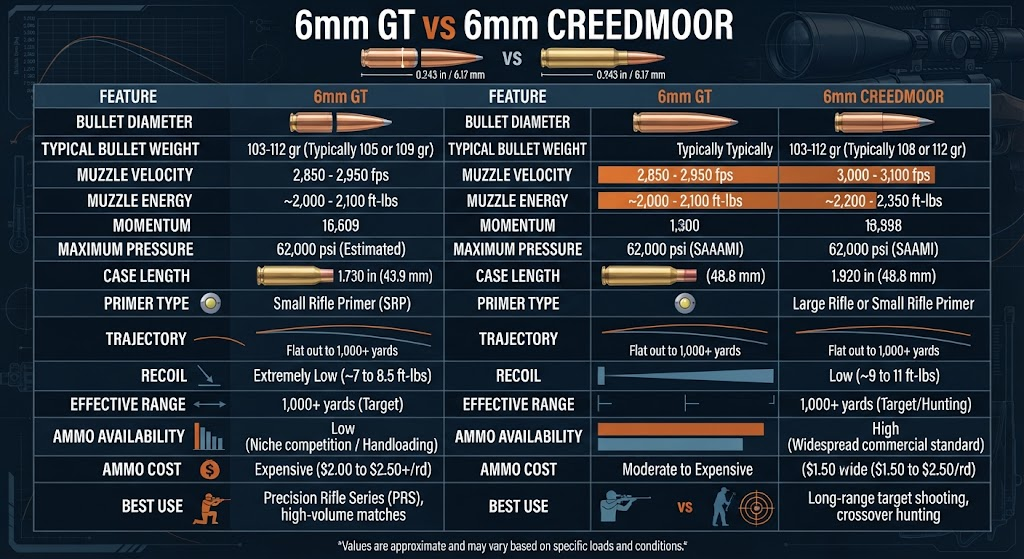
| Feature | 6mm GT | 6mm Creedmoor |
| Bullet Diameter | 0.243 inches (6.17 mm) | 0.243 inches (6.17 mm) |
| Typical Bullet Weight | 103 gr to 112 gr (typically 105 or 109 gr) | 103 gr to 112 gr (typically 108 or 112 gr) |
| Muzzle Velocity | 2,850 to 2,950 fps (26-inch barrel) | 3,000 to 3,100 fps (26-inch barrel) |
| Muzzle Energy | ~2,000 to 2,100 ft-lbs | ~2,200 to 2,350 ft-lbs |
| Momentum | ~43 to ~46 lb-fps | ~46 to ~49 lb-fps |
| Maximum Pressure | 62,000 psi (Estimated) | 62,000 psi (SAAMI) |
| Case Length | 1.730 inches (43.9 mm) | 1.920 inches (48.8 mm) |
| Primer Type | Small Rifle Primer (SRP) | Large Rifle or Small Rifle Primer |
| Trajectory | Flat out to 1,000+ yards | Laser-flat out to 1,000+ yards |
| Recoil | Extremely Low (~7 to 8.5 ft-lbs) | Low (~9 to 11 ft-lbs) |
| Effective Range | 1,000+ yards (Target) | 1,000+ yards (Target/Hunting) |
| Ammo Availability | Low (Niche competition / Handloading) | High (Widespread commercial standard) |
| Ammo Cost | Expensive ($2.00 to $2.50+/rd) | Moderate to Expensive ($1.50 to $2.50/rd) |
| Best Use | Precision Rifle Series (PRS), high-volume matches | Long-range target shooting, crossover hunting |
The table above illustrates a fascinating evolution in precision rifle design. The 6mm Creedmoor was created by simply necking down the highly successful 6.5 Creedmoor case to accept a .243 caliber bullet. While this creates a remarkably fast and powerful cartridge, the long, sloping shoulder can occasionally cause feeding hangups in steep AICS competition magazines, and the massive powder charge burns out barrels quickly.
To solve these exact competition issues, George Gardner and Tom Jacobs designed the 6mm GT in 2019. They created a cartridge that is slightly shorter than the Creedmoor, featuring an optimized 35-degree shoulder and a longer neck. This custom geometry allows the 6mm GT to feed like butter from standard double-stack magazines, burn less powder, utilize small rifle primers for extreme consistency, and extend barrel life all while maintaining enough velocity to hit targets at 1,000 yards easily.
6mm GT Vs 6mm Creedmoor Ballistics
To objectively evaluate the ballistic capabilities, we must examine premium match-grade factory ammunition favored by competitive shooters, fired from heavy 26-inch match barrels.
- Load A (6mm GT Heavy Match): Hornady 109-grain ELD Match. Tested from a 26-inch barrel. Muzzle velocity is 2,900 feet per second. Muzzle energy is 2,035 foot-pounds. Ballistic Coefficient (G1) is 0.542.
- Load B (6mm GT Standard Match): Berger 105-grain Hybrid Target. Tested from a 26-inch barrel. Muzzle velocity is 2,950 feet per second. Muzzle energy is 2,029 foot-pounds. Ballistic Coefficient (G1) is 0.536.
- Load C (6mm Creedmoor Heavy Match): Hornady 108-grain ELD Match. Tested from a 26-inch barrel. Muzzle velocity is 3,050 feet per second. Muzzle energy is 2,231 foot-pounds. Ballistic Coefficient (G1) is 0.536.
- Load D (6mm Creedmoor Precision Match): Barnes 112-grain Match Burner. Tested from a 26-inch barrel. Muzzle velocity is 2,980 feet per second. Muzzle energy is 2,209 foot-pounds. Ballistic Coefficient (G1) is 0.624.
6mm GT Vs 6mm Creedmoor Velocity
Velocity is the primary domain of the 6mm Creedmoor. Because it holds roughly 8 to 10 more grains of powder capacity than the 6mm GT, it acts as a larger engine, driving identical bullets significantly faster.
When firing standard 105-grain to 109-grain match bullets, the 6mm Creedmoor effortlessly exceeds 3,000 feet per second, frequently settling around 3,050 fps depending on the exact load. The 6mm GT was explicitly designed to operate at a more conservative velocity node of roughly 2,900 to 2,950 feet per second. The 6mm Creedmoor maintains a consistent 100 to 150 fps speed advantage over the GT across all equivalent bullet weights.
6mm GT Vs 6mm Creedmoor Muzzle Energy
Muzzle energy represents the raw kinetic work capacity of a projectile. Because the 6mm Creedmoor drives the same projectiles significantly faster, it produces substantially more kinetic energy.
The 6mm GT generates roughly 2,000 foot-pounds of energy at the muzzle. This is excellent for ringing heavy steel targets at distance and is highly capable of taking deer-sized game at moderate ranges.
The 6mm Creedmoor generates roughly 2,200 to 2,350 foot-pounds of energy at the muzzle. This extra 200 to 300 foot-pounds of kinetic force makes the 6mm Creedmoor a vastly superior choice for long-range hunting, delivering deeper penetration and more authoritative terminal shock on medium game.
6mm GT Vs 6mm Creedmoor Momentum
Momentum calculates mass in motion, which dictates a bullet’s ability to drive straight through dense tissue and heavy bone without deflecting.
Because both cartridges fire identically weighted 6mm projectiles, the momentum advantage belongs entirely to the faster cartridge. A 109-grain 6mm GT bullet traveling at 2,900 fps yields approximately 45.2 pound-feet per second of linear momentum. A 108-grain 6mm Creedmoor bullet traveling at 3,050 fps yields approximately 47.0 pound-feet per second. Both carry highly efficient driving mass, but the Creedmoor hits noticeably harder.
6mm GT Vs 6mm Creedmoor Trajectory
Understanding external ballistics highlights the trade-offs between ultimate speed and competition efficiency. The calculations below assume a high-profile target optic height of 1.5 inches above the bore and a 200-yard zero using matched aerodynamics.
| Distance | 6mm GT (109 gr at 2,900 fps) Drop | 6mm Creedmoor (108 gr at 3,050 fps) Drop |
| Muzzle | -1.5 inches | -1.5 inches |
| 200 Yards | 0.0 inches (Zero) | 0.0 inches (Zero) |
| 400 Yards | -19.5 inches | -17.5 inches |
| 600 Yards | -62.5 inches | -55.5 inches |
| 800 Yards | -135.2 inches | -119.8 inches |
| 1000 Yards | -245.5 inches | -218.0 inches |
The trajectory data demonstrates the raw aerodynamic dominance of the 6mm Creedmoor. Because it leaves the muzzle roughly 150 fps faster, it reaches the target sooner, resulting in a significantly flatter curve. At 1,000 yards, the 6mm Creedmoor drops nearly 27 inches (over two feet) less than the 6mm GT, meaning the shooter requires less elevation dialed into their scope. Furthermore, the faster transit time gives crosswinds less time to push the 6mm Creedmoor off course.
6mm GT Vs 6mm Creedmoor Recoil
Recoil management is the exact reason the 6mm GT was invented, as competitive shooters must maintain perfect sight pictures to spot their own bullet impacts during rapid-fire stages.
The 6mm Creedmoor generates roughly 9.5 to 11 foot-pounds of free recoil energy in a heavy match rifle. While this is remarkably low, the fast, heavy powder burn creates a noticeable “snap” at the muzzle.
The 6mm GT burns less powder and operates at lower velocities, generating an incredibly soft 7.0 to 8.5 foot-pounds of free recoil energy. The recoil impulse is best described as a gentle push rather than a snap, allowing shooters to stay locked onto their targets effortlessly, even from awkward barricade positions.
6mm GT Vs 6mm Creedmoor Penetration & Expansion
For competitive target shooting on steel plates, penetration and expansion are irrelevant.
For hunting medium game (deer, antelope), the 6mm Creedmoor is vastly superior. Its higher impact velocities ensure that premium hunting bullets (like the Hornady ELD-X) open violently and reliably at extended ranges where the slower 6mm GT might drop below the minimum velocity threshold required for proper expansion.
6mm GT Vs 6mm Creedmoor Barrel Life
This is a critical metric for high-volume competitive shooters who fire thousands of rounds per season.
The 6mm Creedmoor is notoriously hard on barrels. Because it pushes large volumes of powder through a small 0.243-inch bore, throat erosion happens rapidly. Most competitive shooters report that 6mm Creedmoor barrels lose their match-grade accuracy after 1,200 to 1,500 rounds.
The 6mm GT is highly efficient. Its smaller powder charge and optimized shoulder angle drastically reduce the heat and pressure blasted into the barrel throat. Competitive shooters routinely report exceptional match-grade barrel life spanning 2,000 to 2,500+ rounds, effectively cutting a competitor’s re-barreling costs in half over a few seasons.
6mm GT Vs 6mm Creedmoor Self Defense & Concealed Carry
Neither cartridge is suitable for self-defense, home defense, or concealed carry. Both are extreme long-range rifle cartridges fired from massive, heavy bolt-action platforms entirely unsuited for defensive scenarios.
Which Has More Stopping Power: 6mm GT Vs 6mm Creedmoor?
On medium game at practical hunting distances, the 6mm Creedmoor possesses significantly more stopping power. It delivers higher kinetic energy, superior hydrostatic shock due to faster impact velocities, and deeper penetration.
Which Is More Powerful: 6mm GT Vs 6mm Creedmoor?
Based on raw kinetic energy, powder capacity, and momentum, the 6mm Creedmoor is substantially more powerful, generating roughly 200 to 300 more foot-pounds of energy at the muzzle.
6mm GT Pros And Cons
Pros
- Engineered for flawless feeding from standard AICS double-stack magazines without nose-diving
- Extremely mild recoil impulse allows shooters to effortlessly spot their own bullet trace
- Highly efficient powder burn extends match-grade barrel life to 2,000+ rounds
- Incredible consistency with very low extreme spreads (ES) and standard deviations (SD)
Cons
- Primarily a niche competition cartridge; factory ammunition is expensive and hard to find locally
- Slower velocities result in more bullet drop and wind drift at 1,000 yards compared to larger 6mm variants
- Marginal kinetic energy for long-range hunting applications
6mm Creedmoor Pros And Cons
Pros
- Blistering velocities provide laser-flat trajectories and exceptional wind-bucking capabilities
- Massive commercial adoption guarantees ubiquitous factory ammunition and rifle availability
- Outstanding dual-purpose cartridge that excels at both PRS matches and open-country deer hunting
- Requires less scope elevation adjustment at 1,000 yards
Cons
- Overbore capacity burns out rifle barrels very quickly (1,200 to 1,500 rounds)
- Long, sloping case shoulder can occasionally cause feeding hangups in steep competition magazines
- Generates more recoil and muzzle blast than purpose-built match cartridges
Final Comparison
| Category | Winner | Reason |
| Velocity | 6mm Creedmoor | Larger case capacity drives bullets 100 to 150 fps faster |
| Muzzle Energy | 6mm Creedmoor | Higher velocities yield 200 to 300 more ft-lbs of kinetic energy |
| Momentum | 6mm Creedmoor | Faster speeds applied to identical bullet mass yield superior momentum |
| Penetration | 6mm Creedmoor | Higher impact velocities push hunting projectiles deeper |
| Expansion | 6mm Creedmoor | Maintains expanding velocity thresholds further downrange |
| Trajectory | 6mm Creedmoor | Faster transit time results in noticeably less drop and wind drift at 1,000 yds |
| Recoil Control | 6mm GT | Efficient powder burn generates an incredibly soft, smooth recoil impulse |
| Barrel Life | 6mm GT | Consistently delivers 2,000+ rounds of match accuracy |
| Magazine Feeding | 6mm GT | 35-degree shoulder and optimized length ensure flawless double-stack feeding |
| Ammo Cost | 6mm Creedmoor | Massive commercial production offers more competitive retail pricing |
| Ammo Availability | 6mm Creedmoor | Found in virtually every major sporting goods store nationwide |
| Overall Performance | Depends on Role | 6mm GT for pure competition efficiency; 6mm Creedmoor for crossover speed |
6mm GT Vs 6mm Creedmoor: Which Should You Choose?
Selecting the winner in the 6mm GT Vs 6mm Creedmoor matchup comes down to whether you are a dedicated competition shooter counting every round, or a long-range enthusiast who wants maximum ballistic power and hunting utility.
Choose the 6mm GT if your primary focus is shooting high-volume Precision Rifle Series (PRS) matches. It is a masterpiece of modern competition engineering. It feeds flawlessly, provides incredibly consistent velocities, recoils so softly you can easily spot your own misses, and will save you thousands of dollars in replacement barrels over your shooting career.
Choose the 6mm Creedmoor if you want a highly versatile, blisteringly fast cartridge for long-range target shooting and open-country hunting. It shoots noticeably flatter, fights the wind better, and hits much harder than the GT. Furthermore, you gain the immense convenience of walking into any sporting goods store to buy affordable factory match ammunition.
FAQs
Is 6mm GT more powerful than 6mm Creedmoor?
No, the 6mm Creedmoor is significantly more powerful. It features a larger case capacity that holds more powder, generating higher velocities and roughly 200 to 300 more foot-pounds of kinetic energy than the 6mm GT.
Which has better barrel life?
The 6mm GT has drastically better barrel life. Its smaller, highly efficient powder charge extends match-grade barrel accuracy to roughly 2,000 to 2,500 rounds, whereas the overbore 6mm Creedmoor typically burns out barrels in 1,200 to 1,500 rounds.
Can a 6.5 Creedmoor rifle shoot 6mm Creedmoor?
No. While they share the same parent case, the 6mm Creedmoor has a neck sized specifically for a 0.243-inch bullet. A 6.5 Creedmoor requires a 0.264-inch bullet. Attempting to fire the wrong ammunition will cause catastrophic failure. However, you can convert a 6.5 Creedmoor to a 6mm Creedmoor simply by swapping the barrel.
Why was the 6mm GT invented?
The 6mm GT was invented by competitive shooters who wanted a cartridge that fixed the rapid barrel wear and magazine feeding issues of the 6mm Creedmoor, while offering a bit more velocity and wind resistance than the smaller 6mm BR and 6mm Dasher cartridges.
Which has more recoil?
The 6mm Creedmoor generates slightly more recoil due to its larger powder charge and higher velocities. The 6mm GT provides an incredibly soft, smooth recoil impulse preferred by top-tier competitors.
Which is better for hunting?
The 6mm Creedmoor is universally better for hunting medium game like deer and antelope. Its higher impact velocities ensure reliable bullet expansion and deeper penetration at extended distances.
Which should you choose?
Choose the 6mm GT for high-volume PRS competition, extended barrel life, and flawless magazine feeding. Choose the 6mm Creedmoor for laser-flat trajectories, long-range hunting utility, and widespread commercial ammunition availability.