The main difference between the cartridges is that the .300 Whisper is a proprietary wildcat cartridge developed in the early 1990s for custom suppressed platforms, whereas the 300 Blackout is a mass-produced global standard engineered to ensure universal feeding, factory ammunition availability, and strict interoperability across military AR-15 platforms.
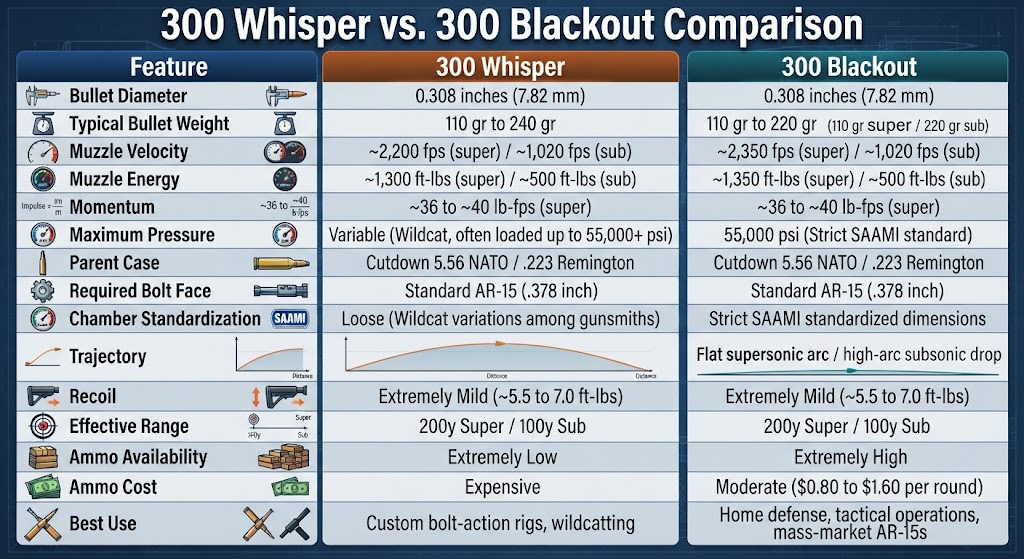
300 Whisper Vs 300 Blackout Comparison
| Feature | 300 Whisper | 300 Blackout |
| Bullet Diameter | 0.308 inches (7.82 mm) | 0.308 inches (7.82 mm) |
| Typical Bullet Weight | 110 gr to 240 gr | 110 gr to 220 gr (110 gr super / 220 gr sub) |
| Muzzle Velocity | ~2,200 fps (super) / ~1,020 fps (sub) | ~2,350 fps (super) / ~1,020 fps (sub) |
| Muzzle Energy | ~1,300 ft-lbs (super) / ~500 ft-lbs (sub) | ~1,350 ft-lbs (super) / ~500 ft-lbs (sub) |
| Momentum | ~36 to ~40 lb-fps (super) | ~36 to ~40 lb-fps (super) |
| Maximum Pressure | Variable (Wildcat, often loaded up to 55,000+ psi) | 55,000 psi (Strict SAAMI standard) |
| Parent Case | Cutdown 5.56 NATO / .223 Remington | Cutdown 5.56 NATO / .223 Remington |
| Required Bolt Face | Standard AR-15 (.378 inch) | Standard AR-15 (.378 inch) |
| Chamber Standardization | Loose (Wildcat variations among gunsmiths) | Strict SAAMI standardized dimensions |
| Trajectory | Nearly identical to 300 Blackout | Flat supersonic arc / high-arc subsonic drop |
| Recoil | Extremely Mild (~5.5 to 7.0 ft-lbs) | Extremely Mild (~5.5 to 7.0 ft-lbs) |
| Effective Range | 200 yards (Super) / 100 yards (Sub) | 200 yards (Super) / 100 yards (Sub) |
| Ammo Availability | Extremely Low (Custom handloads or specialty boutique) | Extremely High (Global commercial standard) |
| Ammo Cost | Expensive (Custom handloading components) | Moderate ($0.80 to $1.60 per round) |
| Best Use | Custom bolt-action whisper rigs, historical wildcatting | Home defense, tactical operations, mass-market AR-15s |
The table above highlights that ballistically, the two cartridges are practically twins. Because the 300 Blackout was engineered directly from the 300 Whisper, their case lengths, powder capacities, and projectile options overlap significantly. The critical difference is standardization. A factory 300 Blackout cartridge will safely and reliably chamber in a 300 Whisper rifle in most cases, but firing a high-pressure 300 Blackout round in a custom 300 Whisper chamber built to looser or older wildcat specifications can occasionally result in dangerous over-pressure issues or improper headspace alignment.
300 Whisper Vs 300 Blackout Ballistics
To objectively evaluate the ballistic capabilities, we must examine real-world ammunition across standard 16-inch rifle barrels. Because factory 300 Whisper commercial loads are virtually non-existent today, data for the Whisper reflects custom handloading standards that mirror factory 300 Blackout specs.
- Load A (300 Whisper Custom Supersonic): Handload 110-grain V-MAX. Tested from a 16-inch barrel. Muzzle velocity is 2,350 feet per second. Muzzle energy is 1,348 foot-pounds.
- Load B (300 Whisper Custom Subsonic): Handload 220-grain Sierra MatchKing. Tested from a 16-inch barrel. Muzzle velocity is 1,020 feet per second. Muzzle energy is 508 foot-pounds.
- Load C (300 Blackout Supersonic Factory): Barnes 110-grain Vor-TX TTSX. Tested from a 16-inch barrel. Muzzle velocity is 2,350 feet per second. Muzzle energy is 1,348 foot-pounds. Ballistic Coefficient (G1) is 0.292.
- Load D (300 Blackout Subsonic Factory): Hornady 220-grain Sub-X. Tested from a 16-inch barrel. Muzzle velocity is 1,020 feet per second. Muzzle energy is 508 foot-pounds. Ballistic Coefficient (G1) is 0.450.
300 Whisper Vs 300 Blackout Velocity
Velocity is functionally identical. When comparing equivalent bullet weights pushed out of matching barrel lengths, both cartridges produce the exact same speeds.
In subsonic configurations, both must stay below the speed of sound (~1,050 to 1,100 fps) to prevent a sonic crack, resulting in identical muzzle velocities right around 1,020 feet per second. In supersonic configurations, both top out around 2,350 fps with lightweight 110-grain bullets. There is zero perceptible difference in speed between the two.
300 Whisper Vs 300 Blackout Muzzle Energy
Muzzle energy represents the raw kinetic work capacity of a projectile. Because the powder capacities and bullet weights are virtually identical, their muzzle energy outputs are identical.
Both generate roughly 1,300 to 1,450 foot-pounds of energy in supersonic configurations, and roughly 480 to 510 foot-pounds in subsonic configurations. Neither cartridge offers a power advantage over the other, as they utilize the exact same physical dimensions and propellant volumes.
300 Whisper Vs 300 Blackout Momentum
Momentum calculates mass in motion, dictating a projectile’s ability to drive through tissue or barriers.
Because both cartridges fire identical .308-inch bullets at matching velocities, their linear momentum profiles are completely identical. A 220-grain subsonic bullet traveling at 1,020 feet per second yields approximately 32.0 pound-feet per second of linear momentum regardless of whether it was stamped as a 300 Whisper or a 300 Blackout.
300 Whisper Vs 300 Blackout Trajectory
External ballistic drop curves are entirely identical. When firing equivalent supersonic or subsonic loads, both cartridges share the same bullet weight, velocity, and aerodynamic profile.
Both experience a flat supersonic arc out to 150-200 yards, and both experience an extreme “rainbow” drop curve past 200 yards when utilizing heavy subsonic ammunition.
300 Whisper Vs 300 Blackout Recoil
Both cartridges generate exceptionally mild recoil. Fired from a standard AR-15, both produce roughly 5.5 to 7.0 foot-pounds of free recoil energy in supersonic configurations, and practically zero felt recoil in subsonic configurations.
300 Whisper Vs 300 Blackout Penetration & Expansion
Terminal performance is dictated entirely by bullet selection rather than the cartridge designation. A 110-grain Barnes TTSX or a 220-grain Hornady Sub-X will perform identically whether fired from a 300 Whisper chamber or a 300 Blackout chamber, provided the impact velocity is the same.
300 Whisper Vs 300 Blackout Self Defense & Home Defense
The 300 Blackout is the definitive choice for home defense and tactical operations. Because it is an international SAAMI standard, you can walk into any sporting goods store and purchase factory-loaded defensive ammunition whose pressures, expansion thresholds, and reliability are strictly guaranteed.
Relying on a custom wildcat like the 300 Whisper for life-or-death defense requires custom handloads, which introduces potential liability and consistency variables.
Which Has More Stopping Power: 300 Whisper Vs 300 Blackout?
Their stopping power is functionally identical. They fire the exact same bullets at the exact same speeds, delivering identical kinetic energy and wound channels.
Which Is More Powerful: 300 Whisper Vs 300 Blackout?
They are tied in absolute power. They share virtually identical case volumes and operate under the same physical pressure limits.
300 Whisper Pros And Cons
Pros
- The original historic wildcat that pioneered the heavy-bullet subsonic AR-15 concept
- Can be handloaded with extreme precision for custom bolt-action rifle platforms
- Historical significance in the evolution of suppressed tactical shooting
Cons
- Obsolete commercial status; factory ammunition is virtually non-existent
- Chamber dimensions can vary wildly depending on which gunsmith cut the barrel, creating potential safety hazards with factory ammo
- Requires handloading brass and specialized components
300 Blackout Pros And Cons
Pros
- Strict SAAMI standardization ensures 100% safe interchangeability of factory ammunition worldwide
- Ubiquitous retail availability of both cheap practice ammo and premium defensive loads
- Massive aftermarket ecosystem of short-barreled uppers, suppressors, and dedicated parts
- The undisputed gold standard for suppressed tactical platforms and home defense
Cons
- Risk of catastrophic chambering mix-ups if 300 Blackout rounds accidentally enter a standard 5.56 NATO rifle magazine/chamber
Final Comparison
| Category | Winner | Reason |
| Velocity | Tie | Identical case volumes and powder charges produce matching speeds |
| Muzzle Energy | Tie | Both generate equivalent kinetic energy (~1,350 ft-lbs super / ~500 ft-lbs sub) |
| Momentum | Tie | Identical projectile masses at matching speeds yield identical momentum |
| Penetration | Tie | Terminal ballistic performance depends entirely on bullet choice |
| Expansion | Tie | Bullets expand identically at matching impact velocities |
| Trajectory | Tie | Ballistic drop curves are completely indistinguishable |
| Recoil Control | Tie | Both generate micro-recoil in standard rifle platforms |
| Effective Range | Tie | Both share identical supersonic and subsonic distance caps |
| Self Defense | 300 Blackout | Standardized factory defensive loads ensure legal and mechanical reliability |
| Concealed Carry | Neither | Both are intermediate rifle calibers unsuited for body concealment |
| Ammo Cost | 300 Blackout | Mass-market commercial production makes 300 Blackout vastly cheaper |
| Ammo Availability | 300 Blackout | Found on store shelves everywhere; 300 Whisper requires custom handloading |
| Overall Performance | 300 Blackout | The standardized modern evolution that completely replaced the 300 Whisper wildcat |
300 Whisper Vs 300 Blackout: Which Should You Choose?
Selecting between the 300 Whisper and the 300 Blackout is simple: choose the 300 Blackout.
The 300 Whisper is a brilliant historical milestone—the wildcat father that proved a heavy .30-caliber bullet could run suppressed in an AR-15. However, because AAC standardized and refined the concept into the 300 Blackout, the Whisper has been rendered commercially obsolete.
By choosing the 300 Blackout, you gain access to safe SAAMI-spec chambers, ubiquitous factory ammunition on every store shelf, standardized magazines, and a massive global ecosystem of tactical hardware.
FAQs
Is 300 Whisper More Powerful Than 300 Blackout?
No, they are effectively tied in power. Because they share virtually identical case capacities, both cartridges produce identical kinetic energy output when firing equivalent bullets at matching speeds.
Can A 300 Blackout Rifle Shoot 300 Whisper Ammunition?
Yes, in almost all modern firearms, it is perfectly safe to fire 300 Whisper ammunition out of a 300 Blackout chamber because the 300 Blackout’s SAAMI dimensions easily accommodate the slightly varying Whisper loads.
Can A 300 Whisper Rifle Shoot 300 Blackout Ammunition?
This is generally discouraged unless specifically cleared by the barrel manufacturer. Because 300 Whisper chambers were cut by custom gunsmiths before standardized dimensions existed, some feature shorter throats. Firing a standard, high-pressure 300 Blackout round in a short-throated Whisper chamber can cause a dangerous pressure spike.
Which Has More Muzzle Energy?
They generate the exact same muzzle energy: roughly 1,300 to 1,450 foot-pounds for supersonic loads, and roughly 480 to 510 foot-pounds for subsonic loads.
Which Is Better For Self Defense?
The 300 Blackout is objectively better for self-defense because factory-loaded, quality-controlled defensive ammunition is globally available and guaranteed to function safely in standardized chambers.
Why Did 300 Blackout Replace 300 Whisper?
Advanced Armament Corporation (AAC) submitted the 300 Blackout to SAAMI to formalize the cartridge so the military and major commercial manufacturers could mass-produce it. The lack of standardized dimensions is what ultimately relegated the 300 Whisper to historical wildcat status.
Which Should You Choose?
Choose the 300 Blackout for its massive hardware ecosystem, universal factory ammunition availability, and guaranteed SAAMI-spec safety.