The main difference between the cartridges is that the 300 Blackout is a universally established tactical cartridge optimized for short-barreled suppressed maneuverability and lightweight combat use, whereas the .338 ARC is a modern, purpose-built “big bore” intermediate cartridge engineered by Hornady to maximize heavy-projectile mass, delivering roughly 50% more kinetic energy, particularly in suppressed subsonic configurations.
Both cartridges are explicitly designed to fit inside the standard AR-15 platform and feed from standard lower receivers using modified magazines, operating on a similar conceptual premise of heavy bullets traveling at modest speeds or supersonic intermediate velocities. The 300 Blackout was standardized in 2011 to provide military operators with a seamless transition between supersonic performance and whisper-quiet suppressed subsonic performance from compact barrels. The .338 ARC (Advanced Rifle Cartridge), introduced by Hornady, utilizes the fatter 6.5 Grendel parent case to pack a massive .338-caliber projectile into an AR-15 magazine well, specifically designed to overcome the energy limitations of the 300 Blackout subsonic platform.
338 Arc vs 300 Blackout Comparison
| Feature | .338 ARC | 300 Blackout |
| Bullet Diameter | 0.338 inches (8.58 mm) | 0.308 inches (7.82 mm) |
| Typical Bullet Weight | 170 gr to 307 gr (175 gr super / 307 gr sub) | 110 gr to 220 gr (110 gr super / 220 gr sub) |
| Muzzle Velocity | ~2,350 fps (super) / ~1,020 fps (sub) | ~2,350 fps (super) / ~1,020 fps (sub) |
| Muzzle Energy | ~2,100+ ft-lbs (super) / ~700 ft-lbs (sub) | ~1,350 ft-lbs (super) / ~480 ft-lbs (sub) |
| Momentum (Subsonic) | ~44.5 lb-fps (307 gr at 1,020 fps) | ~31.5 lb-fps (220 gr at 1,020 fps) |
| Maximum Pressure | 52,000 to 55,000 psi (SAAMI optimized) | 55,000 psi (SAAMI) |
| Parent Case | 6.5 Grendel | Cutdown 5.56 NATO / .223 Remington |
| Required Bolt Face | 6.5 Grendel (Type 2) | Standard AR-15 (.378 inch) |
| Ballistic Coefficient | Moderate to High (Heavy sectional density) | Low to Moderate |
| Trajectory (Subsonic) | High-arc drop (~34 inches at 200 yards) | High-arc drop (~33 inches at 200 yards) |
| Recoil | Mild (~7 to 9 ft-lbs) | Extremely Mild (~5.5 to 7.0 ft-lbs) |
| Effective Range | 300 to 400 yards (Super) / 200 yards (Sub) | 200 yards (Super) / 100 yards (Sub) |
| Ammo Availability | Low to Moderate (Newer Hornady release) | Extremely High (Global commercial standard) |
| Ammo Cost | Expensive ($1.50 to $2.50+ per round) | Moderate ($0.80 to $1.60 per round) |
| Best Use | Suppressed heavy-payload hunting, barrier impact | Home defense, tactical operations, high-volume shooting |
The table above illustrates the fundamental mechanical advantage of the .338 ARC: caliber size and case volume. Because the .338 ARC is built on the fatter Grendel case family, it accommodates much heavier, wider projectiles such as the massive 307-grain Sub-X bullet—without crushing the powder column.The 300 Blackout is constrained by its narrow .223-derived case, which limits its maximum subsonic payload typically to 220 grains.
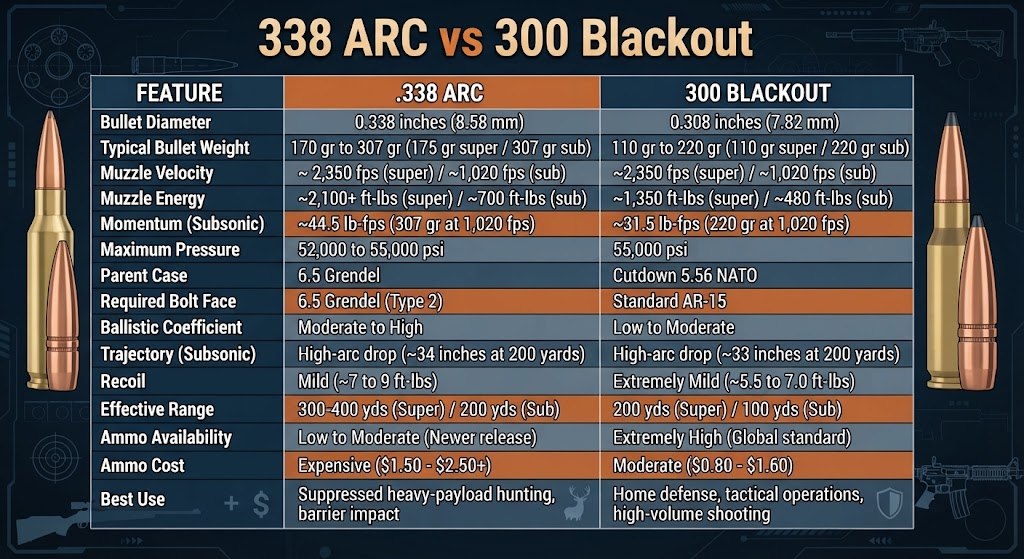
.338 ARC vs 300 Blackout Ballistics
To objectively evaluate the ballistic capabilities, we must examine real-world factory ammunition across both supersonic and subsonic configurations fired from standard 16-inch barrels.
- Load A (.338 ARC Subsonic): Hornady 307-grain Sub-X. Tested from a 16-inch barrel. Muzzle velocity is 1,020 feet per second. Muzzle energy is 708 foot-pounds.
- Load B (.338 ARC Supersonic): Hornady 175-grain HP Match. Tested from a 16-inch barrel. Muzzle velocity is 2,350 feet per second. Muzzle energy is 2,145 foot-pounds.
- Load C (300 Blackout Subsonic): Hornady 220-grain Sub-X. Tested from a 16-inch barrel. Muzzle velocity is 1,020 feet per second. Muzzle energy is 508 foot-pounds.
- Load D (300 Blackout Supersonic): Barnes 110-grain Vor-TX TTSX. Tested from a 16-inch barrel. Muzzle velocity is 2,350 feet per second. Muzzle energy is 1,348 foot-pounds.
.338 ARC Vs 300 Blackout Velocity
In both supersonic and subsonic categories, velocity limits are tightly managed. For subsonic loads, both cartridges must stay below the speed of sound (roughly 1,050 to 1,100 fps) to prevent a supersonic crack. Both cartridges achieve this by launching their respective heavy bullets right around 1,020 feet per second.
In supersonic configurations, both cartridges top out around 2,350 fps depending on barrel length and load selection. However, because the .338 ARC pushes a much heavier 175-grain bullet at that speed compared to the 300 Blackout’s lighter 110-grain projectile, the .338 ARC retains its velocity and energy much more efficiently as distance increases.
.338 ARC Vs 300 Blackout Muzzle Energy
Muzzle energy represents the raw kinetic work capacity of a projectile, and this is where the .338 ARC completely separates itself from the 300 Blackout.
In subsonic roles, the 300 Blackout generates roughly 450 to 500 foot-pounds of energy (comparable to a hot .45 ACP handgun round). The .338 ARC subsonic load generates over 700 foot-pounds of energy at the muzzle—delivering roughly 40% to 50% more raw kinetic force simply due to the massive weight of the 307-grain bullet.
In supersonic configurations, the gap widens further. The .338 ARC supersonic load delivers upwards of 2,100 foot-pounds of energy, easily outclassing the 1,350 foot-pounds produced by typical supersonic 300 Blackout loads.
.338 ARC Vs 300 Blackout Momentum
Momentum calculates mass in motion, dictating a projectile’s ability to drive straight through heavy muscle and bone.
Because momentum relies heavily on bullet mass, the .338 ARC dominates.
A 220-grain subsonic 300 Blackout bullet traveling at 1,020 feet per second yields approximately 32.0 pound-feet per second of linear momentum.
A massive 307-grain .338 ARC subsonic bullet traveling at 1,020 feet per second yields approximately 44.7 pound-feet per second of linear momentum.
This heavy momentum gives the .338 ARC subsonic round deep, freight-train-like penetration on medium game, making it an exceptionally lethal timber-hunting tool when suppressed.
.338 ARC Vs 300 Blackout Trajectory
Because subsonic bullets are legally bound to identical speed limits (~1,020 fps), their exterior ballistic drop curves are remarkably similar out to 200 yards.
When firing subsonic loads, both cartridges experience roughly 33 to 34 inches of drop at 200 yards and plunge drastically past 250 yards, creating a severe “rainbow” trajectory that requires precise holdovers.
In supersonic configurations, the heavier .338 ARC projectiles start dropping slightly faster at extended ranges than ultra-light 110-grain 300 Blackout bullets, but the .338 ARC compensates with vastly superior energy retention and wind resistance.
.338 ARC Vs 300 Blackout Recoil
Both cartridges are exceptionally mild-recoiling and pleasant to shoot. Fired from an AR-15, the 300 Blackout generates roughly 6.0 foot-pounds of free recoil energy, while the .338 ARC generates roughly 8.0 to 9.0 foot-pounds. Neither causes noticeable fatigue, and both allow shooters to easily track bullet impacts through a scope.
.338 ARC Vs 300 Blackout Penetration & Expansion
Both cartridges utilize advanced expanding bullet designs (such as Hornady’s Sub-X line) engineered specifically to open up at low subsonic velocities.
However, the .338 ARC projects a massive 0.338-inch diameter frontal area that expands into an even wider wound channel. Combined with its high sectional density and heavy mass, the .338 ARC drives significantly deeper and creates a much larger permanent crush cavity than the smaller .30-caliber 300 Blackout bullets.
.338 ARC Vs 300 Blackout Self Defense & Home Defense
The 300 Blackout remains the superior choice for urban home defense and tactical CQB applications. It benefits from massive ecosystem support, an enormous variety of short-barreled upper receivers, cheaper practice ammunition, and lighter rifle configurations. Furthermore, lightweight supersonic 300 Blackout rounds fragment rapidly in drywall, minimizing over-penetration risks.
The .338 ARC can be used for defense, but its heavy, deep-penetrating subsonic bullets pose a higher risk of passing entirely through a target, and the platform lacks the decades of widespread tactical hardware maturation that the 300 Blackout enjoys.
Which Has More Stopping Power: .338 ARC Vs 300 Blackout?
The .338 ARC possesses significantly more stopping power. Whether comparing subsonic or supersonic loads, the .338 ARC delivers substantially more kinetic energy, heavier momentum, and a wider projectile diameter, translating to much more authoritative terminal ballistics on medium game.
Which Is More Powerful: .338 ARC Vs 300 Blackout?
Based on raw muzzle energy and physical mass, the .338 ARC is completely dominant, generating roughly 50% more energy across matching operational tiers.
.338 ARC Pros And Cons
Pros
- Delivers 50% more kinetic energy and heavier momentum than comparable 300 Blackout loads
- Represents the pinnacle of suppressed subsonic hunting performance for deer and hogs
- Wider .338-caliber projectile creates massive permanent wound channels
- Fits standard AR-15 platforms with a simple barrel, bolt (Grendel Type 2), and magazine swap
Cons
- Ammunition is significantly more expensive and less widely available than 300 Blackout
- Requires a .338-compatible suppressor (or a dedicated large-bore can) to avoid warranty issues
- Newer cartridge with a smaller supporting hardware ecosystem compared to the mature Blackout market
300 Blackout Pros And Cons
Pros
- The undisputed king of tactical versatility, short-barreled suppression, and home defense
- Ubiquitous ammunition availability and affordability in every sporting goods store
- Massive aftermarket support with endless rifle builds, parts, and barrel lengths
- Lightweight, highly maneuverable platform for close-quarters engagements
Cons
- Noticeably lower kinetic energy and momentum compared to big-bore intermediate rounds
- Subsonic hunting range is strictly limited due to rapid energy drop-off
- Risk of catastrophic chambering mix-ups if .300 Blackout rounds accidentally enter a 5.56 NATO rifle
Final Comparison
| Category | Winner | Reason |
| Velocity | Tie | Both achieve identical speed caps for subsonics (~1,020 fps) and supers (~2,350 fps) |
| Muzzle Energy | .338 ARC | Delivers roughly 40% to 50% more energy across all equivalent loads |
| Momentum | .338 ARC | Heavy 307-grain bullets carry massive linear driving mass |
| Penetration | .338 ARC | High sectional density and massive weight push projectiles deeper |
| Expansion | .338 ARC | Larger 0.338-inch starting diameter creates a wider permanent wound channel |
| Trajectory | Tie | Identical subsonic speed limits result in equivalent drop curves |
| Recoil Control | 300 Blackout | Generates slightly milder felt recoil due to lighter projectile weights |
| Effective Range | .338 ARC | Superior energy retention makes distant subsonic/supersonic impacts more lethal |
| Self Defense | 300 Blackout | Ubiquitous parts, short-barrel optimization, and safer indoor barrier fragmentation |
| Concealed Carry | Neither | Both are intermediate rifle calibers unsuited for body concealment |
| Ammo Cost | 300 Blackout | Decades of massive global production make Blackout significantly cheaper |
| Ammo Availability | 300 Blackout | Found on store shelves everywhere |
| Overall Performance | Depends on Role | .338 ARC for raw energy and heavy subsonic hunting; 300 Blackout for tactical defense and economy |
.338 ARC Vs 300 Blackout: Which Should You Choose?
Selecting between the .338 ARC and the 300 Blackout depends on whether you prioritize raw ballistic power or ecosystem maturity and tactical economy.
Choose the .338 ARC if your primary goal is suppressed hunting—such as dropping wild hogs or deer with a hearing-safe subsonic AR-15—and you want the absolute maximum kinetic energy and mass possible out of a standard-frame rifle.
Choose the 300 Blackout if you want a proven, highly economical, short-barreled home defense or tactical carbine with ubiquitous ammunition availability, cheap high-volume training rounds, and an unmatched selection of suppressors and specialized tactical parts.
FAQs
Is .338 ARC more powerful than 300 Blackout?
Yes, the .338 ARC is significantly more powerful. It delivers roughly 40% to 50% more kinetic energy than comparable 300 Blackout loads in both subsonic and supersonic categories.
Which has more energy when suppressed?
The .338 ARC heavily outperforms the 300 Blackout in subsonic energy, producing over 700 foot-pounds of muzzle energy compared to the 300 Blackout’s ~500 foot-pounds.
Can a 300 Blackout rifle shoot .338 ARC ammunition?
No. They are entirely different calibers utilizing different case geometries, bolt faces, and barrel diameters. Attempting to chamber .338 ARC in a 300 Blackout rifle is physically impossible.
Do I need a special suppressor for .338 ARC?
Because the .338 ARC utilizes a .338-inch bullet, standard .30-caliber suppressors will not accommodate the projectile. You must use a .338-caliber suppressor, a multi-cal can rated for .338, or certain large-bore pistol suppressors cleared for the pressure and bore diameter.
Which is better for hunting?
The .338 ARC is superior for hunting because its heavy projectile mass and higher energy delivery ensure ethical, clean kills at extended subsonic and supersonic distances.
Which should you choose?
Choose the .338 ARC for maximum kinetic energy and hard-hitting suppressed hunting.Choose the 300 Blackout for universal ammunition availability, tactical defense, and budget-friendly shooting.