The main difference between the cartridges is that the .30 Carbine is a lightweight, low-recoil semi-automatic rifle cartridge designed for intermediate-range military defense with high magazine capacity, whereas the .357 Magnum is a high-pressure revolver and lever-action cartridge engineered to deliver massive, magnum-level energy and deep penetration from handguns.
Both cartridges occupy a fascinating middle ground in ballistics, often crossing paths because the .30 Carbine was famously chambered in the iconic M1 Carbine rifle during World War II, while the .357 Magnum can occasionally be found in rare M1 carbines or heavy-duty handguns. The .30 Carbine was developed by Winchester in 1941 to provide support troops, officers, and paratroopers with a lightweight firearm that hit harder than a pistol but was much handier than a full-sized M1 Garand rifle. The .357 Magnum was introduced earlier in 1934 by Smith & Wesson and Winchester, created by lengthening the .38 Special case and loading it to extreme pressures to achieve rifle-like velocities from a handgun.
.30 Carbine vs .357 Magnum Comparison
| Feature | .30 Carbine | .357 Magnum |
| Bullet Diameter | 0.308 inches (7.82 mm) | 0.357 inches (9.06 mm) |
| Typical Bullet Weight | 110 gr | 125 gr to 158 gr (typically 125 or 158 gr) |
| Muzzle Velocity | 1,990 to 2,000 fps (18-inch rifle barrel) | 1,250 to 1,450 fps (6-inch revolver) / 1,800+ fps (rifle) |
| Muzzle Energy | ~965 ft-lbs (18-inch barrel) | ~550 to 800 ft-lbs (handgun) / ~1,200 ft-lbs (rifle) |
| Momentum | ~31.2 lb-fps | ~28 to ~32 lb-fps |
| Maximum Pressure | 40,000 CUP (~45,000 psi equivalent) | 35,000 psi (SAAMI) |
| Case Type | Rimless (Straight-walled) | Rimmed (Revolver-optimized) |
| Ballistic Coefficient | Very Low (~0.150) | Low (~0.140 to 0.190) |
| Penetration | Moderate (Thin-jacketed FMJ/Soft Point) | Deep (Heavy lead or bonded hollow points) |
| Expansion | Limited (Unless using specialized soft points) | Explosive expansion or deep crushing pass-throughs |
| Trajectory | Flat out to 150 yards | Flat out to 100 yards (Handgun) |
| Recoil | Extremely Low (~2.5 to 3.5 ft-lbs in a rifle) | Moderate to Heavy (~6 to 9 ft-lbs in a handgun) |
| Effective Range | 150 to 200 yards | 50 to 100 yards (Handgun) / 150 yards (Rifle) |
| Ammo Availability | Moderate (Surplus and specialty runs) | Extremely High (Global revolver standard) |
| Ammo Cost | Moderate to Expensive ($0.80 to $1.50/rd) | Moderate ($0.60 to $1.20/rd) |
| Best Use | Historic rifle collecting, light home defense, varmints | Handgun hunting, revolver self-defense, versatility |
The table above highlights the fundamental design divergence: the .30 Carbine is fundamentally optimized to be fired from a lightweight, carbine-length semi-automatic barrel, whereas the .357 Magnum is optimized to operate at high pressures inside heavy revolver cylinders. Because the .30 Carbine utilizes a straight-walled rimless case with a tiny 110-grain bullet, it relies entirely on velocity generated from an 18-inch barrel to achieve its kinetic energy. The .357 Magnum, by contrast, throws heavier, wider bullets and can scale its performance dramatically depending on whether it is fired from a 2-inch snub-nosed revolver or an 18-inch lever-action rifle.
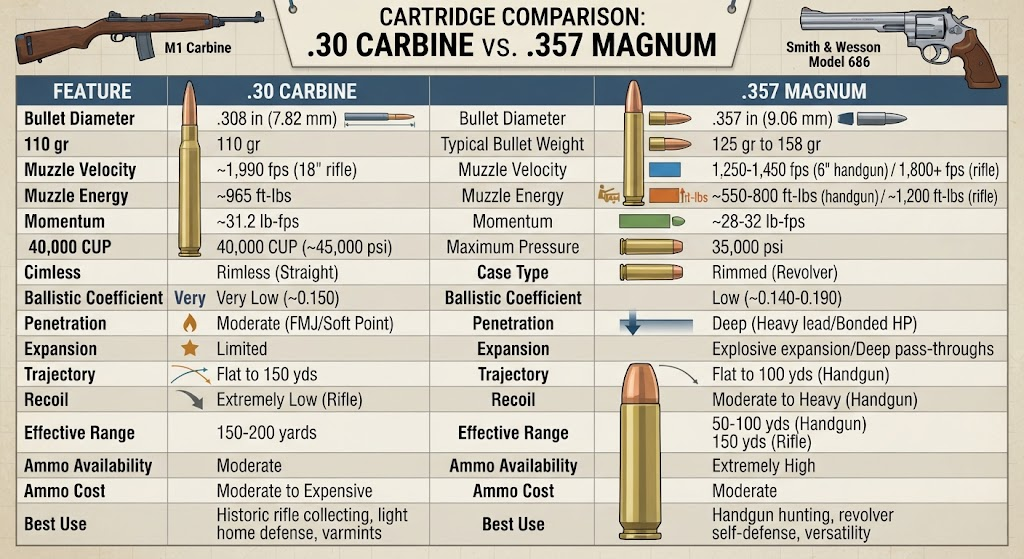
.30 Carbine vs .357 Magnum Ballistics
To objectively evaluate the ballistic capabilities, we must examine real-world factory ammunition across their most common platform pairings (comparing an 18-inch M1 Carbine against a 6-inch .357 Magnum revolver).
- Load A (.300 Carbine Military Surplus/Standard): Winchester 110-grain Full Metal Jacket (FMJ). Tested from an 18-inch M1 Carbine barrel. Muzzle velocity is 1,990 feet per second. Muzzle energy is 968 foot-pounds. Ballistic Coefficient (G1) is 0.150.
- Load B (.30 Carbine Modern Soft Point): Hornady Critical Defense 110-grain FTX. Tested from an 18-inch M1 Carbine barrel. Muzzle velocity is 2,000 feet per second. Muzzle energy is 977 foot-pounds. Ballistic Coefficient (G1) is 0.160.
- Load C (.357 Magnum High-Velocity Handgun): Federal Premium 125-grain JHP. Tested from a 6-inch revolver barrel. Muzzle velocity is 1,450 feet per second. Muzzle energy is 583 foot-pounds. Ballistic Coefficient (G1) is 0.154.
- Load D (.357 Magnum Heavy Handgun): Buffalo Bore 158-grain Hard Cast JHC. Tested from a 6-inch revolver barrel. Muzzle velocity is 1,250 feet per second. Muzzle energy is 548 foot-pounds. Ballistic Coefficient (G1) is 0.175.
.30 Carbine Vs .357 Magnum Velocity
Velocity varies dramatically depending on the firearm platform used.
When fired from its native 18-inch M1 Carbine rifle, the .30 Carbine achieves an impressive 2,000 feet per second. This high velocity makes it shoot remarkably flat out to 150 yards. However, if a .30 Carbine is ever chambered in a handgun (such as the rare Ruger Blackhawk revolver), the short barrel causes velocities to plummet drastically down to roughly 1,200 fps, severely crippling its performance.
The .357 Magnum is a master of versatility. Fired from a standard 6-inch revolver barrel, a light 125-grain .357 load reaches 1,450 fps. But when that same .357 Magnum cartridge is fired out of an 18-inch lever-action rifle barrel, the enclosed powder column achieves a complete burn, pushing velocity past 1,800 to 2,000 fps—effectively matching the muzzle velocity of the .30 Carbine while throwing a heavier, wider bullet.
.30 Carbine Vs .357 Magnum Muzzle Energy
Muzzle energy represents the raw kinetic work capacity of a projectile.
From an 18-inch rifle barrel, the .30 Carbine generates roughly 965 to 980 foot-pounds of energy. This places it comfortably above standard pistol calibers, making it roughly equivalent to a stout .30-30 or a hot .357 rifle round.
From a 6-inch handgun barrel, the .357 Magnum generates roughly 550 to 650 foot-pounds of energy, which is more than double the energy of a standard 9mm pistol. However, when the .357 Magnum is fired from a rifle barrel, its energy skyrockets to over 1,200 foot-pounds, easily surpassing the .30 Carbine.
.30 Carbine Vs .357 Magnum Momentum
Momentum correlates closely with a bullet’s ability to crush through dense bone and heavy tissue without deflecting.
A standard 110-grain .30 Carbine bullet traveling at 1,990 feet per second yields approximately 31.2 pound-feet per second of linear momentum.
A standard 158-grain .357 Magnum bullet traveling at 1,250 feet per second from a handgun yields approximately 28.1 lb-fps, but when pushed to 1,600 fps from a lever-action rifle, its momentum climbs past 36 lb-fps.
In handguns, the heavy .357 Magnum carries superior crushing momentum. In carbine platforms, their momentum profiles are relatively close, though the .30 Carbine relies entirely on speed rather than mass.
.30 Carbine Vs .357 Magnum Trajectory
Understanding external ballistics highlights how these rounds perform at intermediate distances. The calculations below assume a standard optic or sight height of 1.5 inches above the bore and a 100-yard zero for rifle-platform comparisons.
| Distance | .30 Carbine (110 gr from 18″ Rifle) Drop | .357 Magnum (158 gr from 18″ Rifle) Drop |
| Muzzle | -1.5 inches | -1.5 inches |
| 50 Yards | +0.8 inches | +1.1 inches |
| 100 Yards | 0.0 inches (Zero) | 0.0 inches (Zero) |
| 150 Yards | -6.2 inches | -7.5 inches |
| 200 Yards | -18.5 inches | -22.4 inches |
Both cartridges shoot reasonably flat inside 100 yards when fired from carbine-length barrels. However, because both bullets possess very low Ballistic Coefficients (short, blunt profiles), they shed velocity rapidly in the atmosphere. Past 150 yards, gravity and air resistance take over aggressively, causing both rounds to drop like stones. Neither is intended for long-range shooting.
.30 Carbine Vs .357 Magnum Recoil
Recoil management is heavily dependent on the gun weight and platform.
The .30 Carbine is famously soft-shooting. Fired from a 5.5-pound M1 Carbine rifle, it generates a meager 2.5 to 3.5 foot-pounds of free recoil energy. It has virtually no muzzle flip, making it exceptionally comfortable for anyone to shoot.
The .357 Magnum produces noticeably sharper recoil. Fired from a lightweight 35-ounce revolver, a full-power .357 load generates roughly 7 to 10 foot-pounds of free recoil energy, accompanied by a blinding muzzle flash and a concussive blast. However, when fired from a heavy lever-action rifle, that same .357 recoil drops down to a mild, highly manageable push.
.30 Carbine Vs .357 Magnum Penetration & Expansion
Terminal performance varies wildly based on bullet selection.
Standard military surplus .30 Carbine ammunition utilizes a full metal jacket (FMJ) bullet. Because the Geneva Convention prohibited expanding bullets in warfare, the M1 Carbine was issued with non-expanding FMJs that tended to zip straight through soft tissue with minimal expansion, earning a historical reputation in Korea and Vietnam for poor stopping power unless striking vital central nervous system targets. Modern commercial .30 Carbine loads utilizing soft-point or hollow-point bullets fix this issue, expanding well inside soft tissue.
The .357 Magnum is a legendary man-stopper. Utilizing heavy 125-grain jacketed hollow points driven at high handgun velocities, it creates devastating hydraulic shock and massive tissue disruption. When loaded with heavy 158-grain hard-cast lead bullets, it provides deep, bone-crushing penetration capable of stopping large animals.
.30 Carbine Vs .357 Magnum Self Defense & Home Defense
For home defense, the .357 Magnum fired from a revolver or lever-action rifle offers incredible stopping power, but its deafening muzzle blast and blinding flash indoors can cause severe disorientation.
The .30 Carbine served brilliantly as a home defense and truck gun for decades. Its lightweight semi-automatic M1 platform offers a 15-round magazine capacity, very mild recoil, and minimal muzzle blast compared to a magnum revolver, making it exceptionally easy for homeowners to operate under panic. However, standard military ball ammo presents severe over-penetration risks.
Which Has More Stopping Power: .30 Carbine Vs .357 Magnum?
When utilizing modern expanding ammunition, the .357 Magnum possesses superior stopping power at close handgun ranges due to its massive hydraulic shock and wide, heavy projectile.
However, when comparing carbine platforms, the .30 Carbine delivers comparable energy transfer at 100 yards, though its historic FMJ loads lacked reliable stopping power.
Which Is More Powerful: .30 Carbine Vs .357 Magnum?
From carbine-length rifle barrels, their power is relatively close, with the .30 Carbine generating roughly 965 ft-lbs and a rifle-fired .357 Magnum generating roughly 1,100 to 1,200 ft-lbs.
However, because the .357 Magnum can scale its performance across handguns and rifles while handling heavier bullet masses, it is generally considered the more versatile and powerful overall cartridge.
.30 Carbine Pros And Cons
Pros
- Extremely lightweight, highly maneuverable semi-automatic rifle platform (M1 Carbine)
- Generates almost zero felt recoil in a rifle, allowing for rapid follow-up shots
- Standard magazines hold 15 or 30 rounds, offering high capacity for defense
- Shoots flat out to 150 yards with a mild report compared to magnum revolvers
Cons
- Historic military surplus FMJ ammunition has notoriously poor expansion and stopping power
- Very few modern firearms are manufactured in .30 Carbine today (mostly surplus collector pieces)
- Incompatible with standard pistol platforms; performs poorly in short barrels
.357 Magnum Pros And Cons
Pros
- Legendary one-shot stopping power with proven real-world defensive track records
- Incredible versatility: can fire cheap, low-recoil .38 Special ammunition in the exact same gun
- Available across an enormous variety of revolvers and lever-action rifles
- Delivers rifle-like ballistic performance when fired out of a carbine barrel
Cons
- Heavy, punishing muzzle blast and concussive shockwave when fired from short handgun barrels
- Revolver capacity is typically limited to 5 or 6 rounds (though lever-action tubes hold more)
- Heavy recoil in lightweight snub-nosed revolvers can induce severe flinching
Final Comparison
| Category | Winner | Reason |
| Velocity | .30 Carbine | Designed specifically for rifle barrels, maintaining high speed over distance |
| Muzzle Energy | .357 Magnum | Outperforms the .30 Carbine when fired from rifle-length barrels |
| Momentum | .357 Magnum | Heavier bullet masses carry superior linear driving mass |
| Penetration | .357 Magnum | Superior bullet design and heavy mass ensure deep, reliable tissue tracking |
| Expansion | .357 Magnum | Modern hollow points expand violently across a wider velocity envelope |
| Trajectory | Tie | Both shoot flat inside 100 yards and drop rapidly past 150 yards |
| Recoil Control | .30 Carbine | Generates exceptionally mild recoil (~3 ft-lbs) in a lightweight semi-auto rifle |
| Effective Range | Tie | Both top out around 150 yards for ethical, accurate shooting |
| Self Defense | .357 Magnum | Unmatched close-quarters stopping power and platform versatility |
| Concealed Carry | .357 Magnum | Chambered in compact revolvers suitable for carrying on the body |
| Ammo Cost | .357 Magnum | Ubiquitous commercial revolver adoption ensures steady, affordable pricing |
| Ammo Availability | .357 Magnum | Found in virtually every sporting goods store worldwide |
| Overall Performance | .357 Magnum | Superior versatility, multi-caliber compatibility (.38 Special), and stopping power |
.30 Carbine Vs .357 Magnum: Which Should You Choose?
Selecting between the .30 Carbine and the .357 Magnum is a choice between a historic military semi-automatic carbine system and the ultimate versatile revolver and lever-action cartridge.
Choose the .30 Carbine if you are a military history enthusiast who loves shooting the legendary M1 Carbine. It offers a lightweight, incredibly fun semi-automatic platform with almost zero recoil and a 15-round magazine, making it a delightful historic range toy and a soft-shooting home defense gun.
Choose the .357 Magnum for virtually all practical applications. It is an elite self-defense, hunting, and utility cartridge. Its ability to fire mild, cheap .38 Special ammunition for practice and thunderous .357 Magnum loads for serious defense or hunting—whether from a concealable revolver or a hard-hitting lever-action rifle—makes it one of the most practical cartridges ever created.
FAQs
Is .30 Carbine more powerful than .357 Magnum?
From a standard rifle barrel, the .30 Carbine generates roughly 965 foot-pounds, which is comparable to a mid-range rifle-fired .357 Magnum. However, when comparing general versatility and heavy-bullet potential, the .357 Magnum is widely considered the more powerful and adaptable cartridge.
Which has more muzzle energy?
It depends on the barrel length. Out of a handgun, the .357 Magnum dwarfs the velocity and energy of a handgun-fired .30 Carbine. Out of an 18-inch rifle barrel, the .30 Carbine and .357 Magnum generate relatively comparable muzzle energy (~950 to 1,150 ft-lbs).
Can a .357 Magnum rifle shoot .30 Carbine ammunition?
No. They are completely different calibers with incompatible case dimensions and bullet diameters. Attempting to chamber or fire .30 Carbine in a .357 Magnum firearm is physically impossible and dangerous.
Why did the military use .30 Carbine?
The U.S. military developed the .30 Carbine during WWII to replace heavy M1911 pistols and submachine guns for support personnel, officers, and truck drivers who needed a lightweight, easy-to-carry weapon that was effective out to 200 yards.
Which has more recoil?
The .357 Magnum produces noticeably more recoil, generating 7 to 10 foot-pounds in a handgun compared to the gentle 3 foot-pounds of the .30 Carbine fired from a lightweight M1 Carbine rifle.
Can you shoot .38 Special in a .30 Carbine?
No. The .30 Carbine is a rimless rifle cartridge, whereas .38 Special is a rimed revolver cartridge designed specifically for revolvers and lever-actions chambered in .357 Magnum / .38 Special.
Which should you choose?
Choose the .30 Carbine for historic M1 Carbine rifle collecting and ultra-low recoil semi-auto shooting. Choose the .357 Magnum for unmatched versatility, revolver ownership, and high-performance self-defense.