The main difference between the cartridges is that the .220 Swift is an ultra-fast rimmed legacy cartridge designed in 1935 to achieve blistering hyper-velocities exceeding 4,000 feet per second, whereas the 22-250 is a modern rimless bottlenecked cartridge that achieves nearly identical extreme speeds with vastly superior efficiency, easier reloading, and better barrel longevity in modern bolt-action platforms.
Both cartridges represent the absolute pinnacle of speed in the small-bore varminting world. The .220 Swift was introduced by Winchester by necking down the 6mm Lee Navy case, instantly claiming the title of the fastest commercial cartridge in the world a crown it held for over half a century. It was engineered to vaporize prairie dogs, groundhogs, and coyotes at distances where other cartridges required massive holdovers.
The 22-250 started life as a wildcat cartridge in the 1930s based on the .250-3000 Savage case before Remington officially standardized it in 1965. By utilizing a slightly more efficient case design and a rimless base, the 22-250 quickly became the darling of custom gunsmiths and competitive varmint hunters, eventually eclipsing the Swift in commercial popularity.
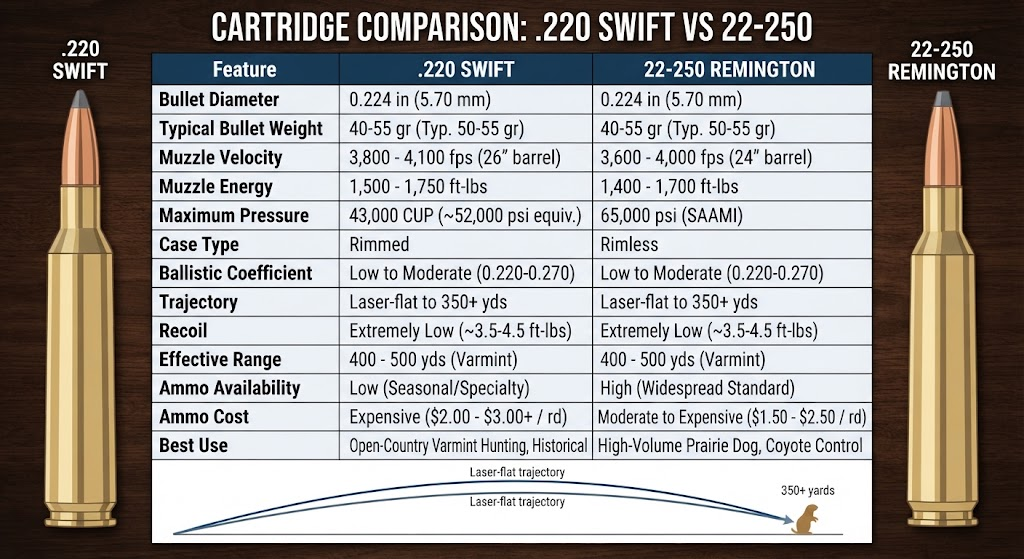
.220 Swift Vs 22-250 Comparison
| Feature | .220 Swift | 22-250 |
| Bullet Diameter | 0.224 inches (5.70 mm) | 0.224 inches (5.70 mm) |
| Typical Bullet Weight | 40 gr to 55 gr (typically 50 gr or 55 gr) | 40 gr to 55 gr (typically 50 gr or 55 gr) |
| Muzzle Velocity | 3,800 to 4,100 fps (26-inch barrel) | 3,600 to 4,000 fps (24-inch barrel) |
| Muzzle Energy | 1,500 to 1,750 ft-lbs | 1,400 to 1,700 ft-lbs |
| Momentum | ~26 to ~30 lb-fps | ~25 to ~29 lb-fps |
| Maximum Pressure | 43,000 CUP (~52,000 psi equivalent) | 65,000 psi (SAAMI) |
| Case Type | Rimmed (Distinct extractor rim) | Rimless (Standard bottleneck) |
| Ballistic Coefficient | Low to Moderate (0.220 to 0.270) | Low to Moderate (0.220 to 0.270) |
| Penetration | Very Shallow (Explosive varmint fragmentation) | Very Shallow (Explosive varmint fragmentation) |
| Expansion | Instantaneous vaporization on impact | Instantaneous vaporization on impact |
| Trajectory | Laser-flat out to 350+ yards | Laser-flat out to 350+ yards |
| Recoil | Extremely Low (~3.5 to 4.5 ft-lbs) | Extremely Low (~3.5 to 4.5 ft-lbs) |
| Effective Range | 400 to 500 yards (Varmint) | 400 to 500 yards (Varmint) |
| Ammo Availability | Low (Seasonal specialty runs) | High (Widespread commercial standard) |
| Ammo Cost | Expensive ($2.00 to $3.00+ per round) | Moderate to Expensive ($1.50 to $2.50 per round) |
| Best Use | Open-country varmint hunting, historical collectors | High-volume prairie dog shooting, coyote control |
The table above illustrates how two distinct case designs achieve remarkably similar ballistic results. The .220 Swift features a distinct rimmed case head with a tapered body. This rimmed design was necessary to ensure reliable feeding in early bolt-action rifles, but it can occasionally cause feeding hangups in modern box magazines if the rims interlock.
The 22-250 utilizes a modern rimless case design with a sharp 28-degree shoulder and a robust operating pressure limit of 65,000 psi. Because it operates at higher modern pressures with an efficient powder column, it achieves velocities that nearly match the Swift while utilizing a shorter, more compact case that cycles effortlessly through standard short-action receivers and detachable magazines.
.220 Swift Vs 22-250 Ballistics
To objectively evaluate the ballistic capabilities, we must examine real-world factory ammunition. Because both cartridges are dedicated high-speed varmint tools, comparing standard 40-grain and 50-grain polymer-tipped loads provides a perfect benchmark.
- Load A (.220 Swift High Velocity): Hornady 40-grain V-MAX. Tested from a 26-inch barrel. Muzzle velocity is 4,050 feet per second. Muzzle energy is 1,457 foot-pounds. Ballistic Coefficient (G1) is 0.200.
- Load B (.220 Swift Standard Varmint): Remington 50-grain AccuTip. Tested from a 26-inch barrel. Muzzle velocity is 3,720 feet per second. Muzzle energy is 1,537 foot-pounds. Ballistic Coefficient (G1) is 0.245.
- Load C (22-250 High Velocity): Hornady 40-grain V-MAX. Tested from a 24-inch barrel. Muzzle velocity is 3,800 feet per second. Muzzle energy is 1,283 foot-pounds. Ballistic Coefficient (G1) is 0.200.
- Load D (22-250 Standard Varmint): Federal Premium 50-grain Ballistic Tip. Tested from a 24-inch barrel. Muzzle velocity is 3,700 feet per second. Muzzle energy is 1,520 foot-pounds. Ballistic Coefficient (G1) is 0.230.
.220 Swift Vs 22-250 Velocity
Velocity is the primary selling point for both of these legendary cartridges. They operate in a hyper-velocity tier that very few commercial rounds ever approach.
When comparing raw muzzle velocity, the .220 Swift holds a slight historical edge. Because its case holds a massive volume of powder (roughly 48 grains of H414 or equivalent), a 40-grain bullet effortlessly exceeds 4,000 feet per second, and some custom handloads can push past 4,200 fps.
The 22-250 is practically right on its heels. A 40-grain load in the 22-250 achieves roughly 3,800 to 3,900 fps, and when standard 50-grain varmint loads are compared side-by-side from standard 24-inch versus 26-inch barrels, their velocities are virtually identical (around 3,700 fps). In the real world of predator hunting, a 100 fps difference at the muzzle is completely undetectable.
.220 Swift Vs 22-250 Muzzle Energy
Muzzle energy represents the raw kinetic work capacity of a projectile. Because both cartridges push identical bullet weights at near-identical hyper-velocities, their muzzle energy outputs are functionally identical, generally hovering between 1,400 and 1,600 foot-pounds.
This is more than enough energy to deliver explosive terminal performance on small varmints and instantly neutralize coyotes at intermediate distances. However, neither cartridge is designed for heavy big-game hunting; their lightweight, fragile bullets lack the sectional density and penetration required for ethical use on deer-sized game.
.220 Swift Vs 22-250 Momentum
Momentum correlates closely with a bullet’s ability to crush through dense tissue or barrier resistance.
Because momentum relies equally on bullet weight and velocity, and both cartridges share identical specifications in these areas, their momentum profiles are completely identical. A 50-grain bullet traveling at 3,700 feet per second yields approximately 26.4 pound-feet per second of linear momentum for both cartridges. Neither round is designed for barrier penetration; they are engineered to dump 100% of their energy instantaneously inside soft targets.
.220 Swift Vs 22-250 Trajectory
Understanding external ballistics highlights why these cartridges are beloved by open-country shooters. The calculations below assume a standard rifle optic height of 1.5 inches above the bore and a zero distance of 200 yards. We will compare standard 50-grain polymer-tipped varmint loads.
| Distance | .220 Swift (50 gr at 3,720 fps) Drop | 22-250 (50 gr at 3,700 fps) Drop |
| Muzzle | -1.5 inches | -1.5 inches |
| 100 Yards | +0.8 inches | +0.8 inches |
| 200 Yards | 0.0 inches (Zero) | 0.0 inches (Zero) |
| 300 Yards | -4.2 inches | -4.3 inches |
| 400 Yards | -13.5 inches | -13.8 inches |
| 500 Yards | -29.5 inches | -30.2 inches |
The trajectory data confirms that both cartridges are absolute laser beams. Out to 400 yards, the difference in bullet drop between the .220 Swift and the 22-250 is a fraction of an inch. A shooter can aim dead-center on a coyote’s chest at 350 yards without needing to dial elevation adjustments into their scope. Both cartridges suffer from the same limitation: their lightweight, low-BC bullets are easily pushed off target by heavy crosswinds past 400 yards.
.220 Swift Vs 22-250 Recoil
Recoil management is critical for watching your own bullet impacts through a magnified optic.
Both cartridges are exceptionally mild. Fired from a standard 7.5-pound bolt-action rifle, both the .220 Swift and the 22-250 generate roughly 3.5 to 4.5 foot-pounds of free recoil energy. This recoil is so minimal that the crosshairs barely twitch, allowing the shooter to maintain sight picture integrity and instantly observe the target reaction through the scope.
.220 Swift Vs 22-250 Barrel Life & Throat Erosion
The most famous technical debate regarding hyper-velocity cartridges centers around barrel life. Because both cartridges push lightweight bullets at extreme speeds using massive powder charges, they suffer from throat erosion (the burning away of the rifling just ahead of the chamber).
The .220 Swift earned an unfair reputation in its early decades for “burning out barrels” in 500 to 1,000 rounds. This was largely a result of early high-pressure reloading practices and corrosive military-surplus powders used in the mid-20th century. Modern steel metallurgy and quality powders have dramatically improved Swift barrel life, but it remains an intense, overbore cartridge.
The 22-250 also experiences throat erosion due to its high velocities, but its efficient case design generally yields slightly better barrel longevity (typically 1,500 to 2,500 rounds of pinpoint accuracy depending on firing strings and heat management).
.220 Swift Vs 22-250 Self Defense & Concealed Carry
Neither cartridge is suitable for standard urban home defense due to the extreme danger of over-penetration and blinding muzzle blasts indoors. Both are specialized long-range rifle rounds entirely unsuited for concealed carry.
Which Has More Stopping Power: .220 Swift Vs 22-250?
On small varmints and predators, their stopping power is functionally identical. When a 40-grain or 50-grain polymer-tipped bullet strikes a target at nearly 4,000 feet per second, the hydraulic pressure causes the bullet to fragment instantly into a violent cloud of lead and copper, creating massive surface trauma that neutralizes coyotes and prairie dogs with absolute finality.
Which Is More Powerful: .220 Swift Vs 22-250?
At the muzzle, the .220 Swift holds a microscopic advantage due to its slightly larger powder capacity, which yields an extra 50 to 100 feet per second of velocity with ultra-light loads. In practical terms, however, they are tied in raw power.
.220 Swift Pros And Cons
Pros
- The historic king of speed; achieves genuine 4,000+ fps velocities with ease
- Incredibly flat trajectory makes 400-yard shots on small targets exceptionally forgiving
- Inherent accuracy makes vintage and custom Swift rifles legendary benchrest performers
- Nostalgic appeal as one of the most famous cartridges in firearms history
Cons
- Ammunition is expensive, scarce, and limited to seasonal specialty manufacturing runs
- Rimmed case design can occasionally cause feeding complications in modern box magazines
- Intense powder charges accelerate throat erosion and barrel wear
22-250 Pros And Cons
Pros
- Stunning hyper-velocities that virtually mirror the legendary .220 Swift
- Rimless case design feeds reliably in all modern bolt-action rifles and detachable magazines
- Widespread commercial ammunition availability in sporting goods stores nationwide at reasonable prices
- Vast selection of rifle platforms and custom barrel options
Cons
- Still an overbore cartridge that will erode barrel throats faster than standard calibers like the .223 Remington
- Lightweight bullets are heavily affected by crosswinds at extreme distances
Final Comparison
| Category | Winner | Reason |
| Velocity | .220 Swift | Slightly larger powder capacity achieves a tiny hyper-velocity edge |
| Muzzle Energy | Tie | Both generate equivalent kinetic energy hovering around 1,400 to 1,600 ft-lbs |
| Momentum | Tie | Identical bullet weights at matching speeds yield identical momentum |
| Penetration | Tie | Both use fragile, explosive varmint bullets that fragment immediately |
| Expansion | Tie | Extreme velocities cause instantaneous vaporization and explosive tissue disruption |
| Trajectory | Tie | Laser-flat drop curves are completely indistinguishable out to 400 yards |
| Recoil Control | Tie | Both generate micro-recoil (~4 ft-lbs) allowing shooters to watch their own impacts |
| Effective Range | Tie | Both excel as 400 to 500-yard open-country varmint rifles |
| Self Defense | Neither | Both present extreme over-penetration hazards in residential environments |
| Concealed Carry | Neither | Both are full-size rifle cartridges unsuitable for concealment |
| Ammo Cost | 22-250 | Widespread commercial popularity guarantees significantly cheaper retail pricing |
| Ammo Availability | 22-250 | Found on store shelves much more consistently than the niche Swift |
| Overall Performance | 22-250 | Delivers 99% of the Swift’s speed with better feeding, cheaper ammo, and wider rifle support |
.220 Swift Vs 22-250: Which Should You Choose?
Selecting between the .220 Swift and the 22-250 is a choice between historical prestige and modern commercial practicality.
Choose the .220 Swift if you are a traditionalist who appreciates classic firearms, loves owning a piece of ballistic history, and handloads your own ammunition to extract every last foot-per-second of performance. It is an absolute masterpiece of 1930s engineering that still turns heads at any shooting range.
Choose the 22-250 for everything else. It delivers virtually identical hyper-velocity performance to the Swift, but wraps it in a modern, rimless case that feeds reliably from any magazine, burns slightly more efficiently, and offers the massive practical convenience of finding factory ammunition in almost any gun shop in the country.
FAQs
Is .220 Swift Faster Than 22-250?
Yes, technically the .220 Swift is slightly faster at the muzzle by about 50 to 100 feet per second when utilizing ultra-light 40-grain bullets, due to its slightly larger powder capacity. In practical field terms, however, their speeds are identical.
Which Has More Muzzle Energy?
They are effectively tied. Both cartridges routinely generate between 1,400 and 1,600 foot-pounds of muzzle energy depending on the specific factory load and bullet weight chosen.
Which Has Better Barrel Life?
The 22-250 generally offers slightly better barrel life than the .220 Swift, though both are classified as overbore cartridges that experience accelerated throat erosion due to extreme velocities and large powder charges.
Which Has More Recoil?
They produce virtually identical recoil, generating roughly 3.5 to 4.5 foot-pounds of free recoil energy. Both are exceptionally mild and comfortable to shoot all day long.
Which Is Better For Coyote And Prairie Dog Hunting?
Both are elite, world-class varmint cartridges. The 22-250 is often recommended today simply because finding factory ammunition and replacement brass is vastly easier and cheaper than for the .220 Swift.
Can A 22-250 Shoot .220 Swift Ammunition?
No. They are completely different cartridges with incompatible case dimensions. Attempting to chamber or fire .220 Swift ammunition in a 22-250 rifle is physically impossible and dangerous.
Which Should You Choose?
Choose the .220 Swift for historical appreciation and classic rifle ownership. Choose the 22-250 for ubiquitous ammunition availability, reliable rimless feeding, and world-class hyper-velocity varmint performance.