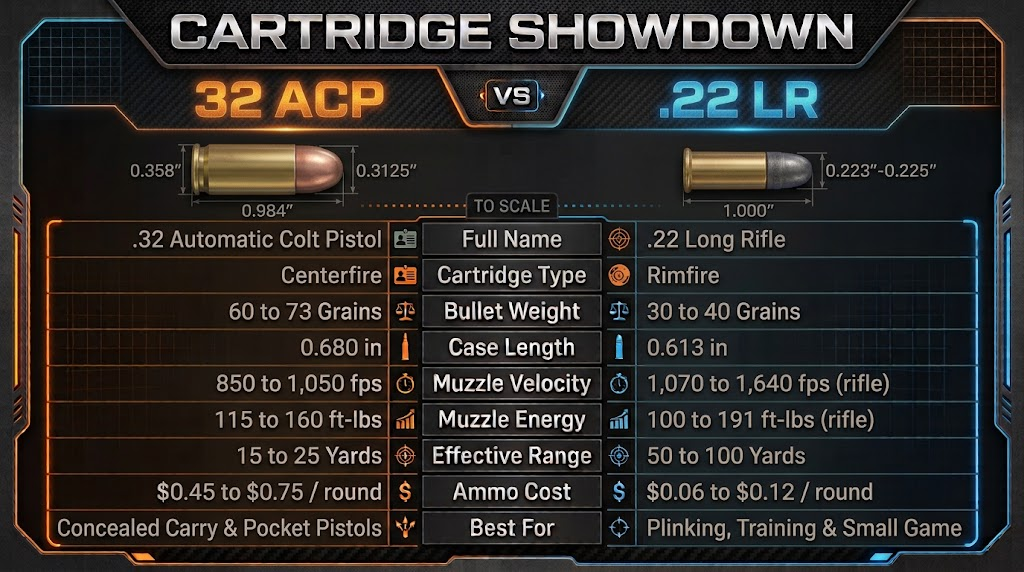
The main difference between 32 ACP and 22 LR is the ignition type and intended application, with the 32 ACP being a centerfire cartridge engineered for compact semi-automatic defensive pistols, and the 22 LR being a rimfire cartridge designed for training and small game. Because the 32 ACP fires a heavier 71-grain bullet from a centerfire case, it provides superior ignition reliability and greater momentum for close-range personal defense compared to rimfire alternatives. However, the 22 LR generates similar kinetic energy when fired from a rifle, offering vastly superior effective range for hunting and target shooting. While the 32 ACP remains a niche pocket pistol cartridge, the 22 LR is the global standard for low-cost, low-recoil marksmanship training. Their completely different chamber dimensions and ballistic profiles mean they serve entirely separate shooting needs.
32 ACP vs 22 LR
| Feature | 32 ACP | 22 LR |
| Full Name | .32 Automatic Colt Pistol | .22 Long Rifle |
| Cartridge Type | Centerfire | Rimfire |
| Bullet Weight | 60 to 73 grains | 30 to 40 grains |
| Bullet Diameter | 0.3125 inches | 0.223 to 0.2255 inches |
| Case Length | 0.680 inches | 0.613 inches |
| Overall Cartridge Length | 0.984 inches | 1.000 inches |
| Typical Muzzle Velocity | 850 to 1,050 fps | 1,070 to 1,640 fps (rifle) |
| Typical Muzzle Energy | 115 to 160 ft-lbs | 100 to 191 ft-lbs (rifle) |
| Effective Range | 15 to 25 yards | 50 to 100 yards |
| Recoil | Very low | Extremely low |
| Ammunition Cost | $0.45 to $0.75 per round | $0.06 to $0.12 per round |
| Common Uses | Concealed carry, pocket pistols | Plinking, training, small game |
| Source | SAAMI / Winchester | SAAMI / Federal Premium |
The Main Difference Between 32 ACP And 22 LR
When comparing 32 ACP vs 22 LR, the most defining difference is the cartridge construction and reliability. John Browning developed the 32 ACP in 1899 specifically to provide a reliable, semi-rimmed centerfire cartridge for the new generation of blowback-operated semi-automatic pocket pistols. Centerfire primers are inherently more reliable than rimfire primers, which is a critical requirement for any firearm intended for self-defense.
The 22 LR relies on a thin rimfire case where the priming compound is spun directly into the rim. While this makes the 22 LR incredibly cheap to manufacture, it also makes it more prone to occasional misfires. Because the 22 LR is primarily fired from longer handgun and rifle barrels, it achieves vastly superior ballistics and accuracy compared to the short-barreled pistols chambered in 32 ACP. The 32 ACP is severely limited by the short barrels of pocket pistols, generating only modest velocity. Consequently, the 22 LR is a versatile target and hunting round, while the 32 ACP remains a dedicated self-defense tool for deep concealment.
32 ACP vs 22 LR Dimensions
Cartridge dimensions dictate powder capacity, chamber compatibility, and magazine requirements. Although the overall lengths of these cartridges are surprisingly similar, their widths and internal structures are completely different.
Based on specifications published by the Sporting Arms and Ammunition Manufacturers’ Institute (SAAMI), the 32 ACP measures:
- Bullet diameter: 0.3125 inches
- Case length: 0.680 inches
- Rim diameter: 0.358 inches
- Case base diameter: 0.337 inches
- Overall cartridge length: 0.984 inches
The 22 LR measures:
- Bullet diameter: 0.223 to 0.2255 inches
- Case length: 0.613 inches
- Rim diameter: 0.278 inches
- Case diameter: 0.226 inches
- Overall cartridge length: 1.000 inches
The 32 ACP case is significantly wider and utilizes a centerfire primer pocket. Interestingly, the standard overall length of the 22 LR is technically a fraction of an inch longer than the 32 ACP. A 32 ACP cartridge will absolutely not fit into a 22 LR chamber.
32 ACP vs 22 LR Velocity
Velocity controls both trajectory and kinetic energy. Comparing these two cartridges requires understanding the barrel lengths used for testing, as the 22 LR is usually fired from rifles, while the 32 ACP is exclusively a pistol cartridge.
Comparing representative factory loads yields the following figures:
- Winchester 32 ACP (71-grain full metal jacket): 905 fps.
- Hornady Custom 32 ACP (60-grain XTP): 1,000 fps.
- Federal AutoMatch 22 LR (40-grain lead round nose): 1,200 fps (rifle barrel).
- CCI Standard Velocity 22 LR (40-grain lead round nose): 1,070 fps (rifle barrel).
When the 22 LR is fired from a standard rifle, it easily produces 200 to 300 fps more velocity than the 32 ACP. However, if you fire a 22 LR from a short pistol barrel, the velocity typically drops to roughly 850 to 950 fps, making the two cartridges nearly identical in speed when fired from handguns. The key difference is that the 32 ACP maintains that speed while pushing a bullet that is nearly twice as heavy.
32 ACP vs 22 LR Energy
Muzzle energy measures the striking force of the bullet. Energy is calculated using a formula combining bullet weight and velocity. Because the 32 ACP fires a much heavier bullet, it generates comparable energy to a 22 LR rifle, even when fired from a handgun.
Representative muzzle energy figures based on manufacturer specifications include:
- Hornady Custom 32 ACP (60-grain XTP): 133 ft-lbs.
- Winchester 32 ACP (71-grain FMJ): 129 ft-lbs.
- Federal AutoMatch 22 LR (40-grain): 128 ft-lbs (from a rifle).
- CCI Standard Velocity 22 LR (40-grain): 102 ft-lbs (from a rifle).
A standard 32 ACP fired from a compact pistol delivers roughly the same kinetic energy as a high-velocity 22 LR fired from a 16-inch rifle barrel. When a 22 LR is fired from a short-barreled handgun, its energy often drops to between 70 and 90 ft-lbs, giving the 32 ACP a clear power advantage in pocket-sized firearms.
32 ACP vs 22 LR Range
When evaluating 32 ACP vs 22 LR range, shooters must clearly differentiate practical range from maximum projectile travel. Maximum projectile travel denotes the absolute distance the bullet can fly if launched at an optimal upward angle. Both of these projectiles can travel well over a mile, requiring a safe backstop at all times.
Effective range specifies the maximum distance at which a bullet retains sufficient accuracy and energy for its intended purpose. The 32 ACP has an effective range of roughly 15 to 25 yards. It was designed exclusively for point-blank personal defense encounters, and the rudimentary sights on most 32 ACP pistols make aiming difficult beyond this distance.
The 22 LR retains functional velocity and striking energy much further downrange. Because it is usually fired from a rifle equipped with proper sights or a magnified optic, a shooter can effectively strike small targets out to 100 yards with predictable holdovers.
32 ACP vs 22 LR Accuracy
Accuracy relies on the quality of the firearm, the sight radius, and the consistency of the ammunition. In practical applications, the 22 LR is vastly more accurate than the 32 ACP.
In documented independent testing, the 22 LR frequently produces incredibly tight groups at 50 yards due to highly specialized, match-grade rimfire ammunition. Fired from a premium bolt-action rifle, this ammunition can routinely stack five shots into groups measuring under 0.5 inches.
The 32 ACP cartridge is mechanically accurate, but it is almost exclusively chambered in micro-compact pocket pistols like the Kel-Tec P32 or the Beretta Tomcat. These tiny handguns feature very short sight radiuses and heavy trigger pulls, making it extremely difficult for a shooter to achieve tight groups beyond 10 yards.
32 ACP vs 22 LR Recoil
Both of these cartridges are celebrated for their exceptionally light recoil, making them popular for recoil-sensitive shooters. Cartridge energy and the overall weight of the firearm dictate the perceived recoil impulse.
When discharged from a standard 6-pound rifle, a 22 LR produces essentially zero felt recoil. When fired from a full-sized handgun, the 22 LR produces virtually no muzzle flip.
A 32 ACP fired from a pocket pistol generates slightly more felt recoil than a 22 LR handgun due to the heavier 71-grain bullet. However, in all-steel pistols like the Walther PPK or CZ 70, the recoil is incredibly mild. In ultra-lightweight polymer pistols, the 32 ACP can be slightly snappy, but it remains vastly easier to control than a modern 9mm micro-compact pistol.
32 ACP vs 22 LR Ammunition Cost
Ammunition cost heavily favors the 22 LR, which remains the most affordable factory ammunition available worldwide. Current retail prices dictate how often a shooter can practice without financial strain.
As of September 2026, representative retail prices indicate:
- Federal AutoMatch 22 LR (40-grain, 325-round bulk box): $19.50 to $26.00 per box, equating to $0.06 to $0.08 per round.
- CCI Standard Velocity 22 LR (40-grain, 50-round box): $4.50 to $6.00 per box, equating to $0.09 to $0.12 per round.
- PMC Bronze 32 ACP (71-grain FMJ, 50-round box): $22.00 to $28.00 per box, equating to $0.44 to $0.56 per round.
- Hornady Custom 32 ACP (60-grain XTP, 25-round box): $22.00 to $26.00 per box, equating to $0.88 to $1.04 per round.
Practicing with a 32 ACP typically costs five to eight times as much per trigger pull as practicing with standard 22 LR ammunition. The 32 ACP does not benefit from the massive economies of scale that keep 22 LR prices low.
32 ACP vs 22 LR For Hunting
The 22 LR is an outstanding small game hunting cartridge. Inside of 50 to 75 yards, a standard 40-grain solid bullet or a 36-grain hollow point will cleanly harvest squirrels, rabbits, and grouse. It is heavily supported by the hunting industry with specialized ammunition.
The 32 ACP is completely unsuitable for hunting. It is manufactured exclusively with self-defense in mind. The tiny handguns chambered in 32 ACP lack the necessary accuracy to safely hunt small game, and the cartridge’s trajectory drops rapidly. Most jurisdictions legally prohibit the use of centerfire pistol cartridges for small game hunting.
32 ACP vs 22 LR For Target Shooting
For plinking, skills training, and recreational target shooting, the 22 LR is the undisputed champion. The combination of practically zero recoil, low noise, and incredibly inexpensive ammunition makes it the ideal choice for high-volume range sessions.
The 32 ACP is a poor choice for dedicated target shooting. The ammunition is highly expensive, and firing tiny pocket pistols for extended periods can be physically fatiguing due to their small grips and short sight radiuses. A shooter will quickly spend a significant amount of money during a casual afternoon of plinking with a 32 ACP compared to a 22 LR.
32 ACP vs 22 LR For Beginners
For new shooters, the 22 LR stands as the absolute best choice. The complete absence of recoil and the very mild report prevent inexperienced shooters from developing a flinch response. A beginner can dedicate hours to mastering sight alignment, breathing, and trigger control without physical fatigue or heavy financial costs.
The 32 ACP is a poor choice for a beginner. While the recoil is low, pocket pistols are notoriously difficult to shoot accurately because of their tiny sights and heavy double-action triggers. Furthermore, the high cost of 32 ACP ammunition discourages the frequent practice necessary to build solid marksmanship habits. The most practical recommendation is to learn the fundamentals strictly on a dedicated 22 LR platform.
32 ACP vs 22 LR Firearms
Firearm manufacturers support the 22 LR with a vast array of platforms. Consumers can select from bolt-action rifles, semi-automatic rifles, lever-action rifles, single-action revolvers, double-action revolvers, and semi-automatic pistols. The 22 LR market remains massive and universally accessible.
Firearms chambered specifically for the 32 ACP are almost entirely compact semi-automatic pistols. Famous historical examples include the FN M1910, the Walther PPK, and the Mauser HSc. Modern examples include the Kel-Tec P32 and the Beretta 3032 Tomcat. Very few modern firearm manufacturers produce new handgun designs in 32 ACP today, as the 380 ACP has largely monopolized the pocket pistol market.
Can 32 ACP And 22 LR Use The Same Gun?
No, standard 32 ACP and 22 LR cartridges cannot be safely fired from the same gun chamber. The chamber dimensions specified for each cartridge are completely incompatible.
The 22 LR requires a chamber cut specifically for a narrow rimfire cartridge, utilizing an off-center firing pin. The 32 ACP requires a wider chamber and a centerfire firing pin. You cannot safely swap these cartridges in the same firearm under any circumstances.
32 ACP vs 22 LR Ammunition Compatibility
Ammunition compatibility is strictly determined by the exact cartridge name stamped on the barrel of the firearm.
- 32 ACP is not interchangeable with 22 LR.
- 22 LR is not interchangeable with 32 ACP.
If a shooter attempts to insert a 32 ACP into a standard 22 LR chamber, the slide will not close because the 32 ACP case is significantly too wide. If a shooter drops a 22 LR into a 32 ACP chamber, it will fit very loosely, and the centerfire firing pin will fail to strike the rimfire primer. Attempting to force incorrect ammunition into a firearm is highly dangerous. Always read the barrel stamping before loading any ammunition.
Pros And Cons
32 ACP Pros And Cons
Pros:
- Centerfire primer design provides superior ignition reliability over rimfire cartridges.
- Heavier 71-grain bullet maintains momentum and penetrates deeper than lightweight rimfire bullets.
- Allows for the manufacture of highly concealable, low-recoil pocket pistols.Cons:
- Ammunition is highly expensive compared to 22 LR.
- Lacks the kinetic energy of modern 9mm defensive cartridges.
- Largely rendered obsolete by modern micro-compact 380 ACP and 9mm pistols.
22 LR Pros And Cons
Pros:
- Exceptionally low ammunition cost enables affordable high-volume practice.
- Massive availability of rifles and handguns worldwide.
- Extremely quiet operation and negligible recoil.
- Highly effective for target training and small game hunting.Cons:
- Rimfire priming is inherently less reliable than centerfire priming for self-defense.
- Produces significantly less kinetic energy when fired from short-barreled handguns.
Manufacturer Data vs Independent Testing
When reviewing 32 ACP ballistics, readers must understand the difference between promotional manufacturer specifications and independent chronograph testing. Ammunition manufacturers typically measure 32 ACP velocity using specialized 4-inch test barrels. However, most consumers fire 32 ACP ammunition from pocket pistols with 2.4-inch or 2.7-inch barrels.
Independent chronograph testing provides a highly realistic baseline for actual field performance. When independent testers fire premium 32 ACP ammunition from a standard pocket pistol, the recorded velocities are frequently 50 to 100 fps slower than the figures printed on the retail box. This velocity loss means that commercial 32 ACP hollow point bullets often fail to reach the required speed to expand reliably in ballistic gel, causing them to act exactly like standard full metal jacket ammunition. When sources provide conflicting figures for pocket pistol cartridges, controlled independent testing through the exact barrel length of the consumer’s chosen firearm represents the most practical data source.
FAQs
What is the main difference between 32 ACP and 22 LR?
The main difference is the ignition system and intended firearm type. The 32 ACP is a centerfire cartridge built for reliable feeding in self-defense pocket pistols. The 22 LR is a rimfire cartridge primarily used in rifles and full-sized handguns for target shooting and small game.
Is 32 ACP more powerful than 22 LR?
When both are fired from short-barreled handguns, the 32 ACP is significantly more powerful because it pushes a heavier bullet. However, when the 22 LR is fired from a 16-inch rifle barrel, it produces roughly the same kinetic energy as a 32 ACP pistol.
Which is faster, 32 ACP or 22 LR?
The 22 LR is vastly faster when fired from a rifle, easily exceeding 1,200 feet per second. The 32 ACP typically operates between 850 and 950 feet per second from a short pocket pistol barrel.
Can a 32 ACP shoot 22 LR?
No. A 22 LR cartridge requires a specialized rimfire firing pin and a narrower chamber. Firing it in a 32 ACP firearm is impossible and unsafe.
Can a 22 LR shoot 32 ACP?
No. A 32 ACP cartridge is too wide to physically fit into a 22 LR chamber.
Are 32 ACP and 22 LR interchangeable?
No. The ammunition is never interchangeable. You must only load the specific ammunition that is stamped on the barrel of your firearm.
Why is 32 ACP so expensive?
The 32 ACP is expensive because it is a centerfire cartridge produced in relatively small quantities compared to military calibers like 9mm. It requires a complex brass case and a replaceable primer, whereas the 22 LR is manufactured by the billions using a very cheap rimfire case.
Which is cheaper to shoot?
The 22 LR is vastly cheaper. It generally costs between 6 and 12 cents per round, while the 32 ACP typically costs between 45 and 75 cents per round.
Is 32 ACP good for self-defense?
While it is considered underpowered compared to modern 9mm or 380 ACP standards, the 32 ACP offers highly reliable centerfire ignition and very low recoil, making it a viable option for those who cannot handle the recoil of larger calibers.
Which is better for beginners?
The 22 LR is the best choice for beginners. The low noise, lack of recoil, and highly affordable ammunition allow a new shooter to practice fundamental marksmanship skills comfortably and frequently.