The main difference between .45 and .45 ACP is that “.45” is a broad caliber category referring to any bullet measuring roughly 0.45 inches in diameter, whereas “.45 ACP” (Automatic Colt Pistol) is a specific, standardized rimless cartridge designed by John Browning in 1904 for semi automatic handguns. When most modern shooters talk about buying a .45 pistol, they are referring specifically to the .45 ACP cartridge, but the broader .45 caliber family also includes famous revolver cartridges like the classic .45 Colt. In this comprehensive guide, we clarify this common terminology confusion and compare the dimensions, velocity, muzzle energy, recoil, penetration, and history of the modern .45 ACP against its most famous older brother, the .45 Colt, to help you confidently understand exactly what ammunition your firearm requires.
.45 vs .45 ACP Comparison Table
To accurately compare these two legendary cartridges, we must examine their physical dimensions and baseline ballistic performance. Because “.45” is a generic term, the data below compares the specific .45 ACP semi automatic cartridge against the original .45 Colt revolver cartridge, which is what most people mean when they ask about the historic “.45” round. The data represents standard premium factory loads.
| Specification | .45 ACP (Automatic Colt Pistol) | .45 Colt (Often called .45 Long Colt) |
| Cartridge Type | Semi Automatic Handgun | Centerfire Revolver |
| Parent Case | None (Original Design, 1904) | None (Original Design, 1873) |
| Bullet Diameter | .451 in (11.45 mm) | .452 in (11.48 mm) |
| Case Length | 0.898 in | 1.285 in |
| Overall Length | 1.275 in | 1.600 in |
| Typical Bullet Weights | 185 gr to 230 gr | 225 gr to 255 gr |
| Muzzle Velocity (5 inch bbl) | 850 fps (230gr Standard) | 850 fps (250gr Standard) |
| Muzzle Energy (5 inch bbl) | 369 foot pounds | 400 foot pounds |
| Maximum Pressure | 21,000 psi (SAAMI) | 14,000 psi (SAAMI Standard) |
| Effective Range | 50 yds (Handgun) | 50 yds (Handgun) |
| Trajectory | Arced | Arced |
| Bullet Drop (50 yds) | Approx. 3.0 inches | Approx. 3.5 inches |
| Wind Drift | Moderate (Heavy bullet) | Moderate (Heavy bullet) |
| Recoil | Moderate (Rolling push) | Mild to Moderate |
| Barrel Length Performance | Excels in 4 to 5 inch barrels | Excels in 4 to 7 inch barrels |
| Suppressor Performance | Elite (Natively subsonic) | Poor (Revolver cylinder gap) |
| Short Barrel Performance | Good (Fast burning powders) | Good |
| Accuracy | Extremely High | High |
| Penetration | Moderate to Deep | Moderate (Deep with Plus P loads) |
| Expansion | Devastating | Moderate (Relies on initial diameter) |
| Hunting Performance | Marginal (Close range only) | Excellent (Deer and hogs at close range) |
| Home Defense | Elite (Proven stopping power) | Good (Mild recoil, wide bullet) |
| Tactical / Duty Use | Historical Military Standard (1911) | Historical Military Standard (1873) |
| AR-15 Compatibility | Yes (AR 45 Pistol Caliber Carbines) | No (Rimmed case) |
| Magazine Compatibility | Fits standard 1911 and Glock 21 magazines | None (Uses 5 or 6 round cylinders) |
| Ammunition Cost | Moderate | High |
| Ammo Availability | Ubiquitous | Moderate |
| Best Uses | Concealed carry, home defense, duty use | Cowboy Action Shooting, woods carry |
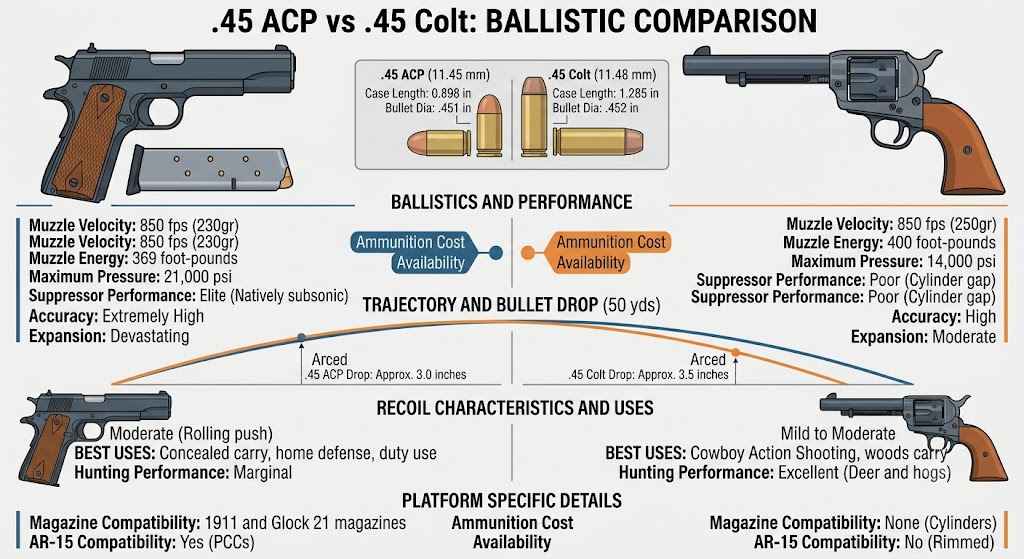
Understanding the Nomenclature
The most important takeaway from this comparison is understanding firearms terminology. If you walk into a gun store and ask to look at a “.45”, the clerk will almost certainly hand you a semi automatic pistol chambered in .45 ACP, such as a 1911 or a Glock 21. In modern parlance, the term “.45” has become universally accepted shorthand for the .45 ACP cartridge.
However, if you own a revolver stamped “.45 Caliber”, it is highly likely chambered for the .45 Colt cartridge. The .45 Colt is a massive, rimmed black powder cartridge designed for the Wild West in 1873. The .45 ACP is a much shorter, rimless smokeless powder cartridge designed for modern semi automatic pistols. You cannot safely interchange these two cartridges.
Velocity Comparison
Velocity dictates how reliably a hollow point bullet expands upon entering soft tissue.
When looking at standard factory loads, both cartridges share remarkably similar velocity profiles. The standard 230 grain .45 ACP full metal jacket load travels at approximately 850 feet per second. The standard 250 grain .45 Colt lead round nose load also travels at roughly 850 feet per second. Both cartridges were specifically engineered to lob massive, heavy pieces of lead at subsonic speeds, relying on bullet weight rather than blistering speed to achieve their terminal effects.
Muzzle Energy Comparison
Muzzle energy measures the kinetic force transferred to the target upon impact.
Because the .45 Colt fires a slightly heavier bullet (250 grains compared to the 230 grain bullet of the .45 ACP) at the same velocity, the .45 Colt generates slightly more kinetic energy. A standard .45 Colt generates roughly 400 foot pounds of energy, while a standard .45 ACP generates roughly 369 foot pounds. Against a human threat or medium game, this 30 foot pound difference is mathematically insignificant. Both deliver massive, bone crushing force.
Trajectory Comparison
A flat trajectory makes hitting targets at unknown distances much easier.
Because both cartridges fire incredibly heavy, slow moving bullets, neither of them possesses a flat trajectory. They both lob their projectiles in a steep arc. They are designed exclusively for close quarters combat and short range hunting. If you attempt to shoot a target at 100 yards with either cartridge, you will need to aim significantly higher than your intended point of impact to compensate for the rapid drop.
Bullet Drop Comparison
Assuming a standard 25 yard zero, the mathematical drop at 50 yards illustrates the trajectory of these slow moving heavyweights. The .45 ACP will drop approximately 3.0 inches at 50 yards. The .45 Colt, being slightly heavier, will drop roughly 3.5 inches at 50 yards. Inside typical self defense distances of 10 yards, bullet drop is completely irrelevant for both cartridges.
Wind Drift Comparison
Wind deflection is mitigated by a bullet’s velocity and its aerodynamic profile.
Both cartridges fire heavy, blunt nosed bullets that resist wind drift fairly well at short ranges simply due to their massive weight. While they travel slowly, the sheer mass of a 230 grain or 250 grain bullet acts like an anchor in the air. At 50 yards, wind drift is a minor concern for both cartridges, but performance degrades equally rapidly for both if pushed to 100 yards in a heavy crosswind.
Recoil Comparison
Recoil dictates a shooter’s ability to fire rapid and accurate follow up shots.
The .45 ACP is famous for its smooth, rolling push. Because it operates at a relatively low 21,000 psi, it does not produce the sharp, stinging snap of a high pressure magnum cartridge. In a heavy steel 1911 pistol, the recoil is incredibly pleasant and easy to manage.
The standard pressure .45 Colt operates at an incredibly low 14,000 psi. When fired from a large single action revolver, the recoil is exceptionally mild. It is a slow, gentle push that allows competitors in Cowboy Action Shooting to fire incredibly fast strings of accurate shots.
Stopping Power Comparison
Stopping power requires reliable energy transfer and wide bullet expansion.
The .45 ACP is widely considered one of the greatest man stopping handgun cartridges ever invented. It served the United States military flawlessly through two World Wars. When loaded with modern hollow point ammunition, the .45 ACP expands from .451 inches to nearly an inch wide, creating devastating permanent wound cavities.
The .45 Colt relies on the fact that it starts out very wide. Standard pressure .45 Colt hollow points often fail to expand because they travel too slowly. However, because the bullet is already nearly half an inch wide before it even hits the target, it crushes a massive hole and causes rapid blood loss regardless of expansion.
Penetration Comparison
Penetration is critical for ensuring the bullet reaches vital organs.
Both cartridges easily meet the strict FBI protocol of 12 to 18 inches of penetration in calibrated ballistic gelatin. The .45 ACP utilizes modern bonded jackets to retain its weight as it punches through tissue. The .45 Colt relies on the heavy mass of its 250 grain cast lead bullets to maintain momentum and push deeply into the target.
Expansion Comparison
To test expansion, the industry relies on calibrated ordinance gel covered in heavy clothing.
A premium .45 ACP hollow point hits tissue at 850 feet per second and violently mushrooms, utilizing deep skives in the copper jacket to force the bullet open. A standard pressure .45 Colt hollow point often struggles to open completely due to its low velocity. To get reliable expansion from a .45 Colt, shooters must rely on soft lead compositions or switch to high pressure loads that are only safe in modern, heavy frame revolvers.
Accuracy Comparison
Both cartridges are capable of elite mechanical accuracy.
The .45 ACP has been heavily optimized for National Match target shooting. When fired from a custom tuned 1911, the .45 ACP will easily print one inch groups at 25 yards. The .45 Colt is also highly accurate, but practical accuracy often favors the .45 ACP simply because modern semi automatic pistols feature vastly superior sights and lighter trigger pulls than traditional single action revolvers.
Effective Range Comparison
The effective range of a handgun is limited by bullet drop and retained energy.
Both cartridges are strictly designed for close quarters engagements. The effective defensive range of both the .45 ACP and the .45 Colt is generally limited to 50 yards for the average shooter. Beyond 50 yards, the steep trajectory requires significant holdover estimation.
Suppressor Performance Comparison
Suppressors are highly effective on native subsonic cartridges.
The .45 ACP is arguably the best suppressor host in the world. Because standard 230 grain loads travel at 850 feet per second, they are naturally subsonic. A suppressed .45 ACP pistol eliminates the muzzle blast and produces absolutely zero sonic crack.
Suppressing a .45 Colt revolver is completely ineffective due to the cylinder gap. High pressure gases and noise escape from the small space between the cylinder and the barrel before ever reaching the silencer.
Short Barrel Performance Comparison
When you cut a barrel down to 3 inches for a concealed carry configuration, internal ballistics change drastically.
The .45 ACP uses extremely fast burning powder. Modern compact .45 ACP pistols retain their velocity very well, pushing 230 grain bullets at roughly 800 feet per second even from tiny barrels. The .45 Colt suffers terribly in snub nose revolvers. The powder does not have enough time to burn completely before the massive bullet exits the muzzle, resulting in extreme velocity loss and poor terminal performance.
Home Defense Comparison
Inside the home, you must balance stopping power against ammunition capacity and weapon simplicity.
A .45 ACP pistol is a gold standard for home defense. A full size pistol holds up to 13 rounds, accommodates a weapon mounted light effortlessly, and provides devastating terminal ballistics.
The .45 Colt revolver holds only 5 or 6 rounds and is very slow to reload under stress. While it offers supreme mechanical reliability and excellent stopping power, the massive advantage in ammunition capacity makes the .45 ACP semi automatic the clear winner for defending a home.
Hunting Comparison
Neither standard cartridge is highly recommended for hunting medium game like deer at extended distances.
However, if you own a strong, modern revolver like a Ruger Blackhawk, you can purchase specialized Plus P high pressure ammunition for the .45 Colt. These heavy loads push 300 grain hard cast bullets at 1,200 feet per second, transforming the antique .45 Colt into a massive bear defense and big game hunting cartridge. The .45 ACP cannot safely achieve these magnum power levels.
Tactical and Duty Use Comparison
The .45 ACP was the undisputed king of the American military from 1911 until 1985. It served with distinction in the legendary M1911 pistol and the Thompson submachine gun. Today, many elite SWAT teams and special operations units still utilize the .45 ACP for its incredible stopping power and suppressor capabilities.
The .45 Colt served as the official sidearm cartridge of the United States Cavalry starting in 1873, but it has been tactically obsolete for military use for over a century.
Action Length and Rifle Compatibility
Both cartridges are occasionally chambered in pistol caliber carbines.
A lever action rifle chambered in .45 Colt is a highly versatile brush gun. The sealed breech of the rifle adds hundreds of feet per second to the cartridge, transforming it into a capable short range deer rifle. The .45 ACP is highly popular in modern AR 45 semi automatic carbines, providing an excellent, low recoil platform for home defense and target shooting.
Ammo Cost Comparison
To become proficient with a defensive handgun, you must practice frequently.
The .45 ACP is moderately priced. Commercial 230 grain practice ammunition is mass produced by the millions, making it affordable for high volume training. The .45 Colt is significantly more expensive. Standard practice ammunition is typically priced at a premium, often costing double the price of a comparable box of .45 ACP target loads.
Ammo Availability Comparison
Walk into any sporting goods store, rural hardware store, or indoor shooting range in the world, and you will find .45 ACP ammunition sitting on the shelf. It is universally available. The .45 Colt is much harder to find. While large sporting goods retailers carry a few boxes for Cowboy Action Shooting enthusiasts, it is frequently absent from small gun shops.
Reloading Comparison
Both cartridges are absolute favorites in the reloading community.
They are straight walled cartridges, making them incredibly easy and fast to reload using carbide dies. The .45 ACP is cheap to reload and uses very little powder. The .45 Colt is a reloader’s dream cartridge. The massive case capacity allows for massive variations in powder charges, letting shooters craft quiet target loads or absolute maximum pressure hunting loads depending on the strength of their revolver.
Pros and Cons
.45 ACP
Pros
- Unmatched combination of smooth recoil and heavy stopping power.
- Elite terminal ballistics with modern hollow point ammunition.
- Ammunition is universally available and affordable.
- Natively subsonic, making it the perfect suppressor host.
- High magazine capacity in modern semi automatic pistols.
Cons
- Requires magazines, which can fail or cause feeding malfunctions.
- Rackable slide can be difficult for shooters with weak grip strength.
- Cannot safely be loaded to magnum pressure levels for big game hunting.
.45 Colt
Pros
- Incredibly mild recoil in heavy, full size revolvers.
- Supreme mechanical reliability with zero feeding issues.
- Can fire specialized heavy cast lead bullets safely.
- Plus P loads offer enough kinetic energy to hunt dangerous game.
- Deeply steeped in American Wild West history.
Cons
- Terrible velocity loss when fired from short snub nose barrels.
- Low kinetic energy in standard loads results in poor hollow point expansion.
- Limited to 5 or 6 rounds in standard cylinders.
- Ammunition is significantly more expensive than .45 ACP.
Final Verdict
Choosing between the .45 ACP and the .45 Colt comes down to balancing modern semi automatic efficiency against traditional revolver versatility.
- For Concealed Carry and Home Defense: Choose the .45 ACP. It offers double the ammunition capacity, superior hollow point expansion, and vastly faster reload times in modern firearms.
- For Suppressed Shooting: Choose the .45 ACP. A semi automatic pistol loaded with standard 230 grain ammunition is naturally subsonic and is infinitely quieter than a revolver leaking high pressure gas from its cylinder gap.
- For Big Game and Bear Defense: Choose the .45 Colt. When loaded with specialized Plus P ammunition in a strong modern revolver, the heavy 300 grain bullet will penetrate deeply through thick bone and muscle that the .45 ACP simply cannot breach.
- For High Volume Training: Choose the .45 ACP. The lower cost of factory ammunition will save you hundreds of dollars in training costs over the lifespan of the firearm.
- For the Heirloom Collector: Choose the .45 Colt. The legendary single action revolver chambered in .45 Colt is a magnificent piece of American history that provides an incredibly enjoyable, low recoil shooting experience at the range.
FAQ
Are .45 and .45 ACP the exact same thing?
In modern casual conversation, yes. When a shooter says they own a .45, they almost always mean a semi automatic pistol chambered in .45 ACP. However, technically speaking, “.45” simply describes the diameter of the bullet, and there are many different cartridges that use a .45 caliber bullet, including the .45 Colt, .45 GAP, and .45 Super.
Can I shoot .45 ACP in a .45 Colt revolver?
Generally, no. The .45 Colt is a rimmed cartridge designed specifically for revolvers, while the .45 ACP is a rimless cartridge designed for semi automatic pistols. They will not headspace correctly in the same chamber. However, some manufacturers produce convertible revolvers that include two different cylinders, allowing you to manually swap the cylinder to shoot either caliber.
What does ACP stand for?
ACP stands for Automatic Colt Pistol. John Browning designed the cartridge in 1904 for use in his prototype semi automatic pistols, which eventually evolved into the legendary Colt M1911 adopted by the United States military.
Why is the .45 Colt sometimes called the .45 Long Colt?
In the late 19th century, the United States military issued a shorter cartridge called the .45 Schofield. Quartermasters and soldiers began calling the original, longer cartridge the .45 “Long” Colt to differentiate it from the shorter Schofield round to prevent supply chain confusion, and the nickname became permanently ingrained in shooting culture.
Which cartridge has more recoil?
When firing standard pressure factory ammunition, both cartridges produce very similar, mild recoil impulses. They both feel like a slow, heavy push rather than a sharp snap. However, if you load the .45 Colt with specialized high pressure Plus P hunting ammunition, the recoil becomes brutally heavy and significantly outpaces the .45 ACP.
Is the .45 ACP good for bear defense?
No. The .45 ACP is highly effective against human threats, but it lacks the deep penetration and kinetic energy required to reliably crush the thick skull and heavy shoulder bones of a large charging bear. A heavy revolver cartridge like a Plus P .45 Colt or a .44 Magnum is universally recommended for bear defense.