The main difference between the cartridges is that the .25-06 Remington is a classic long-action hunting cartridge that utilizes a massive powder column to push lightweight to medium-weight bullets at blistering speeds, whereas the .25 Creedmoor is a modern short-action precision cartridge specifically engineered for fast-twist barrels to stabilize heavy, ultra-aerodynamic projectiles for extreme long-range target shooting and hunting.
These two cartridges represent completely different eras of ballistics engineering within the same .257-caliber bore. The .25-06 Remington was a popular wildcat for decades before Remington standardized it in 1969 by necking down the legendary .30-06 Springfield case. For over half a century, it has been revered as one of the ultimate flat-shooting deer and antelope cartridges in existence.
The .25 Creedmoor is the modern evolution. Developed initially as a wildcat by necking down the wildly successful 6.5 Creedmoor case to .25 caliber, it was born out of a desire to dominate the Precision Rifle Series (PRS). For decades, the .25 caliber was ignored by long-range shooters because standard factory barrels featured slow 1-in-10-inch twist rates that could not stabilize heavy, high-Ballistic Coefficient (BC) bullets. The .25 Creedmoor fixes this historical flaw, demanding fast 1-in-7 or 1-in-7.5-inch twist rates to launch massive 131-grain and 135-grain projectiles that cheat the wind incredibly efficiently.
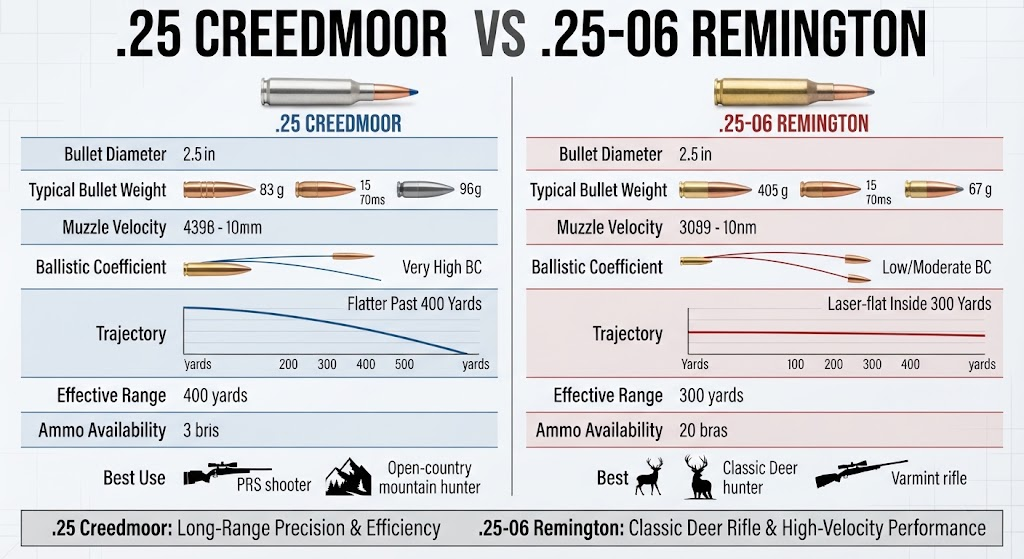
25 Creedmoor vs 25-06 Comparison
| Feature | .25 Creedmoor | .25-06 Remington |
| Bullet Diameter | 0.257 inches (6.53 mm) | 0.257 inches (6.53 mm) |
| Typical Bullet Weight | 110 gr to 135 gr (typically 131 gr or 135 gr) | 90 gr to 120 gr (typically 100 gr or 117 gr) |
| Muzzle Velocity | 2,800 to 3,000 fps (24-inch barrel) | 2,950 to 3,250 fps (24-inch barrel) |
| Muzzle Energy | 2,200 to 2,450 ft-lbs | 2,100 to 2,400 ft-lbs |
| Momentum | ~50 to ~55 lb-fps | ~45 to ~50 lb-fps |
| Maximum Pressure | 62,000 psi (SAAMI equivalent) | 63,000 psi (SAAMI) |
| Ballistic Coefficient | Very High (0.530 to 0.640+) | Low to Moderate (0.350 to 0.420) |
| Standard Barrel Twist | 1:7 or 1:7.5 inches | 1:10 inches |
| Penetration | Deep (Heavy mass, high sectional density) | Moderate to Deep (Depending on bullet) |
| Expansion | Controlled and highly predictable | Explosive and violent at close range |
| Trajectory | Flatter past 400 yards, ignores wind drift | Laser-flat inside 300 yards, suffers in wind |
| Recoil | Low (~11 to 13 ft-lbs) | Low to Moderate (~12 to 15 ft-lbs) |
| Effective Range | 1,000+ yards | 500 to 600 yards |
| Ammo Availability | Low (Niche commercial/wildcat status) | Very High (Global hunting standard) |
| Ammo Cost | Expensive ($2.50+ per round) | Moderate ($1.20 to $2.00 per round) |
| Best Use | PRS competition, long-range open-country hunting | Classic deer and antelope hunting, varmints |
The comparison table highlights the physical constraints that define these cartridges. The .25-06 Remington utilizes a massive 2.494-inch case length, demanding a full-size long-action receiver. It holds roughly 65 grains of water capacity. The .25 Creedmoor utilizes a shorter 1.920-inch case, fitting perfectly into short-action receivers, and holds roughly 52 grains of water capacity.
Despite having less powder room, the .25 Creedmoor operates with modern geometry: a sharp 30-degree shoulder and minimal body taper. This allows long, needle-like modern bullets to seat perfectly at the neck without plunging deep into the powder column, ensuring highly consistent ignition and accuracy.
25 Creedmoor vs 25-06 Ballistics
To objectively evaluate the ballistics, we must examine loads that represent the pinnacle of each cartridge’s design philosophy. The .25-06 is restricted to a maximum bullet weight of roughly 120 grains due to its slow 1:10 factory twist rate. The .25 Creedmoor is universally paired with fast-twist barrels specifically to launch 131-grain to 135-grain heavyweights.
- Load A (.25 Creedmoor Precision Match): Hornady 135-grain A-Tip Match. Tested from a 24-inch barrel. Muzzle velocity is 2,850 feet per second. Muzzle energy is 2,434 foot-pounds. Ballistic Coefficient (G1) is 0.641.
- Load B (.25 Creedmoor Precision Hunter): Blackjack 131-grain ACE. Tested from a 24-inch barrel. Muzzle velocity is 2,900 feet per second. Muzzle energy is 2,446 foot-pounds. Ballistic Coefficient (G1) is 0.645.
- Load C (.25-06 Remington Standard Hunting): Hornady 117-grain SST. Tested from a 24-inch barrel. Muzzle velocity is 2,990 feet per second. Muzzle energy is 2,322 foot-pounds. Ballistic Coefficient (G1) is 0.390.
- Load D (.25-06 Remington Varmint/Light Hunting): Winchester 100-grain Power-Point. Tested from a 24-inch barrel. Muzzle velocity is 3,230 feet per second. Muzzle energy is 2,316 foot-pounds. Ballistic Coefficient (G1) is 0.356.
25 Creedmoor vs 25-06 Velocity
Velocity is the traditional domain of the .25-06 Remington. Because it holds roughly 13 grains more water capacity than the Creedmoor, it can pack significantly more slow-burning powder behind the bullet. A standard 100-grain bullet exits the .25-06 at a blistering 3,230 feet per second. Even when pushed to its absolute maximum weight of 117 to 120 grains, it approaches 3,000 feet per second.
The .25 Creedmoor is slower at the muzzle because it sacrifices powder room to fit into a short-action magazine. Launching a massive 135-grain bullet, it achieves roughly 2,850 feet per second.
However, muzzle velocity tells an incomplete story. Because the heavy bullets utilized by the .25 Creedmoor possess incredibly high Ballistic Coefficients, they slice through the air much more efficiently than the blunt bullets fired by the .25-06. By the time both bullets reach 400 yards, the .25 Creedmoor is actually traveling faster than the .25-06, having retained its initial speed much more effectively.
25 Creedmoor vs 25-06 Muzzle Energy
Muzzle energy represents the kinetic work capacity of a projectile.
Both cartridges generate practically identical muzzle energy, hovering between 2,300 and 2,450 foot-pounds. The .25-06 achieves this energy through raw speed, while the .25 Creedmoor achieves it through sheer bullet mass.
Because the .25 Creedmoor retains its velocity better over long distances, it delivers significantly more kinetic energy upon impact at extreme ranges. At 500 yards, a 135-grain .25 Creedmoor bullet retains roughly 1,450 foot-pounds of energy. A 117-grain .25-06 bullet retains roughly 1,050 foot-pounds of energy. This 400 foot-pound advantage at long range makes the .25 Creedmoor a far more lethal tool for open-country hunting past a quarter-mile.
25 Creedmoor vs 25-06 Momentum
Momentum is a linear measurement calculating mass in motion. High momentum correlates closely with the ability of a bullet to crush through dense bone and heavy shoulder muscles without deflecting.
Because the .25 Creedmoor fires significantly heavier bullets, it holds a distinct advantage in terminal momentum.
A 117-grain .25-06 bullet traveling at 2,990 feet per second yields approximately 49.9 pound-feet per second of linear momentum.
A 135-grain .25 Creedmoor bullet traveling at 2,850 feet per second yields approximately 54.9 pound-feet per second of linear momentum.
This heavier momentum, combined with the exceptionally high sectional density of a 135-grain .25-caliber bullet, ensures that the .25 Creedmoor penetrates much deeper on quartering shots across the heavy bones of mature mule deer or feral hogs.
25 Creedmoor vs 25-06 Trajectory
Understanding external ballistics and bullet drop separates the classic hunting cartridge from the modern precision instrument. The calculations below assume a standard high-profile optic height of 1.5 inches above the bore and a 200-yard zero.
We will compare the 135-grain .25 Creedmoor A-Tip against the 117-grain .25-06 Hornady SST.
| Distance | .25 Creedmoor (135 gr at 2,850 fps) Drop | .25-06 Rem (117 gr at 2,990 fps) Drop |
| Muzzle | -1.5 inches | -1.5 inches |
| 100 Yards | +1.6 inches | +1.4 inches |
| 200 Yards | 0.0 inches (Zero) | 0.0 inches (Zero) |
| 300 Yards | -6.8 inches | -6.6 inches |
| 400 Yards | -19.4 inches | -20.2 inches |
| 500 Yards | -38.5 inches | -42.4 inches |
| 800 Yards | -144.5 inches | -181.5 inches |
Inside 300 yards, the .25-06 Remington is an absolute laser beam, shooting marginally flatter than the .25 Creedmoor due to its higher initial velocity. For a hunter sitting in a tree stand where shots rarely exceed 250 yards, the .25-06 requires absolutely zero thought—just point and shoot.
However, as distances stretch past 400 yards, the .25 Creedmoor’s aerodynamic superiority takes over. By 800 yards, the .25-06 drops 37 inches more than the Creedmoor.
Wind deflection is where the .25 Creedmoor completely destroys the older cartridge. Assuming a direct 10 mile per hour crosswind, the heavy 135-grain .25 Creedmoor bullet will drift approximately 13.5 inches at 500 yards. The 117-grain .25-06 bullet will drift approximately 25.2 inches at the exact same distance. A difference of nearly a foot of wind drift at 500 yards is the sole reason competitive shooters rely on modern, high-BC bullets.
25 Creedmoor vs 25-06 Recoil
Recoil management is critical for spotting your own bullet impacts through a magnified optic. Both cartridges are exceptionally pleasant to shoot, but they feel slightly different.
Fired from a standard 8-pound hunting rifle, a 117-grain .25-06 load generates roughly 14.5 foot-pounds of free recoil energy. Because it burns roughly 55 to 60 grains of powder, it produces a slightly sharper muzzle blast and recoil impulse.
Fired from an identical 8-pound rifle, a 135-grain .25 Creedmoor load generates roughly 12.0 foot-pounds of free recoil energy. Despite firing a heavier bullet, the .25 Creedmoor uses significantly less powder (roughly 42 grains). This reduces the rocket-nozzle effect of expanding gases exiting the muzzle, resulting in a slightly softer push. In heavy 15-pound competition rifles outfitted with muzzle brakes, the .25 Creedmoor exhibits practically zero felt recoil.
25 Creedmoor vs 25-06 Penetration
The .25-06 Remington has a half-century reputation for explosive terminal performance. Lightweight 100-grain to 117-grain bullets striking deer at 3,000 feet per second create massive, immediate hydrostatic shock. However, this extreme velocity can sometimes cause standard cup-and-core bullets to over-expand and fragment prematurely on heavy bone, leading to shallow penetration.
The .25 Creedmoor utilizes heavy 131-grain and 135-grain bullets that boast incredibly high Sectional Density (SD). A higher SD means the bullet is longer for its weight, allowing it to penetrate deeper. Because the Creedmoor impacts at a slightly slower, more controlled velocity, these heavy bullets stay intact beautifully and push deep through heavy shoulder structures, ensuring complete pass-throughs on large game.
25 Creedmoor vs 25-06 Expansion
Striking fluid-filled tissue at high speeds forces a hunting bullet to mushroom. The .25-06 provides more violent, explosive expansion at close ranges due to its raw speed. It is devastating on thin-skinned game.
The .25 Creedmoor provides highly controlled expansion. While it won’t fragment as violently up close, its heavy bullets will reliably expand and crush a deep, wide wound channel out to extreme distances where the .25-06 has bled off too much velocity to guarantee a mushrooming effect.
25 Creedmoor vs 25-06 Effective Range
For practical deer and antelope hunting, the .25-06 Remington is highly effective out to roughly 400 to 500 yards. Beyond 500 yards, the wind drift becomes exceptionally difficult to manage, and the bullet begins to shed the velocity necessary for reliable expansion.
The .25 Creedmoor extends the ethical hunting range significantly. It maintains the universally accepted 1,000 foot-pound energy threshold for deer hunting out to approximately 750 yards, and its superior wind-bucking ability allows marksmen to place shots perfectly at those extended distances. For ringing steel targets, the .25 Creedmoor remains supersonic and highly predictable well past 1,200 yards.
Which Is More Powerful: 25 Creedmoor or 25-06?
At the muzzle, the cartridges are practically identical, generating between 2,300 and 2,450 foot-pounds of kinetic energy.
However, at distance, the .25 Creedmoor is substantially more powerful. Because its heavy, aerodynamic bullets shed velocity very slowly, it retains significantly more kinetic energy upon impact at 500 yards and beyond, hitting the target much harder than the .25-06.
.25 Creedmoor Pros and Cons
Pros
- Exceptional aerodynamic efficiency; arguably the best wind-bucking .25 caliber cartridge in existence
- Fits perfectly into modern short-action rifles, allowing for lighter, more maneuverable precision platforms
- Heavy 135-grain bullets provide deep, straight-line penetration with high sectional density
- Extremely mild recoil allows for rapid follow-up shots and spotting personal trace downrange
Cons
- Primarily a wildcat/niche cartridge; factory ammunition is incredibly expensive and difficult to find on retail shelves
- Requires a specialized 1:7 or 1:7.5-inch fast-twist barrel; cannot be fired optimally from older standard rifles
- Overbore design burns through barrels relatively quickly (often 1,200 to 1,500 rounds of accurate barrel life)
.25-06 Remington Pros and Cons
Pros
- Laser-flat trajectory inside 300 yards makes it the ultimate point-and-shoot cartridge for typical hunting scenarios
- Ammunition is ubiquitous, found in almost every sporting goods store worldwide at reasonable prices
- Explosive terminal performance on thin-skinned game and predators
- Time-tested, century-old legacy built on the reliable .30-06 case architecture
Cons
- Legacy 1:10 twist barrels completely prevent the use of modern, high-BC heavy bullets
- Low-BC bullets suffer from severe wind drift at extended ranges
- Requires a heavier, longer long-action receiver
Final Comparison
| Category | Winner | Reason |
| Velocity | .25-06 Rem | Massive long-action case capacity effortlessly drives light bullets faster |
| Muzzle Energy | Tie | Both generate roughly 2,350 ft-lbs of energy at the muzzle |
| Momentum | .25 Creedmoor | Heavier 131 to 135-grain bullets carry superior linear driving mass |
| Penetration | .25 Creedmoor | High Sectional Density pushes heavy projectiles deeper through dense bone |
| Expansion | .25-06 Rem | Higher initial velocity produces more explosive, rapid expansion up close |
| Trajectory | .25 Creedmoor | High-BC bullets dominate past 400 yards and slice through heavy crosswinds |
| Recoil Control | .25 Creedmoor | Burns significantly less powder, resulting in a milder recoil impulse |
| Effective Range | .25 Creedmoor | Aerodynamics confidently extend ethical shots and target hits past 1,000 yards |
| Ammo Cost | .25-06 Rem | Massive commercial adoption guarantees significantly cheaper retail price tags |
| Ammo Availability | .25-06 Rem | Found in massive quantities in every hardware and sporting goods store nationwide |
| Overall Performance | Depends on Distance | .25-06 for 300-yard deer; .25 Creedmoor for extreme long-range precision |
25 Creedmoor vs 25-06: Which Should You Choose?
Selecting between the .25 Creedmoor and the .25-06 Remington is a choice between modern long-range geometry and classic medium-range convenience.
Choose the .25 Creedmoor if your primary goal is competitive long-range precision shooting or open-country hunting out west where shots routinely exceed 400 yards. The .25 Creedmoor is a ballistic masterpiece. It offers the incredibly low recoil of a 6mm Creedmoor but hits with the commanding authority of a 6.5mm. Its ability to ignore wind drift makes it an elite tool for marksmen. However, you must be willing to pay a premium for specialized ammunition or commit to handloading.
Choose the .25-06 Remington if you want a reliable, point-and-shoot deer, antelope, and varmint rifle for standard hunting distances. Inside 300 yards, the .25-06 shoots flatter than the Creedmoor, hits with explosive force, and allows you to buy highly affordable ammunition at any hardware store in the country. If you do not plan on shooting past 400 yards, the advanced aerodynamics of the Creedmoor provide no practical advantage over the blazing speed of the classic .25-06.
FAQs
Is 25 Creedmoor more powerful than 25-06?
At the muzzle, they are nearly identical. However, at extended ranges (past 400 yards), the .25 Creedmoor is significantly more powerful. Its heavy, highly aerodynamic bullets retain velocity much better, delivering substantially more kinetic energy upon impact at long distances.
Which has more muzzle energy?
They are effectively tied. Both cartridges consistently generate between 2,300 and 2,450 foot-pounds of muzzle energy depending on the specific factory load and bullet weight chosen.
Which has more stopping power?
Inside 300 yards, the .25-06 provides more explosive instantaneous stopping power on deer due to its higher impact velocity and rapid expansion. At extended ranges, the .25 Creedmoor provides superior stopping power due to its higher retained energy and deeper straight-line penetration.
Which has more recoil?
The .25-06 Remington produces slightly more recoil. Even though it fires lighter bullets, it burns significantly more powder (roughly 15 grains more), which creates a stronger rocket-nozzle effect at the muzzle. Both, however, are exceptionally mild and comfortable to shoot.
Which has better penetration?
The .25 Creedmoor penetrates deeper. Its heavy 131-grain to 135-grain bullets boast much higher sectional density than the lightweight bullets of the .25-06, allowing them to punch through heavy bone and dense muscle without deflecting or fragmenting prematurely.
Which expands more?
The .25-06 generally expands more violently at close ranges due to its blistering 3,200+ fps muzzle velocities, which creates immense hydraulic pressure on the bullet nose. The .25 Creedmoor provides more controlled, classic mushrooming.
Which has a flatter trajectory?
Inside of 300 yards, the .25-06 shoots marginally flatter due to its higher initial speed. Beyond 400 yards, the massive aerodynamic advantage of the .25 Creedmoor takes over, resulting in significantly less bullet drop and drastically less wind drift at 1,000 yards.
Is 25-06 faster than 25 Creedmoor?
Yes, the .25-06 is substantially faster at the muzzle. A standard 100-grain .25-06 bullet easily exceeds 3,200 fps, while the .25 Creedmoor typically launches its heavy 135-grain bullets at roughly 2,850 fps.
Is 25 Creedmoor stronger than 25-06?
In terms of raw downrange momentum, wind-bucking ability, and retained kinetic energy past a quarter-mile, the .25 Creedmoor is the stronger cartridge.
Which is cheaper to shoot?
The .25-06 Remington is vastly cheaper to shoot. It has been a commercial hunting staple for decades, meaning ammunition manufacturers produce highly affordable bulk soft-point hunting loads. The .25 Creedmoor is largely a niche precision cartridge carrying premium price tags.
Can a 25-06 shoot 25 Creedmoor?
No. They are completely different calibers with vastly different case geometries. The .25-06 requires a long-action receiver, while the .25 Creedmoor requires a short-action receiver. Attempting to mix the ammunition is physically impossible and dangerous.
Which is easier to shoot?
The .25 Creedmoor is slightly easier to shoot due to its milder recoil impulse and lack of harsh muzzle blast, making it the preferred choice for competitive shooters who need to watch their own bullet trace through a riflescope.
Which should you choose?
Choose the .25-06 Remington for classic, laser-flat deer and antelope hunting inside 300 yards with cheap, universally available ammunition. Choose the .25 Creedmoor for extreme long-range precision target shooting, incredible wind resistance, and modern short-action rifle platforms.