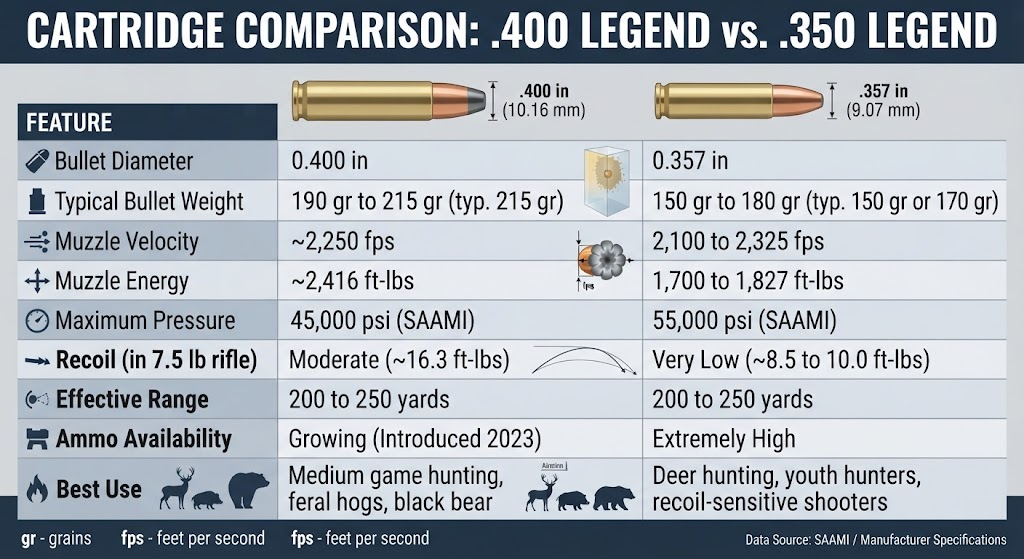
The main difference between the cartridges is that the .400 Legend utilizes a wider 0.400-inch caliber projectile that delivers roughly twenty percent more kinetic energy and superior terminal momentum for larger game animals, whereas the .350 Legend utilizes a narrower 0.357-inch caliber projectile to provide exceptionally mild recoil and an incredibly forgiving shooting experience for beginner and recoil sensitive hunters.
Both cartridges were developed by Winchester to dominate the rapidly expanding straight-wall cartridge hunting market in the American Midwest, where traditional bottlenecked rifle cartridges are legally prohibited for deer hunting. By designing these cartridges to function seamlessly in both modern AR-15 semi-automatic platforms and traditional bolt-action hunting rifles, Winchester created a tiered system for hunters.
The .350 Legend was introduced first in 2019 to offer a low recoil alternative to heavy shotgun slugs, and the .400 Legend was introduced in 2023 to fill the power gap between the mild .350 Legend and the punishing .450 Bushmaster, offering hunters a perfect equilibrium of terminal knockdown power and manageable shoulder recoil.
.400 Legend vs .350 Legend Comparison
| Feature | .400 Legend | .350 Legend |
| Bullet Diameter | 0.400 inches (10.16 mm) | 0.357 inches (9.07 mm) |
| Typical Bullet Weight | 190 gr to 215 gr (typically 215 gr) | 150 gr to 180 gr (typically 150 gr or 170 gr) |
| Muzzle Velocity | 2,250 fps (20-inch barrel) | 2,100 to 2,325 fps (20-inch barrel) |
| Muzzle Energy | 2,416 ft-lbs | 1,700 to 1,827 ft-lbs |
| Momentum | ~69.1 lb-fps (215 gr at 2,250 fps) | ~49.8 lb-fps (150 gr at 2,325 fps) |
| Maximum Pressure | 45,000 psi (SAAMI) | 55,000 psi (SAAMI) |
| Ballistic Coefficient | Low (~0.206 for 215 gr Power-Point) | Low (~0.200 to 0.220) |
| Penetration | 18 to 22 inches (Gelatin) | 16 to 20 inches (Gelatin) |
| Expansion | 0.60 to 0.70 inches | 0.55 to 0.65 inches |
| Trajectory | Flat out to 150 yards, heavy drop beyond | Flat out to 150 yards, heavy drop beyond |
| Recoil | Moderate (~16.3 ft-lbs in a 7.5 lb rifle) | Very Low (~8.5 to 10.0 ft-lbs in a 7.5 lb rifle) |
| Effective Range | 200 to 250 yards | 200 to 250 yards |
| Ammo Availability | Growing (Introduced in 2023) | Extremely High (Massive commercial adoption) |
| Ammo Cost | Moderate ($1.50 to $2.50 per round) | Cheap to Moderate ($0.80 to $1.50 per round) |
| Best Use | Medium game hunting, feral hogs, black bear | Deer hunting, youth hunters, recoil-sensitive shooters |
The table above outlines the foundational differences between two modern straight-wall centerfire rifle cartridges. To fully grasp their operational differences, one must look at their case geometries and the specific engineering required to make them function in an AR-15 platform. The .350 Legend is based on a modified .223 Remington case that has been blown out perfectly straight to accept a 0.357-inch bullet. This allows it to utilize a standard 5.56 NATO bolt face, making AR-15 conversions incredibly simple. It operates at a relatively high maximum chamber pressure of 55,000 psi, which helps it squeeze maximum velocity out of its limited powder capacity.
The .400 Legend requires a slightly different mechanical setup. It is engineered from a modified 6.8 SPC cartridge case, which is wider than a standard .223 Remington case. This wider case accommodates a massive 0.400-inch diameter bullet and holds a significantly larger powder charge. To function in an AR-15, the .400 Legend requires a 6.8 SPC bolt face and specialized magazines. Because the case walls are wide and remove slightly more material from the AR-15 bolt lugs, SAAMI established a more conservative maximum operating pressure of 45,000 psi. Despite this lower pressure ceiling, the larger internal case volume of the .400 Legend allows it to drive much heavier bullets at highly respectable speeds, resulting in devastating terminal performance that bridges the gap between lighter calibers and heavy big bore magnums.
.400 Legend vs .350 Legend Ballistics
To objectively evaluate the ballistic capabilities of the .400 Legend against the .350 Legend, we must examine real-world factory ammunition across their most common applications in modern hunting environments. Both cartridges were explicitly designed to maximize the legal limits of straight-wall regulations while functioning smoothly in modern sporting rifles and short-action bolt rifles. Because of this shared design philosophy, their primary testing data is standardized around 20-inch barrels.
For this highly researched comparison, we will examine the flagship commercial hunting loads that most sportsmen carry into the woods every autumn.
- Load A (.400 Legend Standard Hunting): Winchester 215-grain Power-Point. Tested from a 20-inch barrel. Muzzle velocity is 2,250 feet per second. Muzzle energy is 2,416 foot-pounds. Ballistic Coefficient is 0.206.
- Load B (.400 Legend Solid Copper): Federal Premium 190-grain Power-Shok Copper. Tested from a 20-inch barrel. Muzzle velocity is 2,400 feet per second. Muzzle energy is 2,430 foot-pounds.
- Load C (.350 Legend Standard Hunting): Winchester 150-grain Deer Season XP. Tested from a 20-inch barrel. Muzzle velocity is 2,325 feet per second. Muzzle energy is 1,800 foot-pounds. Ballistic Coefficient is 0.223.
- Load D (.350 Legend Heavy Hunting): Hornady 170-grain American Whitetail InterLock. Tested from a 20-inch barrel. Muzzle velocity is 2,200 feet per second. Muzzle energy is 1,827 foot-pounds. Ballistic Coefficient is 0.215.
Manufacturer-rated data is generally captured under controlled atmospheric conditions using standardized universal receiver barrels. Real-world velocities will vary slightly depending on your specific firearm chamber tolerances, atmospheric density, and barrel length. Shorter 16-inch barrels are incredibly popular for dense timber tree-stand hunters, and utilizing a 16-inch barrel will generally reduce the velocity of both cartridges by approximately 100 to 150 feet per second.
.400 Legend vs .350 Legend Velocity
Velocity is a critical metric for straight-wall rifle ammunition. Because the legal parameters of these cartridges mandate bullet designs that are ballistically blunt, they suffer from poor aerodynamic efficiency. To compensate for their low ballistic coefficients, these cartridges must rely entirely on high initial muzzle velocity to flatten their trajectory over intermediate distances and ensure their hollow points expand reliably upon impact.
When analyzing the velocity of the .400 Legend against the .350 Legend, the numbers remain incredibly competitive despite the massive difference in bullet weight. The .350 Legend is designed to push lightweight 150-grain bullets at approximately 2,325 feet per second from a 20-inch barrel. This high initial speed provides a very flat flight path across the first 150 yards, making it an excellent cartridge for taking quick shots across open agricultural fields in the Midwest. When loaded with heavier 170-grain bullets, the velocity of the .350 Legend drops slightly to 2,200 feet per second.
The .400 Legend is a highly efficient cartridge that manages to push significantly more lead without sacrificing speed. The standard 215-grain Winchester load travels at an impressive 2,250 feet per second. This means the .400 Legend is pushing a bullet that is 45 grains heavier than the heaviest standard .350 Legend load, yet it travels 50 feet per second faster. When utilizing modern lightweight copper solid bullets weighing 190 grains, the .400 Legend can achieve velocities up to 2,400 feet per second. This extreme velocity retention combined with heavy bullet mass gives the .400 Legend a distinct mechanical advantage in the field.
.400 Legend vs .350 Legend Muzzle Energy
Muzzle energy represents the kinetic work capacity of a projectile. The kinetic energy generated by a cartridge is a direct reflection of both the speed of the bullet and its physical mass. Because the .400 Legend fires a projectile that is substantially heavier than the .350 Legend while maintaining identical or slightly faster velocities, it completely dominates the muzzle energy category.
The .350 Legend produces a highly respectable 1,800 foot-pounds of energy at the muzzle when firing standard 150-grain or 170-grain hunting loads. To put this into historical perspective, this is nearly identical to the legendary .30-30 Winchester lever action cartridge. It is more than adequate for humanely harvesting whitetail deer and feral hogs at close to medium ranges.
The .400 Legend operates in a completely different power class. A standard 215-grain Winchester Power-Point load generates a staggering 2,416 foot-pounds of kinetic energy. This represents a massive twenty percent increase in kinetic energy over the .350 Legend. The .400 Legend generates energy levels that rival traditional full-size bottlenecked hunting cartridges. This massive kinetic energy dump ensures catastrophic tissue damage and rapid hydrostatic shock upon impact, making the .400 Legend highly capable of taking on larger, tougher game animals like black bear, elk, and massive wild boars that might brush off a poorly placed shot from a lighter caliber.
.400 Legend vs .350 Legend Momentum
Momentum is a linear measurement calculating mass in motion. In terminal ballistics, high momentum correlates closely with the ability of a bullet to crush through dense bone, heavy winter hides, and thick shoulder muscles without being deflected or stopping prematurely inside the target cavity.
Because momentum relies equally on bullet weight and forward velocity, the heavier .400 Legend thoroughly outclasses the lighter .350 Legend in this specific category.
A 150-grain .350 Legend bullet traveling at 2,325 feet per second yields approximately 49.8 pound-feet per second of linear momentum. While this is perfectly sufficient for penetrating the thin skin and light rib bones of a whitetail deer on a broadside shot, it is not mathematically optimized for punching through the thick cartilage shields of a massive feral hog on a quartering angle.
A heavy 215-grain .400 Legend bullet traveling at 2,250 feet per second yields approximately 69.1 pound-feet per second of linear momentum. This dramatic difference in momentum translates directly to superior terminal performance in the field. The heavy .400 Legend bullet possesses the sheer driving force necessary to reliably track straight through heavy shoulder bones and dense timber brush, anchoring large big game animals instantly and ensuring complete pass-through penetration for an easily trackable blood trail.
.400 Legend vs .350 Legend Trajectory
Understanding external ballistics and predictable bullet drop is critical for straight-wall cartridge hunters attempting to hit targets beyond 150 yards. The trajectory of a bullet is dictated by its initial velocity, the pull of gravity, and the aerodynamic efficiency of the projectile as it cuts through the atmosphere. Both of these cartridges suffer from poor ballistics coefficients measuring roughly 0.200 to 0.220 because their wide, flat noses act like parachutes as they travel downrange.
The calculations below assume a standard high-profile optic height of 1.5 inches above the bore and a clearly stated zero distance of 100 yards. This 100 yard zero is the standard configuration for modern straight-wall hunting rifles utilized in dense Midwestern timber. We will compare the 215-grain .400 Legend Power-Point against the 150-grain .350 Legend Deer Season XP to demonstrate their respective flight paths.
| Distance | .400 Legend (215 gr at 2,250 fps) Drop | .350 Legend (150 gr at 2,325 fps) Drop |
| Muzzle | -1.5 inches | -1.5 inches |
| 50 Yards | +0.8 inches | +0.7 inches |
| 100 Yards | 0.0 inches (Zero) | 0.0 inches (Zero) |
| 150 Yards | -2.6 inches | -2.3 inches |
| 200 Yards | -8.2 inches | -7.6 inches |
| 250 Yards | -17.5 inches | -16.4 inches |
The trajectory data confirms that both cartridges are highly capable intermediate range tools that perform like ballistic twins out to standard hunting distances. The .350 Legend shoots marginally flatter out to 250 yards because it begins its flight at a slightly higher initial velocity and pushes a lighter bullet. However, a difference of roughly one inch of bullet drop at 250 yards is completely indistinguishable in a practical hunting scenario under field conditions.
The reality for both cartridges is that they drop extremely fast past the 150 yard marker. While a hunter can easily hold the crosshairs steady on the center vitals of a deer at 150 yards, taking an ethical shot at 250 yards requires precise laser range finding and a significant vertical holdover calculation. Furthermore, the low ballistic coefficients make both bullets highly susceptible to wind drift, meaning a modest crosswind will push both projectiles significantly off target at extended distances.
.400 Legend vs .350 Legend Recoil
Recoil management is arguably the most important factor for many modern hunters, and it is the exact reason Winchester developed the Legend cartridge family in the first place. The physical recoil generated by a firearm is heavily influenced by the weight of the rifle, the mass of the powder charge, and the weight of the bullet. A shooter who flinches in anticipation of heavy recoil will inevitably pull their shots and miss the vital zone completely.
The .350 Legend was engineered to be one of the softest shooting centerfire hunting cartridges on the market. Fired from a standard 7.5-pound bolt-action hunting rifle, a full-power 150-grain load generates an incredibly mild 8.5 to 10.0 foot-pounds of free recoil energy. This is essentially identical to the light recoil of a .243 Winchester. It is so comfortable to shoot that young children, elderly hunters, and highly recoil sensitive adults can practice all day at the shooting range without developing a flinch or suffering any shoulder fatigue. This lack of recoil ensures absolute confidence and highly accurate shot placement in the field.
The .400 Legend was intentionally engineered to provide massive terminal performance without stepping into the punishing magnum recoil territory of the .450 Bushmaster. Fired from an identical 7.5-pound hunting rifle, a typical 215-grain load generates roughly 16.3 foot-pounds of free recoil energy. While this is noticeably heavier than the .350 Legend, it is still a highly comfortable level of recoil that mirrors a standard .308 Winchester or .270 Winchester. It falls perfectly into the moderate recoil category, providing substantially more power than the .350 Legend without crossing the threshold into painful recoil territory.
.400 Legend vs .350 Legend Penetration
Terminal penetration is rigorously evaluated to ensure the ethical harvesting of game animals. A bullet must penetrate deep enough into soft tissue to reach critical cardiovascular structures regardless of the physical angle the target presents. Because of their massive frontal areas, straight-wall cartridges transfer kinetic energy very quickly to surrounding tissue, which can sometimes hinder deep penetration if the bullet expands too aggressively upon entry.
The .350 Legend utilizes a 0.357-inch diameter bullet. When modern hunting loads strike ballistic gelatin, the soft lead core is designed to peel back while retaining enough mass to push forward. Standard ballistic gel testing indicates the .350 Legend penetrates roughly 16 to 20 inches in soft tissue. This is absolute perfection for broadside shots on whitetail deer and provides enough depth to confidently take quartering shots on medium sized game, though it may struggle to pass completely through a heavy bone structure on larger feral hogs.
The .400 Legend is a penetration powerhouse due to its heavy bullet mass and high momentum. A 215-grain Winchester bullet typically penetrates 18 to 22 inches in tissue, as its heavier mass refuses to be stopped easily by dense resistance. If a hunter opts for a solid copper projectile that retains one hundred percent of its weight upon impact, the .400 Legend will effortlessly penetrate 24 inches or more in gelatin. This ability to push a massive 0.400-inch bullet through two feet of tissue makes the .400 Legend the superior choice for hunters pursuing heavily muscled big game animals in thick brush.
.400 Legend vs .350 Legend Expansion
Bullet expansion dictates the physical diameter of the permanent wound channel inside the target animal. Wide expansion increases the likelihood of severing major arteries and causing rapid incapacitation through catastrophic blood loss. Both of these cartridges deliver terrifyingly large wound channels when utilizing premium ammunition.
The .350 Legend starts with a respectable 0.357-inch frontal diameter. Upon impacting fluid filled tissue at over 2,000 feet per second, the hydraulic pressure forces the copper jacket to peel back, expanding the bullet to roughly 0.55 to 0.65 inches in diameter. This creates a massive crush cavity that guarantees rapid blood trails and swift ethical kills on deer.
The .400 Legend starts with an even larger 0.400-inch diameter. Because it pushes heavier bullets with significantly more kinetic energy, the terminal expansion is highly destructive. A premium 215-grain bullet fired from a .400 Legend frequently expands to 0.60 to 0.70 inches in diameter. The combination of a wider expanded diameter and higher kinetic energy means the .400 Legend simply punches a larger physical hole through the animal, leading to more immediate incapacitation and heavier blood trails for tracking.
.400 Legend vs .350 Legend Effective Range
The ethical effective range of a straight-wall cartridge is determined by the intersection of velocity retention, bullet drop predictability, and the minimum kinetic energy required to humanely kill the target animal. A generally accepted minimum standard for hunting deer is 1,000 foot-pounds of striking energy. Both the .400 Legend and the .350 Legend are heavily limited by their poor aerodynamic shapes, which cause them to bleed velocity and kinetic energy rapidly as they fly downrange.
The .350 Legend maintains its 1,000 foot-pound ethical deer hunting threshold out to approximately 200 yards. A 150-grain Winchester Deer Season XP bullet retains roughly 950 to 1,000 foot-pounds of energy at the 200 yard marker depending on exact atmospheric conditions. Beyond 200 yards, the velocity drops so drastically that reliable bullet expansion cannot be guaranteed, making it strictly a short to medium range hunting tool.
The .400 Legend hits substantially harder at the muzzle and maintains its energy further downrange. The 215-grain Power Point retains roughly 1,134 foot-pounds of kinetic energy at 200 yards, and it does not cross below the 1,000 foot-pound threshold until approximately 250 yards. While the trajectory drop makes hitting targets past 200 yards very challenging, the .400 Legend technically provides an extra 50 yards of ethical kinetic energy reach over the smaller .350 Legend.
.400 Legend vs .350 Legend Self Defense
When discussing self defense with high powered centerfire rifle cartridges, the conversation revolves around tactical applications and the inherent risks of severe over penetration in residential environments.
Neither the .400 Legend nor the .350 Legend is suitable for standard urban home defense. While both are chambered in highly maneuverable modern AR-15 platforms with high capacity magazines, firing a hunting rifle inside a residential hallway will cause immediate and permanent hearing damage due to the concussive muzzle blast. Furthermore, a 150-grain or 215-grain bullet will effortlessly pass completely through an intruder, multiple interior drywall partitions, exterior walls, and continue flying into neighboring properties. The danger posed to innocent bystanders in an urban or suburban environment is extreme.
If utilized for rural property defense or stopping large predatory threats on an isolated farm, both cartridges are highly effective. The .400 Legend, with its massive kinetic energy and heavy bullet weights, is an exceptional close range defense tool capable of stopping aggressive black bears or large feral hogs protecting their territory.
.400 Legend vs .350 Legend Concealed Carry
Concealed carry with either the .400 Legend or the .350 Legend is impossible and entirely impractical. Both are massive centerfire rifle cartridges measuring roughly 2.26 inches in overall length. They require large rifle actions, heavy buffer systems, and substantial barrel lengths to safely contain their operating pressures. There are no practical handguns manufactured that can chamber these rounds for concealed carry. Their appropriate transport method involves a dedicated rifle hard case, a locked vehicle rack, or a sturdy tactical sling worn over the shoulder while hiking in the backcountry.
Which Has More Stopping Power: .400 Legend or .350 Legend?
Stopping power is a non-scientific term generally used to describe the ability of a cartridge to quickly incapacitate a biological target without requiring long tracking jobs into dense brush.
The .400 Legend possesses significantly more stopping power on all game animals. While the .350 Legend is an incredibly efficient killer on deer size game, it cannot match the sheer blunt force trauma delivered by a 0.400 caliber bullet. Striking an animal with over 2,400 foot-pounds of kinetic energy and a heavy 215-grain bullet creates a massive wound channel that induces rapid hydrostatic shock and massive tissue disruption. For animals larger than whitetail deer, the .400 Legend anchors targets with unparalleled authority and leaves vastly superior blood trails.
Which Is More Powerful: .400 Legend or .350 Legend?
Power is defined quantitatively by kinetic energy and linear momentum calculations. Based on the laws of physics and the raw ballistic data, the .400 Legend is vastly more powerful than the .350 Legend.
The .400 Legend generates roughly 2,416 foot-pounds of muzzle energy depending on the specific factory load. The .350 Legend generates roughly 1,800 foot-pounds of muzzle energy. The .400 Legend delivers over 600 more foot-pounds of kinetic energy to the target and boasts a massive advantage in linear momentum due to its heavier bullet mass. It represents a completely different tier of ballistic performance.
.400 Legend Pros and Cons
Pros
- Exceptional compromise between heavy terminal performance and highly manageable moderate recoil
- Delivers twenty percent more kinetic energy than the .350 Legend, ensuring faster ethical kills on heavy game
- Fits perfectly into standard AR-15 platforms using a 6.8 SPC bolt face and specialized magazines
- Extremely effective medium game cartridge tailored specifically for straight-wall legal states
- Rebated rim design ensures reliable feeding in both modern semi-automatics and classic bolt action rifles
Cons
- Ammunition is currently limited and somewhat expensive as it was recently introduced to the market in 2023
- Trajectory drops rapidly past 150 yards, making long range field shots across open fields very difficult
- Does not offer the ubiquitous commercial reloading component availability of older legacy calibers
- Recoil is noticeably heavier than the .350 Legend, which may intimidate very young shooters
.350 Legend Pros and Cons
Pros
- Incredibly low recoil allows youth shooters and recoil sensitive adults to practice comfortably all day long
- Widespread availability of rifles and highly affordable ammunition from virtually every major manufacturer
- Utilizes a standard 5.56 NATO bolt face, making AR-15 upper receiver conversions exceptionally cheap and easy
- Devastating terminal performance on whitetail deer within 150 yards
- Ammunition is priced competitively with standard intermediate military cartridges
Cons
- Lacks the heavy bullet mass and deep penetration required for ethically taking massive big game like elk or moose
- Rapid energy loss limits its ethical effective hunting range to roughly 200 yards maximum
- Low ballistic coefficient bullets are highly susceptible to severe wind drift at intermediate distances
- Straight wall case design requires dedicated magazines for reliable feeding in AR-15 platforms
Final Comparison
| Category | Winner | Reason |
| Velocity | .350 Legend | Lighter bullets achieve slightly faster muzzle speeds approaching 2,325 fps |
| Muzzle Energy | .400 Legend | Generates roughly 600 more ft-lbs of kinetic energy than the .350 Legend |
| Momentum | .400 Legend | Massive .40-caliber bullets carry immense linear driving mass and force |
| Penetration | .400 Legend | Heavy 215-grain bullets effortlessly shatter heavy bone structures and penetrate deeper |
| Expansion | .400 Legend | Starts wider and contains more mass to peel back into a larger permanent wound channel |
| Trajectory | .350 Legend | Marginally flatter out to 200 yards due to slightly higher initial velocity and lighter bullet |
| Recoil Control | .350 Legend | Produces incredibly soft recoil comparable to a .243 Winchester |
| Effective Range | .400 Legend | Retains ethical 1,000 ft-lb hunting energy thresholds out to 250 yards |
| Self Defense | Neither | Both present extreme over penetration hazards in any residential setting |
| Concealed Carry | Neither | Both are massive rifle cartridges entirely unsuitable for concealment on the body |
| Ammo Cost | .350 Legend | Massive commercial adoption guarantees significantly cheaper retail price tags |
| Ammo Availability | .350 Legend | Found in massive quantities in every sporting goods store nationwide |
| Overall Performance | Depends on Shooter | .400 Legend for absolute power; .350 Legend for zero recoil and cheap training |
.400 Legend vs .350 Legend: Which Should You Choose?
Selecting between the .400 Legend and the .350 Legend requires an honest practical assessment of your physical recoil tolerance, the specific size of the animals you intend to hunt, and your local ammunition budget.
Choose the .400 Legend if you are hunting in a straight-wall restricted state and want the absolute maximum terminal performance you can achieve without enduring the punishing magnum recoil of a .450 Bushmaster. The .400 Legend provides exceptional kinetic energy, deep penetration, and a massive wound channel capable of dropping large black bears and massive feral hogs instantly. It is the premier choice for adult hunters who want a highly capable, moderate recoiling big game rifle that functions perfectly in both bolt actions and AR-15 platforms.
Choose the .350 Legend if you are purchasing a rifle for a young hunter, a small statured shooter, or if you simply despise heavy recoil. The .350 Legend is arguably the most pleasant deer hunting cartridge on the market today. It provides more than enough power to ethically harvest whitetail deer inside 150 yards, and its incredibly cheap ammunition allows you to practice extensively without breaking the bank. The ability to use standard AR-15 bolt carrier groups also makes it the most economical choice for modern sporting rifle enthusiasts.
FAQs
Is .400 Legend more powerful than .350 Legend?
Yes, the .400 Legend is significantly more powerful. It generates approximately 600 more foot-pounds of muzzle energy and substantially higher linear momentum than the .350 Legend due to its heavier bullet weights and wider case capacity.
Which has more muzzle energy?
The .400 Legend easily generates over 2,400 foot-pounds of muzzle energy with standard hunting loads. The .350 Legend generates roughly 1,700 to 1,827 foot-pounds of muzzle energy.
Which has more stopping power?
The .400 Legend provides vastly superior stopping power on large game animals due to its heavier bullet mass, wider frontal area, and massive kinetic energy transfer, ensuring rapid incapacitation and deep penetration.
Which has more recoil?
The .400 Legend produces noticeably more recoil. Fired from a standard lightweight hunting rifle, the .400 Legend generates roughly 16 foot-pounds of free recoil energy, whereas the .350 Legend generates a highly manageable 9 foot-pounds of recoil.
Which has better penetration?
The .400 Legend penetrates deeper on heavy game. Its extreme bullet mass allows the heavy projectiles to punch through dense muscle and thick shoulder bones without deflecting or halting prematurely.
Which expands more?
Because it starts at a much wider 0.400-inch diameter and contains significantly more lead mass, a premium .400 Legend expanding bullet will generally create a wider final expanded profile than the 0.357-inch bullet of the .350 Legend.
Which has a flatter trajectory?
The trajectory is effectively identical out to 150 yards. While the .350 Legend is technically a fraction of an inch flatter at 200 yards due to its slightly higher velocity, the difference is negligible in any practical field hunting scenario.
Which is better for self defense?
Neither cartridge is suitable for civilian home defense due to the extreme danger of severe over penetration through residential walls and the blinding, deafening muzzle blast indoors.
Which is better for concealed carry?
Neither. Both are large centerfire rifle cartridges fired from long, heavy rifles that absolutely cannot be concealed on the human body.
Is .400 Legend faster than .350 Legend?
No, the .350 Legend is slightly faster. The .350 Legend typically launches a lightweight 150-grain bullet at roughly 2,325 fps, while the .400 Legend launches a much heavier 215-grain bullet at roughly 2,250 fps.
Is .400 Legend stronger than .350 Legend?
Yes, in terms of sheer kinetic energy, bullet mass, and momentum crushing through tissue, the .400 Legend is drastically stronger than the .350 Legend, even though the .350 Legend operates at a higher internal chamber pressure.
Which is cheaper to shoot?
The .350 Legend is significantly cheaper to shoot. Because it has seen massive commercial adoption over the last several years, manufacturers produce highly affordable bulk practice ammunition for the .350 Legend.
Can an AR-15 shoot .400 Legend?
Yes. An AR-15 can be easily converted to shoot .400 Legend by installing a .400 Legend barrel, a 6.8 SPC bolt face, and utilizing specialized straight-wall magazines.
Which is easier to shoot?
The .350 Legend is drastically easier to shoot due to its exceptionally mild recoil impulse, making it highly preferred for teaching new shooters, youth hunters, and individuals sensitive to loud blast and heavy recoil.
Which should you choose?
Choose the .400 Legend for a highly capable, moderate recoil big game rifle that maximizes kinetic energy. Choose the .350 Legend for absolute minimal recoil, cheap ammunition, and fantastic short range performance on whitetail deer.