The main difference between the projectiles is that the .177 caliber pellet is smaller, lighter, and flies at a much higher velocity to provide a flatter trajectory for precision target shooting, whereas the .22 caliber pellet is wider and significantly heavier, traveling slower but delivering substantially more kinetic energy and momentum for small game hunting and pest control.
Both calibers represent the two most popular airgun chamberings in the world, serving millions of backyard plinkers, competitive shooters, and hunters. The .177 caliber (4.5mm) is the undisputed international standard for target shooting, including the Olympic 10-meter air rifle events. It relies on speed and surgical precision. The .22 caliber (5.5mm) has been the traditional standard for airgun hunters for over a century, providing the blunt force necessary to ethically harvest small game animals like squirrels and rabbits that might otherwise shrug off a lighter, faster pellet.
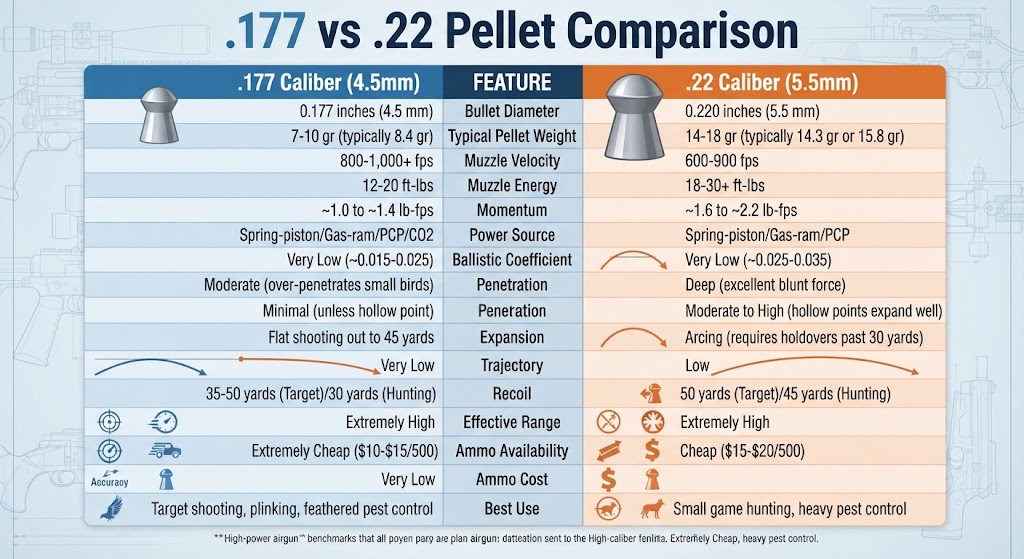
177 vs 22 Pellet Comparison
| Feature | .177 Caliber (4.5mm) | .22 Caliber (5.5mm) |
| Bullet Diameter | 0.177 inches (4.5 mm) | 0.220 inches (5.5 mm) |
| Typical Pellet Weight | 7 gr to 10 gr (typically 8.4 gr) | 14 gr to 18 gr (typically 14.3 gr or 15.8 gr) |
| Muzzle Velocity | 800 to 1,000+ fps (High-power airgun) | 600 to 900 fps (High-power airgun) |
| Muzzle Energy | 12 to 20 ft-lbs | 18 to 30+ ft-lbs |
| Momentum | ~1.0 to ~1.4 lb-fps | ~1.6 to ~2.2 lb-fps |
| Power Source | Spring-piston, Gas-ram, PCP, CO2 | Spring-piston, Gas-ram, PCP |
| Ballistic Coefficient | Very Low (~0.015 to 0.025) | Very Low (~0.025 to 0.035) |
| Penetration | Moderate (Tends to over-penetrate small birds) | Deep (Excellent blunt force on small mammals) |
| Expansion | Minimal (Unless using specialty hollow points) | Moderate to High (Hollow points expand well) |
| Trajectory | Flat shooting out to 45 yards | Arcing, requires holdovers past 30 yards |
| Recoil | Very Low | Low |
| Effective Range | 35 to 50 yards (Target) / 30 yards (Hunting) | 50 yards (Target) / 45 yards (Hunting) |
| Ammo Availability | Extremely High (Found everywhere) | Extremely High (Found everywhere) |
| Ammo Cost | Extremely Cheap ($10-$15 per 500) | Cheap ($15-$20 per 500) |
| Best Use | Target shooting, plinking, feathered pest control | Small game hunting, heavy pest control |
The table above outlines the foundational differences between the two calibers, but the most important variable in airgun ballistics is the power plant firing the pellet. Unlike centerfire rifles where the gunpowder dictates the pressure, airguns rely on mechanical systems: Spring-piston (break barrels), Gas-ram, or Pre-Charged Pneumatics (PCP). A .22 caliber pellet fired from a cheap, low-power break barrel might only reach 450 feet per second, while the exact same pellet fired from a high-end PCP air rifle can exceed 950 feet per second. For this comparison, we will assume both calibers are being fired from identical, modern, high-power adult air rifles (such as a 20+ foot-pound PCP or a magnum springer).
177 vs 22 Ballistics
To objectively evaluate the ballistic capabilities of the .177 pellet against the .22 pellet, we must examine real-world factory ammunition across their most common applications. Airgun pellets are generally made of soft lead and come in various shapes (domed, pointed, hollow point, or wadcutter). For outdoor performance, the classic “domed” (diabolo) pellet is universally preferred due to its superior aerodynamic stability.
- Load A (.177 Standard Domed): JSB Exact Diabolo 8.44-grain. Tested from a high-power PCP air rifle. Muzzle velocity is 950 feet per second. Muzzle energy is 16.9 foot-pounds.
- Load B (.177 Heavy Magnum): H&N Baracuda Match 10.65-grain. Tested from a high-power PCP air rifle. Muzzle velocity is 880 feet per second. Muzzle energy is 18.3 foot-pounds.
- Load C (.22 Standard Domed): Crosman Premier 14.3-grain. Tested from a high-power PCP air rifle. Muzzle velocity is 850 feet per second. Muzzle energy is 22.9 foot-pounds.
- Load D (.22 Heavy Magnum): JSB Exact Jumbo Heavy 18.13-grain. Tested from a high-power PCP air rifle. Muzzle velocity is 800 feet per second. Muzzle energy is 25.7 foot-pounds.
177 vs 22 Velocity
Velocity dictates how flat a projectile shoots across unknown distances. However, in the airgun world, extreme velocity can actually destroy accuracy. Unlike supersonic firearm bullets, the diabolo shape of an airgun pellet becomes aerodynamically unstable if it breaks the sound barrier (roughly 1,125 feet per second depending on altitude and temperature). When a pellet transitions from supersonic back to subsonic flight, it tumbles and accuracy is ruined. The optimal speed for an airgun pellet is generally between 800 and 950 feet per second.
The .177 caliber easily achieves these optimal speeds, and high-power airguns can push lightweight 7-grain .177 pellets entirely too fast (causing a loud crack and terrible accuracy). By utilizing standard 8.4-grain or heavy 10-grain pellets, the .177 stays in the perfect 900 fps “sweet spot,” providing an incredibly flat trajectory that requires very little elevation adjustment at normal backyard distances.
The .22 caliber pushes much heavier pellets, which naturally restricts its maximum velocity. A standard 14.3-grain .22 pellet generally leaves a high-power air rifle at approximately 800 to 850 feet per second. While it travels slower than the .177, it stays well below the sound barrier, ensuring excellent stability and accuracy downrange.
177 vs 22 Muzzle Energy
Muzzle energy represents the kinetic work capacity of a projectile. Because kinetic energy relies heavily on the physical mass of the projectile, the .22 caliber holds a distinct advantage.
A standard .177 caliber pellet fired from a magnum air rifle produces roughly 15 to 18 foot-pounds of energy at the muzzle. This is an exceptional amount of energy for plinking cans and target shooting, and it is more than adequate for dispatching small feathered pests like starlings or pigeons. However, on tougher mammals like large squirrels, this lower energy can sometimes result in the animal escaping if the shot placement is not absolutely perfect.
The .22 caliber operates in a higher power band. A standard 14.3-grain or heavy 18-grain hunting pellet fired from the exact same air rifle will produce roughly 22 to 28 foot-pounds of energy. The .22 caliber routinely generates 30% to 50% more kinetic energy than the .177 caliber simply because it utilizes a projectile that is nearly twice as heavy. This massive disparity in raw power is the primary reason the .22 is the undisputed king of small game airgun hunting.
177 vs 22 Momentum
Momentum is a linear measurement calculating mass in motion. In terminal ballistics, high momentum correlates closely with the ability of a bullet to crush through bone and dense muscle without being deflected.
Because momentum relies equally on bullet weight and velocity, the heavier .22 caliber completely outclasses the lighter .177 caliber in this category.
An 8.4-grain .177 pellet traveling at 950 feet per second yields approximately 1.1 pound-feet per second of linear momentum.
A 14.3-grain .22 pellet traveling at 850 feet per second yields approximately 1.7 pound-feet per second of linear momentum.
This dramatic difference in momentum translates directly to terminal performance in the field. When an airgun hunter needs to punch through the thick shoulder blade of a groundhog or a large rabbit, the heavier .22 caliber pellet possesses the driving force necessary to reliably track straight through that heavy resistance and deliver a fatal blow.
177 vs 22 Trajectory
Understanding external ballistics and predictable pellet drop is critical for airgun shooters because pellets shed velocity very quickly. The calculations below assume a standard airgun optic height of 1.5 inches above the bore and a zero distance of 30 yards. We will compare the 8.4-grain .177 pellet against the 14.3-grain .22 pellet.
| Distance | .177 Caliber (8.4 gr at 950 fps) Drop | .22 Caliber (14.3 gr at 850 fps) Drop |
| Muzzle | -1.5 inches | -1.5 inches |
| 10 Yards | -0.1 inches | -0.1 inches |
| 20 Yards | +0.4 inches | +0.6 inches |
| 30 Yards | 0.0 inches (Zero) | 0.0 inches (Zero) |
| 40 Yards | -1.3 inches | -1.9 inches |
| 50 Yards | -3.7 inches | -5.5 inches |
The data confirms that the .177 is the flatter shooting caliber. At 50 yards, the .177 drops nearly two inches less than the heavier .22 caliber. This flatter trajectory makes the .177 vastly superior for informal target shooting or hitting small targets at unknown distances, as the shooter does not have to guess holdovers as aggressively.
However, wind deflection tells a different story. Assuming a direct 10 mile per hour crosswind, the lighter .177 pellet will drift approximately 3.8 inches at 50 yards. The heavier .22 pellet, possessing a slightly better ballistic coefficient and more mass, will drift approximately 3.2 inches. The .22 handles outdoor wind conditions slightly better than the .177.
177 vs 22 Recoil
Recoil in the airgun world is fundamentally different from firearms. PCP (Pre-Charged Pneumatic) air rifles generate virtually zero felt recoil in both calibers.
However, in spring-piston or gas-ram air rifles, recoil is generated by the heavy internal piston slamming forward. Because it takes more mechanical force to push a heavier .22 caliber pellet out of the barrel, a high-power .22 caliber spring rifle will generally exhibit a slightly harsher “forward-and-backward” recoil impulse than a comparable .177 rifle. This bi-directional recoil is notorious for breaking cheap optics. Still, the recoil of either caliber is incredibly mild compared to any centerfire firearm and is easily managed by shooters of all ages.
177 vs 22 Penetration
Terminal penetration is evaluated to ensure the ethical harvesting of small game animals.
The .177 caliber is a narrow, high-velocity projectile. Because it is so small, it encounters less resistance when entering soft tissue. The .177 often over-penetrates small animals like birds or mice, passing completely through without transferring all of its kinetic energy. This can lead to the animal flying away before expiring.
The .22 caliber penetrates slightly less deeply on soft targets because its wider frontal area creates more resistance upon impact. However, this is exactly what hunters want. The .22 acts like a blunt-force hammer, dumping 100% of its kinetic energy into the animal and causing massive internal trauma that anchors small game instantly.
177 vs 22 Expansion
Airgun pellets are made of soft lead, but they travel at relatively slow velocities compared to firearm bullets.
A standard domed .177 pellet will almost never expand upon impact in soft tissue, acting like a solid drill. Even when utilizing specialized .177 hollow points, the lightweight pellet often lacks the mass to drive the expansion process effectively.
A .22 caliber pellet has a massive advantage in expansion. When utilizing specialized hunting hollow points (like the H&N Crow Magnum or JSB Hades), the heavier mass and wider cavity of the .22 pellet allow it to expand beautifully upon striking small game, frequently mushrooming to over 0.30 inches in diameter and creating a devastating wound channel.
177 vs 22 Effective Range
For target shooting, both calibers are highly accurate out to 50 yards and beyond in capable hands (or up to 100 yards with high-end PCP rifles).
For ethical hunting, the effective range is determined by retained energy. A generally accepted minimum for clean kills on small game (like squirrels) is roughly 5 to 8 foot-pounds of striking energy.
The .177 caliber generally drops below this ethical threshold around 30 to 35 yards depending on the initial muzzle velocity.
The heavier .22 caliber retains its energy much more efficiently, allowing ethical shots on small game out to 45 or 50 yards.
177 vs 22 Self Defense
Neither the .177 caliber nor the .22 caliber airgun pellet is suitable for human self-defense under any circumstances. While high-power air rifles are certainly dangerous and can cause lethal injuries, they lack the massive kinetic energy, immediate hydrostatic shock, and rapid follow-up capabilities of modern centerfire defensive firearms. They should never be relied upon to stop a determined human attacker.
177 vs 22 Concealed Carry
Concealed carry with airguns is not applicable. Airguns are typically large, bulky rifles or large-framed pneumatic pistols designed for sporting use and pest control, not concealed defensive carry.
Which Has More Stopping Power: 177 or 22?
On small game animals, the .22 caliber possesses significantly more stopping power. The combination of a wider diameter, heavier mass, and vastly superior kinetic energy transfer creates a blunt-force trauma that the narrow .177 simply cannot match. A .22 caliber pellet will anchor a squirrel or rabbit instantly, whereas a .177 might over-penetrate and allow the animal to crawl away.
Which Is More Powerful: 177 or 22?
Based on the raw physics, the .22 caliber is vastly more powerful. When fired from the same power plant, the .22 caliber consistently generates roughly 30% to 50% more kinetic energy and linear momentum than the lighter .177 caliber.
.177 Caliber Pros and Cons
Pros
- Exceptional hyper-velocity provides an incredibly flat trajectory, making it highly forgiving on range estimation errors
- The undisputed global standard for precision paper target shooting and competitive matches
- Ammunition is incredibly cheap, allowing for hours of highly affordable backyard plinking
- Highly effective for pest control on small feathered targets (starlings, pigeons, sparrows)
Cons
- Lacks the heavy mass and kinetic energy required to ethically drop larger, tougher small game (rabbits, groundhogs)
- High-power rifles can push lightweight .177 pellets past the speed of sound, ruining accuracy
- Narrow profile often leads to over-penetration on small pests without transferring full energy
.22 Caliber Pros and Cons
Pros
- The ultimate small game airgun hunting caliber, delivering massive blunt force trauma and kinetic energy
- Heavier pellets retain energy significantly better at extended ranges
- Heavier mass resists wind drift more effectively than lightweight .177 pellets in outdoor environments
- Stays well below the sound barrier even in magnum air rifles, ensuring excellent aerodynamic stability
Cons
- Heavier, slower pellets result in a steeper trajectory curve, requiring careful holdover calculations past 30 yards
- Ammunition is slightly more expensive than .177
- Overpowered for simple indoor 10-meter paper target shooting
Final Comparison
| Category | Winner | Reason |
| Velocity | .177 Caliber | Lighter pellets achieve significantly faster muzzle speeds (frequently 950+ fps) |
| Muzzle Energy | .22 Caliber | Heavier mass generates substantially more kinetic energy from the same power plant |
| Momentum | .22 Caliber | Heavy 14 to 18-grain pellets carry immense linear driving mass |
| Penetration | Tie | .177 penetrates deeper via narrow profile; .22 penetrates heavy bone via mass |
| Expansion | .22 Caliber | Wider hollow points and heavier mass allow for vastly superior terminal expansion |
| Trajectory | .177 Caliber | Higher velocity produces a significantly flatter curve inside of 45 yards |
| Recoil Control | Tie | Both generate practically identical, non-existent recoil in PCP platforms |
| Effective Range | .22 Caliber | Superior retained energy confidently extends ethical hunting shots out to 50 yards |
| Self Defense | Neither | Neither caliber is suitable or safe for human self-defense applications |
| Concealed Carry | Neither | Airguns are not designed or legally treated as concealed carry defensive weapons |
| Ammo Cost | .177 Caliber | Standard tins of 500 pellets are noticeably cheaper for the smaller caliber |
| Ammo Availability | Tie | Both are found in massive quantities in every sporting goods store worldwide |
| Overall Performance | Depends on Target | .177 for target shooting/plinking; .22 for ethical small game hunting |
177 vs 22: Which Should You Choose?
Selecting between the .177 and the .22 caliber airgun depends entirely on what you intend to shoot in your backyard or the woods.
Choose the .177 Caliber if your primary goal is punching paper targets, plinking tin cans, or casual backyard fun. The exceptionally flat trajectory means you don’t have to guess your holdovers as aggressively when shifting targets from 20 to 40 yards. Because the ammunition is so cheap, you can shoot all afternoon for the cost of a cup of coffee. It is also the perfect tool for dispatching small invasive birds around a barn or garden.
Choose the .22 Caliber if your primary goal is hunting small game like squirrels, rabbits, or groundhogs. The .22 caliber hits like a hammer. It delivers the massive kinetic energy and blunt force trauma required to humanely anchor mammals instantly, preventing wounded animals from escaping into the brush. While you will have to learn your trajectory arc a bit more carefully at longer distances, the massive increase in terminal performance makes it the undisputed champion of the airgun hunting woods.
FAQs
Is .22 more powerful than .177?
Yes, the .22 caliber is significantly more powerful. When fired from identical high-power air rifles, the .22 caliber generates substantially higher kinetic energy and linear momentum due to its heavier pellet mass.
Which has more muzzle energy?
The .22 caliber easily generates more muzzle energy, often producing 22 to 30 foot-pounds in high-end rifles. The .177 generally produces roughly 15 to 18 foot-pounds of muzzle energy.
Which has more stopping power?
The .22 caliber provides vastly superior stopping power on small game animals due to its wider diameter, heavier mass, and massive kinetic energy transfer, ensuring rapid incapacitation.
Which is louder, 177 or 22?
If fired from the same high-power air rifle, the .177 can actually be much louder. Because it is lighter, a high-power rifle can push a .177 pellet past the speed of sound (1,125 fps), creating a miniature sonic boom (a loud crack). The heavier .22 stays subsonic and generally produces a quieter “thump.”
Which has better penetration?
The .177 often penetrates deeper on very soft targets because it is a fast, narrow needle. However, the .22 caliber provides better penetration through tough resistance (like the shoulder bone of a squirrel) because its heavier mass refuses to be deflected.
Which is better for target shooting?
The .177 is universally preferred for target shooting. Its flat trajectory is highly forgiving, and it punches clean, distinct holes in paper targets. It is the caliber used in Olympic competition.
Which has a flatter trajectory?
The .177 has a significantly flatter trajectory. The higher initial velocity allows it to drop less than the .22 caliber at standard airgun distances (out to 50 yards).
Which is better for self defense?
Neither. Airguns should never be used for self-defense against human threats.
Is .177 faster than .22?
Yes, the .177 is substantially faster. A standard .177 pellet often exits the barrel at roughly 950 fps, while the .22 launches its heavier pellet at roughly 800 to 850 fps.
Is .22 stronger than .177?
Yes, in terms of sheer kinetic energy and momentum crushing through tissue and bone, the .22 caliber is drastically stronger than the .177.
Which is cheaper to shoot?
The .177 is cheaper to shoot. Because it uses less lead, tins of 500 .177 pellets cost less than comparable tins of .22 pellets.
Which should you choose?
Choose the .177 for target shooting, plinking, and light feathered pest control. Choose the .22 for serious small game hunting and maximum kinetic energy transfer on mammals.