The main difference between the cartridges is that the 10mm Auto is a rimless cartridge designed for semi-automatic pistols that utilizes a wider, heavier bullet to deliver deep penetration and high capacity, whereas the .357 Magnum is a rimmed cartridge designed for revolvers that utilizes lighter bullets driven at exceptionally high velocities to create massive hydrostatic shock and rapid expansion.
Both cartridges represent the absolute pinnacle of practical, carry-sized defensive handgun power. The .357 Magnum was introduced in 1935 and quickly established the benchmark for law enforcement and self defense stopping power, utilizing a lengthened .38 Special case to achieve unprecedented velocities. The 10mm Auto was developed in 1983 under the guidance of firearms expert Jeff Cooper, who sought a combat cartridge that shot flatter than the .45 ACP and hit harder than the 9mm Luger. Today, the debate between the two is a classic battle of revolver reliability versus semi-automatic capacity, as their raw kinetic energy outputs are remarkably similar.
10mm vs 357 Magnum Comparison
| Feature | 10mm Auto | .357 Magnum |
| Bullet Diameter | 0.400 inches (10.16 mm) | 0.357 inches (9.07 mm) |
| Typical Bullet Weight | 155 gr to 220 gr (typically 180 gr or 200 gr) | 110 gr to 180 gr (typically 125 gr or 158 gr) |
| Muzzle Velocity | 1,150 to 1,300 fps (4 to 5-inch barrel) | 1,200 to 1,500 fps (4 to 6-inch barrel) |
| Muzzle Energy | 550 to 750+ ft-lbs | 500 to 800 ft-lbs |
| Momentum | ~31 to ~37 lb-fps | ~26 to ~32 lb-fps |
| Maximum Pressure | 37,500 psi (SAAMI) | 35,000 psi (SAAMI) |
| Ballistic Coefficient | Low (~0.130 to 0.170) | Low (~0.140 to 0.190) |
| Penetration | 16 to 28+ inches (Gelatin depending on bullet) | 14 to 24+ inches (Gelatin depending on bullet) |
| Expansion | 0.60 to 0.75 inches | 0.55 to 0.65 inches |
| Trajectory | Flat out to 50 yards | Extremely flat out to 75 yards |
| Recoil | Snappy but mitigated by slide (~9 to 12 ft-lbs) | Sharp and heavy (~10 to 14 ft-lbs) |
| Effective Range | 50 to 75 yards (Handgun Hunting) | 50 to 100 yards (Handgun Hunting) |
| Ammo Availability | High (Growing popularity in semi-autos) | Extremely High (Global revolver standard) |
| Ammo Cost | Moderate to Expensive ($0.60 to $1.50 per round) | Moderate to Expensive ($0.60 to $1.50 per round) |
| Best Use | Wilderness defense, high-capacity bear country carry | Classic revolver carry, hunting, backup woods gun |
The table above illustrates the mechanical frameworks of two incredibly potent handgun cartridges. The .357 Magnum relies on velocity to accomplish its work. By operating at a high pressure limit of 35,000 psi inside a long brass case, it can propel a 125-grain hollow point at speeds that guarantee violent, explosive expansion upon impact.
The 10mm Auto takes a different physical approach. It operates at an even higher maximum chamber pressure of 37,500 psi, but it utilizes a much shorter, fatter case designed to stack efficiently inside a semi-automatic pistol magazine. Instead of pushing ultra-light bullets at hyper velocities, the 10mm Auto is designed to push heavy 180-grain and 200-grain bullets at high subsonic or supersonic speeds. This heavier bullet mass gives the 10mm Auto a distinct advantage in penetration and momentum, making it highly preferred for deep tissue damage on heavy animals.
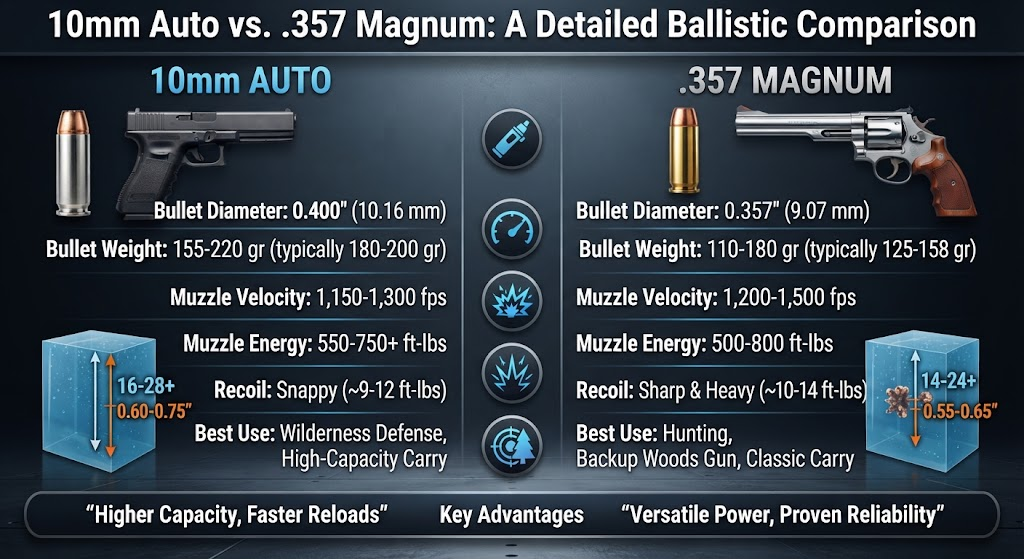
10mm vs 357 Magnum Ballistics
To objectively evaluate the ballistic capabilities of the 10mm Auto against the .357 Magnum, we must examine full-power factory ammunition. It is important to note that many commercial 10mm Auto loads found in big-box retail stores are drastically underloaded, frequently matching the anemic performance of the .40 S&W. For a fair comparison, we will look at full-power defensive and wilderness hunting loads that represent the true potential of both cartridges.
- Load A (10mm Auto Standard Defense): Speer 200-grain Gold Dot Jacketed Hollow Point. Tested from a 5-inch barrel. Muzzle velocity is 1,100 feet per second. Muzzle energy is 537 foot-pounds.
- Load B (10mm Auto Heavy Bear Defense): Underwood 200-grain Hard Cast Flat Nose. Tested from a 5-inch barrel. Muzzle velocity is 1,250 feet per second. Muzzle energy is 694 foot-pounds.
- Load C (.357 Magnum Standard Defense): Federal Premium 158-grain Hydra-Shok Jacketed Hollow Point. Tested from a 4-inch vented barrel. Muzzle velocity is 1,240 feet per second. Muzzle energy is 539 foot-pounds.
- Load D (.357 Magnum Heavy Bear Defense): Buffalo Bore 180-grain Hard Cast Lead Flat Nose. Tested from a 4-inch vented barrel. Muzzle velocity is 1,300 feet per second. Muzzle energy is 675 foot-pounds.
10mm vs 357 Magnum Velocity
Velocity dictates how flat a projectile shoots across distances and how effectively expanding bullets open upon impacting soft tissue. High initial velocity also drastically reduces the time of flight to the target.
When analyzing velocity, the .357 Magnum holds a distinct advantage. Because it utilizes lighter bullets (typically 125 grains to 158 grains), the massive powder charge behind the bullet can accelerate it to blistering speeds. A classic 125-grain .357 Magnum defensive load easily exits a 4-inch barrel at 1,450 feet per second. When fired from a longer 6-inch hunting revolver or a lever-action rifle, the velocity jumps exponentially. This extreme speed forces the hollow point to open violently upon impact, creating a massive temporary stretch cavity in soft tissue.
The 10mm Auto pushes much heavier bullets, which naturally restricts its maximum velocity. A standard 180-grain bullet generally leaves a 5-inch pistol barrel at approximately 1,200 to 1,250 feet per second. If a shooter opts for lightweight 135-grain or 155-grain bullets, the 10mm Auto can reach velocities exceeding 1,400 feet per second, but most shooters prefer the 10mm for its heavy bullet mass.
10mm vs 357 Magnum Muzzle Energy
Muzzle energy represents the kinetic work capacity of a projectile. Because kinetic energy relies heavily on the velocity component, both cartridges generate remarkably similar total energy outputs despite taking different paths to get there.
A full-power 10mm Auto utilizing a 180-grain or 200-grain bullet produces roughly 600 to 750 foot-pounds of energy at the muzzle. Boutique manufacturers like Underwood or Buffalo Bore can safely push the cartridge slightly past 750 foot-pounds in modern, fully-supported chambers (like the Glock 20 or Smith & Wesson M&P 10mm).
The .357 Magnum operates in the exact same power band. A standard 158-grain hunting load produces roughly 550 to 600 foot-pounds of energy. When utilizing heavy 180-grain hard cast loads, the energy climbs to nearly 700 foot-pounds. When fired from equal barrel lengths, the two cartridges are ballistic twins in terms of sheer kinetic energy generation.
10mm vs 357 Magnum Momentum
Momentum is a linear measurement calculating mass in motion. In terminal ballistics, high momentum correlates closely with the ability of a bullet to crush through dense bone, heavy winter hides, structural barriers, and thick muscle without being deflected or stopping prematurely.
Because momentum relies equally on bullet weight and velocity, the heavier 10mm Auto completely outclasses the lighter .357 Magnum in this specific category.
A 158-grain bullet traveling at 1,240 feet per second (representing a standard .357 Magnum load) yields approximately 28.0 pound-feet per second of linear momentum.
A heavy 200-grain bullet traveling at 1,200 feet per second (representing a full-power 10mm Auto load) yields approximately 34.2 pound-feet per second of linear momentum.
This dramatic difference in momentum translates directly to terminal performance in the field. When a hunter or hiker needs to punch through the thick shoulder cartilage of a large feral hog or a black bear, the heavy 200-grain or 220-grain 10mm Auto bullet possesses the sheer driving force necessary to reliably track straight through that heavy resistance. The .357 Magnum is highly effective, but its lighter bullets can occasionally deflect or halt prematurely on extremely heavy bone structures.
10mm vs 357 Magnum Trajectory
Understanding external ballistics and predictable bullet drop is critical for handgun hunters. Handgun bullets are ballistically blunt, possessing poor ballistic coefficients, which means they shed velocity very quickly.
Both cartridges shoot exceptionally flat for handguns. The .357 Magnum holds a slight advantage due to its higher initial velocity, which provides a slightly flatter arc out to 75 yards. However, in practical handgun hunting scenarios where shots are rarely taken beyond 50 yards without a rest, the trajectory difference is indistinguishable. A shooter can hold the sights directly on the center vitals of a deer at 50 yards with either cartridge and guarantee a lethal strike without calculating complex holdovers.
10mm vs 357 Magnum Recoil
Recoil management is a major factor in rapid and accurate shooting. A shooter who flinches in anticipation of heavy recoil will inevitably pull their shots and miss the vital zone completely under stress.
The .357 Magnum is famous for its sharp, snappy recoil and massive concussive muzzle blast. Fired from a standard 35-ounce revolver, a full-power load generates roughly 10 to 14 foot-pounds of free recoil energy. Because a revolver has a fixed cylinder and barrel, one hundred percent of this rearward energy is driven straight into the web of the shooter’s hand. The muzzle flips violently upward, making rapid follow-up shots difficult for inexperienced shooters.
The 10mm Auto generates practically identical raw recoil energy (roughly 9 to 12 foot-pounds depending on the load), but the perceived felt recoil is vastly different. The 10mm Auto is fired from semi-automatic pistols. The reciprocating slide absorbs a massive portion of the rearward energy by compressing the heavy recoil spring. This mechanical action spreads the recoil impulse out over a fraction of a second, changing the sharp “slap” of a revolver into a heavy, controllable “shove.” Most shooters find a full-size 10mm Auto pistol much easier to shoot rapidly and accurately than a full-power .357 Magnum revolver.
10mm vs 357 Magnum Penetration
Terminal penetration is rigorously evaluated to ensure the ethical harvesting of game animals and the effective neutralization of threats.
The .357 Magnum utilizes 0.357-inch diameter bullets. When loaded with premium 158-grain or 180-grain hard-cast lead hunting bullets that do not deform upon impact, the .357 Magnum will reliably penetrate 24 inches or more in dense tissue and ballistic gelatin. This provides reliable straight-line penetration for broadside shots on medium game.
The 10mm Auto is a penetration juggernaut due to its heavy bullet mass and higher momentum. A premium 200-grain or 220-grain hard-cast flat-nose bullet fired from a 10mm Auto will easily crush heavy shoulder bones and continue pushing deep into the vital cavity. Penetration depths exceeding 30 inches are common with heavy wilderness loads, making the 10mm Auto highly preferred for stopping large, heavily muscled predators.
10mm vs 357 Magnum Expansion
Bullet expansion dictates the diameter of the permanent wound channel inside the target.
The .357 Magnum is legendary for its explosive expansion. Because it drives lighter 125-grain hollow points at 1,450 feet per second, the intense hydraulic pressure forces the lead core and copper jacket to peel back violently into a classic mushroom shape. A standard .357 Magnum defensive bullet will typically open to roughly 0.55 to 0.65 inches in diameter, causing rapid incapacitation on human-sized threats.
The 10mm Auto starts with a wider 0.400-inch diameter. While it travels slightly slower, the heavy 180-grain jacketed hollow point contains far more lead mass to peel back. Upon impact, these heavy bullets frequently expand to 0.65 to 0.75 inches in diameter. The combination of a wider expanded diameter and heavier weight means the 10mm Auto punches a significantly larger physical hole through the target, leading to heavier blood trails.
10mm vs 357 Magnum Effective Range
For ethical handgun hunting applications, the effective range is limited by the minimum velocity required for bullet expansion and the visual limitations of the shooter using iron sights. Both the 10mm Auto and the .357 Magnum maintain excellent trajectory characteristics and lethal kinetic energy out to 50 or 75 yards. In the hands of a highly skilled handgun hunter shooting from a stable rest, both cartridges deliver the necessary payload to harvest deer or feral hogs out to 100 yards ethically.
10mm vs 357 Magnum Self Defense
Both cartridges are exceptional self-defense tools, but they rely on completely different firearm platforms.
The .357 Magnum is restricted to revolvers, which typically hold five to seven rounds of ammunition. Reloading a revolver under severe stress requires complex fine motor skills. However, revolvers are practically immune to contact malfunctions; if a defender presses the muzzle directly into an attacker during a physical struggle, the revolver will still fire. The blinding muzzle flash and deafening blast of a .357 Magnum fired indoors without hearing protection will cause permanent hearing damage and severe disorientation.
The 10mm Auto is chambered in semi-automatic pistols like the Glock 20, Springfield XD-M, or Smith & Wesson M&P. These pistols hold 15 rounds of ammunition in a flush-fit magazine, giving the defender more than double the capacity of a standard revolver. Reloading is accomplished in seconds by slamming a fresh magazine into the grip. The heavier capacity and reduced muzzle flip make the 10mm Auto the vastly superior choice for engaging multiple threats or laying down sustained fire during a wilderness emergency.
10mm vs 357 Magnum Concealed Carry
Concealed carry with either cartridge is possible but challenging.
The .357 Magnum is widely available in snub-nose configurations (like the Smith & Wesson J-Frame or Ruger LCR). These small revolvers are incredibly easy to conceal in a pocket or inside the waistband. However, firing full-power .357 Magnum ammunition from a 15-ounce pocket revolver is a violent, painful experience that causes severe flinching for most shooters.
The 10mm Auto is primarily chambered in large, full-size duty pistols designed to mitigate its heavy recoil and house long cartridges in the grip. While compact models like the Glock 29 exist, they are still exceptionally thick and heavy compared to modern 9mm micro-compacts. Concealing a 10mm Auto generally requires a sturdy belt, a high-quality holster, and a cover garment.
Which Has More Stopping Power: 10mm or 357 Magnum?
Stopping power is a combination of kinetic energy, tissue disruption, and penetration depth.
On human-sized targets and thin-skinned game, the .357 Magnum (specifically the 125-grain JHP load) is historically considered to have unparalleled immediate stopping power. The hyper-velocity expansion creates a massive temporary stretch cavity that induces rapid central nervous system shock.
On large, heavily muscled animals like feral hogs or bears, the 10mm Auto possesses vastly superior stopping power. Its heavy 200-grain bullets carry significantly more linear momentum, ensuring that the bullet punches through heavy bone and thick shoulder cartilage to reach vital organs from any angle.
Which Is More Powerful: 10mm or 357 Magnum?
Power is defined quantitatively by kinetic energy and linear momentum.
Based on the raw data, the 10mm Auto is the more powerful cartridge when loaded to its true potential. While both cartridges generate remarkably similar kinetic energy (hovering around 600 to 750 foot-pounds), the 10mm Auto delivers significantly more linear momentum due to its heavier bullet mass.
10mm Auto Pros and Cons
Pros
- Exceptional capacity in semi-automatic pistols, commonly holding 15 rounds per magazine
- Heavy bullet mass (180 to 220 grains) provides deep, crushing penetration on dangerous predators
- Semi-automatic slide reciprocation absorbs significant recoil energy, allowing for faster follow-up shots
- Starts at a wider 0.400-inch diameter, expanding into a massive wound channel
Cons
- Commercial ammunition found in retail stores is often severely underloaded to .40 S&W velocity levels
- Requires large-framed, thick grips to accommodate the long cartridge length, which can be difficult for small hands
- Can suffer from limp-wristing malfunctions if the shooter fails to maintain a perfectly rigid grip under panic
.357 Magnum Pros and Cons
Pros
- Unparalleled mechanical reliability in close-quarters physical struggles (revolvers cannot be pushed out of battery)
- Extreme hyper-velocity 125-grain loads deliver devastating hydrostatic shock and explosive expansion
- Can safely fire cheaper, low-recoil .38 Special ammunition for inexpensive target practice
- Available in ultra-compact snub-nose configurations for deep concealed carry
Cons
- Severely limited ammunition capacity (typically 5 to 7 rounds) and slow reloading times under stress
- Generates a violent, sharp recoil impulse that is punishing to the wrist and induces shooter fatigue
- Cylinder gap bleeds high-pressure gas, slightly reducing velocity and increasing concussive blast
Final Comparison
| Category | Winner | Reason |
| Velocity | .357 Magnum | Lighter projectiles and large powder charges effortlessly exceed 1,400 fps |
| Muzzle Energy | Tie | Both generate roughly 600 to 750 ft-lbs from full-size barrels |
| Momentum | 10mm Auto | Heavy 180 to 220-grain bullets carry immense linear driving mass |
| Penetration | 10mm Auto | Higher momentum pushes heavy hard-cast projectiles deeper through heavy bone |
| Expansion | Tie | .357 Magnum expands violently via speed; 10mm expands wider via original diameter |
| Trajectory | .357 Magnum | Hyper velocity produces a marginally flatter curve out to 75 yards |
| Recoil Control | 10mm Auto | Semi-automatic action absorbs energy, completely eliminating sharp revolver “slap” |
| Effective Range | Tie | Both comfortably reach 50 to 75 yards for ethical handgun hunting |
| Self Defense | 10mm Auto | 15-round capacity and fast reloads thoroughly outclass a 6-shot revolver |
| Concealed Carry | .357 Magnum | Available in tiny, ultra-lightweight snub-nose configurations |
| Ammo Cost | Tie | Both are premium cartridges that carry moderate to expensive price tags |
| Ammo Availability | .357 Magnum | The undisputed global standard for revolvers for nearly ninety years |
| Overall Performance | Depends on User | 10mm Auto for wilderness capacity; .357 Magnum for mechanical reliability |
10mm vs 357 Magnum: Which Should You Choose?
Selecting between the 10mm Auto and the .357 Magnum is ultimately a choice between the firearm platforms that chamber them, rather than a debate over ballistic lethality.
Choose the 10mm Auto if your primary goal is wilderness defense in bear country, hunting heavy feral hogs, or if you prefer the high capacity and rapid reloading capabilities of a modern semi-automatic pistol. The 10mm Auto provides the raw momentum required to crush heavy bone, and having 15 rounds of full-power ammunition in a single magazine provides an unmatched level of security during an adrenaline-fueled emergency.
Choose the .357 Magnum if you prioritize absolute mechanical reliability, deep concealed carry in pocket holsters, or if you want a versatile revolver that can shoot cheap .38 Special ammunition for target practice. The .357 Magnum is a point-and-shoot tool that ignores limp-wristing and contact malfunctions, making it the ultimate close-quarters backup weapon. It delivers hyper-velocity expansion and remains one of the most proven self-defense cartridges in human history.
FAQs
Is 10mm more powerful than 357 Magnum?
Yes, in terms of sheer momentum and crushing capability, the 10mm Auto is slightly more powerful. While both generate roughly identical kinetic energy, the 10mm Auto pushes heavier bullets, giving it stronger penetration capabilities through physical barriers and heavy bone.
Which has more muzzle energy?
They are effectively identical. A full-power 10mm Auto and a full-power .357 Magnum both generate roughly 600 to 750 foot-pounds of energy at the muzzle depending on the specific factory load chosen.
Which has more stopping power?
For human-sized threats, the .357 Magnum provides legendary immediate stopping power due to explosive hyper-velocity expansion. For heavy, dense animals like bears or hogs, the 10mm Auto provides vastly superior stopping power due to deeper momentum-driven penetration.
Which has more recoil?
The .357 Magnum produces noticeably harsher felt recoil. Fired from a revolver, the rearward force drives straight into the hand. The 10mm Auto is fired from semi-automatic pistols where the reciprocating slide absorbs a large portion of the energy, resulting in a smoother, more controllable shove.
Which has better penetration?
The 10mm Auto penetrates deeper on heavy game. Its heavier bullet mass (200+ grains) allows hard-cast projectiles to punch through dense muscle and thick bone without deflecting, whereas lighter .357 Magnum bullets can occasionally halt prematurely on massive shoulder structures.
Which expands more?
Because it starts at a wider 0.400-inch diameter and contains significantly more lead mass, a premium 10mm Auto expanding bullet will generally create a slightly wider final expanded profile than the 0.357-inch bullet.
Which has a flatter trajectory?
The .357 Magnum shoots slightly flatter out to 75 yards due to its extremely high initial velocity.
Which is better for self defense?
The 10mm Auto is considered superior for wilderness defense due to its 15-round capacity. The .357 Magnum is widely considered excellent for urban concealed carry in snub-nose revolvers due to its absolute mechanical reliability.
Which is better for concealed carry?
The .357 Magnum is easier to conceal because it is available in incredibly small 5-shot pocket revolvers. The 10mm Auto is generally restricted to thick, heavy duty-sized pistols.
Is 10mm faster than 357 Magnum?
No, the .357 Magnum is drastically faster at the muzzle. A standard 125-grain .357 Magnum bullet exits the barrel at roughly 1,450 fps, whereas a standard 180-grain 10mm Auto bullet exits at roughly 1,200 fps.
Is 357 Magnum stronger than 10mm?
No. While it is faster, the lighter bullet of the .357 Magnum generates less overall momentum than the heavy 10mm Auto bullets.
Which is cheaper to shoot?
Both cartridges are premium centerfire rounds and can be expensive to shoot. However, .357 Magnum revolvers can safely fire highly affordable .38 Special ammunition, making the .357 platform vastly cheaper for high-volume target practice.
Can a 10mm shoot 357 Magnum?
No. They are completely different calibers with vastly different case geometries. A semi-automatic 10mm pistol cannot chamber rimmed revolver cartridges.
Which is easier to shoot?
The 10mm Auto is drastically easier to shoot due to its semi-automatic slide absorbing recoil, allowing for faster follow-up shots and less pain during extended practice sessions.
Which should you choose?
Choose the 10mm Auto for high-capacity wilderness defense and heavy bullet penetration. Choose the .357 Magnum for ultra-reliable revolver mechanics, pocket concealment, and hyper-velocity expansion.