The main difference between the cartridges is that the .308 Winchester is a commercial sporting cartridge regulated by the Sporting Arms and Ammunition Manufacturers Institute with higher maximum pressure limits and tighter chamber headspace specifications, whereas the 7.62×51 is a military cartridge standardized by NATO featuring thicker brass casing walls and longer chamber headspace tolerances designed to ensure reliable feeding and extraction in fully automatic machine guns operating in harsh combat environments.
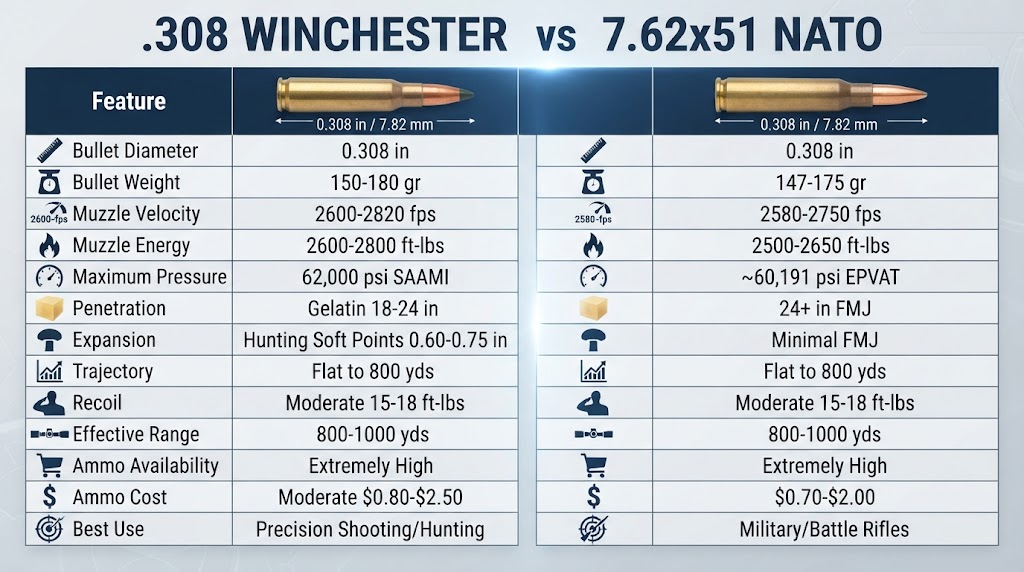
.308 Winchester vs 7.62×51 Comparison
| Feature | .308 Winchester | 7.62×51 NATO |
| Bullet Diameter | 0.308 inches (7.82 mm) | 0.308 inches (7.82 mm) |
| Typical Bullet Weight | 150 gr to 180 gr (typically 150 gr or 168 gr) | 147 gr to 175 gr (typically 147 gr or 175 gr) |
| Muzzle Velocity | 2,600 to 2,820 fps (24-inch barrel) | 2,580 to 2,750 fps (24-inch barrel) |
| Muzzle Energy | 2,600 to 2,800 ft-lbs | 2,500 to 2,650 ft-lbs |
| Momentum | ~60 to ~64 lb-fps (depending on load) | ~57 to ~65 lb-fps (depending on load) |
| Maximum Pressure | 62,000 psi (SAAMI) | ~60,191 psi (EPVAT) / 50,000 CUP |
| Ballistic Coefficient | Moderate to High (0.400 to 0.530) | Moderate to High (0.393 to 0.495) |
| Penetration | 18 to 24 inches (Gelatin) | 24+ inches (Military FMJ Ball) |
| Expansion | 0.60 to 0.75 inches (Hunting Soft Points) | Minimal (Military FMJ relies on yaw and fragmentation) |
| Trajectory | Flat shooting, predictable drop to 800 yards | Flat shooting, predictable drop to 800 yards |
| Recoil | Moderate (~15 to 18 ft-lbs in a standard rifle) | Moderate (~15 to 18 ft-lbs in a standard rifle) |
| Effective Range | 800 to 1,000 yards (Hunting and Target) | 800 to 1,000 yards (Military Sniper and Machine Gun) |
| Ammo Availability | Extremely High (Global commercial standard) | Extremely High (Global military surplus) |
| Ammo Cost | Moderate ($0.80 to $2.50 per round) | Moderate ($0.70 to $2.00 per round) |
| Best Use | Precision target shooting, versatile big game hunting | High volume training, military surplus rifles, battle rifles |
The table above outlines the foundational differences between a premier civilian hunting cartridge and one of the most prolific military cartridges in global history. To truly understand how these cartridges differ, we must examine their shared development history. Following World War II, the United States military sought to replace the venerable .30-06 Springfield with a shorter, lighter cartridge that could deliver identical ballistic performance. Advancements in spherical ball powder developed by Olin allowed engineers at the Frankford Arsenal to replicate .30-06 velocities in a shorter case. This experimental cartridge was designated the T65. Recognizing the massive commercial potential of a short-action .30 caliber cartridge, the Winchester Repeating Arms Company introduced the design to the civilian market in 1952 as the .308 Winchester. Two years later, in 1954, NATO officially adopted the military version of the design as the 7.62x51mm NATO.
While their exterior dimensions are physically identical, their internal dimensions and chamber specifications are not. The military required the 7.62×51 to function flawlessly in fully automatic weapons like the M60 machine gun and the M14 battle rifle. To prevent torn cartridge rims during violent extraction, the military mandated that 7.62×51 brass casings be manufactured with significantly thicker walls and a thicker case web. Because the exterior dimensions cannot change, this thicker brass reduces the internal powder capacity of the military cartridge. Furthermore, military chambers are cut slightly longer to accommodate dirty ammunition on a muddy battlefield. The standard .308 Winchester chamber headspace is cut between 1.6300 and 1.6340 inches. The 7.62×51 chamber headspace is cut longer, measuring between 1.6355 and 1.6405 inches. Firing a commercial .308 Winchester round featuring thinner brass in a military 7.62×51 chamber with maximum headspace allows the thin brass to stretch excessively upon ignition, which can result in catastrophic case head separation and severe damage to the firearm.
.308 Winchester vs 7.62×51 Ballistics
To objectively evaluate the ballistic capabilities of the .308 Winchester against the 7.62×51, we must examine real-world factory ammunition across their most common applications in hunting, target shooting, and military engagements. We cannot use a single load to represent every possible scenario. The .308 Winchester benefits from over seventy years of commercial innovation, offering bullet weights ranging from 110-grain varmint loads to heavy 200-grain subsonic loads. The 7.62×51 is strictly defined by military specifications, primarily revolving around the M80 Ball load and the M118 Long Range sniper load.
For a completely fair comparison reflecting their maximum potential, all loads listed below are recorded from standard 24-inch test barrels. Shooters utilizing shorter 16-inch or 18-inch barrels commonly found on modern tactical carbines will experience proportionally lower velocities.
- Load A (.308 Winchester Commercial Hunting): Federal Premium 150-grain Nosler Partition. Tested from a 24-inch barrel. Muzzle velocity is 2,820 feet per second. Muzzle energy is 2,648 foot-pounds. Ballistic Coefficient (G1) is 0.387.
- Load B (.308 Winchester Precision Match): Federal Premium Gold Medal 168-grain Sierra MatchKing. Tested from a 24-inch barrel. Muzzle velocity is 2,650 feet per second. Muzzle energy is 2,619 foot-pounds. Ballistic Coefficient (G1) is 0.462.
- Load C (7.62×51 Standard Military Ball): Federal American Eagle 149-grain M80 Full Metal Jacket. Tested from a 24-inch barrel. Muzzle velocity is 2,750 feet per second. Muzzle energy is 2,501 foot-pounds. Ballistic Coefficient (G1) is 0.393.
- Load D (7.62×51 Military Sniper): Winchester 175-grain M118 Long Range Open Tip Match. Tested from a 24-inch barrel. Muzzle velocity is 2,620 feet per second. Muzzle energy is 2,668 foot-pounds. Ballistic Coefficient (G1) is 0.495.
Manufacturer-rated data provides a standardized baseline for comparison. Independent testing frequently shows minor variations based on gas system length, chamber tolerances, and barrel temperature during firing. It is crucial to note that while commercial ammunition is strictly regulated by SAAMI to a maximum pressure of 62,000 psi measured by piezoelectric transducers, NATO ammunition is measured using the EPVAT protocol, which places the pressure sensor in a different location on the chamber. When translated to standard civilian measurements, NATO 7.62×51 ammunition generally operates at roughly 60,000 psi, making it slightly lower in pressure than its commercial counterpart.
.308 Winchester vs 7.62×51 Velocity
Velocity is a critical metric for rifle ammunition because it dictates how flat a projectile shoots across unknown distances and how effectively expanding bullets open upon impacting soft tissue. High initial velocity drastically reduces the time of flight to the target, which minimizes the lead required when shooting at moving targets or running game animals.
When analyzing velocity, the .308 Winchester generally holds a slight advantage over military surplus ammunition because commercial manufacturers are permitted to load the cartridge to its absolute maximum SAAMI pressure limits of 62,000 psi. A commercial .308 Winchester loaded with a 150-grain hunting bullet easily exceeds 2,800 feet per second from a 24-inch barrel. This high velocity ensures rapid, violent expansion when striking a game animal, transferring massive hydrostatic shock into the vital organs.
The 7.62×51 M80 Ball load is the global standard for military infantry, generally featuring a 147-grain or 149-grain Full Metal Jacket bullet. Despite utilizing a slightly lighter bullet than the standard commercial hunting load, the M80 Ball typically exits a 24-inch barrel at approximately 2,750 feet per second. The military intentionally limits the velocity and pressure to ensure functional reliability across dozens of different weapon platforms in extreme temperature variations. When evaluating the heavier precision loads, the velocities merge closely. The commercial 168-grain Match load travels at roughly 2,650 feet per second, while the military 175-grain M118LR load travels at 2,620 feet per second. Both retain excellent supersonic velocity well past 800 yards.
.308 Winchester vs 7.62×51 Muzzle Energy
Muzzle energy represents the kinetic work capacity of a projectile. The kinetic energy generated by a cartridge is a direct reflection of both the speed of the bullet and its physical mass. Because both cartridges fire projectiles of identical diameters and highly similar weights at nearly identical velocities, their kinetic energy outputs are virtually indistinguishable in practical field conditions.
A standard 150-grain .308 Winchester hunting load produces roughly 2,650 foot-pounds of energy at the muzzle. When stepping up to heavier 168-grain or 180-grain commercial hunting loads, the kinetic energy remains exceptionally consistent, generally hovering between 2,600 and 2,750 foot-pounds. This is an optimal amount of energy for ethically harvesting large game animals across North America and Europe, providing enough kinetic force to shatter heavy shoulder bones on elk and moose.
The 7.62×51 military loads operate in the exact same power band. The standard M80 Ball load produces roughly 2,500 foot-pounds of muzzle energy, while the heavier M118 Long Range sniper load produces roughly 2,668 foot-pounds of energy. The military views this energy level as the ideal equilibrium for a general-purpose machine gun and designated marksman rifle, as it provides enough raw power to penetrate light barriers, vehicle doors, and thick foliage while remaining manageable enough to be fired from a shoulder-mounted battle rifle.
.308 Winchester vs 7.62×51 Momentum
Momentum is a linear measurement calculating mass in motion. In terminal ballistics, high momentum correlates closely with the ability of a bullet to crush through dense bone, heavy winter hides, structural brick walls, and automotive steel without being deflected or stopping prematurely.
Because momentum relies equally on bullet weight and velocity, and both cartridges share identical specifications in these areas, their momentum profiles are highly dependent on the specific bullet weight chosen by the shooter rather than the name stamped on the brass casing.
A 150-grain bullet traveling at 2,820 feet per second (representing the commercial .308 Winchester) yields approximately 60.4 pound-feet per second of linear momentum.
A 149-grain bullet traveling at 2,750 feet per second (representing the military M80 Ball load) yields approximately 58.5 pound-feet per second of linear momentum.
If a shooter or military sniper utilizes the heavy 175-grain M118LR bullet traveling at 2,620 feet per second, the momentum jumps to roughly 65.5 pound-feet per second. This higher momentum is exactly why the military selected the 175-grain bullet for extreme long-range sniper duty, as the heavier mass drives deeper into targets and retains its forward momentum through the atmosphere much more efficiently than lightweight infantry ball ammunition.
.308 Winchester vs 7.62×51 Trajectory
Understanding external ballistics and bullet drop is critical for any precision shooter attempting to hit targets beyond 300 yards. The trajectory of a bullet is dictated by its initial velocity, the pull of gravity, and the aerodynamic efficiency of the projectile as it cuts through the atmosphere. The aerodynamic efficiency is mathematically represented as a Ballistic Coefficient.
The calculations below assume a standard high-profile optic height of 1.5 inches above the bore and a clearly stated zero distance of 200 yards, which is the standard zero for modern military sniper rifles and commercial hunting rifles. We will compare the commercial 168-grain Gold Medal Match load against the military 175-grain M118LR load to demonstrate their extreme distance capabilities.
| Distance | .308 Win (168 gr Match at 2,650 fps) Drop | 7.62×51 (175 gr M118LR at 2,620 fps) Drop |
| Muzzle | -1.5 inches | -1.5 inches |
| 100 Yards | +2.0 inches | +2.1 inches |
| 200 Yards | 0.0 inches (Zero) | 0.0 inches (Zero) |
| 300 Yards | -8.5 inches | -8.7 inches |
| 400 Yards | -24.3 inches | -24.6 inches |
| 500 Yards | -47.0 inches | -47.5 inches |
At 500 yards, the trajectories of the premier precision loads are functionally identical. The commercial 168-grain load drops 47.0 inches, while the military 175-grain load drops 47.5 inches. This half-inch difference is completely imperceptible to a human shooter under practical field conditions.
Gravity is highly predictable, but wind deflection is the primary cause of missed targets at extreme distances. Assuming a direct 10 mile per hour crosswind, the 168-grain .308 Winchester bullet will drift approximately 22.5 inches at 500 yards. The heavier 175-grain M118LR bullet, boasting a superior ballistic coefficient, will drift approximately 20.8 inches at the exact same distance. Military snipers highly prefer the 175-grain M118LR projectile because it cheats the wind better and remains supersonic to roughly 1,000 yards depending on atmospheric elevation, whereas the classic 168-grain MatchKing bullet often becomes unstable and drops to subsonic speeds around 800 yards.
.308 Winchester vs 7.62×51 Recoil
Recoil management is a major factor in rapid and accurate shooting. The physical recoil generated by a firearm is heavily influenced by the weight of the rifle, the mass of the powder charge, and the weight of the bullet. Because the kinetic energy and mass of these two cartridges are nearly identical, the free recoil energy is essentially the same. The true variable in felt recoil rests entirely on the specific firearm platform chosen by the user.
Fired from a standard 8-pound bolt-action hunting rifle, a commercial 150-grain .308 Winchester load generates roughly 15.5 foot-pounds of free recoil energy. This is a very comfortable level of recoil that most adult shooters can tolerate for long range sessions without developing a severe flinch or suffering shoulder fatigue. It is universally considered the baseline standard for medium-bore hunting recoil.
The 7.62×51 was designed primarily for heavy military weapon systems. When fired from an M14 battle rifle weighing roughly 11 pounds fully loaded, the 7.62×51 generates approximately 12 foot-pounds of free recoil energy. The additional physical weight of the military rifle, combined with the gas-operated semi-automatic action compressing a heavy recoil spring, absorbs a massive portion of the rearward energy. This makes the 7.62×51 incredibly smooth and manageable to shoot in its intended military platforms, allowing soldiers to deliver rapid semi-automatic fire effectively.
.308 Winchester vs 7.62×51 Penetration
Terminal penetration is rigorously evaluated to ensure the ethical harvesting of game animals and the effective neutralization of enemy combatants hiding behind intermediate barriers. A bullet must penetrate deep enough into soft tissue to reach critical cardiovascular structures regardless of the angle the target presents.
The .308 Winchester provides exceptional penetration across a wide variety of North American big game. Utilizing a premium bonded hunting bullet or a solid copper monolithic projectile weighing 150 to 180 grains, the .308 Winchester will reliably penetrate 18 to 24 inches in ballistic gelatin. This provides reliable pass-through performance on broadside shots on deer and elk, ensuring a massive blood trail for rapid recovery.
The 7.62×51 military ammunition follows entirely different penetration rules based on the Hague Convention, which prohibits the military use of expanding hollow-point ammunition. The standard M80 Ball load features a solid Full Metal Jacket. Upon striking soft tissue, it does not expand. Instead, it relies on deep penetration and yawing (tumbling end-over-end) to cause tissue disruption. M80 Ball will routinely penetrate 24 to 30 inches or more in soft tissue, making it a severe overpenetration hazard in civilian environments. Furthermore, the military utilizes specialized barrier-blind ammunition, such as the M993 Armor Piercing load, which features a tungsten carbide core designed to effortlessly punch through structural steel, thick concrete, and heavy body armor at extended distances.
.308 Winchester vs 7.62×51 Expansion
Bullet expansion dictates the diameter of the permanent wound channel inside the target. Wide expansion increases the likelihood of severing major arteries and causing rapid incapacitation through catastrophic blood loss.
The commercial .308 Winchester market offers thousands of expanding bullet options. Striking a target at over 2,600 feet per second generates immense hydraulic pressure on the nose of a hollow point or polymer-tipped bullet. This intense pressure forces the lead core and copper jacket to peel back violently into a classic mushroom shape. A standard 150-grain hunting bullet fired from a .308 Winchester will typically open to roughly 0.60 to 0.75 inches in diameter, which is more than double the original caliber size. This creates a devastating crush cavity inside the animal.
Military 7.62×51 ammunition generally does not expand. As mentioned previously, Full Metal Jacket projectiles are designed to remain intact upon impact. While the 175-grain M118LR bullet is technically an Open Tip Match design (which looks like a hollow point), the small opening at the tip is a byproduct of the manufacturing process used to create a perfectly balanced bullet base, not an engineered expansion cavity. Military bullets destroy tissue through deep penetration and temporary stretch cavities generated by high velocity, rather than mechanical expansion.
.308 Winchester vs 7.62×51 Effective Range
The effective range of a cartridge is determined by the intersection of velocity retention, bullet drop predictability, and the mechanical accuracy of the rifle platform. Both cartridges are highly accurate long-range tools capable of ringing steel targets well beyond 1,000 yards.
For ethical hunting applications, the effective range of the .308 Winchester is limited by the minimum velocity required for bullet expansion (typically 1,800 feet per second) and the minimum kinetic energy required to humanely kill the animal (typically 1,000 foot-pounds for deer and 1,500 foot-pounds for elk). A standard .308 Winchester hunting load maintains at least 1,000 foot-pounds of energy out to approximately 600 yards, making it an incredibly effective medium-range hunting cartridge.
The 7.62×51 serves a dual purpose in the military. In the hands of a machine gunner laying down suppressive fire, the cartridge is considered effective as an area-denial weapon out to 1,000 yards. In the hands of a highly trained military sniper utilizing the 175-grain M118LR load in a precision bolt-action rifle (such as the M24 Sniper Weapon System), the cartridge is employed with surgical precision to neutralize point targets at 800 to 1,000 yards.
.308 Winchester vs 7.62×51 Self Defense
When discussing self defense with high-powered centerfire rifle cartridges, the conversation revolves around tactical applications and the inherent risks of severe overpenetration in residential environments.
Neither the .308 Winchester nor the 7.62×51 is suitable for standard urban home defense. Firing a full-power battle rifle inside a residential hallway without hearing protection will cause immediate and permanent hearing damage due to the concussive muzzle blast. Furthermore, both commercial hunting bullets and military FMJ bullets will effortlessly pass through a human intruder, multiple interior drywall partitions, exterior brick walls, and continue flying into neighboring properties. The danger posed to innocent bystanders in a suburban environment is extreme and unacceptable.
If utilized for rural property defense or law enforcement tactical applications, both cartridges are highly lethal. Police SWAT teams heavily favor precision bolt-action rifles chambered in .308 Winchester loaded with rapidly expanding ballistic tip bullets to ensure a suspect is incapacitated instantly without the bullet passing completely through their body and striking a hostage. The military continues to utilize the 7.62×51 in battle rifles like the FN SCAR-H and the Mk14 EBR for clearing structures and engaging threats hiding behind thick mud walls in modern combat zones.
.308 Winchester vs 7.62×51 Concealed Carry
Concealed carry with either the .308 Winchester or the 7.62×51 is physically impossible and entirely impractical. Both of these cartridges are massive centerfire rifle cartridges measuring roughly 2.800 inches in overall length. They require large rifle actions, heavy buffer systems, and substantial barrel lengths to safely contain their operating pressures. There are no practical handguns manufactured that can chamber these rounds for concealed carry. Their appropriate transport method involves a dedicated rifle hard case, a vehicle rack, or a sturdy tactical sling worn over the shoulder in the field.
Which Has More Stopping Power: .308 Winchester or 7.62×51?
Stopping power is an ambiguous term generally used to describe the ability of a cartridge to quickly incapacitate a biological target without requiring long tracking jobs into the brush.
When comparing military ball ammunition against commercial hunting ammunition, the .308 Winchester possesses significantly more practical stopping power on biological targets. Commercial hunting bullets are explicitly engineered to expand violently upon impact, transferring 100 percent of their kinetic energy directly into the vital organs of the animal to induce massive hydrostatic shock. The military 7.62×51 M80 Ball load is designed to punch clean holes through targets without expanding, which often allows an animal to run for significant distances before expiring from blood loss. If a shooter utilizes identical expanding bullets in both cartridges, their stopping power is completely identical.
Which Is More Powerful: .308 Winchester or 7.62×51?
Power is defined quantitatively by kinetic energy and linear momentum. Based on the laws of physics and the raw data, the .308 Winchester is slightly more powerful than standard military surplus 7.62×51 ammunition.
Because the .308 Winchester is loaded to higher commercial SAAMI pressure limits (62,000 psi) and utilizes brass with slightly more internal volume, ammunition manufacturers can safely pack more powder into the commercial case. This results in slightly higher muzzle velocities and roughly 100 to 150 more foot-pounds of muzzle energy compared to standard military M80 Ball loads, which are deliberately loaded to moderate pressures to ensure reliable automatic fire.
.308 Winchester Pros and Cons
Pros
- Immense variety of commercial ammunition tailored for everything from varmint hunting to extreme long-range precision target shooting
- Operates at higher pressures allowing for maximum velocity and kinetic energy generation
- The undisputed global gold standard for short-action hunting efficiency, fitting perfectly into lightweight mountain rifles
- Expanding commercial projectiles provide catastrophic terminal performance on big game animals
Cons
- Commercial brass is often thinner at the web, which can result in shorter reloading lifespans compared to thick military brass
- Firing high-pressure commercial ammunition in vintage military surplus rifles with long headspace can be extremely dangerous
- Generates a stout recoil impulse in lightweight hunting rifles that can induce flinching in novice shooters
7.62×51 Pros and Cons
Pros
- Military surplus ammunition is often available in massive bulk quantities, making high-volume training highly affordable
- Incredibly thick brass casings are exceptionally durable and highly prized by meticulous reloaders who want maximum case life
- Standardized military pressure specifications guarantee reliable feeding and extraction in semi-automatic battle rifles
- Proven century-long track record of reliability in the harshest combat environments on earth
Cons
- Standard military FMJ ammunition is prohibited for hunting big game in many jurisdictions due to its lack of expansion
- Thicker brass drastically reduces internal powder capacity, forcing reloaders to carefully reduce their powder charges
- Military surplus ammunition is often loaded with corrosive primers or features sealed crimps that make reloading difficult
- Chambers cut to loose military specifications can degrade extreme precision accuracy compared to tight commercial match chambers
Final Comparison
| Category | Winner | Reason |
| Velocity | .308 Winchester | Higher commercial pressure limits drive hunting bullets slightly faster |
| Muzzle Energy | .308 Winchester | Increased powder capacity and pressure yields slightly higher kinetic energy |
| Momentum | Tie | Identical bullet weights at nearly identical velocities yield matching momentum |
| Penetration | 7.62×51 NATO | Military FMJ and armor-piercing loads ignore expansion to maximize depth |
| Expansion | .308 Winchester | Commercial hollow points and soft points are explicitly engineered to expand |
| Trajectory | Tie | Bullet drop and wind drift are virtually indistinguishable out to 800 yards |
| Recoil Control | Tie | Recoil depends entirely on whether you shoot a heavy battle rifle or a light hunting rifle |
| Effective Range | Tie | Both comfortably reach 800 to 1,000 yards in the hands of a skilled marksman |
| Self Defense | Neither | Both present extreme overpenetration hazards in any residential setting |
| Concealed Carry | Neither | Both are massive long-range rifle cartridges entirely unsuitable for concealment |
| Ammo Cost | 7.62×51 NATO | Massive military surplus production offers incredibly cheap bulk practice options |
| Ammo Availability | Tie | Found in immense quantities in every sporting goods store and armory worldwide |
| Overall Performance | Depends on Firearm | .308 for precision bolt actions; 7.62×51 for heavy semi-automatic battle rifles |
.308 Winchester vs 7.62×51: Which Should You Choose?
Selecting between the .308 Winchester and the 7.62×51 is less about choosing a ballistic profile and entirely about understanding the specific firearm you own and the activity you intend to pursue.
Choose the .308 Winchester if you own a modern commercial bolt-action rifle, an AR-10 platform, or if your primary goal is hunting big game and shooting tight groups on paper targets. The massive variety of commercial ammunition allows you to tailor your load perfectly to your specific quarry, from lightweight polymer-tipped bullets for deer to heavy bonded bullets for elk. You benefit from higher velocities, superior expanding projectiles, and incredibly tight manufacturing tolerances.
Choose the 7.62×51 NATO if you own a vintage military surplus battle rifle (such as an original M14, a civilian M1A, a FN FAL, or a Heckler & Koch G3) or if your primary goal is high-volume tactical training at the range. Military battle rifles feature long chamber headspace designed specifically for the thicker brass of the 7.62×51 cartridge. Firing cheap military surplus FMJ ammunition allows you to train extensively without burning through expensive premium hunting rounds, and the thick military brass provides excellent durability for subsequent reloading sessions.
FAQs
Is .308 Winchester more powerful than 7.62×51?
Yes, the .308 Winchester is technically slightly more powerful. Commercial manufacturers load the .308 Winchester to a higher maximum SAAMI pressure limit (62,000 psi), resulting in slightly higher muzzle velocities and kinetic energy compared to standard military 7.62×51 loads.
Which has more muzzle energy?
The .308 Winchester generally produces roughly 2,600 to 2,800 foot-pounds of muzzle energy, while standard military surplus 7.62×51 M80 Ball produces roughly 2,500 foot-pounds of muzzle energy.
Which has more stopping power?
On biological targets, commercial .308 Winchester hunting ammunition provides vastly superior stopping power because the bullets are designed to expand violently and create massive tissue damage. Military 7.62×51 FMJ ammunition does not expand, significantly reducing instantaneous stopping power.
Which has more recoil?
The cartridges generate the exact same amount of free recoil energy. The perceived felt recoil will depend entirely on the weight of the firearm and whether you are shooting a gas-operated semi-automatic rifle or a manual bolt-action rifle.
Which has better penetration?
The 7.62×51 military ammunition provides much deeper penetration. Because military FMJ and armor-piercing bullets do not expand, they retain their aerodynamic shape and push through structural barriers and deep tissue with extreme efficiency.
Which expands more?
The .308 Winchester expands drastically more because commercial manufacturers offer thousands of hollow-point and soft-point bullet designs. Military 7.62×51 ammunition is prohibited from utilizing expanding bullets under international convention.
Which has a flatter trajectory?
The trajectory is functionally identical out to 500 yards. At extreme ranges, the heavy 175-grain military M118LR sniper load provides an exceptionally flat trajectory and aggressive wind resistance.
Which is better for self defense?
Neither cartridge is suitable for civilian home defense due to the extreme danger of overpenetration through residential walls and the blinding, deafening muzzle blast indoors.
Which is better for concealed carry?
Neither. Both are large centerfire rifle cartridges fired from long, heavy rifles that cannot be concealed on the human body.
Is .308 Winchester faster than 7.62×51?
Yes, the .308 Winchester is slightly faster due to its higher operating pressure. A commercial 150-grain bullet generally travels 50 to 100 feet per second faster than a comparable military load.
Is 7.62×51 stronger than .308 Winchester?
The brass casing of the 7.62×51 is physically stronger and thicker at the base to survive violent extraction from machine guns. However, the internal ballistic pressure of the .308 Winchester is higher.
Which is cheaper to shoot?
The 7.62×51 is generally much cheaper to shoot because it is available in massive military surplus bulk packs consisting of simple Full Metal Jacket ammunition.
Can a .308 Winchester shoot 7.62×51?
Yes. A modern commercial rifle chambered in .308 Winchester can safely fire 7.62×51 NATO ammunition because the military ammunition operates at a lower pressure. However, firing high-pressure commercial .308 Winchester in an older 7.62×51 military rifle with long headspace can be dangerous.
Which is easier to shoot?
Both are considered manageable, moderate-recoiling centerfire rifle cartridges that most adult shooters can handle comfortably, though a semi-automatic battle rifle will feel much softer on the shoulder than a lightweight bolt-action mountain rifle.
Which should you choose?
Choose the .308 Winchester for modern commercial rifles, versatile big game hunting, and precision target shooting. Choose the 7.62×51 for high-volume tactical training and feeding vintage military battle rifles.