The main difference between the cartridges is that the .45-70 Government utilizes massive, heavy bullets with immense momentum capable of taking the largest dangerous game on Earth, whereas the .444 Marlin utilizes lighter, smaller-diameter bullets traveling at higher velocities to provide a flatter trajectory and slightly extended effective range for medium to large game.
45/70 vs 444 Marlin Comparison
| Feature | .45-70 Government | .444 Marlin |
| Bullet Diameter | 0.458 in (11.6 mm) | 0.429 – 0.430 in (10.9 mm) |
| Typical Bullet Weight | 300 gr – 430+ gr (typically 300 gr or 405 gr) | 240 gr – 300 gr (typically 265 gr) |
| Muzzle Velocity | 1,600 – 2,350 fps (24-inch barrel) | 2,200 – 2,350 fps (24-inch barrel) |
| Muzzle Energy | 2,200 – 3,500+ ft-lbs | 2,800 – 3,200 ft-lbs |
| Momentum | ~80 to ~116 lb-fps (depending on load) | ~78 to ~85 lb-fps (depending on load) |
| Maximum Pressure | 28,000 CUP (SAAMI) / 40,000+ CUP (Modern Lever) | 44,000 CUP (SAAMI) |
| Ballistic Coefficient | Low (~0.200 to 0.250) | Low to Moderate (~0.220 to 0.270) |
| Penetration | 30+ inches (Hard Cast on heavy game) | 20 – 28 inches (Depending on bullet construction) |
| Expansion | 0.60 – 0.80+ inches (Hollow point/Soft point) | 0.60 – 0.75 inches (Hollow point/Soft point) |
| Trajectory | Rainbow, heavy drop past 150 yards | Flatter arc, reliable to 200 yards |
| Recoil | Heavy to Severe (25 – 45+ ft-lbs) | Moderate to Heavy (20 – 30 ft-lbs) |
| Effective Range | 150 – 200 yards | 200 – 250 yards |
| Ammo Availability | High (Massive modern resurgence) | Low to Moderate (Specialty runs, seasonal) |
| Ammo Cost | Expensive ($1.50 – $3.50+ per round) | Expensive ($2.00 – $4.00 per round) |
| Best Use | Dangerous game, bear defense, thick brush hunting | Deer, elk, black bear, timber hunting |
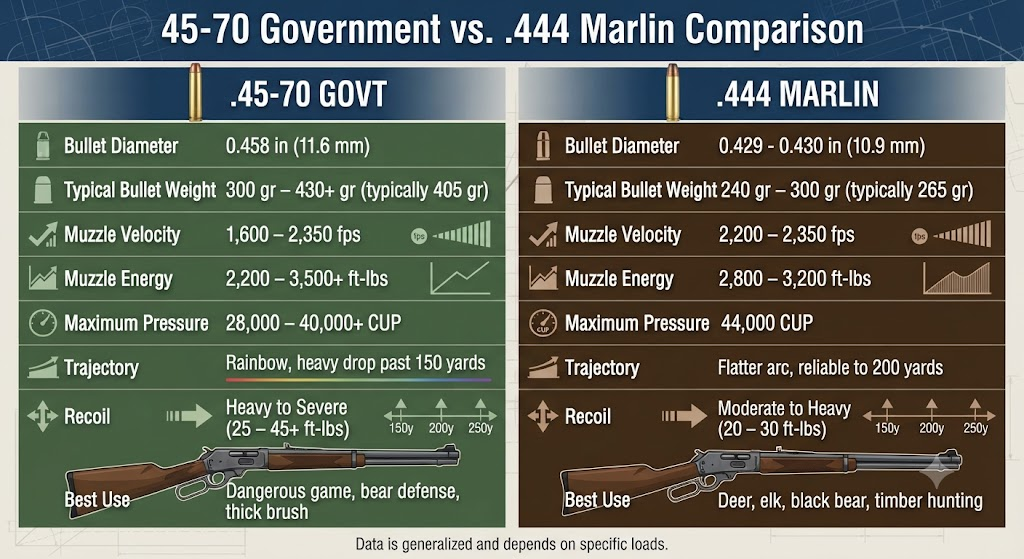
The table above outlines the foundational differences between two of the most legendary big-bore lever-action cartridges in American firearms history. Understanding the nuances of 45/70 vs 444 Marlin requires looking beyond the raw data and examining the history, firearm platforms, and bullet technology that define each round.
The .45-70 Government is a piece of living history. Adopted by the U.S. Military in 1873 for the Springfield Trapdoor rifle, it was originally a black powder cartridge designed to fire a 405-grain lead bullet over 70 grains of black powder. For over 150 years, the cartridge has refused to die. In recent decades, advancements in metallurgy and the popularity of robust lever-action rifles, such as the Marlin 1895 and Winchester 1886, have allowed ammunition manufacturers to load the .45-70 to pressures that were previously unimaginable, turning it into one of the premier dangerous game cartridges on the planet.
The .444 Marlin, introduced in 1964, was designed to fill a specific void. At the time, the .45-70 was suffering a period of declining popularity, and the legendary .348 Winchester had been discontinued. Marlin Firearms teamed up with Remington to create a new big-bore cartridge for the Marlin 336 lever-action platform. By essentially lengthening a .44 Magnum case and tapering it slightly, they created the .444 Marlin. Operating at a substantially higher SAAMI maximum pressure out of the gate, the .444 Marlin was billed as the ultimate modern brush gun, capable of delivering crushing energy on deer, black bear, and elk without the severe arcing trajectory of older black powder cartridges.
45/70 vs 444 Marlin Ballistics
To objectively evaluate the 45/70 vs 444 Marlin ballistics, we must examine real-world factory ammunition across their most common hunting and defensive applications. A critical factor in comparing these two rounds is understanding how they interact with lever-action rifles. Lever-action rifles with tubular magazines necessitate the use of flat-nose, round-nose, or modern polymer-tipped bullets (like Hornady’s LEVERevolution) to prevent the tip of one bullet from igniting the primer of the cartridge in front of it under heavy recoil.
Furthermore, the .45-70 exists in three distinct pressure tiers due to the vast age range of firearms chambered for it:
- Trapdoor Loads (Safe for original 1873 rifles, limited to 28,000 CUP or lower).
- Lever Action / Standard Loads (Safe for modern Marlin 1895s and Winchester 1886s, often loaded up to 40,000 CUP).
- Modern Single Shot / Ruger No. 1 Loads (Extreme high-pressure loads exceeding 50,000 CUP, dangerous in older lever guns).
The .444 Marlin does not have this historical baggage. All factory .444 Marlin ammunition is loaded to operate safely within modern lever-action rifles at a maximum pressure of 44,000 CUP.
To provide a fair and highly researched comparison, we will examine premium hunting loads fired from standard 22-inch to 24-inch test barrels, focusing on modern lever-action-safe ammunition.
- Load A (.45-70 Govt): Hornady 325-grain LEVERevolution FTX. Tested from a 24-inch barrel: Muzzle Velocity = 2,050 fps, Muzzle Energy = 3,032 ft-lbs, Ballistic Coefficient (G1) = 0.230.
- Load B (.45-70 Govt): Buffalo Bore 430-grain Hard Cast Lead Flat Nose (Magnum Lever Action). Tested from a 22-inch barrel: Muzzle Velocity = 1,925 fps, Muzzle Energy = 3,537 ft-lbs.
- Load C (.444 Marlin): Hornady 265-grain LEVERevolution FTX. Tested from a 24-inch barrel: Muzzle Velocity = 2,325 fps, Muzzle Energy = 3,180 ft-lbs, Ballistic Coefficient (G1) = 0.225.
- Load D (.444 Marlin): Buffalo Bore 335-grain Hard Cast Lead Flat Nose. Tested from a 22-inch barrel: Muzzle Velocity = 2,025 fps, Muzzle Energy = 3,050 ft-lbs.
Manufacturer-rated data is generally captured under controlled atmospheric conditions using standardized universal receiver barrels. Real-world velocities measured via chronograph will vary slightly depending on your specific firearm’s chamber tolerances, barrel wear, and environmental temperature.
45/70 vs 444 Marlin Velocity
Velocity determines how flat a projectile shoots and influences how quickly expanding bullets open upon impacting soft tissue. Because the 45/70 and the .444 Marlin utilize vastly different bullet weights, their velocity outputs represent two different philosophies of terminal ballistics.
The 45/70 vs 444 Marlin velocity comparison leans in favor of the .444 Marlin for standard factory hunting loads. Because the .444 Marlin utilizes lighter bullets—typically ranging from 240 grains to 265 grains—it can achieve significantly higher initial muzzle velocities from a 24-inch barrel. Standard 240-grain soft point loads easily push past 2,300 fps, and Hornady’s 265-grain FTX reaches 2,325 fps. This higher velocity gives the .444 Marlin a flatter trajectory, requiring less holdover calculation for hunters engaging game at intermediate distances.
The .45-70 Government is handicapped by the immense weight of its projectiles. A standard 300-grain jacketed hollow point from a modern factory load generally travels at roughly 1,800 to 1,900 fps. Hornady’s innovative 325-grain LEVERevolution pushes this to 2,050 fps by utilizing advanced proprietary powders. However, when hunters opt for the truly heavy 400-grain to 430-grain hard cast loads necessary for stopping a charging grizzly bear, velocities typically drop to between 1,600 fps and 1,900 fps, depending on the pressure rating of the ammunition.
45/70 vs 444 Marlin Muzzle Energy
Muzzle energy represents the kinetic work capacity of a projectile. Because velocity plays a disproportionately large role in generating kinetic energy, the lighter, faster .444 Marlin competes fiercely with the heavier, slower .45-70 on paper.
Looking at the 45/70 vs 444 Marlin energy figures, we see a remarkably tight race in standard commercial ammunition. Hornady’s 265-grain .444 Marlin load generates a devastating 3,180 ft-lbs of muzzle energy, outperforming their 325-grain .45-70 load, which generates 3,032 ft-lbs. For the hunter purchasing standard ammunition off the shelf at a local sporting goods store, the .444 Marlin actually delivers a higher kinetic energy yield.
However, the ceiling for muzzle energy is ultimately higher with the .45-70 due to the sheer internal volume of its brass case and its ability to chamber massive bullets in high-pressure custom loads. Boutique ammunition manufacturers like Buffalo Bore, Underwood, and Garrett Cartridges produce .45-70 +P magnum loads that push 430-grain bullets at speeds that generate over 3,500 ft-lbs of muzzle energy, firmly eclipsing the maximum output of the .444 Marlin. It must be reiterated that these extreme energy loads are strictly limited to modern, heavy-duty lever actions like the Marlin 1895.
45/70 vs 444 Marlin Momentum
Momentum is a linear measurement of mass in motion. While kinetic energy is heavily biased toward velocity, momentum gives equal weight to bullet mass. In the realm of big-bore brush guns and dangerous game hunting, high momentum correlates directly with a bullet’s ability to crush through dense muscle, shatter heavy shoulder bones, and maintain straight-line penetration through intermediate barriers like thick brush or bone.
This is where the 45/70 vs 444 Marlin comparison separates. The .45-70 is the undisputed king of momentum among standard lever-action cartridges.
A heavy 430-grain .45-70 bullet traveling at 1,925 fps yields massive linear momentum, essentially turning the projectile into a freight train that refuses to stop regardless of what it hits. A .444 Marlin firing a 265-grain bullet at 2,325 fps yields significantly less momentum, despite having slightly higher kinetic energy.
This momentum advantage is the primary reason professional guides in Alaska and Africa overwhelmingly prefer the .45-70 for dangerous game defense. When stopping a 1,000-pound brown bear, kinetic energy dispersed on the surface is less important than the sheer momentum required to drive a hard cast lead bullet through three feet of dense muscle and bone to reach the central nervous system.
45/70 vs 444 Marlin Trajectory
Lever-action rifles chambering large, blunt-nosed bullets are not precision sniper platforms; they possess what is commonly referred to as a “rainbow trajectory.” However, within practical hunting distances, understanding bullet drop is critical.
Calculations below assume a standard scope sight height of 1.5 inches above the bore and a zero distance of 100 yards, which is standard for heavy brush hunting.
| Distance | .45-70 (325 gr FTX at 2,050 fps) Drop | .444 Marlin (265 gr FTX at 2,325 fps) Drop |
| Muzzle | -1.5 inches | -1.5 inches |
| 50 Yards | +0.6 inches | +0.4 inches |
| 100 Yards | 0.0 inches (Zero) | 0.0 inches (Zero) |
| 150 Yards | -3.1 inches | -1.8 inches |
| 200 Yards | -9.6 inches | -5.7 inches |
| 250 Yards | -20.5 inches | -12.4 inches |
| 300 Yards | -36.8 inches | -22.5 inches |
The aerodynamic superiority of the .444 Marlin is clearly demonstrated here. Because it pushes a lighter bullet faster, it shoots noticeably flatter. At 200 yards, the .444 Marlin drops just under 6 inches, allowing a hunter to aim at the top edge of a deer’s vitals and make a clean kill without extensive holdover calculations. The .45-70 drops nearly 10 inches at the same distance, demanding a much more precise knowledge of ballistics and range estimation to ensure an ethical hit.
If your hunting environment occasionally presents shots across clearings or canyons stretching out to 200 or 250 yards, the flatter trajectory of the .444 Marlin provides a distinct ballistic advantage.
45/70 vs 444 Marlin Recoil
Recoil is governed by the conservation of momentum. It is heavily influenced by the weight of the rifle, the mass of the powder charge, the weight of the bullet, and the design of the rifle’s stock (straight grip vs. pistol grip).
Both of these cartridges are punishing to shoot from lightweight rifles. When evaluating 45/70 vs 444 Marlin recoil, both cartridges generate enough free recoil energy to bruise shoulders and induce severe shooter flinch if proper fundamentals are not applied.
Fired from a standard 7.5-pound Marlin 1895 lever-action rifle, a standard 300-grain .45-70 hunting load generates roughly 25 foot-pounds of free recoil. However, when stepping up to modern, heavy magnum loads (such as a 405-grain or 430-grain bullet traveling at 1,900 fps), the recoil skyrockets to an agonizing 35 to 45 foot-pounds of free recoil energy. This places the heavy .45-70 squarely in the recoil category of elephant guns, delivering a violent, heavy shove that requires a firm stance and high tolerance for pain.
The .444 Marlin, fired from a similar 7.5-pound rifle, generates roughly 23 to 28 foot-pounds of free recoil energy depending on the specific load. While still a heavy-kicking rifle, it is generally considered slightly more manageable than a fully loaded .45-70, providing a quicker recovery time for a second shot if needed.
45/70 vs 444 Marlin Penetration
Terminal penetration is the true hallmark of big-bore lever-action cartridges. In heavy timber and dense brush, hunters demand a bullet that can punch through shoulder blades, track straight through the vitals, and leave a massive exit wound to facilitate a clear blood trail.
The .45-70 is globally famous for its 45/70 vs 444 marlin penetration characteristics. When loaded with wide, flat-nosed hard cast lead bullets weighing 400 grains or more, the .45-70 is capable of completely passing through a bison or penetrating end-to-end on heavy bears. The massive sectional density and extreme momentum prevent the bullet from deflecting upon striking heavy bone. It acts like an industrial punch press.
The .444 Marlin possesses a slightly complicated history regarding penetration. When it was initially released in the 1960s, ammunition manufacturers simply loaded 240-grain .44 Magnum pistol bullets into the massive rifle case. While these lightweight pistol bullets performed well at 1,400 fps from a revolver, pushing them past 2,300 fps from a rifle caused them to explode violently upon hitting the surface of an animal, resulting in shallow penetration and lost game.
Today, this issue has been entirely resolved. Modern .444 Marlin ammunition utilizes heavily jacketed, rifle-specific 265-grain to 300-grain bullets designed specifically to withstand high-velocity impacts. When using appropriate modern ammunition, the .444 Marlin delivers excellent penetration on elk, moose, and bear, reliably reaching 20 to 28 inches in ballistic gelatin and easily passing through both shoulders of a deer. However, for maximum penetration on the largest dangerous game, the 400+ grain bullets of the .45-70 remain supreme.
45/70 vs 444 Marlin Expansion
Bullet expansion dictates the diameter of the permanent wound channel, increasing the likelihood of severing major arteries and causing rapid incapacitation through blood loss.
When evaluating 45/70 vs 444 marlin expansion, it is crucial to understand that these cartridges often rely on wide meplats (flat noses) rather than extreme hollow-point expansion to cause tissue damage. A hard cast .45-70 bullet with a massive flat nose acts like a flying sledgehammer, permanently crushing a half-inch hole straight through an animal without ever physically expanding.
When using expanding ammunition, such as jacketed hollow points or polymer-tipped FTX bullets, both cartridges perform devastatingly well. Starting at 0.458 inches, a premium .45-70 bullet can expand to over 0.80 inches, creating a massive, ragged wound channel. The .444 Marlin, starting at 0.429 inches, easily expands to 0.70 inches or more. Both cartridges cause catastrophic tissue destruction well beyond what is required to humanely harvest North American big game.
45/70 vs 444 Marlin Effective Range
The effective range of a cartridge is determined by the intersection of three factors: the distance at which the bullet drops so far that aiming becomes guesswork, the distance at which the bullet sheds too much velocity to reliably expand, and the mechanical accuracy of the rifle platform.
The 45/70 vs 444 marlin effective range comparison clearly highlights their roles as specialized short-to-medium range tools.
The .45-70 is highly effective within 150 yards. Beyond 150 yards, the massive bullet begins to drop rapidly, requiring exact rangefinding and holdover compensation. While capable marksmen regularly ring steel plates at 500 yards with a .45-70 using heavy arcing shots, taking an ethical shot on a live animal past 200 yards with a .45-70 is generally discouraged for all but the most experienced shooters.
The .444 Marlin extends this practical hunting range. Thanks to its higher initial velocity and lighter bullet weight, it maintains a much flatter trajectory out to 200 yards and retains enough kinetic energy to confidently harvest game at 250 yards. If your hunting grounds consist of dense woods breaking out into long logging roads or clear-cuts, the extra 50 to 100 yards of reliable reach provided by the .444 Marlin is a substantial benefit.
45/70 vs 444 Marlin Self Defense
When discussing self defense with big-bore lever-action rifles, the conversation typically revolves around protection from large predators rather than urban home defense.
For bear defense, the .45-70 is the undisputed champion. A short-barreled “Guide Gun” chambered in .45-70 and loaded with 430-grain hard cast lead ammunition is considered by many Alaskan guides to be the ultimate insurance policy against charging coastal brown bears. The immense momentum and bone-crushing capabilities of the cartridge can stop an aggressive predator in its tracks, even if the shot placement is slightly off-center.
The .444 Marlin is also an exceptional bear defense cartridge when loaded with heavy 300-grain or 335-grain hard cast bullets. It will reliably handle black bear, moose, and mountain lions. However, its lower maximum bullet weight puts it slightly behind the .45-70 when facing the absolute largest predators on the continent.
For urban home defense against human threats, both cartridges are heavily overpowered. The extreme kinetic energy and mass of these bullets present a severe over-penetration risk, easily passing through an intruder, multiple interior walls, and potentially exiting the structure entirely. Furthermore, the manual lever-action cycling process is slower and more prone to user-induced malfunctions under extreme stress compared to modern semi-automatic platforms like the AR-15.
45/70 vs 444 Marlin Concealed Carry
Concealed carry with either the .45-70 or the .444 Marlin is impossible and entirely impractical. Both of these cartridges are strictly rifle cartridges chambered in large, heavy lever-action or single-shot firearms. While there are a few novelty single-shot pistols (like the Thompson/Center Contender) or massive novelty revolvers (like the Magnum Research BFR) chambered in .45-70, these handguns weigh several pounds and feature barrel lengths exceeding 7 to 10 inches. They cannot be concealed on the body in any practical daily carry holster. Their appropriate carry method involves a slung rifle, a vehicle rack, or a horse scabbard in the backcountry.
Which Has More Stopping Power: 45/70 or 444 Marlin?
Stopping power is not a single scientifically established metric; rather, it is a combination of momentum, kinetic energy transfer, permanent wound cavity diameter, and penetration depth that leads to rapid physiological incapacitation.
In the 45/70 vs 444 marlin stopping power debate, the .45-70 Government holds the clear advantage on large, heavily muscled game. The ability of the .45-70 to utilize massive 400+ grain bullets provides a level of bone-shattering momentum that lighter, faster bullets simply cannot replicate. When stopping power is defined as the ability to anchor a massive animal immediately without tracking, the heavy mass and wide frontal area of the .45-70 make it the supreme choice.
On smaller, lighter-skinned game like whitetail deer or feral hogs, the higher velocity and rapid expansion of the .444 Marlin provide equally devastating stopping power, often dropping the animal instantaneously via severe hydrostatic shock.
Which Is More Powerful: 45/70 or 444 Marlin?
Power is defined quantitatively by kinetic energy and linear momentum.
In terms of standard factory ammunition sold at commercial sporting goods stores, the .444 Marlin actually generates slightly more muzzle kinetic energy due to its high velocity.
However, in terms of maximum potential power, the .45-70 Government is vastly superior. When handloaded or purchased from boutique magnum ammunition manufacturers (and fired from modern, high-strength rifles), the .45-70 can easily exceed 3,500 ft-lbs of kinetic energy and generates significantly higher momentum due to its extreme bullet weights.
45/70 Pros and Cons
Pros
- Immense momentum and penetration capable of taking the largest dangerous game in the world
- Massive modern resurgence means widespread availability of rifles, ammunition, and reloading components
- Incredible versatility; can be loaded with light 300-grain hollow points for deer or massive 430-grain cast solids for bear
- Straight-wall cartridge design makes it legal for deer hunting in many states with restrictive caliber laws
- Subsonic heavy loads are exceptionally effective when paired with a rifle suppressor
Cons
- Severe rainbow trajectory makes long-range hits past 150 yards extremely difficult
- Punishing, painful recoil when utilizing heavy hunting loads
- Historical trapdoor pressure limits require careful attention when buying ammunition to ensure you do not buy weak, low-pressure loads by mistake, or conversely, put magnum loads in antique rifles
444 Marlin Pros and Cons
Pros
- Excellent velocity yields a much flatter trajectory, extending the ethical hunting range out to 200–250 yards
- Devastating kinetic energy delivery on deer, elk, and black bear
- Modern 1-in-20 inch twist rate barrels perfectly stabilize heavy 300+ grain hunting bullets
- Noticeably lighter recoil impulse than a fully loaded magnum .45-70
Cons
- Ammunition is often seasonal, expensive, and can be difficult to find on local retail shelves
- Smaller bullet diameter and lighter maximum bullet weights make it slightly less optimal for the absolute largest dangerous game
- Early historical reputation suffered due to the use of fragile pistol bullets, though this is no longer an issue with modern ammo
Final Comparison
| Category | Winner | Reason |
| Velocity | .444 Marlin | Lighter bullet weights allow for speeds exceeding 2,300 fps |
| Muzzle Energy | Tie | .444 wins in standard factory ammo; .45-70 wins in custom magnum loads |
| Momentum | .45-70 Govt | 400+ grain bullets carry immense linear driving mass |
| Penetration | .45-70 Govt | High mass and wide cast profiles shatter heavy shoulder bones |
| Expansion | Tie | Both expand massively depending on modern bullet selection |
| Trajectory | .444 Marlin | Higher velocity creates a significantly flatter arc out to 200+ yards |
| Bullet Drop (200 yds) | .444 Marlin | Drops roughly 6 inches vs nearly 10 inches for the .45-70 |
| Recoil | .444 Marlin | Generates noticeably less free recoil energy than heavy .45-70 loads |
| Effective Range | .444 Marlin | Flatter trajectory confidently extends ethical shots out to 250 yards |
| Self Defense (Bear) | .45-70 Govt | The absolute gold standard for stopping charging heavy predators |
| Concealed Carry | Neither | Both are massive rifle cartridges entirely unsuitable for concealed carry |
| Ammo Cost | .45-70 Govt | Extreme popularity has lowered relative cost and increased bulk options |
| Ammo Availability | .45-70 Govt | Found in almost every gun shop globally due to modern popularity |
| Overall Performance | Depends on Load | .45-70 for heavy brush and big bears; .444 Marlin for extended range on deer/elk |
45/70 vs 444 Marlin: Which Should You Choose?
Selecting between the .45-70 Government and the .444 Marlin requires an honest assessment of your hunting environment, the size of the game you pursue, and your local ammunition logistics.
Choose the .45-70 Government if you are hunting in thick, dense timber where shots rarely exceed 100 yards, you need maximum bone-crushing momentum for dangerous predators like grizzly bears or moose, or you live in a state that requires straight-wall cartridges for hunting. Its massive popularity guarantees you will always find a wide variety of ammunition and rifle platforms available.
Choose the .444 Marlin if your big-bore hunting environment occasionally presents longer shots across clearings or logging roads out to 200 yards, you primarily hunt deer, black bear, or elk, and you prefer a flatter-shooting cartridge with slightly more manageable recoil. If you reload your own ammunition to ensure supply, the .444 Marlin is an exceptionally well-balanced, fast-hitting lever-action cartridge.
FAQs
Is 45/70 more powerful than 444 Marlin?
In terms of standard factory ammunition found at retail stores, the .444 Marlin often has slightly higher kinetic energy. However, the .45-70 can be loaded to much higher power levels (exceeding 3,500 ft-lbs) in modern rifles and generates vastly more momentum.
Which has more muzzle energy?
The .444 Marlin typically generates around 3,100 to 3,200 ft-lbs with standard loads. Standard pressure .45-70 generates around 2,500 ft-lbs, but modern high-pressure lever-action .45-70 loads easily surpass 3,500 ft-lbs.
Which has more stopping power?
For deer and medium game, both offer devastating, instantaneous stopping power. For massively heavily muscled animals like grizzly bears or bison, the heavy 400+ grain bullets of the .45-70 provide superior bone-shattering stopping power.
Which has more recoil?
The .45-70 Government, when loaded with heavy 400-grain or 430-grain magnum hunting loads, produces substantially more recoil than the .444 Marlin, often reaching 35 to 45 foot-pounds of free recoil energy.
Which has better penetration?
The .45-70 has better penetration on heavy game. Its extreme bullet mass allows hard cast lead bullets to punch through dense muscle, thick bone, and cartilage without deflecting or losing momentum.
Which expands more?
Both cartridges expand massively when utilizing modern jacketed hollow points or polymer-tipped FTX bullets. Because the .45-70 starts at a larger diameter (0.458 vs 0.429 inches), it generally creates a wider final expanded profile.
Which has a flatter trajectory?
The .444 Marlin has a significantly flatter trajectory. Because it fires lighter bullets at higher velocities, it drops much less over 200 yards, making intermediate-range shots easier to execute.
Which is better for self defense?
For home defense, both are severe over-penetration risks. For wilderness defense against dangerous predators, the .45-70 Government is universally recognized as the superior choice due to its massive momentum.
Which is better for concealed carry?
Neither. Both are large centerfire rifle cartridges fired from long, heavy rifles.
Is 45/70 faster than 444 Marlin?
No. The .444 Marlin is faster. It typically drives a 265-grain bullet at over 2,300 fps, whereas modern .45-70 loads generally drive 300 to 325-grain bullets at 1,800 to 2,050 fps.
Is 444 Marlin stronger than 45/70?
The .444 Marlin operates at a higher standard SAAMI pressure (44,000 CUP) compared to the standard pressure of the .45-70 (28,000 CUP). However, modern lever-action rifles allow the .45-70 to be loaded much hotter, making it physically stronger in terms of impact mass.
Which is cheaper to shoot?
The .45-70 is generally cheaper and easier to shoot due to its massive resurgence in popularity. Major manufacturers produce bulk lines of .45-70, while .444 Marlin is often relegated to limited, expensive seasonal production runs.
Which has better ballistics?
The .444 Marlin features better aerodynamic external ballistics (flatter trajectory, higher velocity). The .45-70 features better terminal ballistics on heavy dangerous game (deeper penetration, massive momentum).
Which is easier to shoot?
The .444 Marlin is slightly easier to shoot due to its lighter recoil impulse compared to fully loaded magnum .45-70 ammunition. However, standard-pressure “Trapdoor” .45-70 loads are very mild and pleasant to shoot at the range.
Which should you choose?
Choose the .45-70 for thick brush, dangerous game, and widespread ammunition availability. Choose the .444 Marlin for a flatter trajectory, longer effective range, and excellent deer and elk performance.