The main difference between .22 WRF and .22 Magnum is that the .22 Magnum features a lengthened case and operates at significantly higher pressures, yielding much greater velocity, energy, and effective range. While the older .22 Winchester Rimfire was historically a popular upgrade over standard rimfire options, the .22 Winchester Magnum Rimfire eventually eclipsed it in both terminal performance and commercial availability. Understanding the specific ballistic disparities between these two distinct cartridges helps shooters select the appropriate ammunition for small game hunting, target shooting, and varmint control. This article compares their actual ballistic performance, cost, availability, and practical uses to provide a comprehensive evaluation for modern firearm owners.
22 WRF vs 22 Magnum Comparison
| Feature | .22 WRF | .22 Magnum |
| Bullet Diameter | .224 to .2285 inches | .224 inches |
| Case Length | 0.965 inches | 1.055 inches |
| Overall Length | 1.180 inches | 1.350 inches |
| Typical Bullet Weight | 45 grains | 30 to 50 grains |
| Muzzle Velocity | 1,300 feet per second | 1,875 to 2,200 feet per second |
| Muzzle Energy | 169 foot pounds | 312 to 352 foot pounds |
| Momentum | Low | Moderate |
| Ballistic Coefficient | 0.120 | 0.085 to 0.135 |
| Effective Range | 75 yards | 125 yards |
| Bullet Drop | Substantial | Moderate |
| Recoil | Very Low | Low |
| Penetration | Moderate | High |
| Expansion | Moderate | Reliable |
| Ammunition Availability | Limited | High |
| Ammo Cost | High | Moderate |
| Best Use | Vintage plinking and small game | Varmint hunting and modern small game |
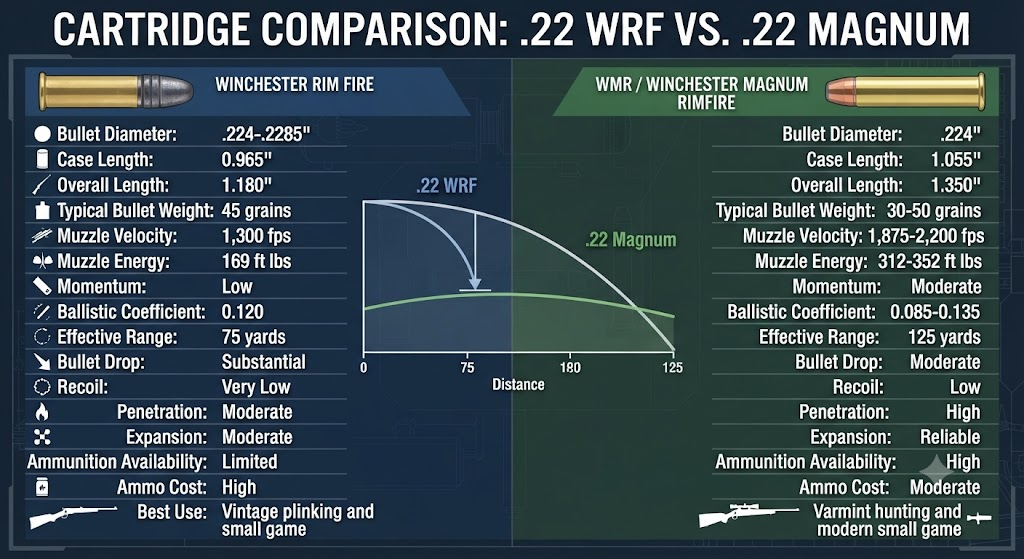
The table above illustrates the distinct physical and performance differences between the two cartridges. The older .22 Winchester Rimfire features a shorter case length of 0.965 inches compared to the 1.055 inch case of the .22 Winchester Magnum Rimfire. This dimensional difference translates directly into internal powder capacity. Because the magnum case holds more modern smokeless powder, it generates much higher chamber pressures. The standard pressure limit for the older cartridge is 19,000 pounds per square inch. The magnum cartridge operates at up to 24,000 pounds per square inch.
This pressure difference defines the ballistic capabilities of each round. The older cartridge typically fires a heavier 45 grain bullet at a modest 1,300 feet per second, yielding 169 foot pounds of kinetic energy at the muzzle.The magnum case pushes lighter 30 to 40 grain bullets at blistering speeds between 1,875 and 2,200 feet per second, generating over 300 foot pounds of energy. Consequently, the magnum option offers a flatter trajectory, deeper penetration, and a considerably longer effective range. While the older round remains a niche option for vintage firearm collectors and short range small game hunters, the modern magnum has become the standard for serious rimfire varmint control.
22 WRF vs 22 Magnum Ballistics
When evaluating 22 WRF vs 22 Magnum ballistics, one must look at how each cartridge behaves from the moment the primer ignites to the moment the bullet strikes the target. Internal ballistics dictate that the larger magnum case burns a heavier charge of slow burning pistol powder, maximizing the velocity achievable in a standard 24 inch rifle barrel. The older cartridge burns a smaller powder charge optimized for lower pressures, which is necessary to keep vintage, soft steel firearm barrels safe from catastrophic failure.
External ballistics heavily favor the magnum cartridge. A projectile traveling at over 2,000 feet per second slices through the air with far less gravitational drop and wind deflection than a bullet traveling at 1,300 feet per second. This means the magnum shooter does not have to apply extreme holdover corrections when aiming at small targets at intermediate distances.
Terminal ballistics define how the bullet behaves upon impact. The older rimfire utilizes a flat nosed or lightly hollowed projectile that expands modestly at lower speeds, transferring energy slowly. The magnum cartridge utilizes advanced jacketed hollow points and polymer tipped projectiles that expand violently upon impact due to high striking velocities. This extreme expansion creates a devastating wound channel, making the magnum highly efficient at stopping medium sized varmints in their tracks.
22 WRF vs 22 Magnum Velocity
Velocity is the most critical factor separating these two rimfire choices. The 22 WRF vs 22 Magnum velocity debate showcases the massive leap in technology that occurred between the late nineteenth century and the mid twentieth century.
Current factory data from CCI shows their standard 45 grain jacketed hollow point for the older cartridge leaves a 24 inch rifle barrel at 1,300 feet per second. Historically, some high velocity loads pushed this to 1,450 feet per second, but modern manufacturers maintain the 1,300 feet per second standard to ensure safe operation in antique slide action rifles.
The magnum cartridge exists in a completely different velocity tier. Independent testing and manufacturer data for the highly popular CCI Maxi Mag 40 grain jacketed hollow point shows a muzzle velocity of 1,875 feet per second from a 24 inch barrel. Lighter projectiles push the boundaries of rimfire speed even further. The Hornady Varmint Express 30 grain V-MAX load reaches a blistering 2,200 feet per second at the muzzle. This extreme speed provides a much flatter flight path and dramatically reduces the time it takes for the projectile to reach the target, minimizing the chance of an animal moving before the bullet strikes.
22 WRF vs 22 Magnum Muzzle Energy
Kinetic energy dictates the stopping power of a hunting cartridge. A look at 22 WRF vs 22 Magnum energy reveals that the magnum cartridge delivers nearly double the striking force of its predecessor.
The standard CCI 45 grain hollow point load for the older cartridge produces 169 foot pounds of energy at the muzzle. By the time the bullet reaches 50 yards, that energy drops to approximately 115 foot pounds due to aerodynamic drag. At 100 yards, the energy falls below 85 foot pounds, making it ethically marginal for anything larger than a squirrel.
In stark contrast, the .22 Magnum is a powerhouse among rimfire rounds. The CCI Maxi Mag 40 grain load generates an impressive 312 foot pounds of muzzle energy. At 50 yards, this load still carries 221 foot pounds of energy, which is more power than the older cartridge possesses at the muzzle.Even at 100 yards, the magnum retains 156 foot pounds of striking force. This sustained energy retention allows the magnum to anchor tough animals like coyotes and bobcats cleanly at distances where the older cartridge would merely wound them.
22 WRF vs 22 Magnum Trajectory
Trajectory refers to the arched path the bullet takes as gravity pulls it toward the earth. The 22 WRF vs 22 Magnum trajectory comparison highlights the severe limitations of slower projectiles.
Because the older rimfire travels at 1,300 feet per second, it spends more time in the air, allowing gravity to pull it downward at a steeper angle. If a shooter zeroes a rifle chambered for the older cartridge at 50 yards, the bullet path arches gently above the line of sight, strikes the center of the target at 50 yards, and then plunges rapidly. Hitting a small target at 100 yards requires the shooter to aim several inches high.
The magnum cartridge flies significantly flatter. The high velocity of 1,875 to 2,200 feet per second means the bullet reaches the target much faster. A shooter can confidently zero a magnum rifle at 100 yards. The bullet will rise roughly one inch above the line of sight at mid range distances and drop back to the zero point exactly at 100 yards. This flat trajectory removes the guesswork from field shooting, allowing hunters to aim dead center on small game at any distance between 15 and 100 yards.
22 WRF vs 22 Magnum Bullet Drop
To quantify the 22 WRF vs 22 Magnum bullet drop, we must examine specific ballistics tables for both cartridges fired from 24 inch test barrels.
For the magnum cartridge, utilizing the widely used CCI Maxi Mag 40 grain jacketed hollow point with a 100 yard zero and a sight height of 1.5 inches above the bore, the independent ballistic data is remarkable:
- 25 Yards: +0.1 inches
- 50 Yards: +1.0 inches
- 75 Yards: +0.8 inches
- 100 Yards: 0.0 inches
- 125 Yards: -2.3 inches
This data proves that a hunter can hold dead center on a small target out to 110 yards without worrying about drop.
For the older cartridge, utilizing the CCI 45 grain hollow point at 1,300 feet per second, shooters typically use a 50 yard zero due to the rapid deceleration of the heavy bullet. With a sight height of 1.5 inches and a 50 yard zero, standard ballistic modeling reveals a much steeper drop profile:
- 25 Yards: +0.2 inches
- 50 Yards: 0.0 inches
- 75 Yards: -2.5 inches
- 100 Yards: -6.5 inches
- 125 Yards: -13.0 inches
This severe drop at 100 yards explains why the older cartridge is rarely used past 75 yards. Judging exactly 6.5 inches of holdover in the field on a tiny target is incredibly difficult for even the most experienced marksmen.
22 WRF vs 22 Magnum Recoil
Rimfire cartridges are beloved for their gentle shooting characteristics. In the 22 WRF vs 22 Magnum recoil discussion, both rounds fall into the category of exceptionally mild recoil, making them perfect for training new shooters or for extended range sessions.
The older rimfire cartridge produces virtually no felt recoil. Firing a 45 grain bullet at 1,300 feet per second out of a standard six pound pump action rifle generates less than a half pound of recoil energy. The sensation is often compared to the soft pop of a standard velocity target round, accompanied by a very mild report.
The magnum cartridge burns more powder and generates higher pressure, which inherently creates more recoil. Firing a 40 grain bullet at 1,875 feet per second out of the same six pound rifle generates roughly double the recoil energy of the older cartridge. However, double of a negligible amount is still negligible. The magnum produces less than one foot pound of recoil energy, which is completely painless for shooters of all ages. The most noticeable difference is not the physical push into the shoulder, but rather the sharp, loud crack of the magnum muzzle blast.
22 WRF vs 22 Magnum Penetration
Penetration capabilities dictate what size game a cartridge can ethically take. The 22 WRF vs 22 Magnum penetration tests reveal completely different terminal philosophies.
The older cartridge utilizes a heavy, 45 grain projectile. Modern offerings like the CCI load use a jacketed hollow point, but because the impact velocity is relatively low at typical hunting distances, the hollow point often exhibits limited expansion. This lack of rapid expansion means the bullet retains its weight and shape, driving moderately deep into soft tissue. This moderate, controlled penetration is highly desirable for small game hunters who wish to harvest rabbits and squirrels without destroying the edible meat.
The magnum cartridge utilizes highly engineered jacketed hollow points and polymer tips designed for violent fragmentation. When a 30 grain polymer tipped magnum bullet strikes a target at 2,000 feet per second, the tip drives backward into the lead core, forcing the copper jacket to peel open instantly. This causes immense trauma and dumps the kinetic energy very quickly. However, for deeper penetration on tougher animals like coyotes, manufacturers offer 40 grain total metal jacket loads. These non expanding bullets use the magnum velocity to drive incredibly deep through thick hide and bone, ensuring vital organ penetration from difficult angles.
22 WRF vs 22 Magnum Hunting
Choosing between these cartridges for field use depends entirely on the size of the target. When comparing 22 WRF vs 22 Magnum hunting applications, hunters must balance meat preservation against knockdown power.
The older rimfire cartridge is a superb small game round. If you are hunting squirrels, rabbits, or grouse in dense timber where shots rarely exceed 50 yards, this cartridge excels. It delivers more initial shocking power than a standard rimfire but travels slowly enough that it does not cause hydrostatic shock or massive tissue tearing. A well placed shot yields a clean harvest while leaving the meat perfectly intact for the dinner table.
The magnum cartridge is generally considered too destructive for small, edible game unless the hunter takes extreme care to only shoot for the head. Instead, the magnum is an elite varmint hunting cartridge. It provides the terminal performance necessary to cleanly dispatch groundhogs, prairie dogs, foxes, raccoons, and coyotes. The explosive impact of the high velocity hollow points ensures that tough predators do not escape into their dens after being hit.
22 WRF vs 22 Magnum Effective Range
Effective range is determined by a combination of remaining kinetic energy, bullet drop, and reliable bullet expansion. The 22 WRF vs 22 Magnum effective range comparison heavily favors the modern cartridge.
The older rimfire is strictly a short range tool. Beyond 75 yards, the bullet drop becomes too severe to reliably place rounds on a target the size of a golf ball. Furthermore, the velocity drops below the threshold required for the hollow point to open up, reducing its terminal effectiveness. Most knowledgeable hunters limit their shots with this cartridge to a maximum of 75 yards.
The magnum cartridge extends the rimfire hunting horizon significantly. Thanks to its high ballistic coefficient and extreme muzzle velocity, it remains supersonic and retains enough energy to initiate reliable expansion out to 125 yards. Shooters utilizing precision optics and premium ammunition can even stretch the effective range to 150 yards on smaller pests, making it a highly capable tool for open pasture varmint control.
22 WRF vs 22 Magnum Ammo Cost and Availability
Practical ownership of any firearm relies on a steady supply of ammunition. The economic reality of 22 WRF vs 22 Magnum ammo cost heavily influences cartridge selection today.
The older cartridge is technically obsolete. While millions of vintage slide action rifles remain in circulation, very few manufacturers still produce the ammunition. CCI and Winchester occasionally run seasonal batches of the ammunition to satisfy collectors, but it is rarely found on local sporting goods store shelves. When it can be located online, the limited production runs drive the price up significantly, making it an expensive option for casual afternoon plinking.
The magnum cartridge is a global commercial success. Every major ammunition manufacturer produces millions of rounds annually. Shooters can find magnum rimfire ammunition in virtually every hardware store, gun shop, and online retailer. Because of the massive economy of scale, the magnum ammunition is moderately priced. While it costs more than standard rimfire target loads, it remains significantly cheaper than centerfire rifle ammunition, allowing shooters to practice extensively without breaking their budgets.
Which Is More Powerful: 22 WRF or 22 Magnum?
There is no debate regarding the power differential between these two cartridges. The .22 Magnum is vastly more powerful than the .22 WRF.
Power in ballistics is measured in kinetic energy, which relies heavily on velocity. Because the magnum case is ten percent longer and built to handle substantially higher chamber pressures, it pushes projectiles at speeds the older cartridge cannot safely achieve. Generating up to 350 foot pounds of muzzle energy with specific lightweight high velocity loads, the magnum produces nearly twice the raw striking power of its predecessor.
This immense power advantage translates directly into real world performance. The magnum shoots flatter, hits harder, expands more reliably, and extends the ethical hunting range by a full fifty yards over the vintage cartridge.
Historical Context
To truly appreciate both cartridges, one must look back at late nineteenth century firearm development. The .22 Winchester Rimfire was introduced in 1890 alongside the wildly popular Winchester Model 1890 slide action pump rifle. At the time, standard rimfire cartridges used outside lubricated bullets, meaning the waxy lubricant was exposed on the outside of the casing. This wax attracted dirt and grit, which could damage firearm bores.
John Browning designed the new cartridge with an inside lubricated flat nosed bullet. The lead projectile sat inside the brass casing, keeping the wax hidden and clean. Originally loaded with seven grains of black powder, it represented a significant step forward in small game harvesting power. Remington quickly adopted the design, branding it the .22 Remington Special, which was identical except for a round nosed bullet profile.
However, ammunition technology progressed rapidly. In the 1930s, chemical engineers developed advanced smokeless powders that allowed standard rimfire cartridges to achieve high velocities. This closed the performance gap, rendering the slightly larger vintage cartridge economically inefficient.
Seeking a true leap in rimfire performance, Winchester engineers returned to the drawing board in 1959. They took the vintage 1890 case design, lengthened it from 0.965 inches to 1.055 inches, thickened the brass to handle 24,000 pounds per square inch of pressure, and loaded it with advanced jacketed bullets. They released this new creation as the .22 Winchester Magnum Rimfire. It was an instant success, offering centerfire like velocities in an affordable rimfire package.
Practical Uses
Evaluating both cartridges across various shooting disciplines reveals distinct strengths.
Small Game Hunting: For harvesting edible animals like squirrels, rabbits, and grouse, the older vintage cartridge is superior. Its slower velocity prevents massive tissue destruction, preserving the meat for the table. The magnum is generally considered too destructive for this application unless the hunter restricts themselves strictly to headshots.
Varmint Control: The magnum cartridge is the undisputed king of rimfire varminting. When clearing properties of coyotes, foxes, groundhogs, and feral pests, hunters need immediate anchoring power. The massive energy transfer and explosive fragmentation of the magnum bullets provide ethical, instant results up to 125 yards. The older cartridge simply lacks the energy for tough predators.
Target Shooting: The magnum provides an excellent platform for learning intermediate distance marksmanship. Its flat trajectory allows shooters to ring steel plates reliably at 100 yards. The older cartridge exhibits too much bullet drop at that distance to be considered a viable target shooting option today.
Plinking: While both cartridges are fun to shoot, the magnum is the practical choice for casual plinking solely due to ammunition availability. Finding cheap bulk ammunition for the older vintage cartridge is nearly impossible.
Survival Use: Survival rifles prioritize ammunition weight, availability, and versatility. The magnum allows a survivalist to take small game with solid bullets and defend against larger predators with hollow points. The widespread availability of the magnum ammo makes it a far more logical choice for an emergency cache.
Pros and Cons
.22 WRF Pros
- Gentle on small game meat due to moderate velocity.
- Operates safely in antique, vintage pump action rifles.
- Generates very low noise and minimal muzzle blast.
- Produces zero noticeable recoil.
- Inside lubricated bullet design keeps actions and pockets clean.
.22 WRF Cons
- Extremely difficult to find in local sporting goods stores.
- High cost per round due to limited, seasonal manufacturing runs.
- Steep bullet drop past 50 yards makes long shots difficult.
- Lacks the kinetic energy required for ethical coyote hunting.
- Very limited selection of modern bullet styles.
.22 Magnum Pros
- Widely available at virtually every ammunition retailer globally.
- Extremely flat trajectory allows for a simple 100 yard zero.
- Massive kinetic energy transfer drops medium varmints instantly.
- Huge variety of bullet choices including polymer tips and full metal jackets.
- Chambered in a massive variety of modern rifles and revolvers.
.22 Magnum Cons
- Highly destructive on small edible game when taking body shots.
- Noticeably louder muzzle blast than standard rimfire cartridges.
- Ammunition is more expensive than standard target rimfire loads.
Final Comparison
| Category | Winner | Reason |
| Velocity | .22 Magnum | Pushes lighter bullets well over 2,000 feet per second, vastly outperforming the older design. |
| Energy | .22 Magnum | Generates over 300 foot pounds of striking force at the muzzle for superior knockdown power. |
| Trajectory | .22 Magnum | Shoots significantly flatter, allowing hunters to hold dead center at 100 yards. |
| Bullet Drop | .22 Magnum | Retains velocity efficiently, dropping only about two inches at 125 yards. |
| Recoil | .22 WRF | Burns less powder and operates at lower pressures, resulting in virtually no rearward push. |
| Penetration | .22 Magnum | High velocity combined with specialized jacketed bullets drives incredibly deep into tough targets. |
| Hunting | Depends on Load | The vintage round preserves small game meat, while the magnum anchors larger, tougher varmints. |
| Effective Range | .22 Magnum | Provides reliable terminal expansion and energy retention up to 125 yards. |
| Ammo Availability | .22 Magnum | Stocked globally in massive quantities by all major ammunition manufacturers. |
| Ammo Cost | .22 Magnum | High volume commercial production keeps retail prices much lower than specialty vintage rounds. |
| Overall Performance | .22 Magnum | The lengthening and modernization of the case provided superior ballistics across every measurable metric. |
22 WRF vs 22 Magnum: Which Should You Choose?
When deciding between these two rimfire cartridges, the choice ultimately comes down to your firearm and your specific shooting application.
If you have inherited a vintage Winchester Model 1890 or a classic Remington slide action rifle, your choice is already made for you. You must use the older vintage cartridge to ensure the safety and mechanical integrity of the antique firearm. It remains a deeply satisfying cartridge for short range rabbit and squirrel hunting, offering a nostalgic connection to the golden age of American rimfire hunting. It will serve you perfectly for harvesting camp meat without destroying the edible portions.
However, if you are purchasing a new firearm today for practical use, the .22 Magnum is the absolute best choice. It is objectively superior in every measurable ballistic category. It provides the high velocity flat trajectory necessary for open field marksmanship. It delivers the massive kinetic energy required to ethically harvest tough varmints like coyotes and bobcats at 125 yards. Most importantly, you will never struggle to find ammunition for it. The modern magnum provides maximum range, maximum velocity, and exceptional versatility for the modern shooter.
FAQs
Is .22 Magnum more powerful than .22 WRF?
Yes. The magnum cartridge generates roughly 310 to 350 foot pounds of muzzle energy, while the vintage cartridge only produces around 170 foot pounds. The magnum uses higher pressures and longer cases to achieve this massive power advantage.
What is the difference between .22 WRF and .22 Magnum?
The main difference is the case length and operating pressure. The magnum case is longer, holds more powder, and operates at 24,000 pounds per square inch compared to the vintage round’s 19,000 pounds per square inch. This translates to significantly higher velocities for the magnum.
Is .22 WRF still available?
Yes, but availability is highly limited. Major manufacturers like CCI and Winchester occasionally produce small, seasonal batches of the ammunition to supply vintage firearm collectors. You will likely need to order it online rather than finding it in local stores.
Can a .22 WRF firearm shoot .22 Magnum?
Absolutely not. The chamber of a vintage firearm is too short to accept the longer magnum case. Attempting to force a magnum round into the older chamber or modifying the chamber to fit it will result in catastrophic firearm failure and severe injury due to the higher pressure. Always use the ammunition specifically stamped on the firearm barrel.
Which has more muzzle energy?
The magnum cartridge has significantly more muzzle energy. A standard 40 grain magnum load produces over 310 foot pounds of energy, whereas the older cartridge produces roughly 170 foot pounds.
Which has more velocity?
The magnum is much faster. It can push lightweight 30 grain bullets to 2,200 feet per second and 40 grain bullets to 1,875 feet per second.The vintage round pushes a 45 grain bullet at 1,300 feet per second.
Which has better range?
The magnum provides superior effective range. Because of its flat trajectory and high energy retention, it can ethically harvest game at 125 yards. The vintage round drops rapidly and loses energy, limiting its ethical range to roughly 75 yards.
Which has less recoil?
The vintage cartridge produces less recoil because it burns a smaller powder charge and operates at a lower pressure. However, both cartridges generate less than one foot pound of recoil energy, making them both extremely pleasant to shoot for beginners.
Which is better for small game?
The vintage cartridge is better for edible small game like squirrels and rabbits. Its slower velocity kills cleanly without causing explosive meat destruction. The magnum is often too destructive for small game unless the hunter takes precise headshots.
Which is better for varmints?
The magnum is the vastly superior choice for varmints. Tough predators like coyotes and bobcats require massive energy transfer for an ethical harvest, and the magnum provides the necessary knockdown power and deep penetration required.
Is .22 WRF ammunition expensive?
Yes. Because it is essentially an obsolete caliber produced in very small, seasonal batches, the cost per round is significantly higher than mass produced modern rimfire cartridges. Economies of scale keep modern magnum ammunition much cheaper.
Is .22 WRF still manufactured?
Yes. While no new firearms are mass produced for the caliber, ammunition manufacturers like CCI continue to manufacture the cartridge periodically to ensure that owners of antique rifles still have safe, reliable ammunition available for their heirlooms.
Can a .22 Magnum firearm shoot .22 WRF?
While the shorter vintage cartridge will physically fit inside a magnum chamber, it is not universally recommended. Shorter cases can cause feeding malfunctions in repeating rifles. Furthermore, the bullet must jump a long distance before engaging the rifling, which can degrade accuracy. Always follow the specific guidance of your firearm manufacturer.
What bullet weights are available for both cartridges?
The vintage cartridge is almost exclusively loaded with heavy 45 grain flat nosed or hollow point projectiles. The magnum cartridge offers a much wider variety of modern projectiles, commonly ranging from lightweight 30 grain polymer tipped bullets to heavy 50 grain solid jacketed hunting rounds.
Why was the .22 WRF invented?
It was invented in 1890 to provide a more powerful and cleaner alternative to the black powder rimfires of the era. It featured an inside lubricated bullet, which kept the waxy residue off the shooter’s hands and prevented dirt from entering the action of the popular pump rifles of the day.