The main difference between the cartridges is that the .32 H&R Magnum utilizes lighter, smaller-diameter bullets traveling at higher velocities to reduce recoil while increasing revolver capacity, whereas the .38 Special relies on heavier, larger-diameter bullets at moderate velocities to achieve proven terminal penetration and expansion.
Table of Contents [Click to open]
32 Magnum vs 38 Special Comparison
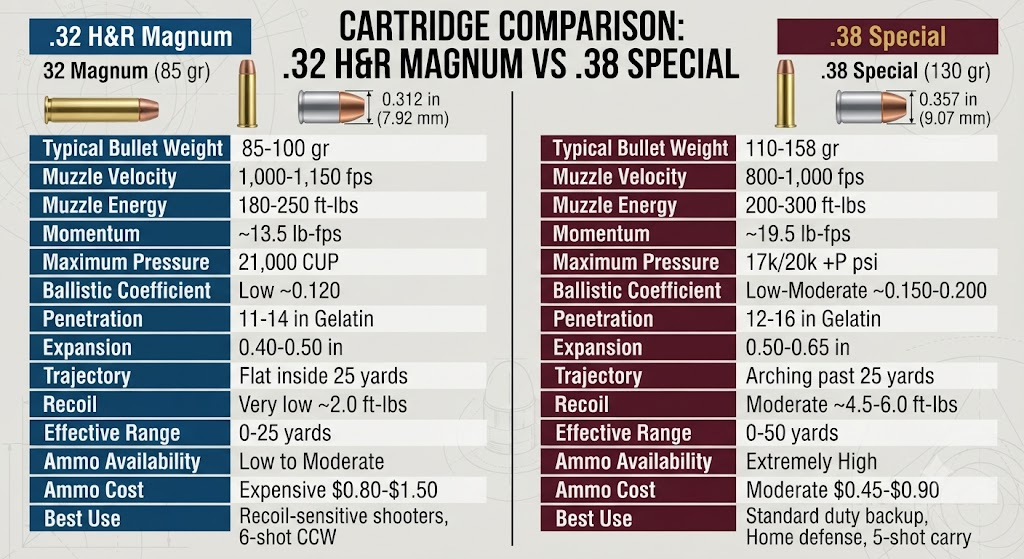
| Feature | .32 H&R Magnum | .38 Special |
| Bullet Diameter | 0.312 in (7.92 mm) | 0.357 in (9.07 mm) |
| Typical Bullet Weight | 85 gr – 100 gr (typically 85 gr) | 110 gr – 158 gr (typically 130 gr or 158 gr) |
| Muzzle Velocity | 1,000 – 1,150 fps (2 to 4-inch barrel) | 800 – 1,000 fps (2 to 4-inch barrel) |
| Muzzle Energy | 180 – 250 ft-lbs | 200 – 300 ft-lbs |
| Momentum | ~13.5 lb-fps (85 gr at 1,120 fps) | ~19.5 lb-fps (130 gr at 900 fps) |
| Maximum Pressure | 21,000 CUP | 17,000 psi (Standard) / 20,000 psi (+P) |
| Ballistic Coefficient | Low (~0.120) | Low to Moderate (~0.150 – 0.200) |
| Penetration | 11 – 14 inches (Gelatin) | 12 – 16 inches (Gelatin) |
| Expansion | 0.40 – 0.50 inches | 0.50 – 0.65 inches |
| Trajectory | Flat inside 25 yards | Arching past 25 yards |
| Recoil | Very low (~2.0 ft-lbs in snubbies) | Moderate (~4.5 – 6.0 ft-lbs in snubbies) |
| Effective Range | 0 – 25 yards (Defensive) | 0 – 50 yards (Defensive) |
| Ammo Availability | Low to Moderate (Specialty runs) | Extremely High (Global standard) |
| Ammo Cost | Expensive ($0.80 – $1.50 per round) | Moderate ($0.45 – $0.90 per round) |
| Best Use | Recoil-sensitive shooters, 6-shot concealed carry | Standard duty backup, home defense, 5-shot carry |
The table above outlines the foundational differences between a specialized late-20th-century revolver cartridge and one of the most prolific handgun cartridges in human history. The .32 Harrington & Richardson Magnum commonly referred to simply as the .32 Magnum or .32 H&R Magnum was introduced in 1984 as a joint venture between H&R and Federal Cartridge. The goal was to provide a cartridge that offered terminal ballistics comparable to a standard-pressure .38 Special but generated substantially less felt recoil. Furthermore, its slimmer case diameter allowed for six chambers in small-frame concealed carry revolvers that traditionally only held five rounds of .38 Special.
The .38 Special, introduced by Smith & Wesson in 1898, originally utilized black powder before seamlessly transitioning to smokeless powder. It operates at a relatively low maximum average pressure of 17,000 psi for standard loads, or 20,000 psi for +P variants. By relying on heavy bullet mass rather than high velocity, it has maintained its status as the gold standard for defensive revolvers for over a century, serving as the primary duty weapon for American law enforcement for decades before the widespread adoption of the 9mm semi-automatic pistol.
32 Magnum vs 38 Special Ballistics
To objectively evaluate the ballistic capabilities of the .32 Magnum against the .38 Special, we must examine real-world factory ammunition across their most common defensive applications. Snub-nose revolvers typically possessing 1.875-inch to 2-inch barrels present unique internal ballistic challenges. Short barrels do not provide enough time for slow-burning powders to fully combust, significantly reducing velocity and altering terminal performance compared to full-sized service revolvers.
For an accurate comparison, we will examine premium defensive loads fired from standard short-barreled defensive revolvers rather than universal receiver test barrels, which often inflate velocity numbers.
- Load A (.32 H&R Magnum): Hornady 80-grain Critical Defense FTX. Tested from a 2-inch barrel: Muzzle Velocity = 1,150 fps, Muzzle Energy = 235 ft-lbs, Ballistic Coefficient (G1) = 0.115.
- Load B (.32 H&R Magnum): Federal Personal Defense 85-grain Jacketed Hollow Point (JHP). Tested from a 2-inch barrel: Muzzle Velocity = 1,120 fps, Muzzle Energy = 237 ft-lbs.
- Load C (.38 Special Standard Pressure): Hornady 110-grain Critical Defense FTX. Tested from a 2-inch barrel: Muzzle Velocity = 900 fps, Muzzle Energy = 198 ft-lbs, Ballistic Coefficient (G1) = 0.130.
- Load D (.38 Special +P): Federal Premium 130-grain Micro HST JHP. Tested from a 2-inch barrel: Muzzle Velocity = 890 fps, Muzzle Energy = 229 ft-lbs, Ballistic Coefficient (G1) = 0.160.
- Load E (.38 Special Standard Pressure): Winchester 158-grain Lead Semi-Wadcutter (LSWC). Tested from a 2-inch barrel: Muzzle Velocity = 750 fps, Muzzle Energy = 197 ft-lbs.
While manufacturer-rated data is generally captured under controlled atmospheric conditions, independent chronograph testing of these loads from standard Smith & Wesson J-frames confirms that the .32 Magnum consistently outpaces the .38 Special in sheer muzzle velocity from short barrels.
32 Magnum vs 38 Special Velocity
Velocity is a critical metric for handgun ammunition, particularly hollow points, as it serves as the mechanical catalyst that forces fluid into the bullet cavity to initiate expansion. If a bullet travels too slowly, the hollow point cavity can plug with heavy clothing (such as denim or leather), turning the projectile into a solid drill that over-penetrates the target.
The .32 Magnum operates at a SAAMI maximum pressure of 21,000 CUP (Copper Units of Pressure), allowing it to drive lightweight 80-grain and 85-grain bullets at surprisingly high speeds despite minimal barrel length. From a 2-inch barrel, the .32 Magnum regularly achieves 1,100 to 1,150 feet per second. From a standard 4-inch barrel, boutique high-performance loads (such as Buffalo Bore’s 100-grain JHP) can approach 1,300 fps.
Because the .38 Special has a massive internal case capacity initially designed to hold large volumes of black powder, modern smokeless powder charges only fill a fraction of the case. Consequently, it operates at low pressures. Standard 130-grain or 158-grain bullets typically exit a 2-inch barrel at subsonic velocities ranging from 750 fps to 850 fps. Even lightweight 110-grain defensive loads struggle to break 1,000 fps from short barrels.
The higher velocity of the .32 Magnum gives it an edge in guaranteeing hollow point expansion. The .38 Special relies heavily on modern projectile engineering, such as soft lead cores and scored copper jackets, to ensure reliable expansion at low velocities.
32 Magnum vs 38 Special Muzzle Energy
Muzzle energy represents the kinetic work capacity of a projectile. Because velocity plays a disproportionately large role in generating kinetic energy compared to raw bullet weight, the lighter, much faster .32 Magnum competes surprisingly well with the heavier, slower .38 Special.
Utilizing Hornady’s 80-grain Critical Defense load at 1,150 fps, the .32 Magnum produces 235 ft-lbs of muzzle energy. Federal’s 85-grain load produces roughly 237 ft-lbs.
Standard pressure .38 Special loads often fall surprisingly low on the energy spectrum when fired from short barrels. A 158-grain lead round nose traveling at 750 fps generates only 197 ft-lbs of energy. However, modern +P defensive loads, such as the Speer Gold Dot 135-grain Short Barrel +P, generate approximately 222 ft-lbs of energy out of a 2-inch barrel. Heavy +P outdoor loads can exceed 300 ft-lbs from longer 4-inch or 6-inch duty barrels, where the powder has more time to burn and accelerate the projectile.
In snub-nose revolvers, the kinetic energy outputs of premium defensive .32 Magnum and .38 Special +P are virtually identical, hovering in the 220 to 240 ft-lbs range. This is why the .32 Magnum is often touted as delivering “.38 Special power with half the recoil.”
32 Magnum vs 38 Special Momentum
Momentum measures the mass of an object in motion. In terminal ballistics, high momentum correlates closely with the bullet’s ability to crush through dense bone, heavy winter clothing, and intermediate barriers without being deflected or stopping prematurely.
An 85-grain .32 Magnum bullet traveling at 1,120 fps yields approximately 13.6 lb-fps of linear momentum. A standard 130-grain .38 Special bullet traveling at 900 fps yields roughly 16.7 lb-fps. A heavy 158-grain .38 Special bullet traveling at 800 fps yields roughly 18.0 lb-fps.
Here, the .38 Special holds a definitive advantage. The .32 Magnum relies entirely on speed, whereas the .38 Special relies on sheer mass. When encountering thick bone or heavy tissue, the heavier momentum of the .38 Special ensures deeper, more consistent straight-line penetration. A bullet weighing 158 grains simply has more mass driving it forward, making it harder to stop once it is in motion.
32 Magnum vs 38 Special Trajectory
Because both cartridges are primarily utilized in short-barreled defensive revolvers, extreme long-range trajectory is rarely a primary concern for the average shooter. However, understanding bullet drop helps illustrate the aerodynamic differences between the two rounds and is highly relevant for shooters using 4-inch or 6-inch revolvers for target shooting or small game hunting.
Calculations below assume a standard sight height of 0.75 inches above the bore (typical for iron-sighted revolvers) and a clearly stated zero distance of 25 yards.
| Distance | .32 H&R Mag (85 gr at 1,120 fps) Drop | .38 Special (130 gr at 900 fps) Drop |
| Muzzle | -0.75 inches | -0.75 inches |
| 10 yards | +0.2 inches | +0.3 inches |
| 25 Yards | 0.0 inches (Zero) | 0.0 inches (Zero) |
| 50 Yards | -2.1 inches | -4.4 inches |
| 75 Yards | -7.5 inches | -12.8 inches |
| 100 Yards | -16.2 inches | -25.5 inches |
The .32 Magnum features a noticeably flatter trajectory due to its higher initial velocity. The heavy, slow .38 Special begins to drop rapidly past 25 yards. However, within realistic self-defense distances inside of 15 yards, the trajectory difference between the two cartridges is entirely negligible. For small-game hunting, the flatter trajectory of the .32 Magnum makes it slightly more forgiving at intermediate distances.
32 Magnum vs 38 Special Recoil
Recoil management is the single most significant reason a shooter might choose the .32 Magnum over the .38 Special. Recoil is governed by the conservation of momentum, heavily influenced by the weight of the firearm, the mass of the powder charge, the velocity of the exiting gases, and the weight of the bullet.
Fired from a 15-ounce aluminum-frame snub-nose revolver such as a Smith & Wesson 642 Airweight a standard .38 Special 130-grain load generates roughly 4.5 foot-pounds of free recoil energy. A .38 Special +P load can generate 5.5 to 6.5 foot-pounds. While this may not sound like much compared to a rifle, in a small, lightweight handgun with a two-finger grip, it creates a sharp, painful snap directly into the palm of the hand. This sharp recoil often induces a severe flinch in novice shooters, causing them to pull their shots low and to the side.
Fired from a similar 15-ounce revolver, an 85-grain .32 H&R Magnum load generates only 2.0 to 2.5 foot-pounds of free recoil energy.
The .32 Magnum produces roughly 50% less felt recoil than a standard .38 Special, making it vastly superior for recoil-sensitive shooters, shooters with arthritis, or those who want to practice extensively at the range without experiencing hand pain or fatigue. The reduced recoil also translates directly into faster, more accurate follow-up shots under the stress of a defensive encounter.
32 Magnum vs 38 Special Penetration
Terminal penetration is rigorously evaluated using calibrated 10% ordnance gelatin, which simulates the density and resistance of human soft tissue. The FBI standard dictates that a defensive bullet must penetrate a minimum of 12 inches and a maximum of 18 inches to reliably reach vital organs from any angle without posing a severe over-penetration risk to bystanders.
Because the .32 Magnum utilizes light 80-grain to 85-grain bullets, achieving deep penetration can be difficult if the bullet expands aggressively. Hornady Critical Defense .32 Magnum typically penetrates between 11.0 and 13.0 inches in bare gelatin. While this is highly lethal with unobstructed frontal shots, it sits on the absolute minimum edge of the FBI standard. If an attacker’s arm is in the way, or the shot is taken from an oblique angle, the lightweight bullet may not have the momentum to reach the central nervous system or vital organs.
Heavy 130-grain to 158-grain .38 Special bullets penetrate exceptionally well due to their high mass and momentum. Premium loads like the Federal 130-grain HST or Speer 135-grain Gold Dot consistently penetrate 12.5 to 15.0 inches, easily meeting FBI standards even after passing through heavy clothing barriers like leather or four layers of heavy denim.
32 Magnum vs 38 Special Expansion
Bullet expansion dictates the diameter of the permanent wound channel, increasing the likelihood of severing major arteries and causing rapid incapacitation through blood loss.
Starting with a small 0.312-inch projectile, premium hollow points in .32 Magnum like the Federal JHP expand to an average diameter of 0.40 to 0.48 inches. Because of its high velocity, expansion is generally very reliable, but the maximum expanded diameter remains small compared to larger defensive calibers.
Starting with a much wider 0.357-inch projectile, premium .38 Special hollow points can expand to an impressive 0.55 to 0.65 inches. The historical challenge for the .38 Special has always been velocity; if a standard-pressure hollow point fails to expand from a 2-inch barrel, it simply acts as a 0.357-inch solid drill. However, modern ammunition manufacturers have largely solved this issue. Loads like the Hornady Critical Defense utilize a polymer insert in the hollow point cavity to prevent clogging, ensuring reliable expansion even at low velocities. When a .38 Special expands properly, it creates a substantially wider crush cavity than the .32 Magnum.
32 Magnum vs 38 Special Effective Range
When fired from a short-barreled revolver, the .32 Magnum is highly effective within 25 yards. Beyond this distance, its lightweight bullets shed velocity and energy rapidly, limiting its utility for defensive target shooting. However, out of a 4-inch or 6-inch barrel, it is an exceptionally accurate cartridge for small game hunting out to 50 yards.
The .38 Special is also primarily a 0 to 25-yard defensive tool in snub-nose form, limited more by the short sight radius and heavy double-action trigger pull of the revolver than by the cartridge itself. When fired from a 4-inch or 6-inch service barrel, standard and +P loads maintain sufficient momentum and mechanical accuracy to be highly effective out to 50 yards and beyond.
32 Magnum vs 38 Special Self Defense
When choosing a cartridge for home defense or daily carry, practical platform considerations often outweigh minor differences in ballistic gel testing.
Revolver capacity is the undeniable trump card of the .32 Magnum. Because the .312-inch diameter of the cartridge is significantly narrower than the .357-inch diameter of the .38 Special, firearm manufacturers can fit six chambers into a standard small-frame cylinder that traditionally only holds five .38 Special rounds. Models like the Ruger LCR in .327 Federal Magnum (which safely chambers and fires .32 H&R Magnum) provide this six-round capability. In a life-or-death encounter, a 20% increase in ammunition capacity without any increase in the firearm’s size or weight is a massive tactical advantage.
The minimal recoil of the .32 Magnum allows the shooter to reacquire their sights and pull the heavy double-action trigger much faster and more accurately than a shooter fighting the muzzle flip of a .38 Special +P.
Furthermore, ammunition versatility favors the .32 caliber family. A revolver chambered in .32 H&R Magnum can safely chamber and fire older, lower-pressure .32 S&W Long and .32 S&W Short cartridges, providing options for ultra-low recoil practice. A .38 Special revolver can chamber and fire .38 Long Colt and .38 Short Colt, though these are far less common today.
32 Magnum vs 38 Special Concealed Carry
Revolvers chambered in .32 H&R Magnum are identical in exterior dimensions to their .38 Special counterparts. They slide effortlessly into pocket holsters, ankle holsters, and inside-the-waistband rigs. Carrying spare ammunition is also slightly easier; a speed strip or speedloader carrying six .32 Magnum rounds is physically lighter and thinner than carrying five .38 Special rounds.
The .38 Special snub-nose revolver is perhaps the most heavily carried backup gun in American history. From the classic Colt Detective Special to the modern Smith & Wesson Model 642, its ubiquitous presence makes finding holsters, speedloaders, and accessories effortless. Its 5-shot capacity is the only significant drawback to an otherwise perfectly optimized concealed carry platform.
Which Has More Stopping Power: 32 Magnum or 38 Special?
Stopping power is not a single scientifically established measurement, nor does either of these handgun cartridges guarantee an immediate physiological incapacitation. Practical terminal performance depends entirely on shot placement, adequate penetration depth, and the diameter of the permanent crush cavity. Handgun bullets incapacitate primarily through blood loss or central nervous system disruption, meaning the bullet must punch deep enough to reach critical structures.
The .38 Special generally possesses superior terminal stopping power. Even though muzzle energy outputs in short barrels are remarkably similar, the .38 Special utilizes a bullet with nearly double the mass of the .32 Magnum. This heavy mass ensures deeper, more reliable penetration through heavy clothing and bone, while its larger diameter creates a wider expanded wound channel. The .32 Magnum, while entirely lethal and highly capable, relies on lightweight bullets that often fall short of optimal penetration depths if they expand aggressively upon entry.
Which Is More Powerful: 32 Magnum or 38 Special?
Power is defined quantitatively by kinetic energy and linear momentum.
While a standard-pressure .38 Special and a high-velocity .32 Magnum produce nearly identical muzzle energy from a 2-inch barrel, the .38 Special +P holds a significantly higher ceiling for raw power. When loaded to +P pressures or fired from longer barrels, the .38 Special can exceed 300 ft-lbs of energy and generates significantly higher momentum due to its heavier projectiles. In terms of sheer bullet mass colliding with a target, the .38 Special is unequivocally the more powerful cartridge.
32 Magnum Pros and Cons
Pros
- Provides a 6-round capacity in ultra-compact revolver cylinders that only hold five .38 Special rounds
- Exceptionally low recoil makes rapid double-action shooting easy and painless, preventing shooter flinch
- High velocity out of short barrels guarantees reliable hollow point expansion
- Firearms can also safely chamber and shoot .32 S&W Long and .32 S&W Short ammunition for ultra-light target practice
Cons
- Lightweight bullets struggle to achieve deep, FBI-spec penetration in ballistic gelatin consistently
- Ammunition is expensive, produced in smaller batches, and rarely found in big-box retail stores
- Largely overshadowed in modern times by the much more powerful .327 Federal Magnum, which offers the same capacity advantages with much higher energy
38 Special Pros and Cons
Pros
- Proven century-old track record in self-defense, law enforcement, and military applications
- Massive bullets ensure deep, straight-line penetration through heavy clothing and intermediate barriers
- Global ammunition availability with virtually unlimited defensive load options, ranging from light target wadcutters to heavy +P hollow points
- Extremely economical and accessible for high-volume range practice
Cons
- Standard compact concealed carry revolvers are strictly limited to a 5-round capacity
- Heavy +P defensive loads produce sharp, painful recoil in lightweight aluminum or scandium frames, making practice punishing
- Short barrels can occasionally fail to generate enough velocity to expand heavy standard-pressure hollow points
Final Comparison
| Category | Winner | Reason |
| Velocity | .32 H&R Mag | Operates at higher pressures to drive light bullets over 1,100 fps |
| Muzzle Energy | Tie | Both produce roughly 200–240 ft-lbs from 2-inch defensive barrels |
| Momentum | .38 Special | Heavy 130gr–158gr bullets carry superior linear mass and driving force |
| Penetration | .38 Special | High momentum ensures reliable 12–16 inch gelatin penetration |
| Expansion | .38 Special | Wider starting diameter yields massive expanded profiles upon impact |
| Trajectory | .32 H&R Mag | Flatter shooting curve out to 50 yards due to high initial velocity |
| Recoil | .32 H&R Mag | Produces roughly half the free recoil energy of a standard .38 Spl +P |
| Effective Range | .38 Special | Retains mass and momentum better out to 50 yards in standard barrels |
| Self Defense | Depends on Shooter | .32 Mag for capacity and fast follow-ups; .38 Spl for sheer penetration |
| Concealed Carry | .32 H&R Mag | Offers six rounds instead of five in the exact same physical gun footprint |
| Ammo Cost | .38 Special | Mass-produced globally, drastically lowering the average cost per round |
| Ammo Availability | .38 Special | Found on the shelves of virtually every sporting goods store and gun shop |
| Overall Performance | .38 Special | Superior terminal ballistics, penetration, and unmatched logistical support |
32 Magnum vs 38 Special: Which Should You Choose?
Selecting between the .32 H&R Magnum and the .38 Special requires an honest assessment of your recoil tolerance, physical hand strength, and logistical priorities.
Choose the .32 H&R Magnum if you are highly recoil-sensitive, suffer from hand weakness or arthritis, or place a massive premium on having a 6-round capacity in a pocket-sized J-frame revolver without enduring the punishing snap of a .38 +P. It is an exceptionally capable defensive round that prioritizes shootability and accuracy over brute force.
Choose the .38 Special if you prioritize deep, reliable terminal penetration, prefer a massive selection of readily available and affordable ammunition, and do not mind managing moderate recoil from a 5-shot revolver. Its century of proven defensive performance makes it one of the most reliable handgun cartridges ever designed.
FAQs
Is 32 Magnum more powerful than 38 Special?
No, while they share similar kinetic energy from short barrels, the .38 Special generates much higher momentum and is capable of greater overall power when loaded to +P specifications.
Which has more muzzle energy?
From a 2-inch barrel, both hover between 200 and 240 ft-lbs, but a .38 Special +P can reach closer to 250 ft-lbs, and out of a 4-inch barrel, the .38 Special easily exceeds 300 ft-lbs.
Which has more stopping power?
The .38 Special has superior practical stopping power due to its heavy bullet mass, which ensures deep, reliable penetration and wider permanent wound channels.
Which has more recoil?
The .38 Special produces roughly twice the free recoil energy of a .32 H&R Magnum when fired from an identical lightweight defensive revolver.
Which has better penetration?
The .38 Special penetrates deeper and more consistently in ballistic gelatin compared to the lightweight .32 H&R Magnum bullets, which sometimes struggle to surpass 12 inches if they expand rapidly.
Which expands more?
Because it starts at a wider diameter, a premium .38 Special hollow point will generally expand to a wider final diameter than the narrower .32 Magnum projectile.
Which has a flatter trajectory?
The .32 H&R Magnum shoots noticeably flatter inside of 50 yards because it travels several hundred feet per second faster than a standard .38 Special.
Which is better for self defense?
The .32 H&R Magnum is better for recoil-sensitive shooters requiring six rounds, while the .38 Special is better for shooters wanting maximum terminal performance and deep penetration.
Which is better for concealed carry?
Both utilize identical lightweight revolver frames, but the .32 Magnum offers a 6-shot capacity, whereas the .38 Special offers a 5-shot capacity.
Is 32 Magnum faster than 38 Special?
Yes, the .32 H&R Magnum easily achieves 1,100 to 1,150 fps from short barrels, whereas the heavy bullets of the .38 Special typically remain subsonic between 800 and 950 fps.
Is 38 Special stronger than 32 Magnum?
In terms of kinetic impact, momentum, and bullet mass, the .38 Special is the stronger cartridge, even though it operates at a lower internal chamber pressure.
Which is cheaper to shoot?
The .38 Special is significantly cheaper to shoot due to massive global production, whereas the .32 H&R Magnum is a specialty cartridge produced in smaller batches.
Can a 32 Magnum shoot 38 Special?
No. They are completely different calibers with different chamber dimensions. However, a .32 H&R Magnum revolver can shoot shorter, lower-pressure .32 S&W Long and .32 S&W Short ammunition.
Which is easier to shoot?
The .32 H&R Magnum is drastically easier to shoot due to its minimal recoil, allowing for faster follow-up shots and pain-free practice sessions.
Which should you choose?
Choose the .32 Magnum for a low-recoil, 6-shot concealed carry revolver. Choose the .38 Special for deep penetration, proven terminal ballistics, and cheap, highly accessible ammunition.