The main difference between the 338 06 and the 35 Whelen is that the 338 06 utilizes a narrower bullet with superior aerodynamics for longer shots.
The 35 Whelen fires a wider bullet that creates a larger initial wound channel for hunting massive game at close range.
Both cartridges share the exact same 30 06 Springfield parent brass case but accomplish their medium bore hunting goals through completely different ballistic philosophies.
The 338 06 excels in maintaining downrange velocity while the 35 Whelen transfers immense kinetic energy immediately upon impact.
338 06 vs 35 Whelen Comparison Table
| Specification | 338 06 A Square | 35 Whelen |
| Bullet Diameter | .338 inches | .358 inches |
| Parent Case | 30 06 Springfield | 30 06 Springfield |
| Case Length | 2.494 inches | 2.494 inches |
| Overall Length | 3.340 inches | 3.340 inches |
| Typical Bullet Weights | 200gr to 250gr | 180gr to 250gr |
| Typical Velocity | 2500 to 2800 fps | 2500 to 2900 fps |
| Muzzle Energy | 3400 to 3600 ft lbs | 3400 to 3700 ft lbs |
| Momentum | Extremely High | Extremely High |
| Typical Trajectory | Flat to Moderate | Moderate to Arced |
| Recoil | Heavy | Heavy |
| Effective Range | 400 to 500 yards | 300 to 400 yards |
| Penetration | Phenomenal | Excellent |
| Expansion | Very Reliable | Very Reliable |
| Ammunition Cost | Extremely Expensive | Moderate |
| Ammo Availability | Very Rare | Moderate |
| Best Uses | Elk and Moose at range | Elk and Bear in timber |
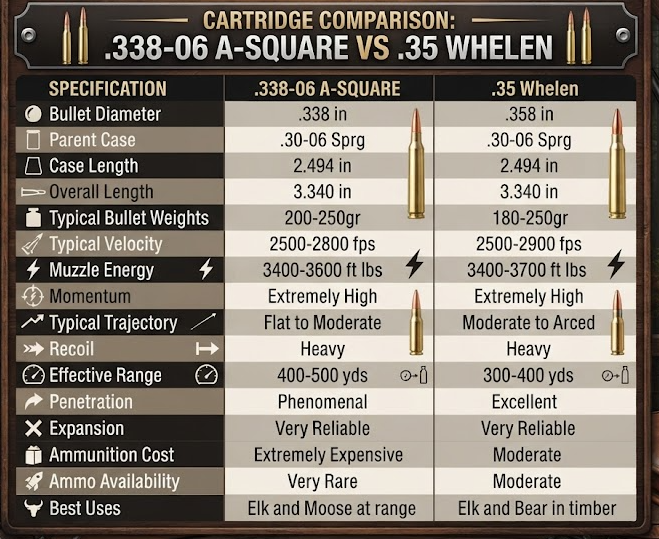
Explanation
When we look closely at the specifications in the table above, the most striking realization is that these two cartridges are mechanical siblings. Both were born by taking the legendary 30 06 Springfield brass case and expanding the neck to accept a larger, heavier projectile. By utilizing the exact same brass case, both cartridges operate in standard length bolt action rifles and offer identical magazine capacities, which is usually four or five rounds depending on the rifle design.
The 35 Whelen has a much longer and richer commercial history. It was originally developed in 1922 by Colonel Townsend Whelen and James Howe at the Frankford Arsenal as a wildcat cartridge designed to bring African safari power to standard American hunting rifles. It remained a wildcat for over six decades until Remington Arms officially standardized the cartridge with SAAMI in 1988, chambering it in their famous Model 700 Classic rifle. This standardization paved the way for widespread commercial ammunition production.
The 338 06 followed a very similar path but much later in history. It originated as a wildcat designed to take advantage of the excellent .338 caliber bullets introduced alongside the 338 Winchester Magnum. It remained a niche cartridge for handloaders until 1998 when A Square officially submitted the specifications to SAAMI, standardizing it as the 338 06 A Square. Unfortunately, while Weatherby and a few other manufacturers briefly produced factory rifles and ammunition for it, commercial support dried up quickly. Today, finding factory loaded 338 06 ammunition is incredibly difficult, making it primarily a handloader proposition, whereas the 35 Whelen enjoys steady support from major manufacturers like Hornady, Barnes, and Federal.
338 06 vs 35 Whelen Ballistics
To truly understand how these two titans of the hunting world compare, we must analyze their internal, external, and terminal ballistics. Both cartridges represent the absolute maximum power you can extract from a standard 30 06 Springfield casing without stepping up to a belted magnum cartridge.
Because they utilize the same case capacity, they burn roughly the same amount of powder. The primary ballistic differentiator is the bullet diameter. The 35 Whelen uses a .358 inch bullet, while the 338 06 uses a .338 inch bullet. This difference in diameter alters the ballistic coefficient, the sectional density, and the frontal surface area of the projectile. The .338 caliber bullets are longer and more aerodynamic for their given weight, allowing them to slice through the air with less drag. The .358 caliber bullets are shorter and fatter, causing them to shed velocity faster but hit with a massive initial footprint.
338 06 vs 35 Whelen Velocity
Velocity dictates trajectory, energy, and bullet expansion. Because the 35 Whelen has a wider bore diameter, expanding gasses from the burning powder have a larger surface area to push against at the base of the bullet. This internal ballistic advantage allows the 35 Whelen to occasionally achieve slightly higher initial muzzle velocities than the 338 06 with identical bullet weights, provided the manufacturer loads it to modern pressure limits. However, the more aerodynamic 338 06 bullets retain their velocity much better over distance.
Let us compare the muzzle velocities of several representative loads from twenty four inch test barrels:
Representative 35 Whelen Velocities:
- Hornady Superformance 200gr Soft Point: 2910 fps
- Barnes VOR TX 200gr TTSX: 2900 fps
- Nosler Custom 225gr AccuBond: 2800 fps
- Federal Premium 225gr Trophy Bonded Bear Claw: 2600 fps
- Remington Core Lokt 250gr Soft Point: 2400 fps
Representative 338 06 Velocities:
- Weatherby Factory 210gr Nosler Partition: 2750 fps
- Nosler Custom 225gr AccuBond: 2750 fps
- Typical Handload 225gr Hornady SST: 2700 fps
- Typical Handload 250gr Nosler Partition: 2500 fps
Winner: Tie. At the muzzle, modern high performance 35 Whelen loads from companies like Hornady push lighter 200 grain bullets exceptionally fast. However, at practical hunting ranges beyond two hundred yards, the superior aerodynamics of the 338 06 allow it to easily overtake the 35 Whelen in retained velocity.
338 06 vs 35 Whelen Muzzle Energy
Muzzle energy represents the destructive potential of the bullet as it leaves the barrel, measured in foot pounds. Both cartridges produce staggering amounts of kinetic energy, vastly outperforming their parent cartridge, the 30 06 Springfield.
Let us look at the raw kinetic energy numbers produced by some of the most popular loads:
| Cartridge Load | Bullet Weight | Velocity | Muzzle Energy |
| 35 Whelen Hornady Superformance | 200 gr | 2910 fps | 3760 ft lbs |
| 35 Whelen Barnes VOR TX | 200 gr | 2900 fps | 3734 ft lbs |
| 35 Whelen Nosler Custom | 225 gr | 2800 fps | 3916 ft lbs |
| 338 06 Weatherby Factory Load | 210 gr | 2750 fps | 3526 ft lbs |
| 338 06 Nosler Custom | 225 gr | 2750 fps | 3778 ft lbs |
| 338 06 Typical Handload | 250 gr | 2500 fps | 3469 ft lbs |
Winner: Tie. Both cartridges easily generate between 3400 and 3900 foot pounds of muzzle energy. This puts them directly into the same class of stopping power, making them perfectly suited for the absolute largest and most dangerous game on the North American continent. Any animal struck properly by nearly four thousand foot pounds of energy from either caliber will be ethically harvested.
338 06 vs 35 Whelen Bullet Diameter
Bullet diameter plays a critical role in creating a permanent wound channel. A wider bullet crushes more tissue as it passes through the animal, leading to faster blood loss and quicker incapacitation even if the bullet fails to expand completely.
The 338 06 fires a .338 inch diameter projectile.
The 35 Whelen fires a .358 inch diameter projectile.
When we calculate the frontal surface area of these bullets, we see a distinct advantage. The .358 caliber bullet has roughly twelve percent more frontal surface area than the .338 caliber bullet. This means that from the exact moment of impact, the 35 Whelen is already punching a noticeably larger hole.
Winner: 35 Whelen. The larger diameter bullet creates a more devastating initial wound cavity, which is highly preferred by hunters tracking game in dense brush where minimal tracking distance is required.
338 06 vs 35 Whelen Momentum
While kinetic energy heavily favors velocity, momentum is driven strongly by bullet weight. Heavy bullets traveling at moderate speeds possess incredible momentum, which translates to deep, bone crushing penetration. Momentum is a key metric evaluated by hunters pursuing dangerous game like grizzly bears.
Because both cartridges fire heavy 200 grain to 250 grain projectiles at roughly the same velocities, they produce nearly identical momentum figures. A 250 grain bullet fired at 2500 feet per second from either the 338 06 or the 35 Whelen produces massive forward momentum that will reliably shatter the heavy shoulder joints of a moose or a bear.
Winner: Tie. Both cartridges deliver exceptional momentum that vastly exceeds standard deer hunting calibers.
338 06 vs 35 Whelen Trajectory
Trajectory dictates how far a bullet drops over distance due to the pull of gravity. A flatter trajectory is highly desirable for hunting in open country because it requires fewer sight adjustments and minimizes the penalty for misjudging the exact distance to the target.
This is the category where the 338 06 definitively pulls ahead. Because .338 caliber bullets are narrower and longer than .358 caliber bullets of the same weight, they possess significantly higher Ballistic Coefficients. A higher Ballistic Coefficient means the bullet slices through the air more efficiently, retaining velocity and resisting wind deflection.
When fired at identical velocities and zeroed at two hundred yards, the 35 Whelen will drop noticeably more at three hundred and four hundred yards than the 338 06. Furthermore, a strong crosswind will push the fatter 35 Whelen bullet much further off target at four hundred yards compared to the sleek 338 06 projectile.
Winner: 338 06. The superior aerodynamics of the .338 caliber bullets provide a noticeably flatter trajectory and significantly less wind drift at extended ranges.
338 06 vs 35 Whelen Recoil
Recoil is the rearward force generated by firing the rifle. Felt recoil depends heavily on the weight of the rifle, the powder charge, the bullet weight, and the velocity.
Both of these cartridges are known to be stout kickers. They are propelling heavy chunks of lead at very high velocities from standard weight hunting rifles. In a typical eight pound rifle, firing a 225 grain bullet at 2700 feet per second will generate roughly twenty five to thirty foot pounds of recoil energy.
This level of recoil is noticeably sharper and heavier than a standard 30 06 Springfield, which typically generates around twenty foot pounds. However, it is noticeably less punishing than a 338 Winchester Magnum, which can easily generate thirty five foot pounds of recoil.
Winner: Tie. Both cartridges produce nearly identical recoil impulses. Shooters sensitive to heavy recoil should utilize quality recoil pads or muzzle brakes when shooting either caliber.
338 06 vs 35 Whelen Penetration
Penetration is the single most vital metric for taking down large game or dealing with heavy boned predators. A bullet must penetrate through thick hide, heavy muscle, and dense bone to reach the vital organs of an animal like a grizzly bear.
Penetration is largely determined by bullet construction and Sectional Density. Sectional Density is a ratio of a bullet weight to its diameter. Long, heavy bullets for their caliber have high Sectional Densities and tend to penetrate incredibly deep.
Because the .338 caliber bullets are narrower than the .358 caliber bullets, they are much longer for any given weight. Assuming identical bullet construction, the 338 06 will reliably penetrate deeper into tissue than the 35 Whelen due to its superior Sectional Density and narrower frontal area.
Winner: 338 06. Its longer bullets possess higher Sectional Density, granting it a noticeable advantage in deep, straight line penetration.
338 06 vs 35 Whelen Expansion
Expansion occurs when the hollow point or soft point of a bullet strikes fluid rich tissue, causing the nose to peel back and form a mushroom shape. This maximizes tissue damage and energy transfer.
Both cartridges excel at bullet expansion because they operate at ideal velocities for standard hunting bullets. They push projectiles fast enough to guarantee violent expansion, but not so incredibly fast that the bullets fragment or explode on impact, which is a common problem with ultra high velocity magnum cartridges.
Because the 35 Whelen starts with a larger .358 inch diameter, its expanded mushroom will generally be slightly wider than an expanded .338 inch bullet, resulting in a slightly wider permanent wound cavity.
Winner: 35 Whelen. The wider initial diameter translates to a wider expanded diameter, devastating the lungs and circulatory systems of large game.
338 06 vs 35 Whelen Stopping Power
While stopping power is a debated concept, hunters generally agree that stopping power involves a combination of kinetic energy, bullet expansion, wound channel diameter, and adequate penetration.
Both the 338 06 and the 35 Whelen are legendary for their ability to anchor massive animals quickly. The 35 Whelen drops moose and elk with the same authority as belted magnums. The 338 06 is equally revered by those who use it, delivering immense shock and devastating wound channels.
Winner: Tie. No animal on the planet will be able to distinguish between a well placed shot from a 338 06 and a well placed shot from a 35 Whelen. Both deliver overwhelming stopping power.
338 06 vs 35 Whelen Hunting
When evaluating these cartridges for hunting, we must look at the environments they are best suited for.
The 35 Whelen is arguably the ultimate timber and brush cartridge. When hunters venture into the dense woods of the northeast for giant black bears or the thick timber of the Rocky Mountains for bull elk, shots are rarely taken beyond two hundred yards. In these environments, the massive frontal area and tremendous energy of the 35 Whelen shine brilliantly. It leaves a massive blood trail and anchors game incredibly fast.
The 338 06 is the superior choice for hunters who might encounter game in a mix of dense timber and open alpine clearings. If you are hunting elk in a canyon where a shot could present itself at three hundred and fifty yards, the flatter trajectory and superior wind bucking capabilities of the 338 06 make it the much wiser choice. It delivers the same lethal payload but makes the long distance shot significantly easier to execute.
Winner: Depends on the Environment. The 35 Whelen is the king of the dark timber, while the 338 06 is better suited for mixed environments and longer distances.
338 06 vs 35 Whelen For Self Defense
In the context of standard urban self defense against human threats, both of these cartridges are wildly overpowered. Firing either cartridge inside a home would result in extreme over penetration, likely passing through the threat, several interior walls, and potentially exiting the exterior of the house. Furthermore, the muzzle blast and concussion indoors would be permanently deafening. Neither cartridge should be chosen for standard home defense.
Winner: Neither. Both are dedicated big game hunting cartridges, entirely unsuitable for close quarters urban self defense.
338 06 vs 35 Whelen For Woods Carry
Woods carry usually implies carrying a firearm for protection against large predators, specifically grizzly bears, brown bears, and mountain lions in the deep backcountry.
For defense against a charging grizzly bear, stopping the threat immediately requires shattering the heavy skeletal structure or destroying the central nervous system. Both cartridges are exceptional for this task. The 35 Whelen chambered in a fast handling pump action rifle is a legendary combination for guides and backcountry hikers. The 338 06 loaded with heavy 250 grain solid or bonded bullets provides the immense penetration needed to reach the vitals of a massive bear from any angle.
Winner: Tie. Both are exceptional choices for protection against the largest dangerous game in North America.
338 06 vs 35 Whelen Ammunition Cost
The cost and availability of ammunition is the single largest dividing factor between these two cartridges today.
The 35 Whelen was standardized by Remington in 1988, and as a result, many major ammunition manufacturers produce high quality factory loads for it. You can regularly find 35 Whelen ammunition from Hornady, Federal Premium, Barnes, and Nosler. While it is not as cheap or abundant as 30 06 Springfield, it is readily available online and in large sporting goods stores.
The 338 06 A Square is practically obsolete in the commercial ammunition market. Weatherby discontinued their factory loads, and only a few custom loaders produce it in extremely small, expensive batches. For all practical purposes, the 338 06 is a handloader exclusive cartridge today.
Winner: 35 Whelen. The 35 Whelen is vastly cheaper to shoot and much easier to source commercially.
338 06 vs 35 Whelen Effective Range
The effective range of a hunting cartridge is determined by its trajectory, its retained energy, and the velocity required for the bullet to properly expand on impact. Most premium hunting bullets require an impact velocity of at least 1800 feet per second to expand reliably.
Because the 35 Whelen uses bullets with lower ballistic coefficients, they shed velocity quickly. A standard 200 grain 35 Whelen bullet will drop below the necessary expansion velocity threshold around four hundred yards, and the bullet drop at that distance is severe.
The 338 06 uses aerodynamic bullets that retain velocity beautifully. A 225 grain Nosler AccuBond fired from a 338 06 will stay above the expansion velocity threshold well past five hundred yards, and the trajectory requires significantly less sight adjustment.
Winner: 338 06. The superior aerodynamics of the .338 caliber bullets push the ethical effective hunting range of the 338 06 approximately one hundred to one hundred and fifty yards further than the 35 Whelen.
Which Is More Powerful: 338 06 or 35 Whelen?
When evaluating raw muzzle energy, neither cartridge is definitively more powerful than the other. Both the 338 06 and the 35 Whelen produce between 3400 and 3900 foot pounds of kinetic energy depending on the exact factory load or handload combination.
However, they apply that power differently. The 35 Whelen applies its power over a wider surface area for maximum initial tissue destruction, while the 338 06 applies its power over a longer, narrower area for maximum penetration and retained downrange energy. In terms of pure mathematical kinetic energy at the muzzle, they are identical twins.
Pros and Cons
338 06 A Square
Pros:
- Incredibly flat trajectory for a large bore cartridge.
- High sectional density provides phenomenal deep penetration.
- Superior ballistic coefficients retain velocity and energy at extended ranges.
- Utilizes standard length rifle actions and standard bolt faces.
- Vast selection of highly advanced .338 caliber bullets available for handloaders.
- Less recoil and muzzle blast than a 338 Winchester Magnum.
Cons:
- Factory loaded ammunition is exceptionally rare and extremely expensive.
- Requires handloading to truly utilize the caliber.
- Very few factory rifles are chambered in it today.
35 Whelen
Pros:
- Massive .358 inch bullet diameter creates devastating wound channels.
- Factory ammunition is readily available from major manufacturers.
- Tremendous stopping power for dangerous game in heavy brush.
- Factory rifles are widely available in bolt action, single shot, and pump action configurations.
- Can be easily formed by simply necking up abundant 30 06 brass.
Cons:
- Arced trajectory limits ethical hunting range to roughly four hundred yards.
- Bullets shed velocity and energy faster due to lower ballistic coefficients.
- Heavy recoil requires proper shooting fundamentals.
Decision Table
| Category | Winner | Reason |
| Velocity | Tie | Both achieve nearly identical muzzle velocities with similar bullet weights. |
| Muzzle Energy | Tie | Both generate between 3400 and 3900 foot pounds of kinetic energy. |
| Bullet Weight | Tie | Both heavily utilize 200 grain to 250 grain projectiles. |
| Bullet Diameter | 35 Whelen | The .358 inch bullet is significantly wider than the .338 inch bullet. |
| Momentum | Tie | Similar bullet mass and velocity create identical heavy momentum. |
| Trajectory | 338 06 | Superior aerodynamics create a noticeably flatter flight path. |
| Bullet Drop | 338 06 | Higher ballistic coefficients result in far less drop at 300 and 400 yards. |
| Recoil | Tie | Both generate approximately 25 to 30 foot pounds of recoil energy. |
| Penetration | 338 06 | Higher sectional density drives the narrower bullets deeper into heavy game. |
| Expansion | 35 Whelen | Larger initial diameter leads to a wider expanded mushroom shape. |
| Hunting | Depends on Range | 35 Whelen is best for close timber while 338 06 is best for open clearings. |
| Woods Carry | Tie | Both are premier choices for defense against grizzly bears in thick brush. |
| Ammunition Cost | 35 Whelen | Factory ammunition is vastly more abundant and cheaper. |
| Ammo Availability | 35 Whelen | Supported by major brands unlike the obsolete 338 06. |
| Effective Range | 338 06 | Retains lethal velocity well past 400 yards outperforming the 35 Whelen. |
338 06 vs 35 Whelen: Which Should You Choose?
The decision between the 338 06 and the 35 Whelen ultimately comes down to your desire to handload ammunition and the specific ranges at which you plan to hunt.
You should choose the 35 Whelen if you want the ultimate brush gun for hunting large game like elk, moose, and bear within three hundred yards. It is the definitive choice for hunters who prefer to buy factory loaded ammunition off the shelf rather than spend hours at a reloading bench. The 35 Whelen provides unparalleled smashing power in dense timber and guarantees massive blood trails.
You should choose the 338 06 A Square if you are a dedicated handloader seeking the absolute most versatile cartridge based on the 30 06 casing. It is the perfect choice for the hunter who demands the deep penetration of a heavy bullet but refuses to sacrifice the flat trajectory required for a four hundred yard shot across an alpine meadow. The 338 06 gives you near magnum performance in a standard rifle without the punishing blast of a belted magnum.
For the vast majority of modern hunters, the 35 Whelen is the practical choice simply due to commercial ammunition availability. However, for the discerning reloader who wants a mathematically superior cartridge for diverse landscapes, the 338 06 remains a hidden masterpiece of ballistics.
FAQ
Is the 338 06 more powerful than the 35 Whelen?
No, they are functionally identical in terms of raw muzzle energy, both producing around 3500 to 3800 foot pounds. The 338 06 simply retains its power better at long ranges due to superior bullet aerodynamics.
Which has more muzzle energy?
Both cartridges generate nearly identical muzzle energy when loaded to modern pressures. Factory loads for the 35 Whelen often peak around 3700 foot pounds, and custom loads for the 338 06 reach the exact same numbers.
Which has higher velocity?
At the muzzle, light 200 grain bullets in the 35 Whelen can edge out the 338 06 due to the larger bore diameter capturing more gas expansion. However, at two hundred yards, the 338 06 is traveling faster because its aerodynamic bullets resist air drag much better.
Which has greater bullet weight?
Both cartridges typically utilize 200 grain to 250 grain bullets, making them equal in typical bullet mass.
Which has more momentum?
Because they fire similarly weighted bullets at similar velocities, they produce nearly identical momentum figures, both of which are excellent for breaking heavy bone on large game.
Which has better penetration?
The 338 06 has better penetration. Its bullets are narrower and longer, giving them a higher Sectional Density which allows them to track straight and deep through dense tissue and bone.
Which has better expansion?
The 35 Whelen generally produces a wider expanded bullet because it starts with a larger .358 inch diameter, leading to a massive permanent wound cavity.
Which has more recoil?
Recoil is virtually identical between the two when firing similar bullet weights. Both are heavy kickers that produce around 25 to 30 foot pounds of recoil energy in a standard hunting rifle.
Which has better trajectory?
The 338 06 has a significantly flatter trajectory. Its high ballistic coefficient bullets drop far less at 300 and 400 yards compared to the blunt bullets of the 35 Whelen.
Which has less bullet drop?
The 338 06 drops less at extended ranges, making it much more forgiving if you slightly misjudge the distance to your target.
Which has a longer effective range?
The 338 06 has a longer effective range, comfortably reaching out to 500 yards with proper bullets, whereas the 35 Whelen begins to drop rapidly past 350 yards.
Which is better for hunting?
The 35 Whelen is better for close range timber hunting where maximum initial shock is desired. The 338 06 is better for hunting in open spaces where shots may stretch past three hundred yards.
Which is better for bear defense?
Both are top tier choices for stopping a charging grizzly bear, though the 35 Whelen is more commonly found in fast handling pump action rifles which are ideal for defense in heavy brush.
Which is cheaper to shoot?
The 35 Whelen is substantially cheaper to shoot because commercial ammunition is actively produced by major manufacturers, whereas the 338 06 is extremely rare and expensive to buy factory loaded.
Which has more ammunition options?
The 35 Whelen has vastly more factory ammunition options. For the 338 06, you must rely on handloading or expensive custom boutique ammunition makers.