The main difference between the 45 70 and the 45 colt is their intended firearm platform and sheer kinetic power. The 45 70 is a massive rifle cartridge engineered to take down the largest and most dangerous big game in North America, while the 45 colt is a legendary revolver cartridge designed for close quarters defensive engagements and short range hunting.
45 70 vs 45 colt Comparison Table
To accurately compare these two historic cartridges, we must examine their physical dimensions, pressure limits, and baseline ballistic performance. The data below represents standard premium factory loads. For the 45 70, we reference modern high pressure loads like the 325 grain Hornady LEVERevolution. For the 45 colt, we reference a traditional 250 grain lead round nose load.
| Specification | 45 70 | 45 colt |
| Cartridge Type | Centerfire Rifle | Centerfire Revolver |
| Parent Case | Original Design (1873) | Original Design (1873) |
| Bullet Diameter | .458 inches (11.6 mm) | .452 inches (11.5 mm) |
| Case Length | 2.105 inches | 1.285 inches |
| Overall Length | 2.550 inches | 1.600 inches |
| Typical Bullet Weights | 300 grains to 430 grains | 200 grains to 255 grains |
| Muzzle Velocity | 2,050 fps (20 inch bbl) | 850 fps (Handgun bbl) |
| Muzzle Energy | 3,032 foot pounds | 400 foot pounds |
| Maximum Pressure | 28,000 CUP to 40,000 CUP | 14,000 psi (SAAMI Standard) |
| Effective Range | 200 to 250 yards | 50 yards (Handgun) |
| Trajectory | Arced | Heavily Arced |
| Bullet Drop (100 yds) | 0 inches (Zeroed at 100) | Approximately 12.0 inches |
| Wind Drift | Moderate | Moderate (Heavy bullet resists drift) |
| Recoil | Severe (Approx. 35 foot pounds) | Mild to Moderate |
| Barrel Length Performance | Excels in 18 to 22 inch barrels | Excels in 4 to 7 inch barrels |
| Suppressor Performance | Good (Subsonic loads available) | Poor in revolvers (Cylinder gap) |
| Short Barrel Performance | Massive muzzle blast | Massive velocity loss in snub noses |
| Accuracy | High | High |
| Penetration | Extreme | Deep (Heavy momentum) |
| Expansion | Devastating | Marginal in standard pressure loads |
| Hunting Performance | Elite (Grizzly, Moose, Elk, Bison) | Excellent (Deer and hogs at close range) |
| Home Defense | Not Recommended (Over penetration) | Good (Supreme mechanical reliability) |
| Tactical Use | Historical Military Standard | Historical Military Standard |
| Platform Compatibility | Full size Lever Action Rifles | Revolvers and Lever Action Carbines |
| Magazine Compatibility | Tubular Magazines | Tubular Magazines |
| Ammunition Cost | Very High | High |
| Ammo Availability | Good | Moderate |
| Best Uses | Dangerous game defense | Cowboy Action Shooting, woods carry |
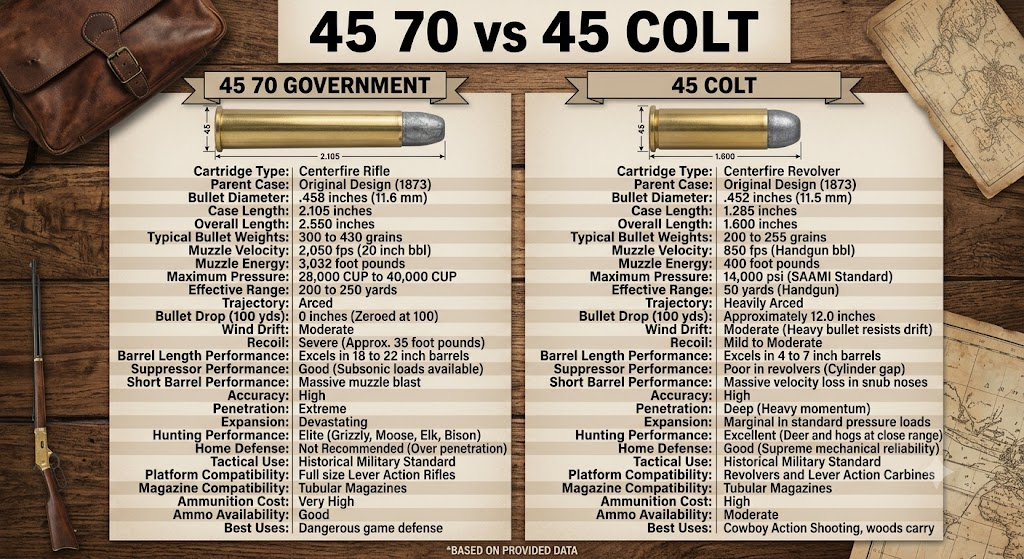
Understanding the Engineering
Both of these cartridges share a birth year of 1873, and both were adopted by the United States Military, but they were built for entirely different battlefields.
The 45 70 was adopted as the official rifle cartridge for the Springfield Trapdoor. It was originally loaded with 70 grains of black powder pushing a 405 grain lead bullet. It requires a massive, elongated case with a thick rim. Today, ammunition manufacturers produce high pressure loads specifically tailored for strong modern lever action rifles like the Marlin 1895. These modern loads push the ballistic capabilities of the 45 70 to extraordinary levels that far exceed its black powder origins.
The 45 colt was adopted as the official sidearm cartridge for the legendary Colt Single Action Army revolver used by the US Cavalry. Because it was originally designed during the black powder era, the brass case is very long to accommodate a large volume of powder. To ensure that modern smokeless ammunition does not blow up antique revolvers, standard 45 colt ammunition is strictly limited to a very low maximum pressure of 14,000 psi.
Velocity Comparison
Velocity dictates the trajectory flatness and the reliable expansion of modern hollow point bullets.
The 45 70 possesses a massive velocity advantage. Because it has a massive powder column designed for rifle barrels, the modern 325 grain Hornady load leaves the barrel at roughly 2,050 feet per second.
The 45 colt must overcome the inertia of a massive 250 grain bullet while operating at a much lower pressure in a short handgun barrel. This naturally restricts its maximum speed, leaving the muzzle at roughly 850 feet per second in standard factory loadings.
Muzzle Energy Comparison
Muzzle energy measures the absolute kinetic force transferred to a target upon impact.
The 45 70 operates in an entirely different universe of raw power. By generating over 3,000 foot pounds of energy with modern hunting loads, the 45 70 delivers devastating hydrostatic shock.
The 45 colt generates roughly 400 foot pounds of energy in standard pressure loads. While this is highly effective kinetic force against a human threat or a deer at close range, it possesses a fraction of the raw kinetic output of the massive rifle cartridge.
Trajectory Comparison
A flat trajectory minimizes the margin of error when estimating range for a hunter in the field.
Because the 45 70 drives heavier bullets much faster out of the muzzle, it shoots noticeably flatter. A hunter can comfortably hold dead on a target out to 150 yards with a modern 45 70. The 45 colt lobs its heavy projectile in a very steep arc, dropping rapidly past 50 yards when fired from a handgun.
Bullet Drop Comparison
Assuming a standard 100 yard zero for the 45 70 rifle, it will drop approximately 10.5 inches at 200 yards.
The 45 colt is practically unusable at 200 yards from a handgun. Assuming a 25 yard zero for a 45 colt revolver, the bullet drops over 12 inches by the time it reaches 100 yards, requiring extreme holdover estimation.
Wind Drift Comparison
Wind deflection is mitigated by a bullet’s velocity and its aerodynamic profile.
Neither cartridge utilizes sleek, highly aerodynamic bullets. However, because the 45 70 reaches the target exponentially faster, it spends far less time exposed to crosswinds. At 100 yards, the 45 70 will drift noticeably less than the slow moving 45 colt handgun bullet.
Recoil Comparison
Recoil dictates a shooter’s ability to fire rapid follow up shots and heavily influences shooter fatigue.
The 45 70 is brutally punishing. Pushing a 325 grain bullet to 2,050 fps from a manually operated lever action rifle transfers all the energy directly into the shooter’s shoulder. It generates approximately 35 foot pounds of free recoil. It hits with violent, bone jarring force.
The standard pressure 45 colt operates at a very low 14,000 psi. Firing a 45 colt from a heavy steel revolver produces a very slow, gentle, rolling push. It is exceptionally pleasant to shoot and practically eliminates shooter flinch.
Stopping Power Comparison
Stopping power requires a combination of adequate penetration, rapid energy transfer, and wide bullet expansion.
The 45 70 offers elite stopping power on the largest and most dangerous game on the planet. It is widely considered the ultimate defense cartridge against charging grizzly bears in dense timber. The massive kinetic energy combined with the .458 inch diameter literally crushes heavy bone and anchors massive predators with unmatched authority.
The 45 colt is a legendary man stopper. Standard pressure hollow points in this caliber often fail to expand because they travel too slowly. However, because the bullet is already nearly half an inch wide before it even hits the target, it crushes a massive permanent wound channel and causes rapid blood loss.
Penetration Comparison
Penetration is critical for ensuring the bullet reaches the vital organs of heavily armored animals.
The 45 70 is the undisputed champion in this category. A 400 grain 45 70 hard cast lead bullet possesses so much momentum that it will easily punch straight through both shoulders of a grizzly bear or bison and exit the other side.
The 45 colt penetrates exceptionally well for a handgun cartridge due to its heavy bullet mass, but it lacks the sheer plowing force required to punch through the thick shoulder plates of a moose or a large brown bear.
Expansion Comparison
To test expansion, the industry relies on calibrated ordinance gel.
A modern 45 70 soft point starts at .458 inches and will often mushroom to over .75 inches in diameter upon high velocity impact. A standard pressure 45 colt hollow point often struggles to open completely due to its low velocity. To get reliable expansion from a 45 colt, shooters must rely on very soft lead compositions or switch to high pressure hunting loads.
Accuracy Comparison
Both cartridges are capable of elite mechanical accuracy at close ranges.
The 45 70 is incredibly precise when fired from modern lever action or single shot rifles. The 45 colt is famous for its precision in single action revolvers, where the fixed barrel and crisp trigger pull allow for ragged hole groups at 25 yards.
Effective Range Comparison
The effective range of a straight walled cartridge is limited by bullet drop and retained energy.
The 45 70 is generally considered a 200 yard to 250 yard hunting round. Beyond 250 yards, it sheds energy rapidly and drops too steeply for ethical shots on game.
The practical effective range of the 45 colt is limited to 50 yards when fired from a handgun, or approximately 100 yards when fired from a lever action carbine rifle.
Suppressor Performance Comparison
Suppressors are highly effective on native subsonic cartridges, but the firearm platform matters entirely.
Because the 45 70 is manually operated, the action stays sealed during firing. This makes a suppressed lever action incredibly quiet when shooting heavy 400 grain subsonic ammunition.
Suppressing a 45 colt revolver is completely ineffective due to the cylinder gap. High pressure gases and noise escape from the small space between the cylinder and the barrel before ever reaching the silencer.
Short Barrel Performance Comparison
When you cut a barrel down, internal ballistics change drastically.
The 45 70 utilizes slower burning rifle powders. When you fire a full power load out of a 16 inch Guide Gun barrel, a significant amount of unburnt powder erupts outside the muzzle, resulting in a blinding fireball and a deafening concussive blast.
The 45 colt suffers terribly in short snub nose revolvers. The powder does not have enough time to burn completely before the massive bullet exits the muzzle, resulting in extreme velocity loss.
Home Defense Comparison
Inside the home, you must balance stopping power against over penetration.
The 45 70 is a terrible choice for suburban home defense. Firing a massive 45 70 indoors will blow clean through an intruder, through multiple interior drywall partitions, and easily penetrate the exterior of a neighboring house.
The 45 colt revolver holds 5 or 6 rounds and provides excellent stopping power with supreme mechanical reliability. The low operating pressures mean the indoor concussive blast is much less deafening than a modern .357 Magnum.
Hunting Comparison
Both cartridges are capable hunting tools, but they serve different roles.
The 45 70 is strictly superior for hunting massive animals like elk, moose, bison, and large brown bears. The heavy bone structures of these massive targets demand the extreme kinetic energy that the 45 70 provides.
The 45 colt is an excellent close range hunting cartridge. If you own a strong, modern revolver like a Ruger Blackhawk, you can purchase specialized high pressure ammunition for the 45 colt. These heavy loads push 300 grain hard cast bullets at 1,200 feet per second, transforming the antique cartridge into a highly capable big game hunting tool that rivals the .44 Magnum.
Platform Compatibility
The 45 70 is a massive rifle cartridge. It is absolutely incompatible with handguns, aside from a few novelty specialty revolvers like the Magnum Research BFR. Firing the 45 70 requires a large framed lever action rifle or a single shot rifle.
The 45 colt is primarily a revolver cartridge, but it is also exceptionally popular in lightweight, fast handling lever action carbines. A companion setup featuring a revolver and a lever action rifle chambered in the same 45 colt caliber is a legendary combination.
Ammo Cost Comparison
To become proficient with a heavy firearm, you must practice frequently.
Neither cartridge is cheap to shoot. They both require massive amounts of raw brass and heavy lead projectiles to manufacture. Standard practice ammunition for the 45 colt is typically priced at a premium. The 45 70 is a very expensive specialty cartridge, with premium hunting rounds costing double the price of modern intermediate rifle rounds.
Ammo Availability Comparison
Walk into any gun store in North America, and you will almost certainly find a few boxes of 45 70 sitting on the shelf. It is a classic that is heavily supported by ammunition manufacturers globally.
The 45 colt is slightly harder to find locally. While large sporting goods retailers carry a few boxes for Cowboy Action Shooting enthusiasts, it is frequently absent from small gun shops.
Reloading Comparison
Both cartridges are absolute favorites in the reloading community.
They are both straight walled cartridges, meaning they are incredibly easy and fast to reload using carbide dies. The 45 70 offers extreme versatility, allowing handloaders to craft mild, low recoil cast lead target loads or absolute maximum pressure bear defense loads depending on the strength of their rifle.
The 45 colt is a reloader’s dream cartridge. The massive case capacity allows for large variations in powder charges, letting shooters easily duplicate historical black powder velocities or craft modern heavy hunting loads.
Pros and Cons
45 70
Pros
- Generates over 3,000 foot pounds of kinetic energy.
- Elite stopping power on the largest, most dangerous game on the planet.
- Massive .458 caliber bullets create devastating wound channels.
- Supreme mechanical reliability in lever action rifles.
- Highly versatile for reloaders.
Cons
- Generates severe, bruising recoil in lightweight lever action rifles.
- Ammunition is very expensive.
- Massive concussive muzzle blast in short barrel configurations.
- Overkill for hunting small to medium game.
45 colt
Pros
- Incredibly mild recoil in heavy, full size revolvers.
- Chambered in lightweight, fast handling pistol caliber carbines.
- Can fire specialized high pressure hunting loads safely in strong revolvers.
- Deeply steeped in American Wild West history.
- Excellent stopping power through massive bullet diameter.
Cons
- Terrible velocity loss when fired from short snub nose barrels.
- Low velocity in standard loads results in poor hollow point expansion.
- Very steep trajectory limits effective range to 50 yards in handguns.
- Ammunition is significantly more expensive than modern 9mm calibers.
Final Verdict
Choosing between the 45 70 and the 45 colt comes down to deciding whether you need the sheer kinetic energy of a primary hunting rifle or the fast handling convenience of a classic revolver.
- For Elk, Moose, and Bear Defense: Choose the 45 70. There is no substitute for pure displacement. The massive 45 70 delivers the kinetic energy and deep penetration required to stop a charging apex predator instantly.
- For Woods Carry and Backup Protection: Choose the 45 colt. A strong modern revolver loaded with heavy cast lead 45 colt ammunition provides excellent protection against predators in a package you can comfortably wear on your hip all day.
- For Cowboy Action Competition: Choose the 45 colt. It is the undisputed king of the single action revolver, providing the exact authentic experience of the American frontier.
- For the Traditional Hunter: Choose the 45 70. The full size lever action rifle is an American classic, and carrying a big bore brush gun into the heavy timber provides a nostalgic and highly effective hunting experience.
FAQ
Are the 45 70 and 45 colt the same thing?
No. They are completely different cartridges. The 45 70 is a massive rifle cartridge that fires a .458 inch diameter bullet. The 45 colt is a much shorter handgun cartridge that fires a .452 inch diameter bullet. They cannot be fired in the same firearms.
Is the 45 70 more powerful than the 45 colt?
Yes, significantly. Because it possesses a massive rifle sized case capacity, the modern 45 70 generates over 3,000 foot pounds of kinetic energy, whereas the standard pressure 45 colt generates roughly 400 foot pounds of energy.
Can I shoot 45 colt in a 45 70 rifle?
Absolutely not. The chamber dimensions are entirely different, and the bullet diameters do not match. Attempting to fire a 45 colt in a 45 70 chamber will result in a catastrophic firearm failure and likely cause severe injury.
Can I shoot a bear with a 45 colt?
If you are carrying a strong, modern revolver like a Ruger Blackhawk, you can load specialized high pressure 45 colt ammunition that is highly effective for black bear defense. However, for massive coastal brown bears or grizzlies, the 45 70 rifle is universally recommended over any handgun cartridge.
Does a 45 70 kick hard?
Yes. Firing a massive 325 grain bullet out of a lightweight lever action rifle generates a heavy recoil impulse. It produces roughly 35 foot pounds of free recoil, which is a sharp, heavy blow to the shoulder that requires strong shooting fundamentals to manage comfortably.