The main difference between 10mm and .45 ACP for bear defense is that the 10mm Auto delivers much higher velocity and utilizes heavy hard cast bullets to achieve the deep, straight line penetration necessary to crush a bear’s skull and heavy bones, while the .45 ACP relies on a slower, wider bullet that often lacks the kinetic energy to reach the vital organs of a large grizzly. When venturing into backcountry territory inhabited by apex predators, choosing between these two semi automatic platforms requires understanding velocity, muzzle energy, recoil, trajectory, bullet drop, penetration, expansion, and effective range. In this comprehensive, data driven guide, we will compare these vital metrics so you can confidently decide which cartridge belongs in your chest holster.
10mm vs .45 ACP for Bear Defense Comparison Table
To understand how these cartridges perform against a 600 to 800 pound predator, we must look at their maximum ballistic potential. The data below represents premium, heavy for caliber, hard cast lead factory loads from specialized manufacturers like Underwood Ammo and Buffalo Bore. Standard target ammunition is irrelevant for this specific defensive application.
| Specification | 10mm Auto (Bear Load) | .45 ACP +P (Bear Load) |
|---|---|---|
| Cartridge Type | Semi-Automatic Handgun | Semi-Automatic Handgun |
| Parent Case | .30 Remington | .200 Winchester |
| Bullet Diameter | .400 in (10.17 mm) | .451 in (11.43 mm) |
| Case Length | 0.992 in | 0.898 in |
| Overall Length | 1.260 in | 1.275 in |
| Typical Bear Bullet Weights | 200 gr to 220 gr | 230 gr to 255 gr |
| Muzzle Velocity (5″ bbl) | 1,200 fps (220gr) to 1,250 fps (200gr) | 925 fps (255gr +P) |
| Muzzle Energy (5″ bbl) | 703 ft-lbs (220gr) | 484 ft-lbs (255gr +P) |
| Maximum Pressure | 37,500 psi (SAAMI) | 23,000 psi (SAAMI +P) |
| Effective Range (Bear) | 0 to 50 yds | 0 to 25 yds |
| Trajectory | Flat | Arced |
| Bullet Drop (50 yds) | Approx. 1.5 inches | Approx. 3.0 inches |
| Wind Drift | Minimal at defensive ranges | Minimal at defensive ranges |
| Recoil | Sharp, heavy, snappy | Heavy, but rolling |
| Barrel Length Performance | Maximizes velocity in 5 to 6 inch barrels | Performs adequately in 4 to 5 inch barrels |
| Suppressor Performance | Poor (Supersonic crack) | Good (Often remains subsonic) |
| Short Barrel Performance | Loses velocity, high muzzle flash | Moderate velocity loss |
| 16 inch vs 10.5 inch (PCC) | Massive velocity gains in 16 inch barrels | Minimal gains due to fast burning powder |
| Accuracy | High (Requires strong grip control) | High (Easier recoil management) |
| Penetration | Extreme (30+ inches in gel/tissue) | Moderate to Deep (20+ inches) |
| Expansion | Zero (Hard cast prevents deformation) | Zero (Hard cast prevents deformation) |
| Hunting Performance | Excellent (Capable of taking medium to large game) | Marginal (Close range only) |
| Home Defense | Not Recommended (Extreme over penetration) | Good (If using hollow points, not hard cast) |
| Tactical / Duty Use | Elite for Wildlife and Forestry Agencies | Historical Military and Police standard |
| AR-15 Compatibility | Yes (AR-10mm Pistol Caliber Carbines) | Yes (AR-45 Pistol Caliber Carbines) |
| Magazine Compatibility | High (15 rounds in Glock 20) | Moderate (13 rounds in Glock 21) |
| Ammunition Cost | High | High |
| Ammo Availability | Specialty or Online | Specialty or Online |
| Reloading | Yes (Requires heavy recoil springs) | Yes (Requires +P rated components) |
| Best Uses | Grizzly and Brown Bear defense, woods carry | Black bear defense, general woods carry |
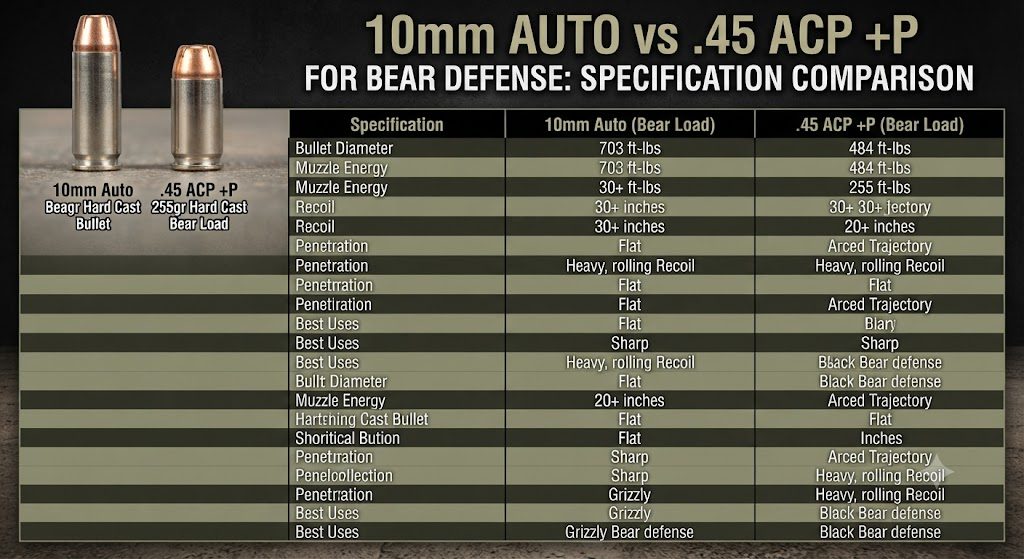
Understanding the Numbers
When analyzing bear defense, standard full metal jacket (FMJ) and jacketed hollow point (JHP) ammunition must be entirely discarded from the conversation. Bears possess incredibly thick hides, heavily matted fur, thick layers of dense adipose tissue, and massive, sloping bone structures. Hollow points expand too rapidly, deploying their energy in the fat layer and failing to reach the vitals.
Therefore, the only viable choice for either cartridge is a hard cast flat nose bullet. Hard cast bullets are alloyed with antimony and tin to prevent them from deforming upon impact. They feature a wide, flat front called a meplat that cuts a clean hole through tissue and crushes bone without deflecting.
Looking at the table, the 10mm Auto generates 37,500 psi of pressure, allowing it to push a 220 grain hard cast bullet at 1,200 feet per second. The .45 ACP, even in over pressured (+P) variants, operates at a much lower 23,000 psi, pushing a heavier 255 grain hard cast bullet at only 925 feet per second. This massive disparity in velocity and pressure dictates everything about their respective terminal performance on dangerous game.
Velocity Comparison
Velocity is the critical engine that drives deep penetration. Without adequate speed, even the heaviest bullet will halt prematurely in dense animal tissue.
Muzzle Velocity Data (5 inch barrel):
- 10mm (Underwood 200gr Hard Cast Flat Nose): 1,250 fps
- 10mm (Underwood 220gr Hard Cast Flat Nose): 1,200 fps
- .45 ACP (Buffalo Bore 255gr Hard Cast +P): 925 fps
- .45 ACP (Underwood 255gr Hard Cast +P): 925 fps
The 10mm Auto is undeniably faster. By utilizing higher chamber pressures, it easily breaks the 1,200 fps threshold even when loaded with massive 220 grain projectiles. This speed is non negotiable when attempting to punch through the thick, sloped frontal plate of a grizzly bear’s skull.
The .45 ACP is severely handicapped by its low pressure case design. Because the cartridge was engineered in 1904 to fire standard 230 grain bullets at 850 fps, pushing it past 925 fps with a 255 grain bullet requires specialized +P brass and heavy recoil springs, yet it still falls nearly 300 fps short of the 10mm.
Winner: 10mm Auto
For bear defense, the 10mm provides the raw speed necessary to drive solid projectiles deep into dense bone and muscle.
Muzzle Energy Comparison
Muzzle energy, measured in foot pounds, illustrates the kinetic force transferred to the target upon impact.
Muzzle Energy Data (5 inch barrel):
- 10mm (Underwood 220gr Hard Cast): 703 ft-lbs
- 10mm (Underwood 200gr Hard Cast): 694 ft-lbs
- .45 ACP (Buffalo Bore 255gr +P): 484 ft-lbs
Because the formula for kinetic energy heavily favors velocity over mass, the 10mm Auto completely outclasses the .45 ACP. The 10mm routinely generates over 700 ft-lbs of energy with heavy bear loads. This places the semi automatic 10mm squarely in the performance territory of the .357 Magnum revolver.
The .45 ACP +P maxes out just shy of 500 ft-lbs of energy. While this is devastating against a human threat, a 600 pound bear charged with adrenaline can absorb 500 ft-lbs of energy with terrifying ease if the bullet does not strike the central nervous system.
Winner: 10mm Auto
The 10mm Auto delivers roughly 45% more kinetic energy than the hottest .45 ACP +P loads on the market.
Trajectory Comparison
In a defensive bear scenario, the target is usually charging from within 25 yards at speeds approaching 35 miles per hour (roughly 50 feet per second). You will not be calculating bullet trajectory while being charged. However, trajectory matters if you are forced to take a shot at a predator stalking you or mauling a partner at 50 yards.
The 10mm Auto, traveling at 1,200 fps, shoots remarkably flat. A 220 grain bullet zeroed at 25 yards will drop less than 1.5 inches at 50 yards. You can place the front sight directly on the animal’s vitals and squeeze the trigger.
The .45 ACP +P, traveling at a sluggish 925 fps, has a noticeably arced trajectory. At 50 yards, a heavy 255 grain bullet will drop roughly 3 to 4 inches. While this is not extreme, it adds an element of vertical holdover estimation that the 10mm does not require.
Winner: 10mm Auto
The 10mm shoots significantly flatter, removing vertical guesswork at extended defensive ranges.
Bullet Drop Comparison
Let us look at the mathematical drop using these specific heavy cast bear loads, assuming a 25 yard zero.
| Distance | .45 ACP +P (255gr Hard Cast) | 10mm Auto (220gr Hard Cast) |
|---|---|---|
| 10 Yards | 0 inches | 0 inches |
| 25 Yards | 0 inches | 0 inches |
| 50 Yards | -3.5 inches | -1.2 inches |
| 75 Yards | -10.2 inches | -4.5 inches |
| 100 Yards | -22.0 inches | -10.8 inches |
Inside 25 yards (where 99% of bear attacks occur) bullet drop is mathematically irrelevant for both cartridges.
However, if you are acting in defense of a third party at 75 yards, the .45 ACP drops over 10 inches, whereas the 10mm drops less than 5 inches. If you must thread a needle to hit a bear’s vitals without hitting the person it is attacking, the flatter trajectory of the 10mm is a massive tactical advantage.
Winner: 10mm Auto
The 10mm cuts bullet drop in half at extended handgun distances.
Wind Drift Comparison
Wind deflection is mitigated by a bullet’s velocity and its ballistic coefficient (BC).
Hard cast flat nose bullets have terrible ballistic coefficients; they are aerodynamically similar to flying bricks. Because both cartridges utilize flat nosed profiles, velocity is the only mitigating factor against crosswinds.
Because the 10mm Auto reaches the target faster, it spends less time exposed to the wind. In a 20 mph crosswind at 50 yards, the 10mm will drift noticeably less than the .45 ACP. Again, while wind drift is a minor concern at 10 yards, it becomes highly relevant if taking a longer shot across a windy Alaskan ridge.
Winner: 10mm Auto
Higher velocity translates to less wind deflection.
Recoil Comparison
In a bear attack, you must put as many rounds on target as accurately and rapidly as humanly possible. Recoil dictates your split times between shots.
The .45 ACP +P generates a heavy but manageable push recoil impulse. Because it operates at a lower pressure, the slide velocity is slightly slower, and many shooters find it relatively easy to return the sights to the target after each shot.
The 10mm Auto (firing a 220gr load at 1,200 fps) generates a violent, snappy recoil impulse. In a polymer framed gun like the Glock 20, the muzzle flip is severe. It requires aggressive grip strength, locked wrists, and significant training to fire 3 to 4 aimed shots per second.
Winner: .45 ACP
The .45 ACP is significantly easier to control under stress, allowing for faster, more accurate follow up shots for the average shooter.
Stopping Power Comparison
When dealing with bears, stopping power has a very specific physiological definition. You cannot rely on a bear bleeding to death to stop a charge. A grizzly with a destroyed heart can still live for 30 to 60 seconds (more than enough time to kill you). True stopping power requires physically destroying the Central Nervous System (CNS) by penetrating the brain or snapping the cervical spine.
The .45 ACP possesses a wider starting diameter of .451 inches. If you hit a bear in the lungs, the .45 ACP will crush a marginally wider hole than the 10mm, resulting in slightly faster blood loss. However, blood loss is too slow to stop a charge.
To hit the CNS, the bullet must punch straight through the thickest, hardest bones in the animal’s body. The 10mm Auto has the kinetic energy (700+ ft-lbs) and the speed (1,200 fps) required to shatter a grizzly’s skull or break its heavy shoulder joints. The .45 ACP often lacks the velocity to breach heavy bone, increasing the risk that the bullet will glance off a sloped skull plate.
Winner: 10mm Auto
The 10mm provides the sheer force necessary to reach and destroy a bear’s central nervous system.
Penetration Comparison
This is the single most important metric for bear defense.
To understand penetration, we must look at Sectional Density (SD), which is the ratio of a bullet’s weight to its diameter.
- A 220 grain .400 caliber (10mm) bullet has an SD of .195.
- A 255 grain .451 caliber (.45 ACP) bullet has an SD of .179.
Because the 10mm bullet is narrower and relatively heavier for its caliber, it concentrates its force onto a smaller surface area. When combined with its 1,200 fps velocity, a 220 grain 10mm hard cast bullet acts like an industrial drill bit. In ballistic gel tests (and real world field reports), full power 10mm hard cast loads routinely penetrate 30 to 40 inches. It will shoot cleanly through a bear end to end.
The .45 ACP 255 grain bullet, being wider and slower, acts more like a snowplow. It meets more resistance as it travels through tissue. While it will penetrate deeply (often 20+ inches), it cannot match the extreme barrier blind penetration of the 10mm.
Winner: 10mm Auto
The 10mm Auto’s superior sectional density and velocity make it one of the deepest penetrating semi automatic cartridges in existence.
Expansion Comparison
In bear defense, expansion is your enemy.
If you load either of these firearms with standard Jacketed Hollow Points (JHPs) intended for human threats (like Federal HST or Speer Gold Dot), you are putting yourself in grave danger.
A hollow point is designed to open up rapidly upon hitting fluid based tissue. If you shoot a brown bear in the shoulder with a 10mm JHP, the bullet will expand to .65 inches, dump all its energy into the bear’s 4 inch layer of shoulder fat, and stop completely before ever reaching the lungs or heart. The bear will be enraged, but not incapacitated.
This is why hard cast bullets are mandatory. They are designed for zero expansion. The flat meplat on the front of the bullet does not mushroom. It stays rigid, cutting a full caliber permanent wound channel as deeply as possible.
Winner: Tie
When using the correct hard cast ammunition, neither bullet should expand at all.
Accuracy Comparison
Mechanical accuracy is largely irrelevant in a bear attack. Practical accuracy (the ability to put rounds on a moving target under extreme physiological stress) is what matters.
The .45 ACP is inherently an incredibly accurate cartridge, and its milder recoil makes it easier to track the front sight through the recoil impulse.
The 10mm Auto is mechanically precise, but anticipating the heavy recoil often causes shooters to flinch or push the muzzle down just before the shot breaks, resulting in low impacts. Furthermore, many shooters allow their wrists to break under the 10mm’s recoil, which can induce a limp wrist malfunction where the pistol fails to cycle properly.
Winner: .45 ACP
Under the terror of a bear charge, the more manageable recoil of the .45 ACP makes it easier to achieve combat effective accuracy.
Effective Range Comparison
For bear defense, the effective range is dictated by threat proximity, not ballistics. A bear is generally not a legal or moral threat until it closes within 25 yards and exhibits charging behavior.
However, looking at terminal ballistics, the .45 ACP +P drops below 400 ft-lbs of energy very quickly, limiting its deep penetration capability to very close ranges. The 10mm Auto retains over 500 ft-lbs of energy out past 50 yards, giving it a much longer mechanical effective range if you are forced to shoot at distance.
Winner: 10mm Auto
It retains lethal energy and penetration capability much further downrange.
Suppressor Performance Comparison
While hikers rarely carry suppressed pistols due to the added weight and length, camp defense guns or PCCs are often suppressed.
The 10mm Auto bear loads are entirely supersonic (1,200+ fps). A suppressor will tame the muzzle blast, but the loud supersonic crack of the bullet breaking the sound barrier will remain.
The .45 ACP +P bear loads (at 925 fps) are entirely subsonic. If you attach a suppressor to a .45 ACP, it eliminates both the muzzle blast and the sonic crack. It is remarkably quiet and highly effective for suppressed shooting.
Winner: .45 ACP
Because heavy .45 ACP loads are natively subsonic, it is a far superior suppressor host.
Short Barrel Performance Comparison
Many backcountry anglers and hikers prefer compact handguns (like the Glock 29 in 10mm or the Glock 30 in .45 ACP) to save weight.
When you cut a 10mm barrel down from 5 inches to 3.7 inches (Glock 29), you lose a significant amount of velocity, often dropping a 1,200 fps load down to roughly 1,080 fps. Additionally, the unburnt powder creates a massive fireball. However, even handicapped, a 220gr bullet at 1,080 fps still hits with roughly 570 ft-lbs of energy.
The .45 ACP uses very fast burning powders. Dropping from a 5 inch barrel to a 3.7 inch barrel (Glock 30) usually only costs the .45 ACP about 50 to 75 fps. It retains its ballistic efficiency very well in short barrels.
Winner: 10mm Auto
Even with the severe velocity penalty of a short barrel, the 10mm still mathematically outperforms the .45 ACP in kinetic energy and penetration.
16 inch vs 10.5 inch Barrel Performance
Pistol Caliber Carbines (PCCs) like the CMMG Banshee, Kriss Vector, or AR platform PCCs are incredibly popular for defending stationary backcountry camps or cabins against bears.
- 10mm Auto: The 10mm utilizes medium burn pistol powders that thrive in longer barrels. Moving from a 10.5 inch to a 16 inch barrel allows the 10mm to reach its absolute maximum potential. A 220 grain hard cast load out of a 16 inch carbine barrel can easily exceed 1,400 fps, generating nearly 1,000 ft-lbs of energy. This turns the 10mm into a true rifle caliber equivalent at close range.
- .45 ACP: Because it uses low pressure, fast burning powder, the .45 ACP achieves full powder burn within the first 8 to 10 inches of barrel. Moving from a 10.5 inch to a 16 inch barrel yields practically zero velocity gain (and sometimes a slight loss due to barrel friction).
Winner: 10mm Auto
If you are using a carbine for camp defense, the 10mm scales massively with longer barrel lengths, whereas the .45 ACP stagnates.
Home Defense Comparison
While this article focuses on bears, many gun owners want one pistol to pull double duty for both the woods and the nightstand.
If you load a 10mm Auto with 220 grain hard cast ammunition and fire it inside a suburban home, you will shoot through the intruder, through three interior walls, through the exterior siding, and into your neighbor’s house. Extreme penetration is a massive liability in an urban environment.
The .45 ACP is the king of home defense. If you swap your woods carry hard cast ammo for standard 230 grain Jacketed Hollow Points (like Federal HST), the .45 ACP expands to nearly an inch wide, dumps all its energy into the intruder, and rarely over penetrates drywall.
Winner: .45 ACP
For urban environments, the .45 ACP is vastly safer and highly effective. (Note: If using 10mm for home defense, you MUST switch to lightweight, rapidly expanding hollow points to mitigate over penetration).
Hunting Comparison
Occasionally, hunters carry a handgun as a primary weapon to intentionally hunt bears or wild hogs.
Hunting requires ethical, one shot kills, usually taken at distances of 20 to 50 yards on unaware animals.
The .45 ACP simply lacks the kinetic energy and flat trajectory to be considered a viable primary hunting cartridge for large game.
The 10mm Auto, particularly out of a 6 inch barrel (like a Glock 40 or SIG P320 XTen) equipped with a red dot sight, is a highly capable hunting tool. The 700+ ft-lbs of energy and deep penetrating capabilities allow ethical harvests of deer, hogs, and black bears at close range.
Winner: 10mm Auto
The 10mm provides the necessary range, energy, and penetration for ethical hunting.
Tactical / Duty Use Comparison
In the context of wildlife management, the 10mm Auto is the undisputed champion. The Sirius Dog Sled Patrol (an elite Danish naval unit patrolling Greenland) issues the 10mm Glock 20 specifically for defense against polar bears. Dozens of U.S. state wildlife agencies and Alaskan fishing guides issue the 10mm as the standard duty sidearm for bear protection.
The .45 ACP has a legendary history with the U.S. military and urban SWAT teams, but it has practically zero footprint in modern wildlife agency duty holsters.
Winner: 10mm Auto
The 10mm is the gold standard for professionals working in apex predator territory.
AR-15 Compatibility
Both cartridges are widely available in AR style Pistol Caliber Carbines (AR-9, AR-45, or AR-10mm platforms).
- An AR-45 is an excellent, quiet, low recoil platform for plinking and home defense.
- An AR-10mm is a devastatingly powerful camp defense weapon. Because the AR platform allows for heavier buffers and stiffer springs, it tames the violent recoil of the 10mm beautifully, allowing the shooter to deliver 1,000+ ft-lb impacts with practically zero muzzle rise.
Winner: 10mm Auto
In a carbine platform, the 10mm offers vastly superior terminal ballistics.
Magazine Compatibility
When facing a charging grizzly, ammunition capacity is your only insurance policy against missed shots under panic.
The .45 ACP is a very wide cartridge. A standard 1911 holds only 8 rounds. A double stack Glock 21 holds 13 rounds, but the grip is notoriously thick and blocky.
The 10mm Auto is narrower. A standard Glock 20 flush fit magazine holds 15 rounds of full power 10mm. Having 15 rounds of .357 Magnum equivalent power that can be deployed as fast as you can pull the trigger is the primary reason the 10mm has largely replaced the 6 shot .44 Magnum revolver in the backcountry.
Winner: 10mm Auto
More capacity means a higher probability of scoring a critical CNS hit during a chaotic attack.
Ammo Cost Comparison
Standard target ammunition for .45 ACP is relatively cheap and available everywhere. Standard 10mm target ammo is roughly 20% to 30% more expensive.
However, for bear defense, you must buy specialized hard cast ammunition (like Buffalo Bore, Underwood, or DoubleTap). These premium, boutique loads cost exactly the same for both calibers, usually hovering around $1.50 to $2.00 per round.
Winner: Tie
Premium hard cast bear ammunition is equally expensive for both calibers.
Ammo Availability Comparison
You can find .45 ACP target ammo in any hardware store in America. 10mm target ammo is slightly harder to find in rural areas.
However, trying to find 255gr hard cast .45 ACP +P on a store shelf is nearly impossible; it must almost always be ordered online. Conversely, because the 10mm is so heavily associated with bear defense, sporting goods stores in Alaska, Montana, and Idaho regularly stock 10mm hard cast loads on the shelf.
Winner: 10mm Auto
In bear country, stores are much more likely to stock heavy 10mm field loads than heavy .45 ACP field loads.
Reloading Comparison
Handloading for bear defense requires extreme caution.
- 10mm: Reloading 10mm to maximum pressure requires robust brass and careful powder metering. Because it operates at 37,500 psi, a slight over charge can catastrophically destroy the firearm.
- .45 ACP: Pushing the .45 ACP to +P velocities with a massive 255 grain bullet leaves very little case capacity for powder. Seating the bullet too deeply will violently spike chamber pressures.
Winner: Tie
Reloading heavy hard cast loads for maximum velocity requires advanced handloading skills for both cartridges.
Pros and Cons
10mm Auto (Bear Defense)
Pros
- Delivers 700+ ft-lbs of kinetic energy (matching .357 Magnum).
- Deep, 30+ inch penetration required to crush grizzly skulls.
- High magazine capacity (15+1 in standard full size frames).
- Flat trajectory makes longer defensive shots easier.
- The standard issue sidearm for many professional wildlife agencies.
Cons
- Violent, snappy recoil makes rapid follow up shots difficult.
- Requires expensive, specialty hard cast ammunition to be effective.
- Extreme over penetration makes it a liability in urban environments.
.45 ACP (Bear Defense)
Pros
- Milder, rolling recoil allows for faster, more accurate follow up shots.
- Readily available platforms (1911s, Glock 21s) that many shooters already own.
- Safer to dual purpose for home defense (when swapped to JHP ammo).
- Highly effective suppressor host.
Cons
- Lacks the kinetic energy necessary for reliable stops on large grizzlies.
- Cannot penetrate as deeply through thick bone as the narrower 10mm.
- Lower magazine capacity compared to 10mm platforms.
- Requires +P rated firearms and heavy springs to shoot bear loads safely.
Final Verdict
When your life depends on stopping a charging apex predator, the physics are absolute. You need velocity, sectional density, and deep penetration.
- For Grizzly and Brown Bear Defense: 10mm Auto. This is not a contest. The 10mm provides the raw kinetic energy and 30+ inches of straight line penetration required to shatter a grizzly’s skull and reach the central nervous system.
- For Black Bear and Cougar Defense: 10mm Auto. While a .45 ACP can easily dispatch a smaller black bear or cougar, the 10mm still provides superior terminal ballistics and higher magazine capacity.
- For Shooters with Extreme Recoil Sensitivity: .45 ACP. A .45 ACP +P hard cast load is better than missing entirely with a 10mm you cannot control. If you cannot manage the snappy recoil of the 10mm under stress, the .45 ACP is your next best semi auto option.
- For Camp Defense Carbines (PCCs): 10mm Auto. The 10mm gains massive velocity from a 16 inch barrel, turning it into a true rifle power threat against bears.
- For Dual Purpose Home and Woods Carry: .45 ACP. If you can only afford one pistol and live in the suburbs but occasionally hike in black bear country, the .45 ACP is safer for the home (with JHPs) and adequate for the woods (with Hard Cast).
FAQ
Is 10mm enough for a grizzly bear?
Yes. When loaded with 200 grain or 220 grain hard cast flat nose ammunition, the 10mm Auto has proven highly effective at penetrating grizzly bear skulls and stopping charges. It is widely carried by Alaskan guides and wildlife troopers.
Will standard .45 ACP stop a bear?
Standard 230 grain .45 ACP Full Metal Jacket (FMJ) or Hollow Point ammunition is highly discouraged for bear defense. It lacks the velocity and sectional density to penetrate thick bear bone reliably. You must use specialized +P hard cast loads.
Why should I not use hollow points for bear defense?
Hollow points are designed to expand rapidly in fluid. A bear has thick hide and several inches of dense fat. A hollow point will expand in the fat layer and stop before ever reaching the heart, lungs, or central nervous system.
What is a hard cast bullet?
A hard cast bullet is made from a lead alloy mixed with antimony and tin to make it extremely hard. It is designed not to deform or expand upon impact, allowing it to punch straight through heavy bone and dense muscle to reach vital organs.
Does a Glock 20 10mm have a lot of recoil?
Yes. Firing full power bear loads out of a polymer framed Glock 20 generates a sharp, snappy recoil impulse. It requires a firm grip, locked wrists, and practice to shoot rapidly and accurately.
Which gun holds more ammo, 10mm or .45 ACP?
The 10mm generally holds more ammo. Because the cartridge is narrower, a standard Glock 20 holds 15 rounds of 10mm, whereas a similarly sized Glock 21 holds 13 rounds of .45 ACP.
Can I shoot .45 ACP +P in any .45 handgun?
No. You must verify with your firearm’s manufacturer that the gun is rated for +P (over pressure) ammunition. Firing +P bear loads in an older or unrated 1911 can cause accelerated wear or catastrophic failure.
Where should you aim at a charging bear?
You should aim for the central nervous system (CNS), specifically the brain and face or the spine directly between the front shoulders. A heart and lung shot will kill the bear eventually, but it may still live long enough to maul you.
Is a 10mm better than a .44 Magnum for bears?
The .44 Magnum revolver is significantly more powerful per shot than the 10mm. However, the 10mm offers 15 rounds compared to 6, vastly faster reload times, and less recoil, making it the preferred choice for those who prioritize capacity and speed over raw single shot power.
Do I need a longer barrel for 10mm bear defense?
While a 5 inch or 6 inch barrel (like the Glock 40) maximizes the velocity of the 10mm, standard 4 inch to 4.5 inch barrels (like the Glock 20 or M&P 10mm) provide plenty of velocity to achieve lethal penetration on bears.