A 35 Remington Trajectory Chart serves as a vital guide for hunters who utilize this classic, medium range cartridge, detailing the vertical flight path and bullet drop from 50 to 300 yards. Because this cartridge is primarily used in lever action rifles for woodland and brush hunting, understanding its rapid trajectory arc is essential for maintaining ethical shot placement. By utilizing verified factory ammunition data, this chart provides a clear expectation of how various bullet weights perform, allowing shooters to adjust their point of aim effectively. Mastering these ballistic figures ensures that your rifle remains a reliable tool for harvesting medium game within its optimal engagement window.
35 Remington Trajectory Chart
| Manufacturer | Load Name | Weight (gr) | Type | BC | MV (fps) | 50y Drop | 100y Drop | 150y Drop | 200y Drop | 250y Drop | 300y Drop | Zero (y) |
| Hornady | LEVERevolution | 200 | FTX | 0.300 | 2225 | +0.8 | 0.0 | -4.6 | -13.6 | -27.8 | -48.2 | 100 |
| Remington | Core-Lokt | 200 | RN | 0.160 | 2080 | +1.1 | 0.0 | -6.9 | -19.8 | -41.2 | -72.6 | 100 |
| Federal | Power-Shok | 200 | FN | 0.155 | 2080 | +1.1 | 0.0 | -7.0 | -20.1 | -42.0 | -74.1 | 200 |
| Buffalo Bore | Heavy | 220 | FN | 0.170 | 2200 | +0.9 | 0.0 | -5.8 | -16.9 | -34.8 | -61.2 | 100 |
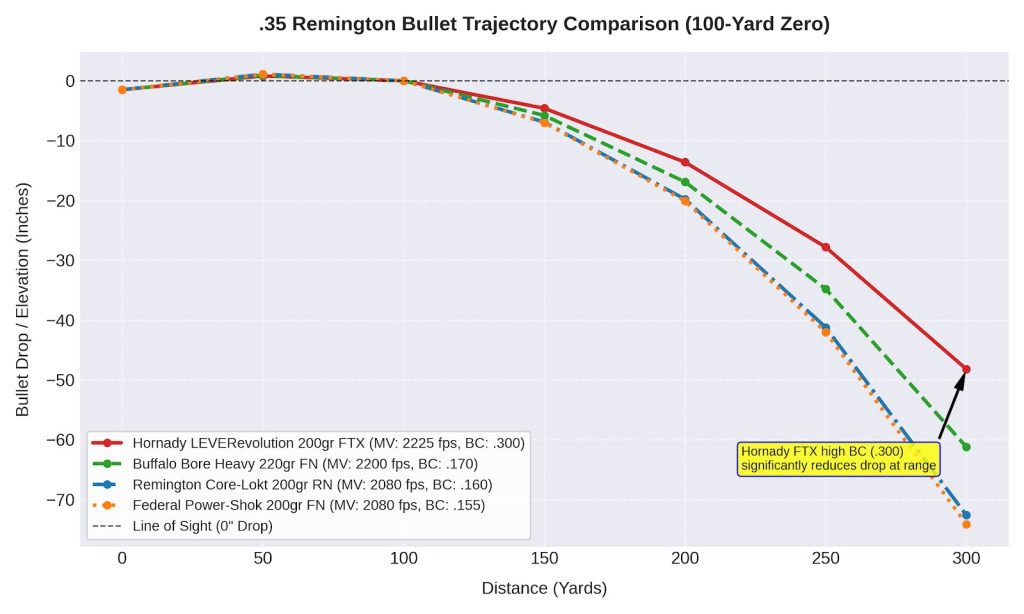
To effectively use this trajectory chart, shooters must first confirm which specific factory load is being utilized, as the ballistic coefficients vary significantly between traditional round nose bullets and modern polymer tipped designs. By establishing a 100 yard zero, you can easily determine the necessary holdover by referencing the drop in inches for your target distance. For instance, the Hornady FTX load drops 13.6 inches at 200 yards, while the traditional Remington round nose load drops nearly 20 inches at the same distance, highlighting the importance of choosing the right ammunition for your specific shooting range.
Understanding The 35 Remington Trajectory Chart
The values presented in the table are derived from standardized test conditions and serve as the baseline for your field ballistic planning. Treating these numbers as your guide will help you understand the limitations and strengths of the 35 Remington.
Trajectory Analysis
The trajectory of the 35 Remington is defined by its low muzzle velocity and the requirement for flat or round nose bullet profiles. The Hornady FTX, with its polymer tip, shows a much flatter curve, dropping 48.2 inches at 300 yards. In contrast, the traditional Remington Core-Lokt round nose bullet drops 72.6 inches at that same distance. This clearly illustrates that the 35 Remington is best suited for engagements within 200 yards.
Velocity Analysis
Muzzle velocity for the 35 Remington is typically moderate, ranging from 2080 to 2225 fps. The Hornady LEVERevolution load is the fastest in the table at 2225 fps, which provides a flatter initial flight path. Loads like the standard 200 grain round nose offerings at 2080 fps rely on momentum rather than speed, resulting in a significantly steeper arc at ranges beyond 150 yards.
Ballistic Coefficient Analysis
Ballistic coefficient is the primary differentiator between modern and traditional 35 Remington loads. The Hornady FTX possesses a BC of 0.300, which is nearly double that of the 0.160 BC found in traditional round nose projectiles. This allows the FTX to retain its velocity much further downrange, resulting in significantly less bullet drop and more retained energy at the 200 and 250 yard markers.
Best Factory Loads Based On The Chart
For the most versatile performance across a variety of ranges, the Hornady LEVERevolution 200 grain FTX is the clear winner, offering the flattest trajectory and best energy retention. For traditionalists hunting in thick brush at very close range, the 200 grain Remington Core-Lokt or Federal Power-Shok provides reliable, deep-penetrating performance. The Buffalo Bore 220 grain load is the recommended choice for hunters pursuing larger medium game where terminal impact energy is more important than flat trajectory.
Key Takeaways From The Chart
The 200 grain Hornady FTX load is the most aerodynamic factory option, providing the flattest flight path and most effective reach. The 100 yard zero is the most practical setting for this cartridge, keeping the bullet within the vital zone of deer sized game out to approximately 150 yards. The significant drop values past 200 yards demonstrate that the 35 Remington should be treated as a medium range cartridge rather than a long range tool.
Common 35 Remington Bullet Weights
The 35 Remington is optimized for heavy, medium caliber bullets that provide reliable terminal performance.
200 Grain
The 200 grain bullet is the standard weight for this cartridge and is available in various profiles, from traditional round nose to modern polymer tipped bullets. It offers an ideal balance of velocity and impact energy for deer hunting in woodland environments.
220 Grain
The 220 grain bullet is designed for hunters who require additional penetration for larger species. While it produces a steeper trajectory arc, its weight ensures significant energy transfer and consistent expansion on impact at close ranges.
Effective Range
Woodland Hunting
The 35 Remington is ideally suited for woodland hunting where shots are typically 100 yards or less. At these distances, the bullet weight and caliber ensure clean kills on deer.
Open Field Hunting
The 35 Remington’s effective range on deer in open fields is roughly 150 to 200 yards. Shooters must be prepared to adjust their holdover significantly if they choose to push this cartridge toward the 200 yard limit.
Brush Hunting
The 35 Remington is legendary for brush hunting. Within 100 yards, the 200 grain bullets are effective and consistent, though hunters should always prioritize clear lines of sight whenever possible.
Factors That Affect 35 Remington Trajectory
Bullet Profile
The flat or round nose profile of 35 Remington bullets is mandated by the tubular magazines of most rifles chambered in this caliber. This profile creates more drag, which limits the effective ballistic coefficient and flattens the range potential.
Muzzle Velocity
As a moderate pressure cartridge, the 35 Remington has limited room for velocity increases. Variations in barrel length can have a noticeable effect on the drop at ranges exceeding 150 yards.
Ballistic Coefficient
Choosing a higher BC bullet like the FTX can effectively add 50 yards of useful range to your rifle by reducing the vertical drop and wind drift.
Zero Distance
The 100 yard zero provides the most predictable performance. Shifting to a 150 or 200 yard zero is possible but can lead to misses on close range shots due to the pronounced height of the bullet arc.
Best Zero Distance
100 Yard Zero
The 100 yard zero is the industry standard for the 35 Remington. It provides a simple, “aim small, miss small” experience for the vast majority of hunting situations encountered by users of this cartridge.
150 Yard Zero
A 150 yard zero can be used to extend the point blank range, but it results in the bullet striking significantly higher at 50 yards. This is generally only recommended for hunters who are confident in their ability to compensate for the high mid range trajectory.
35 Remington Compared To Similar Cartridges
| Cartridge | Trajectory | Velocity | BC | Effective Range | Wind Drift | Recoil |
| 35 Rem | Moderate | Low | Low | 150y | High | Moderate |
| 30-30 Win | Moderate | Moderate | Low | 150y | Moderate | Low |
| 308 Win | Flat | High | High | 400y | Low | Moderate |
| 444 Marlin | Steep | Low | Low | 150y | High | Moderate |
The 35 Remington is often compared to the 30-30 Winchester. While the 30-30 offers a flatter trajectory and better ammunition availability, the 35 Remington provides a larger frontal diameter bullet, which many hunters believe results in better terminal performance on deer and black bear.
Frequently Asked Questions
What is the ideal engagement range for the 35 Remington?
The 35 Remington is most effective within 150 yards for most hunting applications.
Can I use the 35 Remington for elk?
It is generally considered marginal for elk and is best reserved for deer and black bear at moderate distances.
Why does the 35 Remington have a steep trajectory?
The trajectory is primarily limited by low muzzle velocity and the low ballistic coefficient of the required round nose bullet profiles.
Is the 35 Remington good for thick brush?
Yes, it is considered one of the finest brush cartridges due to its heavy, slow moving bullets.
What zero distance is recommended?
A 100 yard zero is the standard and most practical zero for the 35 Remington.
Are polymer tipped loads safe for tubular magazines?
Yes, the Hornady LEVERevolution FTX loads are specifically engineered with soft polymer tips to be safe in tubular magazines.
Is 35 Remington ammunition easy to find?
Ammunition availability can vary; it is often found seasonally and may be less common than mainstream cartridges like the 308 Winchester.
Does the 35 Remington have a lot of recoil?
It has moderate recoil that is generally considered very manageable for most shooters.
Can I hunt black bear with the 35 Remington?
Yes, it is a traditional and effective cartridge for black bear hunting in woodland habitats.
Why is the 35 Remington popular?
Its popularity stems from its heritage, its effectiveness in lever action rifles, and its reputation as a reliable deer and bear cartridge.
How would you like to proceed with your ballistics website development, or is there another cartridge trajectory chart you would like me to generate for your database?