The .44 Remington Magnum is a legendary straight-walled cartridge developed in the 1950s by Elmer Keith and Smith & Wesson. Originally designed for large-frame revolvers to deliver massive stopping power on dangerous game, it has also become a highly popular carbine and lever-action rifle round. Out of a longer rifle barrel, the cartridge gains significant velocity, flattening its trajectory and increasing kinetic energy for close-to-medium range hunting.
Table of Contents [Click to minimize]
44 Mag Ballistics: Bullet Drop and Trajectory Chart
Note: All data in this table is sourced directly from manufacturer-published specifications. Because the .44 Magnum is a pistol-caliber cartridge, long-range trajectory data is rarely published by manufacturers. Missing manufacturer data is strictly marked as “Not Published.”
| Manufacturer | Ammunition / Product | Bullet (gr & Type) | Zero Distance | Muzzle (Vel / Eng) | 100 Yards | 200 Yards | 300 Yards | 400 Yards | 500 Yards |
| Hornady | LEVERevolution (Rifle Data) | 225 gr FTX | 100 Yards | Vel: 1870 fps Eng: 1747 ft-lbs | Vel: 1545 fps Eng: 1192 ft-lbs Drop: 0.0″ | Vel: 1282 fps Eng: 821 ft-lbs Drop: -16.4″ | Vel: 1097 fps Eng: 602 ft-lbs Drop: -66.8″ | Vel: Not Pub. Eng: Not Pub. Drop: Not Pub. | Vel: Not Pub. Eng: Not Pub. Drop: Not Pub. |
| Hornady | Custom (Handgun Data) | 240 gr XTP | 50 Yards | Vel: 1350 fps Eng: 971 ft-lbs | Vel: 1122 fps Eng: 671 ft-lbs Drop: -6.1″ | Vel: Not Pub. Eng: Not Pub. Drop: Not Pub. | Vel: Not Pub. Eng: Not Pub. Drop: Not Pub. | Vel: Not Pub. Eng: Not Pub. Drop: Not Pub. | Vel: Not Pub. Eng: Not Pub. Drop: Not Pub. |
| Federal | HammerDown (Rifle Data) | 270 gr Soft Point | 100 Yards | Vel: 1715 fps Eng: 1763 ft-lbs | Vel: 1406 fps Eng: 1184 ft-lbs Drop: 0.0″ | Vel: 1163 fps Eng: 811 ft-lbs Drop: -18.7″ | Vel: Not Pub. Eng: Not Pub. Drop: Not Pub. | Vel: Not Pub. Eng: Not Pub. Drop: Not Pub. | Vel: Not Pub. Eng: Not Pub. Drop: Not Pub. |
| Federal | American Eagle | 240 gr JHP | 50 Yards | Vel: 1180 fps Eng: 742 ft-lbs | Vel: 994 fps Eng: 526 ft-lbs Drop: -7.5″ | Vel: Not Pub. Eng: Not Pub. Drop: Not Pub. | Vel: Not Pub. Eng: Not Pub. Drop: Not Pub. | Vel: Not Pub. Eng: Not Pub. Drop: Not Pub. | Vel: Not Pub. Eng: Not Pub. Drop: Not Pub. |
| Remington | High Terminal Perf. (HTP) | 240 gr JSP | 50 Yards | Vel: 1180 fps Eng: 742 ft-lbs | Vel: 994 fps Eng: 526 ft-lbs Drop: -7.5″ | Vel: Not Pub. Eng: Not Pub. Drop: Not Pub. | Vel: Not Pub. Eng: Not Pub. Drop: Not Pub. | Vel: Not Pub. Eng: Not Pub. Drop: Not Pub. | Vel: Not Pub. Eng: Not Pub. Drop: Not Pub. |
| Winchester | Super-X | 240 gr HSP | 50 Yards | Vel: 1180 fps Eng: 741 ft-lbs | Vel: 994 fps Eng: 526 ft-lbs Drop: -7.6″ | Vel: Not Pub. Eng: Not Pub. Drop: Not Pub. | Vel: Not Pub. Eng: Not Pub. Drop: Not Pub. | Vel: Not Pub. Eng: Not Pub. Drop: Not Pub. | Vel: Not Pub. Eng: Not Pub. Drop: Not Pub. |
| Barnes | VOR-TX Handgun | 225 gr XPB | 50 Yards | Vel: 1235 fps Eng: 762 ft-lbs | Vel: 1058 fps Eng: 559 ft-lbs Drop: -6.8″ | Vel: Not Pub. Eng: Not Pub. Drop: Not Pub. | Vel: Not Pub. Eng: Not Pub. Drop: Not Pub. | Vel: Not Pub. Eng: Not Pub. Drop: Not Pub. | Vel: Not Pub. Eng: Not Pub. Drop: Not Pub. |
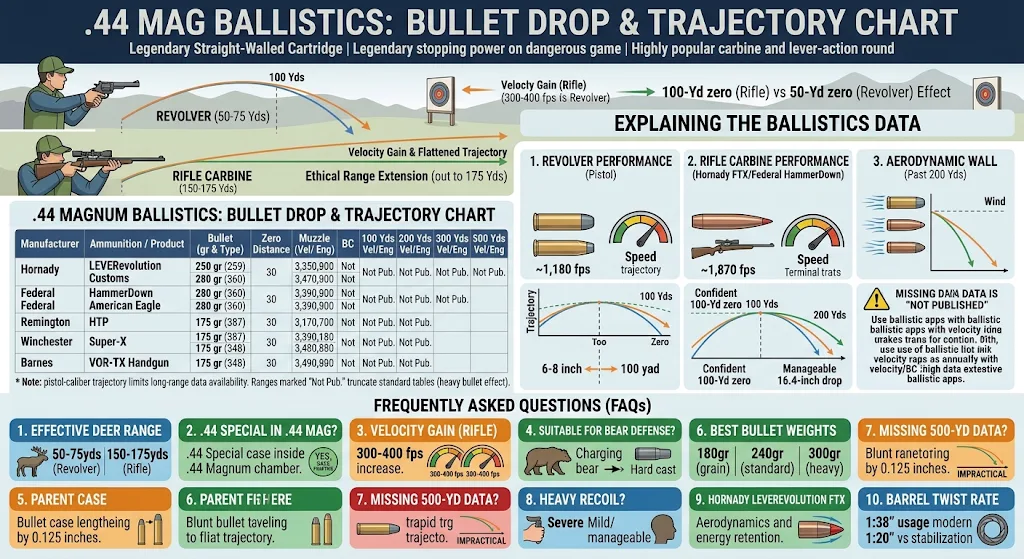
Explaining the Ballistics Data
The table above illustrates the dual nature of the .44 Magnum cartridge, which performs vastly differently depending on whether it is fired from a revolver or a carbine rifle. When fired from a standard handgun barrel (as seen with the Federal American Eagle or Remington HTP loads), the 240-grain bullets leave the muzzle at roughly 1,180 fps. Because these projectiles are heavy and aerodynamically blunt (low ballistic coefficients), they shed velocity quickly. When zeroed at 50 yards, a standard handgun load will drop between 6 and 8 inches by the time it reaches 100 yards, strictly limiting its ethical range.
Conversely, modern ammunition designed specifically for lever-action rifles such as Hornady’s LEVERevolution and Federal’s HammerDown completely transforms the cartridge. The Hornady 225-grain FTX, utilizing a flexible polymer tip for tubular magazine safety, pushes muzzle velocities to 1,870 fps out of a rifle barrel. This increased velocity allows hunters to confidently zero the rifle at 100 yards. At 200 yards, the LEVERevolution drops only 16.4 inches while retaining over 800 ft-lbs of energy. However, past 200 yards, the blunt shape of .44 caliber projectiles causes them to hit an aerodynamic wall; they drop precipitously, which is why major manufacturers practically never publish trajectory data for the .44 Magnum at 400 or 500 yards.
FAQs
1. What is the effective range of a .44 Magnum for deer hunting?
When fired from a revolver, the effective range is typically 50 to 75 yards, depending on the shooter’s proficiency. When fired from a carbine rifle using high-performance ammunition, the ethical effective range extends to roughly 150 to 175 yards.
2. Can I shoot .44 Special ammunition in a .44 Magnum?
Yes. Just as a .357 Magnum can safely fire .38 Special, any firearm chambered in .44 Magnum can safely chamber and fire .44 Special ammunition. This is an excellent way to practice with less recoil and lower ammunition costs.
3. How much velocity does the .44 Magnum gain in a rifle barrel?
Ammunition fired from an 18-inch or 20-inch carbine barrel typically gains between 300 and 400 feet per second (fps) over the same load fired from a standard 6-inch revolver barrel.
4. Is the .44 Magnum suitable for bear defense?
Yes, it is considered one of the premier backup calibers for defense against large predators. Heavily constructed 240-grain to 300-grain hard cast or jacketed soft point bullets offer the deep, bone-breaking penetration required to stop a grizzly or brown bear at close range.
5. What is the parent case of the .44 Remington Magnum?
The .44 Magnum was created by lengthening the older .44 Special case by 0.125 inches. This prevented the new, high-pressure Magnum rounds from being accidentally loaded into older, weaker firearms designed only for the .44 Special.
6. What is the best bullet weight for the .44 Magnum?
The 240-grain bullet is the gold standard for the .44 Magnum, offering an ideal balance of speed, trajectory, and penetration for most applications. Lighter 180-grain bullets are available for reduced recoil, while 300-grain bullets are preferred for hunting heavy, thick-skinned game.
7. Why don’t manufacturers publish 500-yard ballistics for the .44 Mag?
The .44 Magnum fires heavy, blunt projectiles with poor aerodynamics. By the time the bullet reaches 300 yards, it is falling rapidly and losing stability, making 400 and 500-yard shots practically impossible for ethical hunting or predictable target shooting.
8. Does the .44 Magnum have heavy recoil?
In a revolver, the .44 Magnum generates severe felt recoil and significant muzzle blast, requiring proper grip technique and practice to master. In a rifle or carbine, the heavier weight of the firearm absorbs much of the force, reducing the recoil to a very mild and manageable level.
9. What makes Hornady LEVERevolution ammunition different?
Traditional lever-action rifles use tubular magazines, which require flat-nosed bullets to prevent accidental chain detonations. Hornady LEVERevolution uses a soft, pliable polymer tip (FTX) that is safe in tubular magazines but drastically improves the bullet’s aerodynamics and downrange energy retention.
10. What is the typical barrel twist rate for a .44 Magnum rifle?
Historically, lever-action rifles in .44 Magnum featured a slow 1:38″ twist rate, which stabilized standard 240-grain bullets but struggled with heavier 300-grain loads. Today, many modern manufacturers use a faster 1:20″ twist rate to ensure excellent stabilization across all bullet weights.