The 22 Creedmoor Ballistics Chart is a comprehensive reference guide that details the velocity, kinetic energy, trajectory curve, and wind drift of the highly advanced 22 Creedmoor cartridge over various distances. By studying this specific chart, you can visualize exactly how your heavy, high-ballistic-coefficient .22 caliber bullet will behave from the precise moment it leaves your barrel until it strikes a target thousands of yards downrange. This critical data allows you to accurately predict bullet drop, compensate for wind deflection, and verify that your projectile retains enough energy for ethical predator hunting or extreme long-range precision.
Shooters, hunters, reloaders, and precision rifle competitors use a 22 Creedmoor Ballistics Chart to unlock the absolute true potential of this modern high-velocity cartridge. Originally developed as a wildcat cartridge by necking down the 6.5 Creedmoor case to accept a .224 caliber bullet, the 22 Creedmoor has rapidly transitioned into a standardized commercial powerhouse. It was specifically engineered to solve the historical limitations of classic varmint cartridges like the 22-250 Remington by utilizing modern short-action case geometry paired with fast-twist barrels explicitly designed to shoot extremely long, aerodynamic bullets. By analyzing the numbers, a dedicated predator hunter can confidently take a challenging shot on a coyote at six hundred yards, knowing exactly how their polymer-tipped bullet will perform. In this comprehensive guide, you will learn how to analyze ballistics data, choose the absolute best bullet weight for your specific needs, determine the ideal zero distance, and see exactly how this modern laser-beam cartridge dominates the precision shooting world.
22 Creedmoor Ballistics Chart
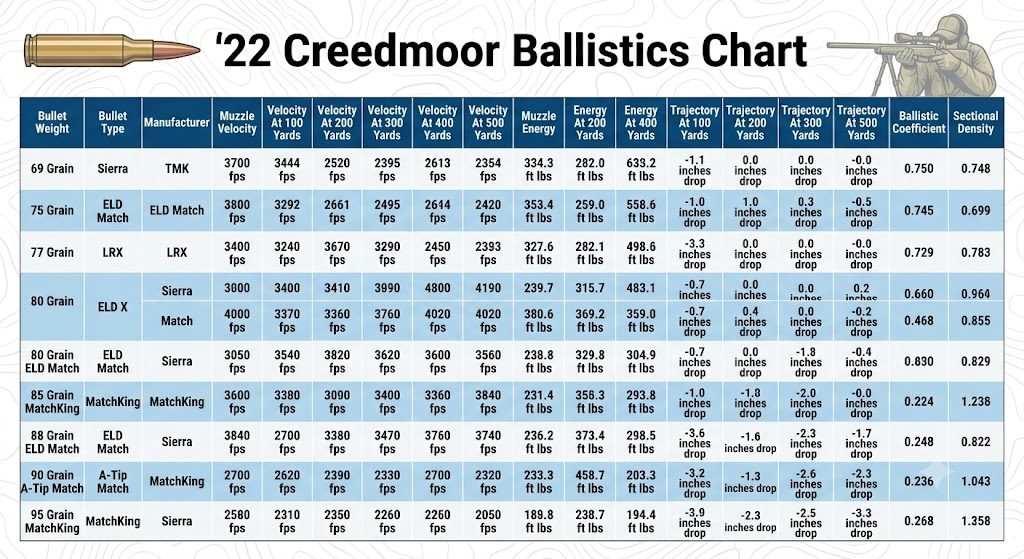
Below is a detailed ballistics table featuring popular factory-loaded ammunition and premium custom loads available for this modern cartridge today. The data represents a standard twenty-four-inch test barrel and assumes a one hundred yard zero. Atmospheric conditions are based on standard sea-level metrics.
| Bullet Weight | Bullet Type | Manufacturer | Muzzle Velocity | Velocity At 100 Yards | Velocity At 200 Yards | Velocity At 300 Yards | Velocity At 400 Yards | Velocity At 500 Yards | Muzzle Energy | Energy At 100 Yards | Energy At 200 Yards | Energy At 300 Yards | Energy At 400 Yards | Energy At 500 Yards | Trajectory At 100 Yards | Trajectory At 200 Yards | Trajectory At 300 Yards | Trajectory At 400 Yards | Trajectory At 500 Yards | Ballistic Coefficient | Sectional Density |
| 69 Grain | Sierra TMK | Copper Creek | 3450 fps | 3155 fps | 2880 fps | 2620 fps | 2375 fps | 2145 fps | 1823 ft lbs | 1525 ft lbs | 1271 ft lbs | 1052 ft lbs | 864 ft lbs | 705 ft lbs | 0 inches | 1.6 inches drop | 6.8 inches drop | 16.5 inches drop | 31.8 inches drop | 0.375 | 0.196 |
| 75 Grain | ELD Match | Hornady | 3350 fps | 3110 fps | 2885 fps | 2670 fps | 2465 fps | 2270 fps | 1868 ft lbs | 1610 ft lbs | 1386 ft lbs | 1187 ft lbs | 1012 ft lbs | 858 ft lbs | 0 inches | 1.7 inches drop | 7.0 inches drop | 17.0 inches drop | 32.5 inches drop | 0.467 | 0.214 |
| 77 Grain | LRX | Barnes | 3300 fps | 3055 fps | 2825 fps | 2605 fps | 2395 fps | 2195 fps | 1862 ft lbs | 1596 ft lbs | 1364 ft lbs | 1160 ft lbs | 981 ft lbs | 824 ft lbs | 0 inches | 1.8 inches drop | 7.4 inches drop | 17.8 inches drop | 34.0 inches drop | 0.420 | 0.219 |
| 80 Grain | ELD X | Hornady | 3250 fps | 3025 fps | 2810 fps | 2605 fps | 2410 fps | 2225 fps | 1876 ft lbs | 1625 ft lbs | 1403 ft lbs | 1205 ft lbs | 1032 ft lbs | 880 ft lbs | 0 inches | 1.8 inches drop | 7.5 inches drop | 18.0 inches drop | 34.2 inches drop | 0.464 | 0.228 |
| 80 Grain | ELD Match | Hornady | 3300 fps | 3080 fps | 2870 fps | 2670 fps | 2480 fps | 2295 fps | 1934 ft lbs | 1685 ft lbs | 1463 ft lbs | 1266 ft lbs | 1092 ft lbs | 936 ft lbs | 0 inches | 1.7 inches drop | 7.2 inches drop | 17.2 inches drop | 32.8 inches drop | 0.485 | 0.228 |
| 85 Grain | MatchKing | Copper Creek | 3200 fps | 2990 fps | 2790 fps | 2600 fps | 2415 fps | 2240 fps | 1932 ft lbs | 1687 ft lbs | 1469 ft lbs | 1275 ft lbs | 1101 ft lbs | 947 ft lbs | 0 inches | 1.9 inches drop | 7.8 inches drop | 18.5 inches drop | 35.0 inches drop | 0.495 | 0.242 |
| 88 Grain | ELD Match | Hornady | 3150 fps | 2965 fps | 2785 fps | 2615 fps | 2450 fps | 2290 fps | 1939 ft lbs | 1718 ft lbs | 1515 ft lbs | 1336 ft lbs | 1173 ft lbs | 1025 ft lbs | 0 inches | 2.0 inches drop | 8.0 inches drop | 18.8 inches drop | 35.2 inches drop | 0.545 | 0.251 |
| 90 Grain | A-Tip Match | Hornady | 3100 fps | 2925 fps | 2760 fps | 2600 fps | 2445 fps | 2295 fps | 1920 ft lbs | 1710 ft lbs | 1522 ft lbs | 1350 ft lbs | 1194 ft lbs | 1052 ft lbs | 0 inches | 2.0 inches drop | 8.2 inches drop | 19.2 inches drop | 35.8 inches drop | 0.585 | 0.256 |
| 95 Grain | MatchKing | Sierra | 3000 fps | 2840 fps | 2685 fps | 2535 fps | 2390 fps | 2250 fps | 1898 ft lbs | 1701 ft lbs | 1520 ft lbs | 1355 ft lbs | 1205 ft lbs | 1068 ft lbs | 0 inches | 2.2 inches drop | 8.8 inches drop | 20.8 inches drop | 38.5 inches drop | 0.600 | 0.270 |
Understanding The Chart
A ballistics chart can look overwhelming at first glance due to the sheer volume of data presented. Breaking down each individual column reveals key information about how a specific load performs in the field.
Muzzle Velocity
Muzzle velocity is the speed at which the bullet exits the barrel of the firearm, measured in feet per second. Because the 22 Creedmoor uses the high-capacity 6.5 Creedmoor case to push a relatively tiny .224 caliber bullet, the resulting velocities are blistering. Lightweight 69-grain bullets can easily exceed 3,400 feet per second, while heavy 90-grain match bullets still launch at a remarkably fast 3,100 feet per second. This massive speed forms the foundation of its laser-flat trajectory.
Retained Velocity
Retained velocity refers to the speed of the bullet at specific distances downrange, such as one hundred or five hundred yards. Air resistance constantly slows the bullet down as it travels through the atmosphere. Thanks to the highly aerodynamic, low-drag bullets utilized in this cartridge, it retains its speed much better than older traditional varmint calibers. Heavy bullets like the 90-grain A-Tip remain supersonic well past 1,200 yards.
Kinetic Energy
Kinetic energy is the amount of destructive physical force the bullet carries, measured in foot-pounds. It is calculated utilizing the weight of the bullet and its velocity at any given distance. The 22 Creedmoor generates roughly 1,900 foot-pounds of energy at the muzzle. Because the heavy bullets retain their velocity so efficiently, they also retain lethal kinetic energy far beyond standard hunting distances, often maintaining over 1,000 foot-pounds of energy past 500 yards.
Trajectory
Trajectory indicates the actual physical path the bullet takes as it flies through the air, factoring in the constant downward pull of gravity. The trajectory chart displays the bullet drop in inches at various yardages relative to a 100-yard zero. Because this cartridge fires extremely sleek bullets at blistering speeds, its trajectory is exceptionally flat, completely dominating the precision rifle landscape and practically eliminating the need for steep holdovers inside 300 yards.
Ballistic Coefficient
The Ballistic Coefficient (BC) is a numerical value representing how efficiently a bullet cuts through the air. A higher number means the bullet is more aerodynamic. High BC bullets resist wind drift much better than bullets with a lower rating. The 22 Creedmoor was specifically designed around long, heavy-for-caliber bullets (80 to 95 grains) that possess some of the highest aerodynamic ratings available today in the .224 diameter.
Sectional Density
Sectional density is the ratio of a bullet’s weight compared directly to its diameter. This metric is a strong indicator of how deeply a bullet will penetrate into a target. Because the 22 Creedmoor fires heavy projectiles in a slender .224-inch diameter, the bullets possess excellent sectional density, allowing them to penetrate deeply through thick muscle and bone on medium-sized game animals like deer and pronghorn.
Common 22 Creedmoor Bullet Weights
Older .22 caliber centerfire cartridges utilized slow barrel twist rates that prevented them from firing heavy aerodynamic bullets. The 22 Creedmoor fixes that historic flaw by standardizing incredibly fast-twist barrels, allowing it to stabilize exceptionally long projectiles.
69 to 75 Grain
Bullet weights in the 69 to 75-grain range offer blisteringly fast muzzle velocities, often exceeding 3,350 feet per second. These weights are primarily used for dedicated varmint hunting where laser-flat trajectories are highly preferred over extreme deep penetration. They provide devastating terminal performance on coyotes and prairie dogs but shed velocity slightly faster than the heavier aerodynamic options.
77 to 80 Grain
The 77 to 80-grain bullet bridges the gap perfectly between blazing speed and solid hunting stability. Premium solid copper options like the Barnes LRX or polymer-tipped expanding bullets like the Hornady ELD-X offer an excellent balance of high velocity and highly reliable weight retention. This weight class provides devastating terminal performance on deer and antelope across wide-open plains.
85 to 88 Grain
The 85 to 88-grain category includes highly advanced match designs like the Hornady ELD Match. These specialized bullets boast massive aerodynamic ratings, allowing them to retain lethal kinetic energy and resist wind drift far beyond traditional hunting distances. They are the ideal choice for shooters who want maximum wind resistance combined with flat trajectories.
90 to 95 Grain
The 90 to 95-grain bullets represent the absolute gold standard for competitive precision rifle shooters utilizing this caliber. Massive projectiles like the Hornady A-Tip or Sierra MatchKing require a very fast-twist barrel to stabilize properly, but they reward the shooter with extreme aerodynamic efficiency. They cut through the wind better than almost any other bullet in this caliber class, making them absolutely perfect for hitting small steel targets consistently at 1,000 yards.
Effective Hunting Range
The 22 Creedmoor’s effective range is one of its most impressive attributes. It was explicitly designed to be an absolute powerhouse for taking game animals at vastly extended distances by utilizing incredibly sleek bullets.
Coyotes and Predators
When hunting coyotes and other predators, the 22 Creedmoor completely dominates the open plains. Because the bullets are highly aerodynamic and travel extremely fast, they slice through the wind effortlessly. You can accurately harvest coyotes out to 800 yards with a highly skilled shooter. The extreme energy transfer ensures instant ethical kills on fast-moving predators, making it widely considered the ultimate dedicated coyote cartridge in existence today.
Whitetail Deer and Antelope
For whitetail deer and pronghorn antelope, this cartridge is highly effective at extended ranges—provided you use the correct ammunition. Hunters absolutely must use premium, controlled-expansion bullets in the 77-grain to 85-grain class (like the Barnes LRX or Hornady ELD-X). Standard match bullets or lightweight varmint bullets will fragment too quickly on the surface of a deer. With proper bullet selection, a skilled marksman can ethically harvest medium game out to 500 yards.
Elk and Black Bear
Hunting elk or black bear with the 22 Creedmoor is highly discouraged and widely considered unethical. While the cartridge generates impressive energy on paper, the slender .224 caliber bullets simply lack the structural mass and heavy kinetic transfer required to reliably break through the massive shoulder bones of an elk or a large bear.
Target and Precision Rifle Shooting
For recreational steel target shooting and precision rifle series (PRS) matches, the 22 Creedmoor is a phenomenal tool. It offers long-range ballistics that rival the 6.5 Creedmoor, but with significantly less felt recoil. It is a fantastic option for ringing steel plates out to 1,200 yards, providing the perfect platform for spotting your own trace and impacts through the optic.
Factors That Affect 22 Creedmoor Ballistics
Ballistics numbers are never completely static. The exact data provided in any 22 Creedmoor velocity chart will change constantly based on environmental conditions and the physical characteristics of your rifle setup.
Barrel Length
Barrel length has a major direct impact on your final muzzle velocity. Because the 22 Creedmoor is highly “overbore” (burning a large amount of powder through a very small hole), it requires a long barrel to achieve maximum efficiency. Factory data is typically generated using a 24-inch barrel. Utilizing a longer 26-inch custom barrel will yield significantly higher velocities, while cutting the barrel down to 18 inches will result in a severe velocity penalty and a massive, loud muzzle flash.
Twist Rate
To properly stabilize the massive, long, aerodynamic bullets (80 to 95 grains) that give this cartridge its legendary performance, rifle barrels absolutely must utilize a very fast twist rate. Most custom builders and manufacturers specifically utilize a 1-in-7 or 1-in-7.5-inch twist barrel. A slower twist rate (like a 1-in-9 or 1-in-12 commonly found on older .22-250 rifles) will cause these heavy bullets to tumble through the air, completely destroying accuracy.
Altitude and Temperature
Shooting at high elevations dramatically improves your ballistic performance. Thin mountain air provides much less atmospheric resistance against the fast-moving bullet, resulting in a flatter trajectory. Conversely, cold, dense winter air creates more drag on the bullet and slows down the powder burn rate, which reduces muzzle velocity and increases overall bullet drop.
Best Zero Distance
Selecting the optimal zero distance depends entirely on how you plan to use your rifle in the field.
100 Yard Zero
The 100-yard zero is the absolute gold standard for precision shooters and long-range hunters who utilize modern rifle scopes with exposed tactical turrets. It provides a clean, perfect mathematical baseline, allowing the shooter to easily dial their scope turrets upward for any extended distance engagement without ever needing to hold under the target.
200 Yard Zero
For coyote and deer hunters who prefer a Maximum Point Blank Range (MPBR) strategy, a 200-yard zero is highly effective. A fast-moving 80-grain bullet zeroed at 200 yards will typically impact only about 1.5 inches high at 100 yards and drop just over a few inches at 250 yards. This allows a hunter to aim dead-center on the vitals of a coyote out to nearly 300 yards without touching their scope turrets or calculating holdovers.
22 Creedmoor Ballistics Compared To Other Cartridges
Below is a detailed comparison showcasing how the 22 Creedmoor evaluates against established varmint and precision cartridges at 500 yards under standard sea-level conditions.
| Cartridge | Muzzle Velocity | Muzzle Energy | Trajectory At 500 Yards | Recoil | Effective Range | Receiver Size |
| 22 Creedmoor (80gr) | 3300 fps | 1934 ft lbs | 32.8 inches drop | Very Light | 1000+ Yards | Short Action |
| 22-250 Remington (55gr) | 3680 fps | 1654 ft lbs | 49.5 inches drop | Very Light | 600 Yards | Short Action |
| 223 Remington (77gr) | 2750 fps | 1293 ft lbs | 62.0 inches drop | Extremely Light | 600 Yards | AR-15 / Mini Action |
| 6mm Creedmoor (108gr) | 2960 fps | 2100 ft lbs | 43.5 inches drop | Light | 1000+ Yards | Short Action |
| 6.5 Creedmoor (140gr) | 2700 fps | 2266 ft lbs | 54.0 inches drop | Light-Moderate | 1000+ Yards | Short Action |
The 22 Creedmoor completely outclasses the legendary 22-250 Remington at long range. While the 22-250 shoots light bullets incredibly fast, its standard slow twist rate prevents it from utilizing heavy, high-BC bullets. As a result, the 22 Creedmoor retains vastly more kinetic energy and shoots significantly flatter past 400 yards. When compared to its parent case, the 6.5 Creedmoor, the .22 variant shoots significantly flatter inside 600 yards and produces noticeably less recoil, though it sacrifices kinetic energy on massive game animals.
Frequently Asked Questions
What is a 22 Creedmoor Ballistics Chart?
It is a highly comprehensive reference table tracking the velocity, kinetic energy, trajectory curve, and wind drift of the cartridge over various distances. Shooters rely on this data to calculate exact elevation drops and wind holds for extreme long-range target shooting and predator hunting.
Does the 22 Creedmoor burn out barrels quickly?
Yes. Because it is a highly overbore cartridge pushing a massive amount of hot powder gas through a tiny .224 caliber hole, barrel throat erosion happens quickly. Competitive precision shooters typically replace their 22 Creedmoor barrels after 1,200 to 1,500 rounds to maintain match-winning accuracy. For hunters who shoot infrequently, a barrel will easily last a lifetime.
Is the 22 Creedmoor good for deer hunting?
Yes, provided you use the correct ammunition. While originally designed for target shooting and varmint hunting, loading the 22 Creedmoor with heavy, tough, controlled-expansion bullets (like the 77-grain Barnes LRX or 80-grain Hornady ELD-X) makes it a highly capable, low-recoil option for whitetail deer and antelope.
How much does a 22 Creedmoor drop at 500 yards?
With a standard 100-yard zero, a typical 80-grain high-BC bullet will drop approximately 32 to 34 inches at 500 yards. This is exceptionally flat compared to standard hunting cartridges like the .308 Winchester, which drops over 50 inches at the same distance.
What barrel twist rate do I need for a 22 Creedmoor?
To maximize the performance of this modern cartridge and properly stabilize the heavy 80 to 95-grain bullets, you must utilize a fast barrel twist rate of 1-in-7 inches or 1-in-7.5 inches.
Conclusion
A 22 Creedmoor Ballistics Chart highlights the extreme performance capabilities of this highly modern, laser-flat cartridge. By merging a high-capacity short-action case with fast-twist barrels capable of launching heavy, aerodynamically perfect .224 caliber projectiles, the 22 Creedmoor solves the long-range limitations of classic varmint rounds. Understanding its trajectory curvature, retained velocity, and energy transfer characteristics enables predator hunters and long-range precision shooters to extract maximum accuracy and devastating terminal performance at extreme distances.